


Risultati da 1 a 10 di 51
-
01-08-06, 11:03 #1email non funzionante


- Data Registrazione
- 13 May 2009
- Messaggi
- 30,192
-

- 0
-

- 11
- Mentioned
- 2 Post(s)
- Tagged
- 0 Thread(s)
Le diversità etniche e culturali nello Stato Italiano
-
01-08-06, 11:08 #2email non funzionante
- Data Registrazione
- 13 May 2009
- Messaggi
- 30,192
-
- 0
-
- 11
- Mentioned
- 2 Post(s)
- Tagged
- 0 Thread(s)

http://www.snpa.nordish.net/racesofeurope.htm
Italy
Italy, one of the most clearly demarcated geographical units in Europe, is a country of considerable racial variability. Although the Mediterranean race is strongly represented in it, Italy belongs only partially to the Mediterranean world, for much of it is more typically Alpine racial territory. Unfortunately, it is impossible to trace the early prehistory of the Alpines in Italy, since our knowledge of the Palaeolithic and Mesolithic periods there is still obscure. The primary racial impulse of the early Neolithic, however, is known. This was the immigration of small Mediterraneans in great numbers, coming largely if not entirely by sea; these first food-producers were followed by more competent navigators, Atlanto-Mediterraneans, who settled chiefly in the north and in the islands, and Dinarics from the eastern Mediterranean in search of metal. Some of the Dinarics penetrated the Alpine Valleys while others settled in the Po Valley and in central Italy. The movement of highly cultured peoples from the east into Italy continued into historic times, and included the settlement of the Etruscans in Tuscany, and of the Greeks in Sicily and in the southern end of the peninsula.
As early as the Bronze Age there were, however, counter-movements from the north, icluding the invasions of the early Italici, ancestors of Oscans and Umbrians, Latins and Faliscans, and also the arrival of Illyrian tribes in northern and eastern Italy. Whereas the movements by sea had brought in Mediterraneans of different kinds, some short and some tall, some straight-nosed and others beaked in a Near Eastern manner, as well as Dinarics, the movements from the north introduced Nordics of two varieties; the classic Hallstatt type, and the Keltic Iron Age type which was later to form the basic racial element among the Roman patricians. Further invasions from the north, of Kelts and of Germans, had only local influence.
More important perhaps than many of these invasions was the effect of the Roman industrial system, which relied on involuntary labor, and which necessitated the introduction of slaves of all known races and countries by the thousands. Although some of these slaves were prevented by ill usage and by segregation from propagating, the majority without doubt reproduced, and with their emancipation under Christianity blended readily into the local populations. Other strangers who were not slaves moved to Italy in great numbers; as traders, craftsmen, soldiers, and visitors attracted to the center of civilization. Thus through her rôle as mistress of the world Rome accumulated and assimilated a heterogeneous population.
That this popualtion was by no means purely or even predominantly Mediterranean is shown by the study of the skulls of Pompeiians,72 victims of the eruption which turned their city from a metropolis into a museum. These crania, with a mean cranial index of 80, represent a population which had acquired a racial character of its own despite its mixed origin, and in which the Alpine element was the most important. The vaults are of moderate size, as are the faces; the mean nasion-menton height of 119 mm. is too low to suggest a strong Dinaric element, which the mesorrhiny typical of the group also precludes. A series of 100 modern crania from Bologna,73 with a mean cranial index of 83.5, is almost purely Alpo-Dinaric, with the latter element in a position of prominence. The Dinaric race is common in northern, but not southern Italy, and this distinction has been true since the Bronze Age.
Our knowledge of the physical antropology of living Italians is based largely upon the work of Livi,74 who measured some 300,000 recruits of the classes of 1859-63. In using this material it must be remembered that it is over half a century old, and that Livi's head measuring technique was not in accordance with modern standards. Thus the Italians are without doubt taller now than in Livi's day, and they are from one to two points less brachycephalic. Despite these corrections, Livi's work is of great value. It has established the main facts of regional distribution in Italy beyond question. These are that stature increases as one goes northward from Sicily and the toe of Italy; that the cephalic index increases in the same manner, as does blondism. In northern Italy the tallest men are longer headed than the mean; in southern Italy the shortest men are longer headed. Blondism is everywhere correlated with a realtively high cephalic index.
In other words, the southern Italians are a blend for the most pat of Alpines and small Mediterraneans, while among the northern Italians the most important dolichocephalic strain is the Atlanto-Mediterranean. The association of relatively great blondism with brachycephaly merely indicates that both Alpines and Dinarics are characteristically mixed or intermediate in pigmentation. The few unaltered Nordics still found in northern Italy and in aristocratic families elsewhere are far outnumbered by Atlanto-Mediterraneans.
The mean stature for the recruits of 1859-63 was 164.5 cm., that for the classes of 1907-09 was 165.5 cm.75 A better figure for the present would probably be 166 cm. The present provincial range would probably run from 164 cm. in the south, to 168 cm. in Piedmont and Veneto, as well as in the Trentino. The mean cephalic index of Livi's recruits was 82.7; that of the 1907-09 class 80.8. The reduction of two index points is largely technical, but may be partly due to stature increase. Despite this difference, the northern Italians, the Piedmontese particularly, are very brachycephalic, more so that the Swiss or Austrians, and the Piedmont forms a continuation of the southwestern French zone of Alpine racial concentration.
Special studies of southern Italians and Sicilians have been made in America, where several millions of these people live.76 Although some selection may have taken place in the determination of who should come to America and who should stay at home, they probably fall near enough to the total mean for present purposes. This group is not short, but slightly under medium in stature; the present mean is about 165 cm. A relative span of 102, and a relative sitting height of 53.3, strongly indicate a short-legged, short-armed, and long-bodied condition, while a mean weight of 150 pounds is heavy for this stature level. Although slender, delicately built Mediterraneans are found among these people, the great majority are thick-set, short-necked, short-fingered, broad-handed, and heavy-torsoed. They incline to corpulence in middle age, and few of the women remain slender past the period of child-bearing.
The mean cephalic index for this group is 79; there is, however, a great range, and many are typical brachycephals. The head size stands in accord with the body bulk; a mean head length of 191 mm., and breadth of 151 mm., indicate a larger vault than is usual among Mediterraneans of the same stature. The facial breadths again exceed Mediterranean figures; the minimum frontal mean is 106 mm., that of the bizygomatic 140 mm., and of the bigonial 108 mm. These dimensions fall suggestively into the Alpine category, while at the same time resembling those of coastal groups from Portugal. The mean total face height is 121 mm., the upper face height 70 mm. Facial and upper facial indices are mesoprosopic and mesene. The nasal dimensions (54 mm. by 36 mm.) are moderately long and broad, the nasal index mean of 67 leptorrhine, but in a Mediterranean and Alpine rather than Nordic or Dinaric sense.
The skin color is as a rule dark; over 50 per cent of unexposed shades are definitely light brown or olive-colored, while the exposed skin often tans to a distinctive reddish-brown. Ten per cent are freckled. About 20 per cent have black hair, and 48 per cent dark brown; reddish brown shades, or dark to medium brown with a reddish glint, account for some 16 per cent, while the remaining 6 per cent have light brown or blondish colors. Pure dark eyes are found among 44 per cent of those studied; mixed eyes among 50 per cent, and pure light eyes among 6 per cent. The high ratio of reddish shades in the hair and of mixed eyes reflects the strong Alpine strain in this population, as does the large minority of non-brunet skin colors and the presence of freckling. Of the mixed eyes, the majority are dark-mixed, and green-brown combinations are three times as common as blue-brown and gray-brown put together.
The southern Italians depart from a Mediterranean standard in the development of the pilous system; over 80 per cent have medium to heavy beards, and the body hair is heavier than among any other European group studied.77 The hair is rarely fine, usually coarse to medium in texture, and is curly in 10 per cent of this group, while wavy forms are usual. The forehead is of medium height and slope, as a rule, and the browridges medium; their typical development is Alpine rather than Mediterranean. The eyebrows are usually heavy, in 57 per cent concurrent. The nasion depression is medium to deep, the nasal root of medium height, and frequently broad. The nasal bridge is usually quite high, and broader than among most other Europeans; the profile is variable, with large concave as well as convex categories; several types are present in this respect. The nasal tip is as a rule thicker than the European standard, and the wings as often flaring as compressed. In 35 per cent the tip is depressed. The lips vary considerably in thickness, but more fall into the thick category than in most European groups; well over a third show a visible degree of facial or alveolar prognathism. The chin is frequently prominent, and the gonial angles frequently flaring; prominent malars are much commoner than compressed ones.
The southern Italians, as this survey will indicate, are a distinctive group of people who will not fall into any one recognized racial category. Besides conventional Mediterraneans and Alpines there are two special types which are particularly common, and will be familiar to anyone living in Italian sections of the United States, as well as to anyone who has visited southern Italy. These are: (1) a coarse Mediterranean, short-statured, thick-limbed, mesocephalic, possessing a narrow forehead, wide malars, heavy browridges, a short, broad, straight or lightly concave nose with upturned tip, a strong jaw, and some prognathism; (2) a local approximation to an Armenoid, short-statured, especially thick-set and short-necked, with a flattened occiput, dome-shaped lateral vault profile, heavy browridges, a high-rooted, high-bridged, thick-tipped and depressed-tipped nose, and an especially prominent jaw.
The coarse Mediterranean mesocephal has counterparts in Spain and Portugal, as well as North Africa, and goes back at least to the time of the shell-heap burials of Muge. It seems, however, especially prevalent among South Italians. The local Armenoid may be partly descended from Near Easterners brought to cental and southern Italy in imperial times, but it is more likely that it is to a greater extent a local combination of Alpine with various Mediterranean elements, through the mechanism of differential inheritance.
Observational data on the poulation of the neighborhood of Bologna78 permits, by contrasts to the foregoing, a study in some detail of a North Italian population, one with a mean stature of about 168 cm. and a mean cephalic index of about 83 or 84. The skin color of the face is about equally divided between light brown and pinkish-white; the hair is black in 25 per cent, dark brown in 60 per cent, and light brown to blond in the rest of cases. Twenty-five per cent of eyes are dark brown, 38 per cent light brown or dark-mixed, and 27 per cent light-mixed or light. The pigmentation is lighter than in southern Italy, but still prevailingly brunet. There is a slight linkage between the lightest hair and eye colors and dolichocephaly, indicating that a Nordic type has preserved its identity as a minor element here.
The development of the pilous system is less marked here than in the south; body and beard hair are of normal European thickness; furthermore, only 14 per cent have concurrent eyebrows. These actually go more with the dolichocephals than with the brachycephals. The noses are convex in 32 per cent, straight in 58 per cent, and concave in 8 per cent of the group; convex noses are slightly more frequent among the long heads. Nasal tip thickness is usually medium, and lips are frequently thin. The thin nose and thin lip combination, which takes the form of a positive correlation, is again linked with dolichocephaly.
In the population of the Bolognese there is a strong prevalence of Alpine and Dinaric types, especially the former, but approximately one-third of the population is long-headed or nearly so. Among this third, Nordics are not uncommon, but the most important element is a tall, slender, brunet, long-faced type, with a thin, straight or convex nose, and thin lips. It is a variant of the Atlanto-Mediterranean, with some of the Cappadocian facial features brought from western Asia by early navigators, including the Etruscans. Associated with this type is a frequent obliquity of the eye slits, which are very long; highly arched eyebrows and full malars. The beauty of Bolognese women is proverbial, and the type described above is to a certain extent responsible for this reputation. It is common elsewhere in northern Italy as well, and was often portrayed by Renaissance painters. This type is also found as a minor element in the Tyrol, where it seems to form a basic part of the Dinaric racial complex.
No country in Europe in which one language and one cultural tradition prevail shows a greater diversity of race between its southern and its northern extremities than does Italy. The binding element which is common to all sections is the Alpine, which has reëmerged from obscure beginnings through a superstructure composed of Dinaric, Nordic, and various kinds of Mediterranean accretions. Italy stands on the fence between the Alpine and Mediterranean worlds.
Notes:
72. Nicolucci, G., APA, vol. 12, 1882, pp. 143-178.
Schmidt, E., AFA, vol. 17, 1888, pp. 189-227.
73. Calori, C. L., MASB, ser. 2, vol. 8, 1868, pp. 205-234.
Schwerz, F., AFA, vol. 43, 1917, pp. 181-195.
74. Livi, R., Anthropometria Militare.
75. Gini, C., CIPP, ser. 1, vol. 5, 1934, pp. 589-607.
Gini's figures cover exactly the same territory as Livi's, and do not include recruits from the provinces acquired by Italy since Livi's day.
76. Boas, F., Materials for the study of Inheritance in Man; ZFE, vol. 45, 1913, pp. 615-626.
Davenport, C.B., and Love, A. G., Army Antropometry.
Hooton, E. A., The American Criminal.
Hrdlicka, A., The Old Americans.
Willoughby, R. R., HB, vol. 5, 1933, pp. 690-705.
77. That is, in Hooton's American criminal material, drawn directly from all parts of Europe.
78. Frasetto, F., Note Antropologiche Sulla Populazione del Bolognese.
-
01-08-06, 11:12 #3email non funzionante
- Data Registrazione
- 13 May 2009
- Messaggi
- 30,192
-
- 0
-
- 11
- Mentioned
- 2 Post(s)
- Tagged
- 0 Thread(s)
Le lingue parlate nello Stato Italiano
http://www.comitau.org//Mangaras/ain..._-_incerti.pdf
-
01-08-06, 11:16 #4email non funzionante
- Data Registrazione
- 13 May 2009
- Messaggi
- 30,192
-
- 0
-
- 11
- Mentioned
- 2 Post(s)
- Tagged
- 0 Thread(s)

La mappa dell'eugenista Madison Grant nel 1916, mostra la distribuzione delle "razze europee". L'Italia è divisa in due: al nord il territorio si compone della razza nordica (indicata in rosso) e di quella alpina o celtica (in verde), al centro-sud si compone della razza mediterranea (in giallo)
-
01-08-06, 11:20 #5email non funzionante
- Data Registrazione
- 13 May 2009
- Messaggi
- 30,192
-
- 0
-
- 11
- Mentioned
- 2 Post(s)
- Tagged
- 0 Thread(s)
The Mediterranean Myth
One of the most hoary myths of race is the postulated existence of a cohesive, trans-continental "Mediterranean race." According to this fantasy, this race includes all brunette, non-Nordish, non-Alpinid "Caucasians", from Portugal to Bangladesh, from the Alps downward through the Sahara. As we shall see, such a race does not exist and has never existed. We shall also briefly consider the motivations of those who, with complete indifference to reality, continue to promote this myth, for reasons which may have much to do with an animus toward a real sub-racial group - Sudeuropids (South Europeans: i.e., Italians, Iberians, Greeks, Balkan Slavs, Romanians, etc.). Let us examine the evidence.
1. Traditional Physical Anthropology (TPA)
TPA is often invoked to promote the Mediterranean Myth. Three problems with TPA in this regard are:
A) It is out-dated. Many TPA race texts are from the pre-WWII era. Genetic science did not exist then, and TPAs relied more on subjective evaluations of racial similarities and differences. TPA was/is also extensively influenced by the 19th century practice of superficial classification, without a strong empirical basis. We must recognize that what the "experts" of the past said on certain matters sometimes needs to be revised on the basis of current knowledge. We no longer believe that whales are fish, or that infectious diseases are caused by "ill vapors in the ether." Likewise, our knowledge of race needs to be advanced.
B) TPA itself is somewhat contradictory, because the ethnic phenotypes do not match some of the racial classifications. While Carleton Coon is often cited by the promoters of the Mediterranean Myth, the photographs of Sudeuropids in "The Races of Europe" do not fit into this scheme. The photos are of European people, who do not bear any resemblance to Arabs, Hindus, or any other such "Mediterraneans." One can look at the phenotypes of Sudeuropids and easily contrast them to that of non-European "Caucasian" groups. The reader of this essay should reflect on the phenotypes of some prominent Sudeuropid celebrities - politicians, entertainers, scientists, etc. - and ask themselves how many of these folks would ever be confused with "Gunga Din." Racial phenotype does not support the Mediterranean Myth.
C) The Nord extremists who currently support the Mediterranean Myth, on the basis of TPA, seem rather choosy in what they believe and do not believe. For example, Baker (in "Race") indicates that "Nordids" and "Mediterranids" are quite similar to each other racially, and both groups are far more similar to each other than either is to "Alpinids." Meanwhile, the current promoters of the Mediterranean Myth ignore this and seem to suggest the opposite. Coon seems to be popular among modern promoters of the Mediterranean Myth. However, these folks seem to ignore the fact that Coon also saw a close relationship between "Nordics" and "Mediterraneans", and indeed, in some of the text legends to his photographs, indicated a belief that "Nordics" are "partially depigmented" Mediterraneans; in other words, that Nordics are racially derived from Mediterraneans, these groups having a common racial origin. If TPA is to be wholeheartedly believed, then should not these views of Baker and Coon be promoted also?
In summary, TPA is a rather weak reed for the promoters of the Mediterranean Myth to lean on. The evidence below emphasizes that fact.
2. Genetic evidence.
Many people are familiar with the work of Cavalli-Sforza, which does support the points of this essay. However, in our opinion, an even better scientific analysis was the work of Nei and Roychoudhury (Mol. Biol. Evol. 10, 927-943, 1993), henceforth referred here to as "NR93." In this work, 29 gene loci (121 gene alleles) from 26 different human populations were studied to ascertain the evolutionary relationships between these groups. This work is of high value precisely because of the large number of genes looked at. As the authors state:
Earlier we emphasized the importance of using a large number of loci in the study of human evolution. This is because (a) the interpopulational genetic variation is very small compared with intrapopulational variation and (b) the evolution of a single gene (or mtDNA) is subject to large stochastic errors (Nei and Livshits 1989; Livshits and Nei 1990). In this study, using gene frequency data for 29 genetic loci, we could reconstruct an evolutionary history of human populations that seems likely to be less controversial and more enduring than some current alternatives.
The findings of this study are of the highest importance. Different population groups were shown to differ genetically - proving the existence of biological race. Africans split off from the rest of humanity first, the next major split being that between Caucasians and a general Asian cluster, each of which demonstrated further splits. Of relevance here is that the European groups studied - English, Germans, Finns, and Italians - all clustered together in an European group, distinctly separate from non-European Caucasians such as Iranians and North Indians, as well as from Lapps. Thus, in contrast to the racial fantasies of the Mediterranean Myth, Sudeuropid Italians were in the European group, separate from non-European "Mediterraneans." Within the European cluster, one can find sub-clusters, which may correlate with "sub-race": NW Euros (Germans and English), NE Euros (Finns), and S Euros (Italians). The major point remains that all these groups are European, and no evidence exists here for a "Mediterranean race" including Italians, Iranians, and Indians. The evidence in fact directly contradicts the Mediterranean Myth.
Arthur Jensen in "The g Factor" subjected the NR93 data to sophisticated numerical analysis, producing a chart which demonstrated, in a quantitative sense, which populations clustered together. The number of each population indicates how close that population is to the norm of their respective racial cluster. Populations with similar numbers are highly genetically clustered together. This chart was adapted by Dr. Glayde Whitney and appeared in American Renaissance magazine. The general Caucasian group yielded interesting results. The numbers for this group were: Italians - 989, Finns - 988, Germans - 978, English - 948, North Indians - 704, Iranians - 635, and Lapps - 500. Note well that the various European populations cluster very tightly together, and all are very close to group norms. All European groups are genetically distinct from North Indians, Iranians, and Lapps - another crushing blow to the fantasies of the Mediterranean Myth. In fact, the close European cluster compares with that found for NE Asians; in the NE Asian cluster, Koreans had a value of 959; Japanese, 936. Thus, European populations, in general, are approximately as genetically similar as Koreans and Japanese. This indicates common origins and/or extensive inter-breeding in the past.
Of course, this is not to deny that there has been some gene flow across the Mediterranean. Certainly, there is some genetic evidence for a limited amount of gene flow and gene admixture between the "western Mediterranean" and the "eastern Mediterranean", between Southern Europe and the Near East. There were a number of instances in history where such flows could have taken place. The questions here are: 1) was this substantial enough to cause the populations to be the same?, 2) is this unique in European history? The answer to #1 is clearly no. First, the NR93 data indicate that Sudeuropid populations are genetically in the overall European cluster. Second, the study by Hammer et al. (PNAS 97, 6769-6774, 2000) of Y-chromosome biallelic haplotypes demonstrates that Southern European populations fall within the general European cluster and are genetically distinct from Middle Eastern/Near Eastern populations, which form their own cluster. Within the European cluster, Sudeuropid populations tend to fall together, a further proof that Sudeuropids are a sub-race of the greater European race, and not part of some sort of brown-skinned trans-continental "Mediterranean race." Also of interest is the Y-chromosome study of Bosch et al. (Am. J. Hum. Genet. 68, 1019-1029, 2001) which states the following:
The most striking results are that contemporary NW African and Iberian populations were found to have originated from distinctly different patrilineages and that the Strait of Gibraltar seems to have acted as a strong (although not complete) barrier to gene flow........The Islamic rule of Spain, which began in a.d. 711 and lasted almost 8 centuries, left only a minor contribution to the current Iberian Y-chromosome pool.
So, again, the answer to #1 is no; some gene flow took place, but the populations are clearly genetically and phenotypically, and thus racially, distinct.
The answer to #2 is that such admixture is not unique in European history. Even in Northern Europe there is some evidence of genetic admixture from non-European, and indeed in some cases, non-Caucasian, sources, including Negro as well as Saamish, Ugric, and other Asian-type genes. European ethnic history is complex, but this does not obviate the reality of distinct European racial types. Race is not dependent on absolute "racial purity."
3. Racial History
The racial history of Sudeuropids is clearly distinct from other putative members of a so-called "Mediterranean race." NR93 says the following of the European groups studied, including Italians:
Most European populations (e.g., Finns, Germans, English, and Italians) have exchanged genes during the past few thousand years, but they are included here as a group, for study of their evolutionary relationships with other populations.
Indeed. The origins of these closely related populations are explained by NR93 thus:
By contrast, the population that later became Caucasoid apparently moved northwest to occupy Europe; Cro-Magnon, who lived - 10,000-30,000 years ago in Europe, are apparently ancestors of the present Europeans (fig. 6).
This can be contrasted with the comments made by NR93 of other groups, based on the available evidence.
Regarding Iranians and North Indians, they state:
For example, Iranians and northern Indians probably have had gene admixture with East Asians, though they are now primarily Caucasians.
It is obvious that admixture with East Asians is not part of the racial history of Southern Europe.
NR93 give more information about the racial origins of the populations of the Indian sub-continent. Referring to migrations of Blacks from Africa into Asia, they state:
A second group migrated to the Indian Subcontinent and then to Southeast Asia, where they had gene admixture with the mongoloid group (fig. 6). The resultant population absorbed most of its gene pool from the mongoloid group but retained the genes for dark skin, frizzled hair, etc., from Africans, because of natural selection in tropical conditions. This population then moved to New Guinea and Australia - 40,000 years ago. The Indian Subcontinent and Southeast Asia were later invaded by Caucasoids and mongoloids, respectively, and further gene admixture occurred. This hypothesis is supported by the fact that in these areas there are isolated populations (e.g., Philippine Negritos, Andamanese, Dravidians) with African traits.
This racial history of admixture between Mongolid, Negroid, and Caucasoid populations in the region of India, taking place thousands of miles from Southern Europe, is clearly distinct from the racial history of Sudeuropids. There is no connection whatsoever.
As far as Middle-Easterners and North Africans go, NR93 state:
Therefore, we have excluded populations that are clearly products of recent gene admixture as documented by history (e.g., northern Africans and Middle Easterns)
These populations, clearly considered by NR93 as distinct form the European populations, have their own unique racial histories. For example, Arabs are Semites with a Middle-Eastern origin. In some places they are still relatively pure Semites, in other places, there has been significant admixture with Berber as well as Negro blood (for an example of the latter, remember the phenotype of Anwar Sadat). The issue of gene-flow between the Near East and Southern Europe has been dealt with above. Despite limited gene flow (which has occurred with varying populations throughout Europe), Sudeuropids and Near-Easterners remain phenotypically and genetically distinct populations - different races. The NR93 and Hammer studies reinforce this.
In summary, clearly then the different racial histories of the putative "Mediterranean" groups clearly demonstrate that they are of different race.
Conclusion
The Mediterranean Myth is false, an absurd farce. The reality is of a greater Caucasian race, which can be divided into European, Semitic, Irano-Afghan, Indio-Dravidian, and other such races, each of which can be further sub-divided into sub-races (e.g., in Europe: Nordeuropids, Alpineuropids, Sudeuropids, et al. ). Now, we have no doubt that even after the evidence in this essay is made known, there will be some who will continue to propagate the Mediterranean Myth. Why? Well, if we wish to be charitable, we can say that they, despite all the evidence, are too stubborn to accept the findings of modern science. Or, perhaps, they lack the education and/or mental capacity to understand the data. Less charitable suggestions may be that they hold an animus against Sudeuropids, or even that they wish to promote Sudeuropid genocide via admixture with racially alien groups. If that latter possibility is true, then the agenda there would be to de-legitimize Sudeuropid racial identity, and promote the idea that Sudeuropids are identical to racially alien "Mediterranean" types. The idea would be to deny the existence of the group (Sudeuropids) to be destroyed.
One hopes though that reasonable people will see the evidence and realize that the Mediterranean Myth is false. We can then move beyond absurdities that would claim that Joe DiMaggio was equivalent to a Bangladeshi, and start serious and mature discussions of racial issues, discussions based on truth, science, and mutual respect.
-
01-08-06, 11:25 #6email non funzionante
- Data Registrazione
- 13 May 2009
- Messaggi
- 30,192
-
- 0
-
- 11
- Mentioned
- 2 Post(s)
- Tagged
- 0 Thread(s)
POST WAR ITALY - MENACE OF THE SOUTH
Apart from losing all of its colonial possessions, a large number of Italians died in the war. This, combined with the natural population increase of the southern Italians, which soon outstripped that of the northern Italians, meant that slowly but surely, Italy started growing darker and darker.
This process, which is by no means complete or total, was significant enough to create a virtually constant state of political anarchy in Italy. Since the end of the Second World War very few Italian governments have been able to last for more than a year in office, and a strong northern separatist emotion has emerged during the last part of the 20th Century, working hard for total separation from the obviously darker and impoverished south of that country.
Violence and lawlessness, which had long since been the trademark of the dark mixed race south of the country, (the Mafia) is spreading its tentacles ever further into central and northern Italy as the racial balance shifts - this is a process which is visible to any contemporary observer.
Today Italy is a bi-racial nation - most of the White population is concentrated in the north, while in the south and in Sicily, most of the population are of mixed race. The north/south division in Italy is an active point of political debate in that country, particularly on the economic level. Northern Italy is mostly urban and considerably wealthier than southern Italy, with its businesses accounting for two-thirds of the entire country's Gross National Product (GNP).
Italy has also served as a major entry point for many illegal Third World immigrants entering western Europe - these developments are reviewed in a later chapter.
-
01-08-06, 11:31 #7email non funzionante
- Data Registrazione
- 13 May 2009
- Messaggi
- 30,192
-
- 0
-
- 11
- Mentioned
- 2 Post(s)
- Tagged
- 0 Thread(s)
Genti italiche
Prima dell'unificazione da parte dei Romani del territorio italiano, esistevano nella nostra penisola popoli molto differenti, sia per quanto riguarda la loro origine che per quello che riguarda la lingua, gli usi ed i costumi. Alcuni di questi popoli erano nativi della penisola, altri vi erano arrivati dal mare od attraverso le Alpi. Di questi popoli sappiamo ben poco, e quel poco che sappiamo ci deriva da documenti latini o greci di epoca ben più tarda. Pochi sono i documenti originali, per lo più iscrizioni votive o funerarie, spesso di difficile comprensione.
I popoli
I vari popoli italici hanno origini differenti. A parte i greci ed i celti, arrivati in epoche storiche, alcuni popoli sono probabilmente nativi della penisola italica, altri arrivarono in Italia sia dal mare che dal continente. Molte genti sono di origine indo-europea, e tal è l'origine della loro lingua.
Fra i vari popoli abbiamo a nord-ovest i Liguri ed i Galli, a nord-est i Veneti, i Ræti ed i Carni, nella zona dalmata gli Istri, gli Iapodi ed i Liburni, nel centro-nord gli Etruschi e gli Umbri, nel centro i Latini, i Sabini, i Picenti, i Vestini, i Marsi ed i Volsci, nella regione campana gli Aurunci ed i Sanniti, in quella pugliese i Daunii, gli Iapygi, i Peucetii, i Messapii ed i Calabri, in quella lucana i Lucani e gli Oenotri, in quella calabra i Bruttii, i Morgeti e gli Itali, in Sicilia gli Elymi, i Sicani ed i Siculi, in Sardegna i Sardi ed in Corsica i Corsi. Benchè la Corsica faccia parte oggi giorno della Francia, essa è geograficamente italiana, e tale è stata anche politicamente finchè non fu ceduta alla Francia. Le coste dell'Italia meridionale furono invece interessate dalla colonizzazione greca e fenicia
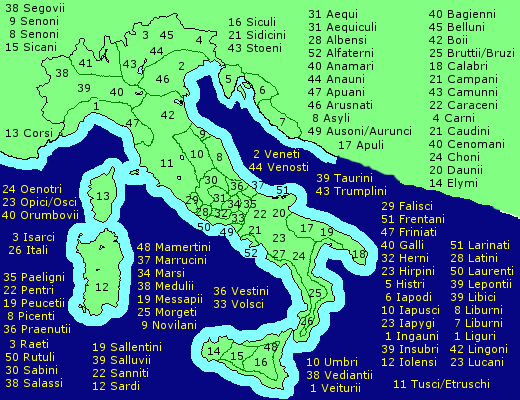
Popoli italici
Le lingue
Le varie lingue sono il risultato degli influssi esterni, sopra tutto indo-europei e greci, su quelli che erano gli idiomi originali della preistoria italiana. Fra le lingue di origine indo-europea abbiamo il latino, l'osco-umbro, il venetico ed il messapico. L'osco-umbro ha tuttavia legami anche con il celtico ed il greco, il venetico con le lingue germaniche, ed il messapico con il tracio e l'illirico. In quanto agli etruschi la loro origine è ancora incerta, anche se è quasi sicuro che essa si basi sulla civiltà pre-villanoviana dell'età del bronzo finale.
http://www.dejudicibus.it/dizionario...tal_lingue.gif
Lingue italiche
I dizionari disponibili in questo sito fanno principalmente riferimento al periodo che va dal IX al V secolo avanti Cristo.
I dizionari
I dizionari relativi a questi popoli contengono una lista quanto più completa possibile dei termini conoscuti a partire dalle poche iscrizioni pervenuteci. Per quanto contengano poche decine di termini, essi sono quanto di più completo abbiamo a riguardo e come tali la loro qualità deve essere considerata elevata. Ovviamente non abbiamo potuto usare gli alfabeti originali all'interno del dizionario, per cui abbiamo utilizzato l'alfabeto latino moderno con alcuni caratteri aggiuntivi. Una tabella di conversione fra l'alfabeto originale e quello utilizzato nel programma è riportata nella scheda di ciascuna lingua.
Bibliografia
Massimo Pallottino, "Genti e culture dell'Italia preromana",
Società Editoriale Jouvence s.r.l., 1981
V. Pisani, "Le lingue dell'Italia antica oltre il latino",
Torino, 2a edizione, 1964
-
01-08-06, 12:45 #8email non funzionante
- Data Registrazione
- 13 May 2009
- Messaggi
- 30,192
-
- 0
-
- 11
- Mentioned
- 2 Post(s)
- Tagged
- 0 Thread(s)
Richard McCulloch sull'Italia dice che:
Italy = 50% Dinaricized Mediterranean (most common in the south and Sicily), 20% Dinaric (most common in the north), 15% Alpine (most common in the northwest), 10% West Mediterranean (most common in Sardinia), 4% Noric (most common in the north, 1% Nordic (most common in the remnants of the Ostrogoth and Lombard aristocracy) = 5% Nordish (1% central and 4% periphery types). Italy, much like the other southern European countries of the Mediterranean region -- Spain, Portugal and Greece -- experienced several waves of Nordish invasions during ancient and early Medieval times, from the Danubians (circa 2,000-1,500 B.C.), who brought the Indo-European language that developed into Latin, and the Kelts (beginning circa 500 B.C.), to the Germanic Ostrogoths and Lombards (A.D. 400-700). These Nordish elements have been gradually assimilated into the majority Mediterranean population, but some of their genetic traits, existing in solution, occasionally recombine to appear in individuals whose other traits are mostly non-Nordish.
-
01-08-06, 12:46 #9email non funzionante
- Data Registrazione
- 13 May 2009
- Messaggi
- 30,192
-
- 0
-
- 11
- Mentioned
- 2 Post(s)
- Tagged
- 0 Thread(s)
E. A. Hooton all'interno della famiglia caucasoide parla di sei gruppi: Mediterraneo, Ainu, Celtico, Nordico, Alpino, Baltico. A questi aggiunge quattro sottogruppi nati da incroci tra i gruppi principali: Armenoide, Dinaride, Nordico-Alpino, Nordico-Mediterraneo.
La divisione di W. K. Gregory comprende otto gruppi: 1) Negroidi; 2) Melanoidi e Mediterranoidi - veddalis, dravidicus, indoafghanus, aethiopicus, mediterraneus -; 3) Ainu; 4) Xantoidi - nordicus -; 5) Alpinoidi - assyroideus, armenianus, adriaticus, alpinus -; 6) Mongoloidi; 7) Amerindi; 8) Oceanici.
Altrettanto elaborata è la divisione di E. Von Eickstedk, che chiama i caucasoidi "homines sapientes albi", suddividendoli in quattro gruppi: a) Xanthochroici - europeus (nordico), slavonicus (baltide) -; b) Melanochroici - pelagius (mediterranide), arabicus (orientalide), indicus (indide), occidentalis (polineside) -; c) Brachimorphi - alpinus, dinaricus, syriacus (armenide), eurasicus (turanide) -; d) Protomorphi - veddalis, curilanus (ainu) -.
Osservando l'Europa occidentale e centro-orientale possiamo distinguere
"... 5 razze principali: la nordica, la mediterranea, l'alpina, la baltica e la dinarica; ... Due di queste razze, che si identificano con la stirpe eurafricana, sono dolicomorfe (la nordica e la mediterranea) ... Le altre tre, che costituiscono insieme gli eurasici, sono brachimorfi (l'alpina, la dinaride o adriatica, la baltica)." (A. Mori)
Di interesse per questo studio sono soltanto alcuni tipi razziali, tutti della famiglia caucasoide.
Nordide: pelle bianco-rosea, capelli ondulati biondi, iridi azzurre o grigie, pelosità abbondante, dolicocefalia con occipite prominente, faccia alta e stretta, naso alto con dorso diritto, labbra sottili, statura elevata (cm. 175), proporzioni corporee di macroscelia (gambe lunghe). E' diffuso nel Nord-Europa, un sottotipo è il Falico, con faccia più bassa e corporatura più massiccia.
Mediterranide: pelle bianco-brunetta, capelli e occhi bruni, pelosità sviluppata, dolicocefalia con occipite arrotondato, faccia alta e ovale, labbra moderatamente piene, naso alto e stretto a dorso dritto. E' diffusa nell'Europa meridionale e nell'Africa settentrionale. Secondo il Biasutti, sottotipi sarebbero: il berbero, il litoraneo, il paleo-sardo.
Orientalide: pelle bianco-bruna, capelli e occhi molto scuri, pelosità abbondante, dolicocefalia con occipite prominente, faccia lunga, naso alto diritto o convesso, statura medio-alta, longilineo. Si trova nella Penisola arabica, in Iraq, in Iran, in Afghanisthan.
Alpinide: pelle bianco-opaca, capelli castani o neri, occhi castani o azzurri, brachicefalia con occipite arrotondato e testa bassa, faccia larga tondeggiante, naso a dorso diritto o concavo, labbra moderatamente sottili, statura media (cm. 165), proporzioni corporee di brachischelia (gambe corte). E' diffuso in tutta l'Europa centrale, dalla Francia sino alla Russia. Un suo sottotipo è quello Georgiano.
Baltide: pelle bianca o bianco-avorio, capelli biondo cenere, occhi grigio-azzurri, brachicefalia, testa moderatamente alta, faccia lunga quadrangolare, labbra sottili, naso piccolo e concavo a punta rialzata, statura media, corporatura robusta brachischele. E' ben rappresentato nell'Europa orientale.
Dinaride: pelle chiara o bianco-bruna, capelli castani o castano scuri, pelosità abbondante, brachicefalia con occipite appianato, testa alta, faccia lunga, naso prominente spesso convesso, statura elevata (cm. 175), proporzioni corporee di meso- e macro-schelia. E' diffuso nei Balcani, nelle Alpi orientali e nella Padania orientale. Sottotipi sono il Nordico e il Padano.
"... bruni appaiono il tipo propriamente dinarico, alto di statura e fortemente profilato, nonché la sottorazza padana, di tratti raddolciti e statura media. Bruna è pure una forma balcanica a faccia molto larga, che è un carattere non raro nelle forme preistoriche più antiche della razza." (R. Biasutti)
Pamiride: pelle bianco-opaca, capelli e occhi bruni, pelosità abbondante, brachicefalia con occipite appianato, testa alta, faccia alta, naso diritto e stretto, labbra sottili, statura medio-alta, corporatura massiccia, E' diffuso in Anatolia, Mediterraneo orientale, Pamir e Caucaso. Sottotipo è l'Armenide.
Turanide: pelle bianco-giallo-bruna, capelli leggermente ondulati, pelosità media, notevole brachicefalia con occipite arrotondato, faccia lunga con occhi bruno scuri, naso stretto a dorso diritto o convesso, statura media, proporzioni di brachischelia. E' diffuso nel Turkesthan e in Afghanisthan, è considerato un tipo razziale metamorfico
Le razze caucasoidi non solo soltanto queste, più verso oriente ne esistono delle altre, come l'Uralica (metamorfica) o l'Indiana, prive d'interesse in questo contesto.
Piccolissimo prontuario bibliografico
R. Biasutti, Razze e popoli della terra, IV voll.
F. Facchini, Evoluzione, Uomo e Ambiente, ed. Utet 1988
A. Mori, L'Italia nei suoi caratteri antropogeografici, Lib. Goliardica PI
M. C. Pantaleo, Tavole sulle razze umane, ed. Giunti Bemporad Marzocco
-
01-08-06, 12:47 #10email non funzionante
- Data Registrazione
- 13 May 2009
- Messaggi
- 30,192
-
- 0
-
- 11
- Mentioned
- 2 Post(s)
- Tagged
- 0 Thread(s)
Houston Stewart Chamberlain
"Le fondamenta del XIX Secolo"
di Gualtiero Cìola
Figlio di un ammiraglio inglese, filosofo, musicologo, biografo, storico e antropologo, è soprattutto noto per aver dato alle stampe in Germania, nel 1899, una poderosa opera, scritta in lingua tedesca : "Die Grundlagen des XIX Jahrunnderts" ; nei due tomi della sua controversa ricerca elaborò delle teorie che da allora gli avvalsero l’epiteto di "razzista" dai contemporanei ed ancor più dai posteri .
Chamberlain si era trasferito assai presto in Germania , ove aveva sposato una figlia di Richard Wagner ; nel 1916 gli fu conferita le cittadinanza germanica, dopo che si era decisamente schierato dalla parte delle potenze centrali allo scoppio della grande guerra 1914 -’18. Si può dire Chamberlain, nel 1914 rinnegò la sua nazione per non rinnegare la razza alla quale sapeva di appartenere ; anche allora, come nel 1939, quello che scoppiò fu un conflitto di razze : come Lui,, sul finire della seconda guerra, dei Francesi, Spagnoli, Belgi, Olandesi, Danesi, Norvegesi, Svedesi, Slavi e Italiani andarono a morire indossando una uniforme tedesca. Essi fecero la medesima scelta , poiché capirono che era in gioco la sopravvivenza stessa della razza ario-europea.
Che la loro intuizione fosse giusta lo sta dimostrando lo spappolamento delle etnie europee, sotto la minaccia del meticciamento razziale voluto e guidato dalle centrali del Nuovo Ordine Planetario, pilotato dal sionismo internazionale.
Le teorie di H.S.Chamberlain ci sono sembrate interessanti per il fatto che non coincidono esattamente con quelle dei suoi nuovi compatrioti, pur essendo stato molto prodigo di elogi per le virtù dei Germani, alfieri della civiltà europea, dopo la caduta dell’Impero Romano d’Occidente.
La sua interpretazione del Rinascimento italiano lo accosta ad un altro antropologo : Ludwig Woltmann ; ambedue hanno interpretato il fenomeno come la nascita di una nuova civiltà, anziché come il risveglio della Romanità che consideravano ormai definitivamente estinta.
Il XIII secolo viene considerato dal Chamberlain come il momento intermedio di questa nuova interpretazione della Rinascenza che arriverebbe fino al XIX secolo quale fase preparatoria di una nuova era.
Il progresso nella vita civile che si verificò nel Medio Evo viene da Lui visto come l’estrinsecazione del genio germanico che si è risvegliato da un lungo sonno : in questa nuova luce si può parlare di Rinascimento.
Il concetto di germanicità inteso da Chamberlain si differenzia da quello proposto dalla più parte degli autori tedecschi . " Io comprendo nell’Accezione di "Germani" le diverse popolazioni nord-europee che come Celti, Germani e Slavi irruppero nella Storia, dai quali, e per lo più mescolati ad essi, si formarono i diversi popoli europei. Che provenissero originariamente da un’unica famiglia, lo dimostrerò nel corso della mia opera ; purtuttavia l’animo germanico descritto da Tacito si è mantenuto così bene nel campo spirituale, morale e psichico, che ci sentiamo autorizzati ad usare tale termine come compendio di tutta la stirpe ."
Pur non discostandosi dalle tesi del De Gobineau che vedeva nel meticciamento razziale un male enorme, incommensurabile, non ne condivideva a fondo il pessimismo, anzi, ne auspicava una fusione dell’elemento germano-tedesco con quello dei paesi slavi dell’est europeo.
Pur accusando il crescente influsso giudaico in politica, nel Diritto, nella Scienza e nell’arte europea e pur riconoscendo gli Ebrei diversi dai popoli indoeuropei ed ammettendo essere essi il risultato di un meticciamento tra semiti-siriaci ed europei, non può esimersi dall’ammirarne la caparbia difesa della loro stirpe, intesa a mantenerla pura da altre commistioni e contaminazioni ; per questo non simpatizzò mai con i più accesi antisemiti, ironizzando inoltre sulla loro pretesa di fare apparire gli Ebrei come i capri espiatori di tutti i mali del mondo.
Chamberlain morì, per sua fortuna, alcuni anni prima dell’avvento del Nazismo, ma anche così è stato considerato , per le sue teorie, un razzista precursore dei Rosenberg e dei Günther.
" L’ingresso dei Germani nella Storia del Mondo.
Il concetto di "germano" è da intendersi in senso più ampio e nello stesso tempo più restrittivo di quanto fece Tacito, per delle sue considerazioni sia storiche che antropologiche.
Il concetto è amplificato dalla convinzione che i germani di tacito possono essere difficilmente differenziati sia dai loro predecessori storici : i Celti, che dai loro successori che siamo abituati a riassumere semplicisticamente nel termine di "popoli slavi". Nessun naturalista esiterebbe a considerare queste tre stirpi, secondo le caratteristiche fisiche, come rami di un medesimo ceppo. I Galli che nel 380 a.C. conquistano Roma, corrispondono perfettamente alla descrizione che tacito fa dei germani : "radiosi occhi azzurri, capelli rossicci, alta statura " ; d’altra parte i reperti cranici delle necropoli più antiche hanno dimostrato, con grande meraviglia del mondo scientifico, che gli Slavi del tempo delle grandi migrazioni dei popoli erano,, senz’ombra di dubbio, dei veri dolicocefali di alta statura, come lo erano gli antichi Germani e come lo sono ancora quelli rimasti di ceppo puro. Inoltre le ricerche del Vircow sul colore dei capelli e degli occhi ha portato al risultato che gli Slavi, nelle loro sedi originarie, erano egualmente del tipo biondo, come lo sono ancora in certe regioni dell’Est, analogamente ai Germani.
Così sembra che, a prescindere dalla rappresentazione teoretica ed ipotetica dell’uomo indoeuropeo, si debba ritenere con ogni ragione che il concetto di "Germano" che ci è venuto da Tacito, legato poi a considerazioni puramente linguistiche, debba assumere un significato più ampio.
I Celto-Germani.
Parliamo prima di tutto dei Celti . dal momento che per preminenti considerazioni filologiche, le lingue celtiche sono state ritenute più affini a quelle greco-italiche che alle germaniche, ci siamo abituati all’idea di trascurare gli elementi fisici e quelli spirituali , ancora più incisivi, per avvicinare i Celti ai Germani .
Noi assegniamo i Celti al ceppo greco-italico, mentre essi sono, al contrario, più intimamente legati ai Germani, perché consanguinei.
Può darsi che i Galli totalmente romanizzati abbiano voluto differenziarsi dai loro vicini Franchi o Burgundi, così come più tardi i Galli stanziati da secoli nel Nord-italia, che Floro rappresenta sempre come "super-uomini " (corpora plus quam humana erant), facendoli ancora rassomigliare fisicamente ai Germani, ma non solo fisicamente, giacchè avevano in comune la voglia di migrare, la gioia e la propensione per la lotta e la guerra ( come più tardi i Goti) che li spingerà a guerreggiare sino in Asia, il loro amore per il canto...Tutto questo rappresenta un segno tangibile della fratellanza razziale celto-germanica, mentre sarebbe più arduo trovare simili punti di contatto con i ceppi greco-italici.1
Mescolati a Celti e guidati da Celti , i Germani compaiono sulla scena della storia mondiale nel vero senso dei racconti di Tacito ; già la parola "germani" è di origine celtica...
Non incontriamo forse ancor oggi in Scozia e nel Galles alte stature con occhi azzurri e capelli rossicci che sono più simili ai tedeschi che non ai Mediterranei ? E non vediamo anche i moderni Bretoni emulare gli antichi Vichinghi quali temerari navigatori ? Come questo fiero carattere celto-germanico si sia in molti luoghi ingentilito e quasi effemminato a contatto con la civiltà romana, ce lo descrive G.Cesare nella prima parte del suo libro "De bello gallico". Ma ancora più sorprendenti e decisivi sono i caratteri spirituali che affratellarono gli antichi Celti ai Germani, che si deducono dalla storia e che costituiscono la specifica indole germanica (...)". Germanica e non tedesca, dice Chamberlain, poiché si riferisce non all’epoca moderna, ove le differenziazioni indotte dall’istruzione hanno creato dei caratteri "nazionali" che, seppur superficialmente dividono, ma a mille anni indietro, quando i Bretoni e gli altri Celti erano ancora del tutto simili agli Svevi ed ai Bavaresi.
Ma è soprattutto nella poesia che la comune appartenenza razziali di Celti e Germani meglio si appalesa, soprattutto nelle saghe e nelle composizioni epico-cavalleresche francesi composte a cavallo fra il XII ed il XIII secolo.
Gli Slavo-Germani
Sugli autentici Slavi non si riesce ad essere più informati, non sapendo bene dove cercarli ed in primo luogo avendo la certezza che si è verificato un travisamento del concetto di etnia slava, in seguito alle caratteristiche della "razza slava" che vengono oggi fornite, come ad esempio la figura tarchiata, la testa rotonda, gli zigomi alti, i capelli scuri: caratteri che non erano certamente degli Slavi che entrarono nella storia d’Europa. Ancora oggi,del resto, il tipo biondo è dominante nelle parti settentrionali ed orientali della Russia Europea ed anche i Polacchi differiscono dagli Slavi del Sud per il colore della pelle (Vircow) ; in Bosnia colpisce l’insolita altezza della statura degli uomini, così come la frequenza della capigliature bionde."
La stessa osservazione l’abbiamo fatta anche per i Dalmati e gli altri Croati che, assieme ai Cosacchi, erano ritenuti, da parte degli ideologi dell’Ahnenerbe , appartenere ai resti dei Goti Orientali e dei Variaghi vikinghi, variamente slavizzati . Che ciò corrisponda al vero non ci sentiamo di affermarlo senza prove concrete ; quel che è certo è che tutte le popolazioni slave hanno inevitabilmente subito mescolanze coi c.d. Popoli delle steppe, di origine asiatica, che hanno mescolato dei segni caratteristici inequivocabili che si riscontrano frequentemente tra i Serbi, i Bulgari e gli stessi Russi ; fra le eredità caratteriali asiatiche rientra senz’altro la proverbiale ferocia dei bellicosi Serbi, tutto ciò appare evidente ad ogni attento osservatore anche se Chamberlain afferma che "...il cosiddetto tipo slavo dai tratti mongolici, non l’ho mai incontrato una sola volta nei miei viaggi durati mesi, in quel paese ( la Russia) , così come non ho visto il caratteristico "viso a patata" dei contadini cechi . Lo stesso vale per lo stupendo ceppo montenegrino" . Però ammette che i crani dolicocefali che si trovano nelle tombe, decrescono, passando dalle necropoli più antiche a quelle più moderne : segno di un imbastardimento progressivo che ha interessato peraltro tutti i popoli indogermanici . Siamo d’accordo con Lui quando afferma : "Malgrado il generale e diffuso pregiudizio, ci sono ancora adesso sufficienti indizi fisici che i Germani, nel momento in cui entrarono nella storia, oltre ai fratelli più antichi dell’occidente, ne avevano altri più giovani ad Oriente dai quali non differivano affatto .
Assai complicato risulta districare il problema degli Slavi originari, a causa del dato di fatto che questo ramo della famiglia germanica venne assai presto quasi completamente assimilato alle altre etnie, assai prima ed in modo più radicale ed anche misterioso di quanto non successe ai Celti ; tutto ciò non ci deve impedire di riconoscere i tratti di affinità razziale e di intraprendere il tentativo di distinguerli e di selezionarli da quella massa estranea."
Qui Chamberlain pare ammettere quanto abbiamo sostenuto più sopra, vale a dire che l’incontro e lo scontro con i popoli migratori delle steppe asiatiche ha profondamente modificato i tratti somatici e spirituali di una parte degli Slavi ; solo un lungo periodo di politica eugenetica avrebbe potuto o ancora potrebbe far riapparire la razza slava originaria. Ma lo stesso discorso varrebbe per tutti i popoli europei, non escluso il nostro...
Anche per gli Slavo-Germani Chamberlain invoca la produzione poetica per ritrovare i legami dello spirito con Celti e Germani, in particolare il ciclo epico-eroico, eco delle tante guerre combattute, durante le quali il sentimento di fedeltà fino alla morte, la supremazia dell’onore personale, rispetto alla scarsa considerazione per i beni materiali, li accomuna agli stessi miti celtici e germanici.


 Rispondi Citando
Discussioni Simili
-
Quote etniche,servono le quote etniche SUBITO nei posti pubblici al Nord!
Di Dragonball (POL) nel forum Padania!Risposte: 17Ultimo Messaggio: 27-04-06, 14:46 -
le lingua parlate nello stato italiano
Di Perdu nel forum EtnonazionalismoRisposte: 0Ultimo Messaggio: 22-07-04, 19:11 -
le lingua parlate nello stato italiano
Di Perdu nel forum Padania!Risposte: 0Ultimo Messaggio: 22-07-04, 19:11
 Permessi di Scrittura
Powered by vBulletin® Version 4.2.5
Copyright © 2026 vBulletin Solutions Inc. All rights reserved.
Change privacy settings
Copyright © 2026 vBulletin Solutions Inc. All rights reserved.
Change privacy settings
Tutti gli orari sono GMT +2. Adesso sono le 20:03.
