


The Mystery of Hanuman - Inspiring Tales from Art and Mythology
Article of the Month - August 2004
Once Shiva and Parvati, ever the adventurous lovers, decided to transform themselves into monkeys and indulge in amorous games in the dense Himalayan forests. During a climactic moment, the seed of Shiva found its mark and impregnated Parvati. Since they were in simian form it was but natural that the offspring born of such a union too would be a monkey. Not desiring to go against the laws of nature, Shiva directed the wind god Vayu to carry his semen from Parvati's womb, and deposit it into that of Anjana - a female monkey, who at that very moment was praying for a male child.
Another slightly variant version of this story in the Shiva Purana states that when Vishnu once disguised himself as the heavenly beauty Mohini, her charms so impressed Shiva that he could not restrain his seed. Vayu then carried the seed and deposited it into Anjana's womb. There was no question of Shiva's potent discharge resulting in an offspring less than extraordinary and the child conceived under such exceptional circumstances was bound to be especial, and so it was. The resulting bundle of joy was none other than Hanuman, one of the most celebrated and worshipped figures in Indian thought. Two exceptional traits further marked his birth. The first was that unlike ordinary children, Hanuman was born wearing a loincloth. This was an early pointer to his life-long pursuit of a celibate, almost ascetic lifestyle. The other significant occurrence was the presence of elaborate earrings adorning his ears. The latter has an interesting piece of legend explaining it:
At the time of Hanuman's birth, the undisputed leader of the monkey-world was Vali, a strong and powerful ape. When Vali came to know that Anjana was pregnant with a child who was bound to develop into a powerful rival, he decided to end matters in Anjana's womb itself. He created a missile using five metals: gold, silver, copper, iron and tin. When the unsuspecting mother was asleep, he directed the missile into her womb. A normal child may have succumbed to this dastardly attack, but not one born of Shiva's fiery seed. The missile as soon as it touched Hanuman's body melted, and transformed into a pair of earrings. Thus wearing the trophies of his first battle, fought while still in his mother's womb, Hanuman gloriously entered this world.
Little Hanumana Goes for the Sun
Indeed, having both Shiva and Vayu as his illustrious fathers, he was no ordinary child. Hanuman was restless, spirited, energetic and inquisitive. He was obviously endowed with awesome strength and the scriptures abound in tales expounding on his remarkable feats. Once for example he mistook the sun for a ripe fruit (monkeys are naturally lured by red ripe fruits), and rushed towards the sky in an attempt to grab it.
On his way however he saw Rahu the dragon making his way to devour the sun and thus cause an eclipse. Mistaking him to be a worm, the restless Hanuman dashed towards Rahu and attempted to catch hold of him. Rushing for his life, Rahu sought shelter in the refuge of Indra, the lord of the skies. Indra picked up his deadly thunderbolt, mounted his white elephant named Airavata and made off in search of Hanuman, seeking to restrain his seeming impudence. The clouds rumbled and lightning thundered across the vast skies in an expression of Indra's wrath. But neither this scary scenario, nor the mightily armed Indra on his high mount, was sufficient enough to induce even a trace of fear in the heart of Hanuman. On the contrary, the spectacle only served to fuel his excitement and mistaking Airavata for a toy, he made a grab for the pachyderm, seized its trunk and leapt on its back. Taken aback by the child's spirited and playful defiance, Indra stuck at Hanuman with his thunderbolt, and the wound thus inflicted hurtled him speedily down to the earth. His father Vayu immediately sprung to his rescue and caught him in mid air.
The sight of his beloved son lying helpless in his arms infuriated the wind-god. He drew in a mighty breath and sucked away all the air from the cosmos. "Let all those who have harmed Anjana's son choke to death," he thought out aloud. Predictably there was panic in the cosmos. Without air, life on every level was threatened. The gods, realizing their folly, went in unison to Vayu and asked for his forgiveness. To make amends they showered the following blessings and powers on the monkey child:
a). Brahma: "May you live as long as Brahma himself lives."
b). Vishnu: "May you live all your life as the greatest devotee of God."
c). Indra: "No weapon of any kind will wound or hit your body."
d). Agni: "Fire will never affect you."
e). Kala: "May death never court you."
f). All the Devas (gods): "None will ever equal you in strength and speed."
Brahma concluded the session by bestowing on Hanuman a power greater than even Vayu and Garuda, and endowed him with a speed faster than even the mightiest wind. Thus pacified, Vayu restored air into the cosmos and Hanuman was returned to his parents.
There was one catch however. It was decreed that Hanuman would remain blissfully unaware of his own prowess, unless, during the course of a meritorious deed, his memory would remind him of his superhuman ability. It will be seen later how this apparently insignificant matter lays bare the symbolical significance of Hanuman.
Hanuman's Education
As he grew up, Hanuman sought to educate himself and for this purpose he chose Surya the sun god as his guru saying: "You see everything there is to see in the universe and you know everything there is to know. Please accept me as your pupil." Surya hesitated. "I don't have the time," he said. "During the day I ride across the sky, and at night I am too tired to do anything."
"Then teach me as you ride across the sky during the day. I will fly in front of your chariot, facing you from dawn to dusk." Impressed by Hanuman's zeal and determination, Surya accepted him as his pupil. Thus Hanuman flew before the chariot of the sun god, withstanding the awesome glare, until he became well versed in the four books of knowledge (the Vedas), the six systems of philosophies (darshanas), the sixty-four arts or kalas and the one hundred and eight occult mysteries of the Tantras.
Having become a master of all that he set out to learn, it was now time for Hanuman to pay for his education (guru-dakshina). Surya asserted that watching the devoted pupil study was payment enough for him but when Hanuman insisted on giving something to express his gratitude, the sun god asked him to look after the welfare of his son Sugriva, who was the stepbrother of Vali, the king of monkeys.
Before Vali became the lord of apes, a simian named Riksha ruled over them. Once it so transpired that Riksha fell in an enchanted pool and turned into a woman. Both the sky-god Indra and the sun-god Surya fell in love with her and she bore each of them a son. Indra's son was her first born Vali while Sugriva her second offspring was the son of Surya. After bearing the sons, Riksha regained his male form.
Abduction of Sita by Ravana When Riksha died, in accordance with the law of the jungle, the monkeys fought each other for becoming the leader. Vali successfully killed or maimed every other contender to the throne and became the undisputed ruler of the monkey world. As one who had successfully earned his dominant place among the apes, Vali was not obliged to share the spoils of power with anyone, but being of a magnanimous nature he shared everything with his younger brother Sugriva. It was in these circumstances that Hanuman entered the companionship of Sugriva who later became the king of monkeys himself. It was under Sugriva that the massive army of monkeys helped Lord Rama reclaim his wife who had been abducted by the demon Ravana.
This article by Nitin Kumar
http://www.exoticindiaart.com/article/hanuman
Risultati da 1 a 4 di 4
Discussione: il mistero di Hanuman
-
22-01-07, 17:38 #1Vittima del kali yuga


- Data Registrazione
- 25 Feb 2006
- Località
- Il desiderio, è come un fuoco insaziabile. Grazie alla barca della conoscenza certamente varcherai tutto l'oceano del male (b. gità)
- Messaggi
- 13,954
-

- 0
-

- 0
- Mentioned
- 0 Post(s)
- Tagged
- 0 Thread(s)
 il mistero di Hanuman
-
22-01-07, 17:39 #2Vittima del kali yuga
- Data Registrazione
- 25 Feb 2006
- Località
- Il desiderio, è come un fuoco insaziabile. Grazie alla barca della conoscenza certamente varcherai tutto l'oceano del male (b. gità)
- Messaggi
- 13,954
-
- 0
-
- 0
- Mentioned
- 0 Post(s)
- Tagged
- 0 Thread(s)
Hanuman The Selfless

Valmiki and the Wounded Bird
A pair of lovebirds, reveling in their natural freedom, was soaring the boundless skies. Fate however had scripted a cruel ending to their mating. A hunter's arrow found its mark and the devoted female lost her male. She did not however escape from the scene but rather lingered on, circling over the lifeless form of her mate. Witnessing this poignant episode inspired the accomplished sage Valmiki to poetry and what came out of his heart was the Ramayana, one of the greatest epics the earth has had the good fortune to inherit. Indeed, Valmiki's poem became renowned in the three worlds as it struck a chord in every heart that heard it.
One day Valmiki came to know that the great Hanuman too had penned the adventures of Rama, engraving the story with his nails on rocks. A curious Valmiki traveled to the Himalayas where Hanuman was residing to partake this version. When Hanuman read out his narration, Valmiki was overwhelmed by its sheer power and poetic caliber. It was truly an inspired piece. Valmiki felt both joy and sorrow. Joy because he had had the chance to hear an exceptionally beautiful poem, and sad because it obviously overshadowed his own work.
When Hanuman saw the unhappiness his work had caused Valmiki he smashed he engraved rocks destroying his creation forever. Such was Hanuman's selflessness. For him, narrating the tales of Rama' s adventures was a means to re-experience Rama, not a ticket to the hall of fame.
Hanuman's name too illustrates his self-effacing character, being made up of 'hanan' (annihilation) and 'man' (mind), thus indicating one who has conquered his ego.
Hanuman and Yoga

Hanuman as Yogachara
If yoga is the ability to control one's mind then Hanuman is the quintessential yogi having a perfect mastery over his senses, achieved through a disciplined lifestyle tempered by the twin streams of celibacy and selfless devotion (bhakti). In fact, Hanuman is the ideal Brahmachari (one who follows the path of Brahma), if ever there was one.
He is also a perfect karma yogi since he performs his actions with detachment, acting as an instrument of destiny rather than being impelled by any selfish motive.
Hanuman - The First to Teach Pranayama and the Inventor of the Surya Namaskar
Pranayama is the ability to control one's breath so that the inhalation and exhalation of air is rhythmic. Vayu, the god of air and wind, first taught pranayama to his son Hanuman, who in turn taught it to mankind.
The Surya Namaskar (salutation to the sun) too, was devised by Hanuman as a greeting for his teacher Surya.
Hanuman and Sorcery
The villain of the epic Ramayana was the mighty demon Ravana. When he carried away Sita, her aggrieved husband Rama, accompanied by Hanuman and a massive army of monkeys laid siege on Lanka, the capital of Ravana's empire. As the battle progressed, the demon lost all his brothers and sons and it became clear that he was headed towards defeat. Finally, he sent for his only surviving son Mahiravana, a powerful sorcerer who ruled over the underworld (patala loka). Mahiravana was a great devotee of Goddess Kali from whom he had obtained vital occult secrets. Initially Mahiravana did not wish to join the fight against Rama since he felt the latter's cause to be just. But understanding his weakness for ritual magick Ravana addressed him thus: "Think of the powers the goddess Kali will grant you when you offer to her the heads of two handsome and virile youths like Rama and Lakshmana." Needles to say, Mahiravana agreed.
The great sorcerer Mahiravana managed to kidnap both Rama and his brother Lakshmana while they were sleeping. He left behind, in place of their bed, a dark trail stretching deep into the bowels of the earth. Hanuman immediately dived into the tunnel and made his way to patala, the subterranean kingdom of Mahiravana. There he found the two brothers tied to a post, their bodies anointed with mustard oil and bedecked with marigold flowers, ready to be sacrificed. Near them, Mahiravana was sharpening the sacrificial blade and chanting hymns to invoke the goddess.
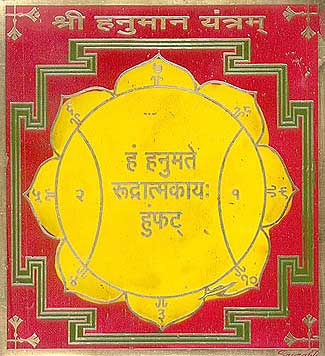
Sri Vaibhav Hanumana Yantra
Hanuman taking the form of a bee whispered into Rama's ear, "When Mahiravana asks you to place your neck on the sacrificial block, inform him that being of royal lineage you have never learned to bow your head. Tell him to show you how." Mahiravana fell for the trap. No sooner had he bowed his head in the ritually prescribed manner than Hanuman regained his form, seized the blade, and decapitated the sorcerer. Thus did Hanuman turn the tables and sacrificed the demon himself to Mother Goddess Kali. Impressed, she made Hanuman her doorkeeper and indeed many temples of the goddess are seen to have a monkey guarding their doorways. Further, to this day, Hanuman is invoked in any fight against sorcery, and amulets and charms depicting him are therefore extremely popular among devotees.
Hanuman and Astrology
Mahiravana's death filled Ravana's heart with fear. He consulted the court astrologers who studied his horoscope and decreed that the alignment of celestial bodies was not in his favor. Now, Indian astrology is governed by nine planets, known as the navagrahas. Ravana thought that by changing the alignment of these heavenly bodies he would be able to alter his destiny. Mounting his flying chariot he rose to the skies, captured the nine planets, and herded them to his capital in chains. He then began a series of rituals which if successful would force the planets to realign themselves in his favor. When Hanuman came to know of this ritual, he assembled and led a band of daredevil monkeys to Ravana's sacrificial hall, intending to disrupt the proceedings. They found the villain sitting beside a fire altar with his eyes shut in profound meditation, mouthing mantras. The group of simians let out a loud war cry and rushed into the hall. They snuffed out the sacred fire, kicked off the ceremonial utensils and wiped off the occult diagrams (yantras) painted on the floor. Unfortunately none of this roused Ravana from his deep trance and he continued chanting the holy formulas. Hanuman realized that Ravana would have to be stopped at any cost, otherwise the villain would succeed in changing the course of destiny.
Towards this end he devised a mischievous plan, and ordered his lieutenants to enter the female chambers and scare away Ravana's many wives. The monkeys did as instructed and attacked Ravana's queens and concubines, pulling their hair, scratching their faces and tearing away their clothes. But it was all to no avail; the immovable Ravana did not stir.

Hanuman – The Remover of Unfavourable Astrological Influences
At last the monkeys confronted Mandodari, the chief wife of Ravana. They bared their teeth, beat their chests and began to grunt menacingly. Terrified, Mandodari lamented, "Woe is me. My husband meditates while monkeys threaten my chastity." Her words ashamed Ravana to open his eyes and rush to her defence. Thus having successfully distracted Ravana, Hanuman ran back to the sacrificial hall and liberated the nine planets held captive there. For having successfully aborted Ravana's misplaced attempts to subvert fate, Hanuman won the eternal gratitude of the grahas and is thus believed to exercise considerable power over them. Correspondingly, he is worshipped by his devotees whenever they perceive their troubles to be a result of the unfavorable configuration of celestial bodies. Indeed, Hanuman is often shown trampling under his feet a woman who is said to represent Panvati, a personification of baneful astrological influences.
Another interesting legend deals specifically with the planet Saturn (Shani). Perceived to be an unfavorable influence, it is believed that Saturn visits each individual at least once in his/her lifetime for a period of seven-and-a-half years. As fate would have it, Saturn descended on Hanuman when he was busy building a bridge over the ocean to help Rama and his army cross over to Lanka. Hanuman requested the planet to postpone his visit till he had successfully assisted Rama in regaining Sita. But Saturn was adamant and Hanuman had to bow against the will of nature. He suggested that Saturn sit on his (Hanuman's) head as his hands were engaged in serving Rama and his legs were too lowly for Saturn.
Saturn happily settled on Hanuman's head and the mighty monkey continued with his work, piling heavy boulders and stones on his head in an apparently casual manner and carrying them to the construction site. After a while Saturn found it impossible to bear the load of the heaped boulders any longer and wished to climb down. Hanuman insisted that he complete his mandatory seven-and-a-half years but Saturn pleaded for release saying that the seven-and-a-half minutes he stayed on Hanuman's head felt like seven-and-a-half years anyway. Thus speaking Saturn took leave of Hanuman and since then worshippers of this monkey god rest assured that the unavoidable ill effects of Saturn's sade-sati (seven-and-a-half year's stay) can be whittled down by a true devotion to Hanuman.
Hanuman and the Mother Goddess
We have seen above how Hanuman serves as a favorite of the Mother Goddess. But the attribute of Hanuman, which impresses the goddess most, is his brahmacharya. Indeed Hanuman never threatens the world with his virility unlike say Shiva whose virility often has to be restrained by goddess Kali. Accordingly, Hanuman gains her unparalleled appreciation.
Hanuman and Tantra
Tantra represents the occult side of Hinduism. With the aid of chants (mantras) and diagrams (yantras) Tantriks (practitioners of Tantra) channelise the powers of the cosmos for the advantage of humanity.
Tantriks believe that Hanuman is the most accomplished of their lot having achieved the much-sought after eight occult powers:
1). Anima - The ability to reduce his size.
2). Mahima - Ability to increase his size.
3). Laghima - The ability to become weightless.
4). Garima - Ability to increase weight.
5). Prapti - The ability to travel anywhere and acquire anything.
6). Parakamya - Irresistible will power.
7). Vastiva - Mastery over all creatures.
8). Isitva - Ability to become god like with the power to create and destroy.
The Ramayana abounds with tales illustrating Hanuman's mastery over each of these siddhas (occult powers). Not surprisingly, he is reverently deified as a Mahsiddha (Maha - Great).
-
22-01-07, 17:39 #3Vittima del kali yuga
- Data Registrazione
- 25 Feb 2006
- Località
- Il desiderio, è come un fuoco insaziabile. Grazie alla barca della conoscenza certamente varcherai tutto l'oceano del male (b. gità)
- Messaggi
- 13,954
-
- 0
-
- 0
- Mentioned
- 0 Post(s)
- Tagged
- 0 Thread(s)
Hanuman and the Potency of Mother's Milk
After the annihilation of Ravana, Rama asked Hanuman how he would like to be thanked for his services. He answered, "My lord, let me spend the rest of my days in your service." Rama gladly accepted the request. Thus Hanuman too boarded the chariot, that was to take Rama and his entourage back to their native Ayodhya.
On the way however, Hanuman thought of visiting his mother Anjana who lived on a mountain nearby. Rama and all other members of the party too were curious to meet Hanuman's mother and hence the chariot was diverted to her dwelling.
On reaching the place Hanuman approached his mother whose happiness knew no bounds. She embraced her bundle of joy. All others present too bowed in reverence to the mother of Hanuman. The worthy son narrated to her the entire sequence of events ending with Ravana's death on the battlefield. Surprisingly, his words did not please his mother but rather she became remorseful and addressed Hanuman thus: "My giving birth to you has been in vain, and feeding you with my milk has been of no avail." On hearing her strange words all became panicky and were left speechless. Hanuman too stared at her in mute incomprehension.
After a brief pause she continued with her tirade: "Shame on your strength and velour. Did you not have enough power to uproot Ravana's city of vice Lanka on your own? Could you not have annihilated the ten-headed monster and his army yourself? If you were not strong enough to do so it would have been better if you had at least perished yourself in fighting him. I regret the fact that even though you were alive Lord Rama had to build a perilous bridge of stones over the turbulent ocean to reach Lanka and had to fight the massive army of demons and thus suffer a great ordeal in order to recover his beloved Sita. Indeed, the nourishment my breast has given you has proved to be unfruitful. Go away and don't ever show me your face again." She was obviously referring to the instance when Hanuman was deputed to go and search for Sita in the city of Lanka. Only when he had confirmed Sita's presence in Ravana's custody could a formal battle be launched to rescue her. Hanuman not only brought news of her wretched condition in captivity but also during his brief visit managed to burn down the whole city and thus gave Ravana an inkling of the times to come. Anjana's annoyance stemmed from the fact that even though Hanuman was supremely capable of bringing back Sita on his own during that visit itself, he did not do so and much effort had to be expended later to accomplish the mission.
Hence was she trembling with wrath. With folded hands Hanuman addressed her: "O Great Mother, no way have I compromised on the sacred worth of your milk. I am but a mere servant. During that visit I had been instructed only to search for Sita and not kill Ravana. Had I done so of my own accord it would have amounted to overstepping my brief. I therefore acted scrupulously and kept my word." In fact, Hanuman had asked Sita, when he met her in Ravana 's captivity, whether she would prefer to be rescued by him at that very moment. She replied in the negative stressing that it was her husband's duty to liberate her and Rama himself would have to come and take her back.
The entire gathering corroborated Hanuman's version and much mollified his distressed mother. She spoke to him affectionately: "Dear son I never knew all this but now that I do it is comforting that my milk has indeed borne abundant fruit."
The repeated glorification of her own milk by Anjana was not relished by Lakshmana, who thought it an exaggeration. Sensing this, she addressed him saying: "Lakshmana, you are wondering why this apparently feeble monkey-woman is harping on the efficacy and potency of her own milk? My milk is indeed extraordinary." Saying this Anjana squeezed her breast and the oozing milk shower shot to a nearby mountain cleaving it thunderously into two. Addressing Lakshmana again she elaborated: "Hanuman has been brought up on the same milk, how could it ever go to waste?" (This story was narrated in the annual issue of the spiritual journal 'Kalyan,' published at Gita Press Gorakhpur. (1975, page 327)).
Why Idols of Hanuman are Red in Color

Rama Durbar
After safely reaching Ayodhya, Rama in no time settled down to a happy life of kingship and matrimony. Hanuman continued to be a constant and devoted companion with an unrestricted access to Rama.
Life went on normally. Many delightful episodes from this period establish Hanuman as the ultimate bhakta, and shed much light on his unique personality.
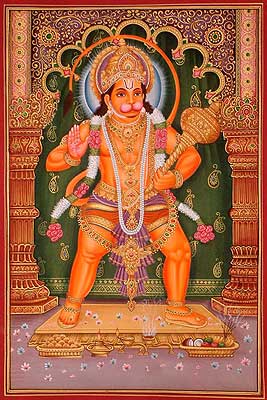
Hanumana
Every morning Hanuman would observe Sita put a red mark on her forehead and smear the parting of her hair with vermilion powder, enacting a ritual which is the exclusive prerogative of married women in India. Being naturally of a curious bent of mind he asked her the reason behind this daily ritual. "For the well-being of my husband," replied she. Hanuman, ever the humble well-wisher of his chosen lord wondered: "If a virtuous woman like Sita has to apply vermilion in this manner for the good of Lord Rama, I, a mere monkey, need to do more." Thus thinking, he took a bowlful of the paste and smeared his whole body with it. Needless to say, both Rama and Sita were moved by the purity of Hanuman's heart. Since then, idols of Hanuman are colored a rich vermilion red.
Why Hanuman is Shown Tearing Open his Own Chest

Hanuman Tears Open His Chest
Once Sita gave Hanuman a necklace of pearls. After a while, the residents of the city observed him breaking the necklace and inspecting each pearl minutely. Intrigued they asked him the reason. "I am looking for Rama and Sita," replied Hanuman. Laughing at his apparent naivety the spectators pointed out to him that the royal couple was at the moment seated on the imperial throne. "But Rama and Sita are everywhere, including my heart" wondered aloud the true bhakta. Not understanding the depth of his devotion, they further teased him: "So Rama and Sita live in your heart, can you show them to us?" Unhesitatingly, Hanuman stood up and with his sharp talons tore open his chest. There, within his throbbing heart, the astonished audience were taken aback to find enshrined an image of Rama and Sita. Never again did anyone make fun of Hanuman's devotion.
The Five-Headed (Panchamukhi) Hanuman - An Intriguing Image

Madhavacharya (1197-76)
Vaishnavas believe that the wind-god Vayu underwent three incarnations to help Lord Vishnu. As Hanuman he helped Rama; as Bheema he assisted Krishna; and as Madhavacharya (1197-76), he founded the Vaishnava sect.

Hanuman, Humble and Powerful
It is interesting to note that in his youth Madhavacharya distinguished himself in physical exercises and field games and is said to have had a wonderful physique. Truly, physical prowess is an integral aspect of the cult of Hanuman and he is the patron deity of wrestlers and body-builders. He is most popularly referred to as 'Vajra-anga-Bali,' meaning the Powerful One (bali) with a body (anga) hard as a thunderbolt (vajra).

Five-Headed Hanumana
The Vaishnavas evolved a syncretic form of Hanuman with five heads and ten arms, incorporating in the composite image five important Vaishnavite deities:
At the center a monkey's face (Hanuman).
A lion's visage representing Narasimha gazing southwards.
An eagle's head symbolizing Garuda facing west.
A boar head of Varaha (north).
A horse's face for Hayagriva (facing the sky).
Each head signifies a particular trait. Hanuman courage and strength, Narasimha fearlessness, Garuda magical skills and the power to cure snake bites, Varaha health and exorcism and Hayagriva victory over enemies.
The Spiritual Significance of Hanuman
The goal of all mystical yearning is union of the individual soul with the universal soul. In the Adhyatma ('spiritual') Ramayana, a Sanskrit text dating from the fourteenth or fifteenth century, Sita represents the individual (jiva-atma), which has separated from the universal (param-atma) symbolized by Rama. In a beautiful interpretation, Hanuman here is said to personify bhakti, which annihilates the 'ahankara' or ego (Ravana), and re-unites the two.
The Enduring Relevance of Hanuman
In Hindu symbolism, a monkey signifies the human mind, which is ever restless and never still. This monkey-mind happens to be the only thing over which man has absolute control. We cannot control the world around us but we can control and tame our mind by ardent discipline. We cannot choose our life but we can choose the way we respond to it. Hanuman, when he was a child, was tempted by the sun and he rushed towards it thinking it to be a delectable fruit. On his way however, he was distracted by the planet Rahu and changed his path. Thus Hanuman is the temperamental human intellect, which is unquiet and excitable. It is only by diverting it to the path of pure bhakti (devotion), that it can be made aware of its profound and silent essence.
According to the Hindu point of view, there is no objective world 'out there.' The whole manifested world is a subjective phenomenon created by our own selves. We - as humans - have the unique ability to condition our minds. In other words, we have the power to change the way we perceive life. And by changing our perceptions of life, we have the power of changing our world. When Hanuman enters Rama's life, he changes Rama's world. He transforms a crisis (the loss of Sita) into an opportunity (rid the world of Ravana). He transforms a victim into a hero.
Thus, Hanuman is no ordinary monkey. While embarking on the search for Sita, the monkeys were confronted by the vast ocean lying between them and Lanka. They wondered how they would make their way across this mighty obstacle. Someone suggested that Hanuman jump and cross over the sea. But Hanuman was doubtful, "I cannot do that," he said. At that moment, one of his companions reminded Hanuman of the awesome powers lying dormant within him. Instantly Hanuman regained memory of his divine strength and he successfully leaped across the ocean. Thus our mind too needs to be reminded of its divine potential and of the fact that it can achieve phenomenal heights provided it believes in its ability to perform the task in question. Truly Hanuman is symbolic of the perfect mind, and embodies the highest potential it can achieve.
References and Further Reading
- Khokar, Ashish and S. Saraswati. Hanuman: New Delhi, 2001.
- Nagar, Shanti Lal. Hanuman in Art, Culture, Thought and Literature: New Delhi, 1995.
- Pattanaik, Devdutt. Hanuman an Introduction: Mumbai, 2001.
- Shri Hanuman Ank (In Hindi): Gita Press Gorakhpur, 1975.
- Tompkins, Ptolemy. The Monkey in Art: New York, 1994.
-
23-01-07, 10:16 #4INVICTIS VICTI VICTURI
- Data Registrazione
- 21 Apr 2009
- Messaggi
- 4,268
-
- 589
-
- 647
- Mentioned
- 2 Post(s)
- Tagged
- 0 Thread(s)
Ave Stuart...
Cosa pensi del possibile legame tra la figura indiana di Hanuman con la figura cinese di Sun Wukong?
Vale.


 Rispondi Citando
Discussioni Simili
-
mistero
Di pietroancona nel forum OlimpiadiRisposte: 7Ultimo Messaggio: 10-08-08, 23:12 -
Mistero
Di furbo nel forum Politica NazionaleRisposte: 23Ultimo Messaggio: 13-07-07, 16:20 -
il mistero di Hanuman
Di stuart mill nel forum Filosofie e Religioni d'OrienteRisposte: 15Ultimo Messaggio: 22-02-07, 20:20 -
Il ritorno del dio Hanuman
Di Shambler nel forum Esoterismo e TradizioneRisposte: 1Ultimo Messaggio: 21-07-06, 11:29 -
Mistero
Di kernel nel forum Aviazione CivileRisposte: 30Ultimo Messaggio: 05-12-03, 21:34
 Permessi di Scrittura
Powered by vBulletin® Version 4.2.5
Copyright © 2026 vBulletin Solutions Inc. All rights reserved.
Change privacy settings
Copyright © 2026 vBulletin Solutions Inc. All rights reserved.
Change privacy settings
Tutti gli orari sono GMT +2. Adesso sono le 06:26.
