


Dal sito SANTI E BEATI:
Sant' Efrem, Diacono e dottore della Chiesa
9 giugno - Memoria Facoltativa
Nisibi, attuale Nizip in Turchia, c. 306 - Edessa, Siria (attualmente Turchia), 9 giugno 373
Teologo della tradizione siriaca, Efrem nacque a Nisibi, nella Mesopotamia settentrionale all'inizio del IV secolo, probabilmente nel 306. Aveva sette anni quando Costantino emanò l'editto di Milano. Pare tuttavia che della libertà di culto Efrem non potesse godere in famiglia, perché suo padre (sacerdote pagano) era poco propenso ad accettare la formazione cristiana che al figlio impartiva la madre. Efrem fu cacciato di casa. A 18 anni ricevette il battesimo e visse a Edessa, come inserviente in un bagno pubblico. Nel 338 Nisibi venne attaccata dai Persiani ed Efrem accorse in suo aiuto. Quando Nisibi cadde sotto il dominio persiano, Efrem, divenuto diacono, nel 365 si stabilì definitivamente a Edessa, dove diresse una scuola. Vi morì il 9 giugno 373. La tradizione ce lo ricorda come uomo austero. Non conosceva il greco e probabilmente questa fu la ragione per cui non troviamo nella sua opera letteraria quell'influsso teologico contemporaneo, caratterizzato dalle controversie trinitarie. (Avvenire)
Etimologia: Efrem = che porta frutto, fertile, dall'ebraico
Martirologio Romano: Sant’Efrem, diacono e dottore della Chiesa, che dapprima in patria a Nisibi esercitò il ministero della predicazione e dell’insegnamento della sacra dottrina, poi, rifugiatosi a Edessa nell’Osroene con i suoi discepoli dopo l’invasione di Nisibi da parte dei Persiani, pose le fondamenta di una scuola teologica. Esercitò il suo ministero con la parola e con gli scritti e rifulse a tal punto per austerità di vita e dottrina da meritare per l’eleganza degli inni da lui composti l’appellativo di cetra dello Spirito Santo.
Martirologio tradizionale (18 giugno): Ad Edessa, in Mesopotamia, sant'Efrem, Diacono Edesseno e Confessore, il quale, dopo molte fatiche sostenute per la fede di Cristo, illustre per dottrina e santità, sotto l'Imperatore Valente, si riposò in Dio, e dal Papa Benedetto decimoquinto fu proclamato Dottore della Chiesa universale.
Sappiamo pochissimo sulla vita di S. Efrem. Nacque a Nisibi, nella Mesopotamia settentrionale all'inizio del IV secolo, probabilmente nel 306. Aveva quindi sette anni quando Costantino emanò il cosiddetto editto di Milano. Pare tuttavia che della libertà di culto Efrem non potesse godere nell'ambito della propria famiglia, essendo suo padre sacerdote pagano e poco propenso quindi ad accettare la formazione cristiana che al figlio impartiva la pia madre. Efrem fu cacciato di casa. A 18 anni ricevette il battesimo e visse del proprio lavoro, a Edessa, come inserviente in un bagno pubblico. Nel 338 Nisibi venne attaccata dai Persiani ed Efrem accorse in suo aiuto.
Quando Nisibi cadde sotto il dominio persiano, Efrem, divenuto diacono, nel 365 si stabilì definitivamente a Edessa, dove diresse una scuola. Vi morì il 9 giugno 373. Benedetto XV lo dichiarò dottore della Chiesa nel 1920. La tradizione ce lo ricorda come uomo austero. Non conosceva il greco e probabilmente questa fu la ragione per cui non troviamo nella sua opera letteraria quell'influsso teologico contemporaneo, caratterizzato dalle controversie trinitarie. Egli è il trasmettitore genuino della dottrina cristiana antica. Il mezzo usato da S. Efrem per la divulgazione della verità cristiana è prevalentemente la poesia, per cui a ragione è stato definito "la cetra (o l'arpa) dello Spirito Santo".
Nella sua epoca si andava organizzando il canto religioso "alternato" nelle chiese. Gli iniziatori sono stati S. Ambrogio a Milano e Diodoro ad Antiochia. Il diacono di Nisibi, alle frontiere della cristianità e del mondo romano, compose nella lingua nativa poesie di contenuto didattico o esortativo, dall'andamento lirico e idonee al canto collettivo. Il carattere popolare delle sue poesie ne decretò subito una vasta diffusione. Dalla Siria raggiunsero l'Oriente mediterraneo, grazie anche ad accurate traduzioni in greco.
Efrem non scriveva per la gloria letteraria; egli si serviva della poesia come di un eccellente mezzo pastorale perfino nelle omelie e nei sermoni. La profonda conoscenza della Sacra Scrittura offriva alla sua ricca vena poetica l'elemento più congeniale per tuffarsi nei misteri della verità e trarne utili ammaestramenti per il popolo di Dio. Egli è anche il poeta della Madonna, alla quale indirizzò 20 inni e verso la quale ebbe espressioni di tenera devozione. Egli invocava Maria " più splendente del sole, conciliatrice del cielo e della terra, pace gaudio e salute del mondo, corona delle vergini, tutta pura, immacolata, incorrotta, beatissima, inviolata, venerabile, onorabile...".
Autore: Piero Bargellini
Risultati da 1 a 5 di 5
-
09-06-08, 08:44 #1**********


- Data Registrazione
- 04 Jun 2003
- Messaggi
- 23,775
-

- 18
-

- 35
- Mentioned
- 2 Post(s)
- Tagged
- 0 Thread(s)
 18 giugno (9 giugno) - S. Efrem diacono, dottore della Chiesa
-
09-06-08, 09:34 #2vetera sed semper nova

- Data Registrazione
- 14 Mar 2007
- Località
- Lazio
- Messaggi
- 529
-
- 0
-
- 0
- Mentioned
- 0 Post(s)
- Tagged
- 0 Thread(s)
BENEDETTO XVI
UDIENZA GENERALE
Aula Paolo VI
Mercoledì, 28 novembre 2007
Sant'Efrem, il Siro
Cari fratelli e sorelle,
secondo l'opinione comune di oggi, il cristianesimo sarebbe una religione europea, che avrebbe poi esportato la cultura di questo Continente in altri Paesi. Ma la realtà è molto più complessa, poiché la radice della religione cristiana si trova nell'Antico Testamento e quindi a Gerusalemme e nel mondo semitico. Il cristianesimo si nutre sempre a questa radice dell'Antico Testamento. Anche la sua espansione nei primi secoli si è avuta sia verso occidente – verso il mondo greco-latino, dove ha poi ispirato la cultura europea – sia verso oriente, fino alla Persia, all'India, contribuendo così a suscitare una specifica cultura, in lingue semitiche, con una propria identità. Per mostrare questa pluriformità culturale dell’unica fede cristiana degli inizi, nella catechesi di mercoledì scorso ho parlato di un rappresentante di questo altro cristianesimo, Afraate il saggio persiano, da noi quasi sconosciuto. Nella stessa linea vorrei parlare oggi di sant'Efrem Siro, nato a Nisibi attorno al 306 in una famiglia cristiana. Egli fu il più importante rappresentante del cristianesimo di lingua siriaca e riuscì a conciliare in modo unico la vocazione del teologo e quella del poeta. Si formò e crebbe accanto a Giacomo, Vescovo di Nisibi (303-338), e insieme a lui fondò la scuola teologica della sua città. Ordinato diacono, visse intensamente la vita della locale comunità cristiana fino al 363, anno in cui Nisibi cadde nelle mani dei Persiani. Efrem allora emigrò a Edessa, dove proseguì la sua attività di predicatore. Morì in questa città l’anno 373, vittima del contagio contratto nella cura degli ammalati di peste. Non si sa con certezza se era monaco, ma in ogni caso è sicuro che è rimasto diacono per tutta la sua vita ed ha abbracciato la verginità e la povertà. Così appare nella specificità della sua espressione culturale la comune e fondamentale identità cristiana: la fede, la speranza — questa speranza che permette di vivere povero e casto in questo mondo ponendo ogni aspettativa nel Signore — e infine la carità, fino al dono di se stesso nella cura degli ammalati di peste.
Sant'Efrem ci ha lasciato una grande eredità teologica: la sua considerevole produzione si può raggruppare in quattro categorie: opere scritte in prosa ordinaria (le sue opere polemiche, oppure i commenti biblici); opere in prosa poetica; omelie in versi; infine gli inni, sicuramente l’opera più ampia di Efrem. Egli è un autore ricco e interessante per molti aspetti, ma specialmente sotto il profilo teologico. La specificità del suo lavoro è che in esso si incontrano teologia e poesia. Volendoci accostare alla sua dottrina, dobbiamo insistere fin dall’inizio su questo: sul fatto cioè che egli fa teologia in forma poetica. La poesia gli permette di approfondire la riflessione teologica attraverso paradossi e immagini. Nello stesso tempo la sua teologia diventa liturgia, diventa musica: egli era infatti un grande compositore, un musicista. Teologia, riflessione sulla fede, poesia, canto, lode di Dio vanno insieme; ed è proprio in questo carattere liturgico che nella teologia di Efrem appare con limpidezza la verità divina. Nella sua ricerca di Dio, nel suo fare teologia, egli segue il cammino del paradosso e del simbolo. Le immagini contrapposte sono da lui largamente privilegiate, perché gli servono per sottolineare il mistero di Dio.
Non posso adesso presentare molto di lui, anche perchè la poesia è difficilmente traducibile, ma per dare almeno un'idea della sua teologia poetica vorrei citare in parte due inni. Innanzitutto, anche in vista del prossimo Avvento, vi propongo alcune splendide immagini tratte dagli inni Sulla natività di Cristo. Davanti alla Vergine Efrem manifesta con tono ispirato la sua meraviglia:
“Il Signore venne in lei
per farsi servo.
Il Verbo venne in lei
per tacere nel suo seno.
Il fulmine venne in lei
per non fare rumore alcuno.
Il pastore venne in lei
ed ecco l’Agnello nato, che sommessamente piange.
Poiché il seno di Maria
ha capovolto i ruoli:
Colui che creò tutte le cose
ne è entrato in possesso, ma povero.
L’Altissimo venne in lei (Maria),
ma vi entrò umile.
Lo splendore venne in lei,
ma vestito con panni umili.
Colui che elargisce tutte le cose
conobbe la fame.
Colui che abbevera tutti
conobbe la sete.
Nudo e spogliato uscì da lei,
egli che riveste (di bellezza) tutte le cose”
(Inno “De Nativitate”11, 6-8).
Per esprimere il mistero di Cristo Efrem usa una grande diversità di temi, di espressioni, di immagini. In uno dei suoi inni, egli collega in modo efficace Adamo (nel paradiso) a Cristo (nell’Eucaristia):
“Fu chiudendo
con la spada del cherubino,
che fu chiuso
il cammino dell’albero della vita.
Ma per i popoli,
il Signore di quest’albero
si è dato come cibo
lui stesso nell’oblazione (eucaristica).
Gli alberi dell’Eden
furono dati come alimento
al primo Adamo.
Per noi, il giardiniere
del Giardino in persona
si è fatto alimento
per le nostre anime.
Infatti tutti noi eravamo usciti
dal Paradiso assieme con Adamo,
che lo lasciò indietro.
Adesso che la spada è stata tolta
laggiù (sulla croce) dalla lancia
noi possiamo ritornarvi”
(Inno 49,9-11).
Per parlare dell’Eucaristia Efrem si serve di due immagini: la brace o il carbone ardente, e la perla. Il tema della brace è preso dal profeta Isaia (cfr 6,6). E’ l’immagine del serafino, che prende la brace con le pinze, e semplicemente sfiora le labbra del profeta per purificarle; il cristiano, invece, tocca e consuma la Brace, che è Cristo stesso:
“Nel tuo pane si nasconde lo Spirito
che non può essere consumato;
nel tuo vino c’è il fuoco che non si può bere.
Lo Spirito nel tuo pane, il fuoco nel tuo vino:
ecco una meraviglia accolta dalle nostre labbra.
Il serafino non poteva avvicinare le sue dita alla brace,
che fu avvicinata soltanto alla bocca di Isaia;
né le dita l’hanno presa, né le labbra l’hanno inghiottita;
ma a noi il Signore ha concesso di fare ambedue cose.
Il fuoco discese con ira per distruggere i peccatori,
ma il fuoco della grazia discende sul pane e vi rimane.
Invece del fuoco che distrusse l’uomo,
abbiamo mangiato il fuoco nel pane
e siamo stati vivificati”
(Inno “De Fide”10,8-10).
E ancora un ultimo esempio degli inni di sant'Efrem, dove parla della perla quale simbolo della ricchezza e della bellezza della fede:
“Posi (la perla), fratelli miei, sul palmo della mia mano,
per poterla esaminare.
Mi misi ad osservarla dall’uno e dall’altro lato:
aveva un solo aspetto da tutti i lati.
(Così) è la ricerca del Figlio, imperscrutabile,
perché essa è tutta luce.
Nella sua limpidezza, io vidi il Limpido,
che non diventa opaco;
e nella sua purezza,
il simbolo grande del corpo di nostro Signore,
che è puro.
Nella sua indivisibilità, io vidi la verità,
che è indivisibile”
(Inno “Sulla Perla” 1, 2-3).
La figura di Efrem è ancora pienamente attuale per la vita delle varie Chiese cristiane. Lo scopriamo in primo luogo come teologo, che a partire dalla Sacra Scrittura riflette poeticamente sul mistero della redenzione dell’uomo operata da Cristo, Verbo di Dio incarnato. La sua è una riflessione teologica espressa con immagini e simboli presi dalla natura, dalla vita quotidiana e dalla Bibbia. Alla poesia e agli inni per la liturgia, Efrem conferisce un carattere didattico e catechetico; si tratta di inni teologici e insieme adatti per la recita o il canto liturgico. Efrem si serve di questi inni per diffondere, in occasione delle feste liturgiche, la dottrina della Chiesa. Nel tempo essi si sono rivelati un mezzo catechetico estremamente efficace per la comunità cristiana.
E’ importante la riflessione di Efrem sul tema di Dio creatore: niente nella creazione è isolato, e il mondo è, accanto alla Sacra Scrittura, una Bibbia di Dio. Usando in modo sbagliato la sua libertà, l’uomo capovolge l’ordine del cosmo. Per Efrem è rilevante il ruolo della donna. Il modo in cui egli ne parla è sempre ispirato a sensibilità e rispetto: la dimora di Gesù nel seno di Maria ha innalzato grandemente la dignità della donna. Per Efrem, come non c’è Redenzione senza Gesù, così non c’è Incarnazione senza Maria. Le dimensioni divine e umane del mistero della nostra redenzione si trovano già nei testi di Efrem; in modo poetico e con immagini fondamentalmente scritturistiche, egli anticipa lo sfondo teologico e in qualche modo lo stesso linguaggio delle grandi definizioni cristologiche dei Concili del V secolo.
Efrem, onorato dalla tradizione cristiana con il titolo di “cetra dello Spirito Santo”, restò diacono della sua Chiesa per tutta la vita. Fu una scelta decisiva ed emblematica: egli fu diacono, cioè servitore, sia nel ministero liturgico, sia, più radicalmente, nell’amore a Cristo, da lui cantato in modo ineguagliabile, sia infine nella carità verso i fratelli, che introdusse con rara maestria nella conoscenza della divina Rivelazione.
-
18-06-08, 07:27 #3**********
- Data Registrazione
- 04 Jun 2003
- Messaggi
- 23,775
-
- 18
-
- 35
- Mentioned
- 2 Post(s)
- Tagged
- 0 Thread(s)
St. Ephraem
(EPHREM, EPHRAIM).
Born at Nisibis, then under Roman rule, early in the fourth century; died June, 373. The name of his father is unknown, but he was a pagan and a priest of the goddess Abnil or Abizal. His mother was a native of Amid. Ephraem was instructed in the Christian mysteries by St. James, the famous Bishop of Nisibis, and was baptized at the age of eighteen (or twenty-eight). Thenceforth he became more intimate with the holy bishop, who availed himself of the services of Ephraem to renew the moral life of the citizens of Nisibis, especially during the sieges of 338, 346, and 350. One of his biographers relates that on a certain occasion he cursed from the city walls the Persian hosts, whereupon a cloud of flies and mosquitoes settled on the army of Sapor II and compelled it to withdraw. The adventurous campaign of Julian the Apostate, which for a time menaced Persia, ended, as is well known, in disaster, and his successor, Jovianus, was only too happy to rescue from annihilation some remnant of the great army which his predecessor had led across the Euphrates. To accomplish even so much the emperor had to sign a disadvantageous treaty, by the terms of which Rome lost the Eastern provinces conquered at the end of the third century; among the cities retroceded to Persia was Nisibis (363). To escape the cruel persecution that was then raging in Persia, most of the Christian population abandoned Nisibis en masse. Ephraem went with his people, and settled first at Beit-Garbaya, then at Amid, finally at Edessa, the capital of Osrhoene, where he spent the remaining ten years of his life, a hermit remarkable for his severe asceticism. Nevertheless he took an interest in all matters that closely concerned the population of Edessa. Several ancient writers say that he was a deacon; as such he could well have been authorized to preach in public. At this time some ten heretical sects were active in Edessa; Ephraem contended vigorously with all of them, notably with the disciples of the illustrious philosopher Bardesanes. To this period belongs nearly all his literary work; apart from some poems composed at Nisibis, the rest of his writings-sermons, hymns, exegetical treatises-date from his sojourn at Edessa. It is not improbable that he is one of the chief founders of the theological "School of the Persians", so called because its first students and original masters were Persian Christian refugees of 363. At his death St. Ephraem was borne without pomp to the cemetery "of the foreigners". The Armenian monks of the monastery of St. Sergius at Edessa claim to possess his body.
The aforesaid facts represent all that is historically certain concerning the career of Ephraem (see BOUVY, "Les sources historiques de la vie de S. Ephrem" in "Revue Augustinienne", 1903, 155-61). All details added later by Syrian biographers are at best of doubtful value. To this class belong not only the legendary and occasionally puerile traits so dear to Oriental writers, but also others seemingly reliable, e.g. an alleged journey to Egypt with a sojourn of eight years, during which he is said to have confuted publicly certain spokesmen of the Arian heretics. The relations of St. Ephraem and St. Basil are narrated by very reliable authors, e.g. St. Gregory of Nyssa (the Pseudo?) and Sozomen, according to whom the hermit of Edessa, attracted by the great reputation of St. Basil, resolved to visit him at Caesarea. He was warmly received and was ordained deacon by St. Basil; four years later he refused both the priesthood and the episcopate that St. Basil offered him through delegates sent for that purpose to Edessa. Though Ephraem seems to have been quite ignorant of Greek, this meeting with St. Basil is not improbable; some good critics, however, hold the evidence insufficient, and therefore reject it, or at least withhold their adhesion. The life of St. Ephraem, therefore, offers not a few obscure problems; only the general outline of his career is known to us. It is certain, however, that while he lived he was very influential among the Syrian Christians of Edessa, and that his memory was revered by all, Orthodox, Monophysites, and Nestorians. They call him the "sun of the Syrians," the "column of the Church", the "harp of the Holy Spirit". More extraordinary still is the homage paid by the Greeks who rarely mention Syrian writers. Among the works of St. Gregory of Nyssa (P.G., XLVI, 819) is a sermon (though not acknowledged by some) which is a real panegyric of St. Ephraem. Twenty years after the latter's death St. Jerome mentions him as follows in his catalogue of illustrious Christians: "Ephraem, deacon of the Church of Edessa, wrote many works [opuscula] in Syriac, and became so famous that his writings are publicly read in some churches after the Sacred Scriptures. I have read in Greek a volume of his on the Holy Spirit; though it was only a translation, I recognized therein the sublime genius of the man" (De viris illustr., c. cxv). Theodoret of Cyrus also praised his poetic genius and theological knowledge (Hist. Eccl., IV, xxvi). Sozomen pretends that Ephraem wrote 3,000,000 verses, and gives the names of some of his disciples, some of whom remained orthodox, while others fell into heresy (Hist. Eccl., III, xvi). From the Syrian and Byzantine Churches the fame of Ephraem spread among all Christians. The Roman Martyrology mentions him on 1 February. In their menologies and synaxaria Greeks and Russians, Jacobites, Chaldeans, Copts, and Armenians honour the holy deacon of Edessa.
Works of St. Ephraem
The works of this saint are so numerous and important that it is impossible to treat them here in detail. Let it suffice to consider briefly: (1) the text and the principal versions and editions of his writings; (2) his exegetical writings; (3) his poetical writings.
Texts and principal versions and editions
The Syriac original of Ephraem's writings is preserved in many manuscripts, one of which dates from the fifth century. Through much transcription, however, his writings, particularly those used in the various liturgies, have suffered no little interpolation. Moreover, many of his exegetical works have perished, or at least have not yet been found in the libraries of the Orient. Numerous versions, however, console us for the loss of the originals. He was still living, or at least not long dead, when the translation of his writing into Greek was begun. Armenian writers seem to have undertaken the translation of his Biblical commentaries. The Mechitarists have edited in part those commentaries and hold the Armenian versions as very ancient (fifth century). The Monophysites, it is well known, were wont from an early date to translate or adapt many Syriac works. The writings of Ephraem were eventually translated into Arabic and Ethiopian (translations as yet unedited). In medieval times some of his minor works were translated from the Greek into Slavonic and Latin. From these versions were eventually made French, German, Italian, and English adaptations of the ascetic writings of St. Ephraem. The first printed (Latin) edition was based on a translation from the Greek done by Ambrogio Traversari (St. Ambrose of Camaldoli), and issued from the press of Bartholomew Guldenbeek of Sultz, in 1475. A far better edition was executed by Gerhard Vossius (1589-1619), the learned provost of Tongres, at the request of Gregory XIII. In 1709 Edward Thwaites edited, from the manuscripts in the Bodleian Library, the Greek text, hitherto known only in fragments. The Syriac original was unknown in Europe until the fruitful Oriental voyage (1706-07) of the Maronites Gabriel Eva, Elias, and especially Joseph Simeon Assemani (1716-17), which resulted in the discovery of a precious collection of manuscripts in the Nitrian (Egypt) monastery of Our Lady. These manuscripts found their way at once to the Vatican Library. In the first half of the nineteenth century the British Museum was notably enriched by similar fortunate discoveries of Lord Prudhol (1828), Curzon (1832), and Tattam (1839, 1841). All recent editions of the Syriac original of Ephraem's writings are based on these manuscripts. In the Bibliotheque Nationale (Paris) and the Bodleian (Oxford) are a few Syriac fragments of minor importance. Joseph Simeon Assemani hastened to make the best use of his newly found manuscripts and proposed at once to Clement XII a complete edition of the writings of Ephraem in the Syriac original and the Greek versions, with a new Latin version of the entire material. He took for his own share the edition of the Greek text. The Syriac text was entrusted to the Jesuit Peter Mobarak (Benedictus), a native Maronite. After the death of Mobarak, his labours were continued by Stephanus Evodius Assemani. Finally this monumental edition of the works of Ephraem appeared at Rome (1732-46) in six folio volumes. It was completed by the labours of Overbeck (Oxford, 1865) and Bickell (Carmina Nisibena, 1866), while other savants edited newly found fragments (Zingerle, P. Martin, Rubens Duval). A splendid edition (Mechlin, 1882-1902) of the hymns and sermons of St. Ephraem is owing to the late Monsignor T. J. Lamy. However, a complete edition of the vast works of the great Syriac doctor is yet to be executed.
Exegetical writings
Ephraem wrote commentaries on the entire Scriptures, both the Old and the New Testament, but much of his work has been lost. There is extant in Syriac his commentary on Genesis and on a large portion of Exodus; for the other books of the Old Testament we have A Syriac abridgment, handed down in a catena of the ninth century by the Syriac monk Severus (851-61). The commentaries on Ruth, Esdras, Nehemias, Esther, the Psalms, Proverbs, the Canticle of Canticles, and Ecclesiasticus are lost. Of his commentaries on the New Testament there has survived only an Armenian version. The Scriptural canon of Ephraem resembles our own very closely. It seems doubtful that he accepted the deuterocanonical writings; at least no commentary of his on these books has reached us. On the other hand he accepted as canonical the apocryphal Third Epistle to the Corinthians, and wrote a commentary on it. The Scriptural text used by Ephraem is the Syriac Peshito, slightly differing, however, from the printed text of that very ancient version. The New Testament was known to him, as to all Syrians, both Eastern and Western, before the time of Rabulas, in the harmonized "Diatessaron" of Tatian; it is also this text which serves as the basis of his commentary. His text of the Acts of the Apostles appears to have been one closely related to that call the "Occidental". (J. R. Harris, "Fragments of the Commentary of Ephrem Syrus upon the Diatessaron", London, 1905; J. H. Hill, "A Dissertation on the Gospel Commentary of St. Ephraem the Syrian", Edinburgh, 1896; F. C. Burkitt, "St Ephraim's Quotations from the Gospel, Corrected and Arranged", in "Texts and Studies", Cambridge, 1901, VII, 2.) The exegesis of Ephraem is that of the Syriac writers generally, whether hellenized or not, and is closely related to that of Aphraates, being, like the latter, quite respectful of Jewish traditions and often based on them. As an exegete, Ephraem is sober, exhibits a preference for the literal sense, is discreet in his use of allegory; in a word, he inclines strongly to the Antiochene School, and reminds us in particular of Theodoret. He admits in Scripture but few Messianic passages in the literal sense, many more, however, prophetic of Christ in the typological sense, which here is to be carefully distinguished from the allegorical sense. It is not improbable that most of his commentaries were written for the Christian Persian school (Schola Persarum) at Nisibis; as seen above, he was one of its founders, also one of its most distinguished teachers.
Poetical writings
Most of Ephraem's sermons and exhortations are in verse, though a few sermons in prose have been preserved. If we put aside his exegetical writings, the rest of his works may be divided into homilies and hymns. The homilies (Syriac memrê, i.e. discourses) are written in seven-syllable verse, often divided into two parts of three and four syllables respectively. He celebrates in them the feast of Our Lord and of the saints; sometimes he expounds a Scriptural narrative or takes up a spiritual or edifying theme. In the East the Lessons for the ecclesiastical services (see OFFICE, DIVINE; BREVIARY) were often taken from the homilies of Ephraem. The hymns (Syriac madrashê, i.e. instructions) offer a greater variety both of style and rhythm. They were written for the choir service of nuns, and were destined to be chanted by them; hence the division into strophes, the last verses of each strophe being repeated in a kind of refrain. This refrain is indicated at the beginning of each hymn, after the manner of an antiphon; there is also an indication of the musical key in which the hymn should be sung. The following may serve as an illustration. It is taken from an Epiphany hymn (ed. Lamy, I, p. 4).
Air: Behold the month.
Refrain: Glory to Thee from Thy flock on the day of Thy manifestation.
Strophe: He has renewed the heavens, because the foolish ones had adored all the stars | He has renewed the earth which had lost its vigour through Adam | A new creation was made by His spittle | And He Who is all-powerful made straight both bodies and minds
Refrain: Glory to Thee etc.
Mgr. Lamyu, the learned editor of the hymns; noted seventy-five different rhythms and airs. Some hymns are acrostic, i.e., sometimes each strophe begins with a letter of the alphabet, as in the case with several (Hebrew) metrical pieces in the Bible, or again the fist letters of a number of verses or strophes form a given word. In the latter way Ephraem signed several of his hymns. In Syriac poetry St. Ephraem is a pioneer of genius, the master often imitated but never equalled. He is not, however, the inventor of Syriac poetry; this honour seems due to the aforesaid heretic Bardesanes of Edessa. Ephraem himself tells us that in the neighbourhood of Nisibis and Edessa the poems of this Gnostic and his son Harmonius contributed efficaciously to the success of their false teachings. Indeed, if Ephraem entered the same field, it was with the hope of vanquishing heresy with its own weapons perfected by himself. The Western reader of the hymns of Ephraem is inclined to wonder at the enthusiasm of his admirers in the ancient Syriac Church. His "lyricism" is by no means what we understand by that term. His poetry seems to us prolix, tiresome, colourless, lacking in the person note, and in general devoid of charm. To be just, however, it must be remembered that his poems are known to most readers only in versions, from which of course the original rhythm has disappeared---precisely the charm and most striking feature of this poetry. These hymns, moreover, were not written for private reading, but were meant to be sung by alternating choirs. We have only to compare the Latin psalms as sung in the choir of a Benedictine monastery with the private reading of them by the priest in the recitation of his Breviary. Nor must we forget that literary taste is not everywhere and at all times the same. We are influenced by Greek thought more deeply than we are aware or like to admit: In literature we admire most the qualities of lucidity, sobriety, and varied action. Orientals, on the other hand, never weary of endless repetition of the same thought in slightly altered form; they delight in pretty verbal niceties, in the manifold play of rhythm and accent, rhyme and assonance, and acrostic. In this respect it is scarcely necessary to remind the reader of the well-known peculiarities and qualities of Arabic poetry.
Bibliography
As stated above there is no complete edition of the works of St. Ephraem; nor is there any satisfactory life of the great doctor. Mention has been made of the Assemani edition of his works: Opera omnia quae extant graece syriace latine in sex tomos distributa (Rome, 1732-46). It is considered imperfect from the textual standpoint, while the Latin translation is rather a paraphrase. OVERBECK, S. Ephraemi Syri opera sclecta (Oxford, 1865); BICKELL, Carmina Nisibena (Leipzig, 1866); LAMY, Hymni et Sermones (Mechlin, 1882-86 and 1902). Among the versions it may suffice to mention the Armenian version edited by the MECHITARISTS (Venice, 1856, 1893). See also BICKELL, Conspectus rei Syrorum literariae (Munster, 1871); WRIGHT, A Short History of Syriac Literature (London, 1894); Zingerle in Kirchenlex., s. v. Ephraem; especially BARDENHEWER, Patrology, tr. SHAHAN (Freiburg im Br., 1908), 387-93, excellent appreciation and extensive bibliography; RODIGER-NESTLE in Realencyk. F. prof. Theol. und Kirche, s. v. Ephram; DUVAL, Hist. de la litt. Syriaque (3d. ed., Paris, 1906); IDEM, Histoire d' Edesse, 150-61; LAMY, Prolegomena to Vols. I and II of the Hymni et Sermones.
Fonte: The Catholic Encyclopedia, vol. V, New York, 1909
-
18-06-08, 08:18 #4**********
- Data Registrazione
- 04 Jun 2003
- Messaggi
- 23,775
-
- 18
-
- 35
- Mentioned
- 2 Post(s)
- Tagged
- 0 Thread(s)
Sant'Efrem il Siro
Sant'Efrem il Siro (siriaco: ܐܦܪܝܡ ܣܘܪܝܝܐ, Aphrêm Sûryāyâ; arabo أفرام السرياني; greco: Ephraim Syros; latino: Ephraem Syrus; Nisibi, 306-Edessa, 9 giugno 373) fu un teologo, autore di inni in lingua siriaca, visse buona parte della vita nella città natale, fu esiliato a Edessa nel 363 dove morì.
Viene venerato come santo dai cristiani del mondo intero, ma in particolare dalla Chiesa cattolica sira. Venne riconosciuto come dottore della Chiesa cattolica nel 1920 da papa Benedetto XV nella sua enciclica Principi Apostolorum del 5 ottobre.
Efrem ha scritto moltissimi inni, poesie e omelie in versi e commentari biblici in prosa. Questi ultimi sono opere di teologia pratica, per l'edificazione della Chiesa, scritti in un momento di grande incertezza attorno alla fede. Furono così famosi e apprezzati che venivano persino usati nella liturgia come testi di scrittura ispirata assieme alle Pastorali di Ermes e alle Epistole di Clemente Romano. Per secoli dopo la sua morte, autori cristiani scrissero centinaia di opere pseudo-epigrafiche su di lui. Gli scritti di Efrem testimoniano una fede cristiana ancora primitiva ma vibrante, poco influenzata dal pensiero occidentale e più vicina al modo di pensare orientale.
La vita
Efrem nacque attorno al 306, nella città di Nisibi, attuale Nusaybin (Turchia sud orientale), ai confini con la Siria. Basandosi sulle sue opere si deduce che i suoi genitori facevano parte della crescente comunità cristiana della città. In alcune agiografie si dice che suo padre era un sacerdote pagano che, visto il figlio convertito al cristianesimo, lo avrebbe cacciato di casa. Ai suoi tempi si parlavano molte lingue nella sua città natale, in particolare dialetti armeni. La comunità cristiana utilizzava invece il siriaco. A Nisibi erano presenti anche molti altri culti: oltre alle religioni pagane era presente anche una comunità giudea e alcune correnti eretiche della nascente chiesa cristiana, che cercavano di guadagnare nuovi proseliti. Quell'epoca fu contraddistinta da una grande tensione religiosa e politica. Nel 298 l'imperatore romano Diocleziano aveva stipulato un trattato con il re persiano sasanide Narseh (Narsī), con il quale aveva ottenuto il trasferimento della città sotto Roma. Questa annessione ebbe come conseguenza che la giovane comunità cristiana dovette subire la persecuzione romana: il ricordo della stessa era perciò molto vivo nei cristiani durante la giovinezza di Efrem.
Giacobbe, il primo vescovo di Nisibi, che venne nominato nel 308, partecipò nel 325 al Primo concilio di Nicea. Efrem venne battezzato all'età di 18 anni e quasi sicuramente entrò in un convento. Divenne diacono e il suo vescovo lo volle come professore (in siriano malp̄ānâ, titolo che è ancora molto diffuso presso la chiesa siriana). Compose inni e scrisse dei commentari biblici, nell'ambito delle sue mansioni educative. Nei suoi inni parla di sé come di un "pastorello" (`allānâ), chiama il suo vescovo "pastore" (rā`yâ) e indica la sua comunità (dayrâ) "gregge". La tradizione vede in Efrem il fondatore della scuola di Nisibi, che nei secoli successivi fu il centro educativo della Chiesa d'oriente.
Alla morte di Costantino I, nel 337, il sovrano persiano Sapore II cercò di approfittare della situazione per riconquistare la Mesopotamia romana con una serie di attacchi. Nisibi venne assediata a più riprese nel 338, 346 e 350. Efrem afferma che furono le preghiere del vescovo Giacobbe a salvare la città dal primo assedio. Poco dopo questo assedio respinto, il vescovo morì e gli succedette Babu. Durante l'ultimo assedio del 350, i persiani deviarono il fiume Migdonius per spallare le mura della città, mentre gli elefanti dei persiani caricavano: il terreno fangoso e molle frenò però la loro carica e gli assediati riuscirono a chiudere le falle apertesi nelle mura, salvandosi ancora una volta. Questo evento fu di nuovo visto dalla comunità cristiana come miracoloso e celebrato da Efrem in un inno dove compara la sua città all'Arca di Noé salva al disopra dell'inondazione.
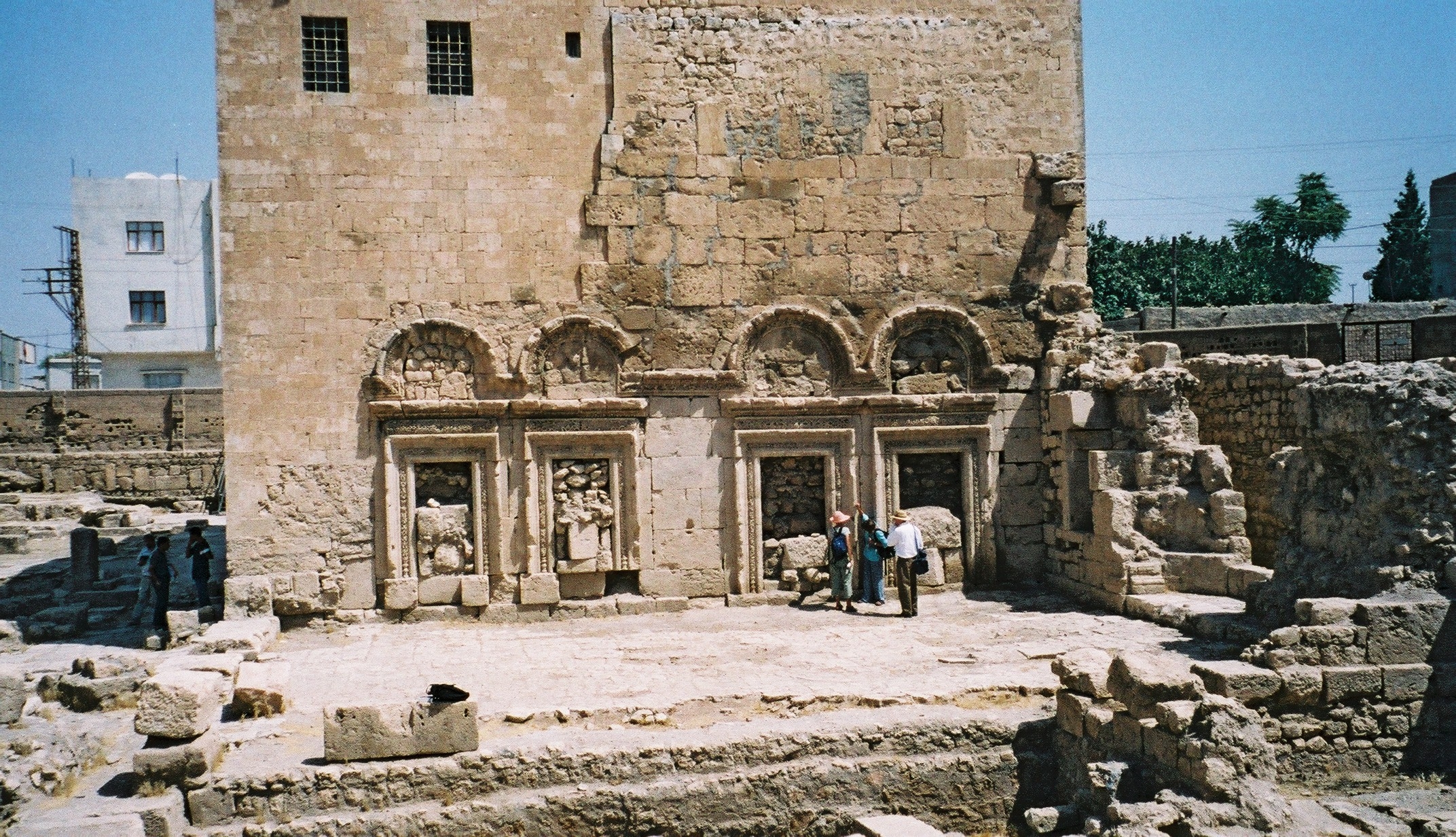
 La chiesa di San Giacobbe di Nisibi, primo vescovato dove Efrem svolse il suo ministero
Il battistero di Nisibi, ancora visibile oggi, porta la data del 359: edificato sotto il vescovo Vologese, resta una viva testimonianza di quella comunità. In quell'anno Sapore II ricominciò a devastare la regione. Le città dei dintorni vennero una dopo l’altra distrutte e i loro abitanti uccisi o espulsi. La lotta di potere tra Costanzo II e Giuliano indebolì il fianco orientale. Alla morte del primo, Giuliano intraprese una campagna marciando con i suoi eserciti verso la Mesopotamia, portando con sé persecuzioni contro le giovani chiese cristiane della regione.[citazione necessaria] Durante la campagna arrivò sino a Ctesifonte, ma, costretto alla ritirata, perse la vita e al suo posto venne nominato imperatore Gioviano, cristiano niceano. Egli fu costretto a concordare un armistizio con Sapore, per il quale Nisibi venne ceduta alla Persia con la clausola che la comunità cristiana potesse lasciare la città. Sotto il vescovo Abramo, successore di Vologese, la comunità partì in esilio.
Efrem dapprima si portò ad Amida, attuale Diyarbakir, e nel 363 si istallò definitivamente a Edessa, attuale Şanlıurfa. Efrem, allora sessantenne, si rimise al lavoro nella nuova comunità e sembra abbia continuato a insegnare, forse nella Scuola di Emessa. In questo nuovo ambiente operavano numerosi filosofi e religiosi rivali. Efrem ci informa che i cristiani di fede ortodossa venivano chiamati "palutiani", dal nome di un vescovo precedente. Vi si trovavano anche ariani, marcionisti, manichei, seguaci di Bardesane e gnostici. Tutti proclamantisi la "vera chiesa". Contro queste eresie Efrem compose numerosi inni: un autore siriaco tardivo, Jacob di Serugh, scrive come Efrem facesse cantare questi inni da cori di voci femminili su arie di musica popolare siriana. Rimase fino alla fine dei suoi giorni in questa città, morendo di peste il 9 giugno 373.
Informazioni biografiche non accertate
I dettagli aggiunti più tardi dagli agiografi siriani sono di dubbio valore ed è impossibile separare la verità storica dall'agiografia.
- Efrem si sarebbe recato in Egitto, permanendovi otto anni, periodo durante il quale egli avrebbe confutato pubblicamente alcuni portavoce dell’eretico Ario.
- Le relazioni fra sant’Efrem e san Basilio sono raccontate da autori che alcuni ritengono affidabili, come san Gregorio di Nissa e Sozomeno, secondo cui l’eremita di Edessa, attratto dalla grande reputazione di Basilio, decise di fargli visita a Cesarea. Fu accolto calorosamente e fu ordinato diacono da Basilio; quattro anni dopo egli rifiutò sia il sacerdozio, sia l’episcopato che Basilio gli offriva mediante delegati mandati a questo scopo ad Edessa. Sebbene sembri che Efrem conoscesse pochissimo il greco, questo incontro con Basilio non è improbabile; alcuni critici, comunque, ritengono la prova insufficiente e perciò la rifiutano.
Opere
Teologo e poeta
La tradizione lo presenta come un uomo austero. Non si trovano, nelle sue opere letterarie, accenni alle dispute teologiche contemporanee, caratterizzate dalle controversie trinitarie: questo probabilmente perché non conosceva la lingua greca. La piena ortodossia cristiana di Efrem si rivela attraverso il suo metodo di divulgazione preferito: la poesia. A questo riguardo, è stato definito "la cetra (o l'arpa) dello Spirito Santo".
Nella sua epoca si andava organizzando il canto religioso cosiddetto "alternato" nelle chiese, del quale gli iniziatori sono stati Ambrogio a Milano e Diodoro ad Antiochia. Efrem compose nella lingua nativa poesie di contenuto didattico o esortativo, con un forte lirismo e particolarmente idonee al canto collettivo. La grande diffusione di questi canti (dalla Siria raggiunsero l'Oriente mediterraneo, grazie anche a precise ed accurate traduzioni in greco) fu favorito soprattutto dal carattere popolare delle sue poesie. Efrem si serviva della poesia come di un eccellente mezzo pastorale perfino nelle omelie e nei sermoni, dove risaltava la sua profonda conoscenza della Sacra Scrittura.
Dedicò 20 inni alla Madonna, della quale era molto devoto.
Efrem viene accusato di essere uno dei pensatori cristiani maggiormente antisemiti e uno dei più responsabili della diffusione dell'antisemitismo. A titolo di esempio si possono citare il suo accenno al "tanfo degli Ebrei puzzolenti" e l'invettiva "O infelice fuggi da lui [il popolo ebraico]; per lui non hanno valore la tua morte e il tuo sangue! Si è macchiato del sangue del Signore, esiterà a macchiarsi del tuo? ... hanno crocefisso Dio ... hanno sacrificato i profeti come agnelli innocenti. Medici sono venuti per curarli, ma anche di questi hanno fatto carne da macello. Fuggi e salvati da questo popolo indemoniato, cerca rifugio in Cristo! ... [il figlio di Dio] è venuto tra i discendenti di Abramo ma essi lo hanno ucciso". Ma in verità si tratta di espressioni che si colgono nel più genuino spirito antigiudaico, comune a molti santi e dottori della Chiesa, cui è estranea la visione razzista dell'antisemitismo, nato in epoca moderna.
Testi e versioni dei suoi scritti
Il siriaco originale degli scritti di Efrem è mantenuto in molti manoscritti, uno dei quali risale al V secolo. Attraverso molte trascrizioni, comunque, i suoi scritti, in particolare quelli usati nelle varie liturgie, hanno subito non poche interpolazioni. Inoltre molte delle sue opere esegetiche si sono deteriorate, o almeno non si trovano più nelle biblioteche dell’Oriente.
Numerose versioni, comunque, compensano la perdita degli originali. Efrem viveva ancora, o almeno era morto da poco, quando fu cominciata la traduzione delle sue opere in greco. Gli scrittori armeni sembrano aver intrapreso la traduzione dei suoi commentari biblici. I Mechitaristi hanno pubblicato in parte questi commentari e ritengono la versione armena molto antica (V secolo). I Monofisiti, è ben noto, erano abituati tradurre o adattare le opere siriache. Gli scritti di Efrem furono infine tradotte in arabo ed etiopico (traduzioni fino ad oggi non pubblicate). Nel medioevo alcune delle sue opere minori furono tradotte dal greco in lingua slava e latina. Alla fine da queste versioni furono fatti adattamenti degli scritti ascetici di Efrem in francese, tedesco, italiano ed inglese.
La prima edizione stampata (in latino) si basava su una traduzione dal greco fatta da Ambrogio Traversari e pubblicata dalla stamperia di Bartolomeo Guldenbeek di Sultz, nel 1475. Un’edizione molto migliore fu eseguita da Gerardo Vossius (m. 1619), il dotto prevosto di Tongres, per richiesta di Gregorio XIII. Nel 1709 Edoardo Thwaites pubblicò, dai manoscritti della Biblioteca Boldeiana, il testo greco, fino a quel momento conosciuto solo per frammenti. L’originale siriano rimase sconosciuto in Europa fino al fruttuoso viaggio in oriente (1706-1717) dei maroniti Gabriele Eva, Elia, e in particolare Giuseppe Simeone Assemani, che si concluse con la scoperta di una preziosa raccolta di manoscritti nel monastero nitriano (Egitto) di Nostra Signora. Questi manoscritti trovarono subito la loro collocazione nella Biblioteca Vaticana. Nella prima metà del XIX secolo il British Museum fu notevolmente arricchito da simili fortunate scoperte di Lord Prudhol (1828), Curzon (1832) e Tattam (1839, 1841). Tutte le edizioni recenti degli scritti siriani originali di Efrem sono basate su questi manoscritti. Nella Biblioteca nazionale di Parigi e Bodleiana (Oxford) ci sono alcuni frammenti siriani di minore importanza. Giuseppe Simeone Assemani si affrettò a fare il miglior uso possibile dei suoi nuovi manoscritti e propose subito a Clemente XII un’edizione completa delle opere di Efrem nell’originale siriano e nella versione greca, con una nuova versione latina dell’intero materiale. Da parte sua egli prese l’edizione del testo greco. Il testo siriano fu affidato al gesuita Pietro Mobarak (Benedetto), in quanto maronita. Dopo la morte di Mobarak, i suoi lavori furono continuati da Stefano Evodio Assemani. Alla fine questa monumentale edizione dell’opera di Efrem fu pubblicata a Roma (1732-1746) in sei volumi in folio. Fu completata dai lavori di Overbeck (Oxford, 1865) e Bickell (Carmina nisibena, 1866), mentre altri studiosi pubblicarono frammenti ritrovati (Zingerle, P. Martin, Rubens Duval). Una edizione (Mechlin, 1882-1902) degli inni e sermoni di S. Efrem si deve a monsignor T. J. Lamy.
Comunque, un’edizione completa della vasta opera di Efrem deve essere ancora prodotta.
Opere esegetiche
Efrem scrisse commentari sull'intera Bibbia, sia l’Antico che il Nuovo Testamento, ma molte delle sue opere sono andate perdute. Esiste ancora in siriaco il suo commentario sulla Genesi e un’ampia parte dell’Esodo: per gli altri libri dell’Antico Testamento abbiamo una sintesi siriana, tramandata dal monaco siriano Severo (851). I commentari su Rut, Esdra, Neemia, Ester, i Salmi, i Proverbi, il Cantico dei cantici e l’Ecclesiaste sono perduti. Il canone scritturale di Efrem somiglia moltissimo al nostro. Sembra incerto che egli accettasse gli scritti deuterocanonici; almeno nessuno di questi commentari è arrivato fino a noi. D’altra parte accettava come canonica l’apocrifa Terza epistola ai Corinti, e scrisse un commentario su di essa. Il testo scritturale usato da Efrem è il siriano Peshito, lievemente differente, comunque, dal testo stampato di quella antichissima versione. Il Nuovo testamento era noto a lui ed a tutti i siriani, sia orientali che occidentali, prima del tempo di Rabulas, nel Diatessaron armonizzato di Taziano. Il suo testo degli Atti degli Apostoli sembra essere stato strettamente collegato a quello chiamato "Occidentale".
L’esegesi di Efrem è quella degli scrittori siriani in generale, sia ellenizzati che non, ed è strettamente collegato a quella di Afraate, essendo, come l’ultimo, abbastanza rispettosa della tradizione ebraica e spesso basata su di essa. Come esegeta Efrem è sobrio, mostra una preferenza per il senso letterale, è discreto nell’uso dell’allegoria; in poche parole, inclina fortemente alla Scuola Antiochena, e ci richiama in particolare Teodoreto di Ciro. Egli ammette nella Scrittura solo pochi passaggi messianici nel senso letterale, molti di più, comunque, profetici di Cristo nel senso tipologico, che deve essere attentamente distinto dal senso allegorico. Non è improbabile che la maggior parte dei suoi commentari fosse scritta per la scuola cristiana persiana (Schola Persarum) di Nisibis, della quale fu uno dei fondatori e anche uno dei più distinti professori.
Opere poetiche
La maggior parte dei sermoni e delle esortazioni sono in versi, sebbene si siano conservati alcuni sermoni in prosa. Tolti i suoi scritti esegetici, il resto delle sue opere si può dividere in omelie ed inni. Le omelie (in siriano memrê, cioè discorsi) sono scritte in settenari, spesso divisi in due parti di tre e quattro sillabe rispettivamente. Egli vi celebra la festa di "Nostro Signore e dei santi"; a volte interpreta un racconto scritturale o tratta un tema spirituale o edificante. In Oriente le Lezioni per i servizi ecclesiastici erano spesso tratte dalle omelie di Efrem. Gli inni (in siriano madrashê, cioè istruzioni) offrono una grande varietà sia di stile che di ritmo. Erano scritti per il servizio corale delle suore, ed erano destinati ad essere da loro cantati; da qui la divisione in strofe, poiché gli ultimi versi di ogni strofa venivano ripetuti in una sorta di ritornello. Questo ritornello è indicato all’inizio di ogni inno, alla stregua di un’antifona; c’è anche un’indicazione della chiave musicale in cui l’inno deve essere cantato. Il seguente può servire come esempio. È preso da un inno per l’Epifania (ed. Lamy, I, p. 4).
Aria: Guarda il mese.
Ritornello: Gloria a Te dal tuo gregge nel giorno della tua manifestazione.
Strofa:
Egli ha rinnovato i cieli, perché i pazzi avevano adorato tutte le stelle
Egli ha rinnovato la terra che aveva perduto il suo vigore a causa di Adamo
Una nuova creazione è stata fatta dalla sua saliva
ed Egli che è l’Onnipotente ha fatto retti sia il corpo che la mente.
Monsignor Lamyu, editore degli inni, notò settantacinque differenti ritmi ed arie. Alcuni inni sono acrostici, cioè, a volte, ogni strofa comincia con una lettera dell’alfabeto, come nel caso di parecchi pezzi metrici della Bibbia (ebraici), o, ancora la prima lettera di un numero di versi o strofe forma una data parola. In quest’ultimo modo Efrem firmò parecchi dei suoi inni. Egli non è, tuttavia, l’inventore della poesia siriana, questo onore sembra appartenere al sopracitato eretico Gardesano di Edessa. Lo stesso Efrem ci dice che nelle vicinanze di Nisibis ed Edessa le poesie di questo gnostico e di suo figlio Harmonius contribuirono efficacemente al successo dei loro falsi insegnamenti. In effetti, se Efrem entrò nello stesso campo, fu con la speranza di sconfiggere l’eresia con le stesse armi perfezionate da lui stesso. Il lettore occidentale degli inni di Efrem è portato a meravigliarsi per l’entusiasmo dei suoi ammiratori dell’antica chiesa siriana. Il suo lirismo non è affatto quello che noi intendiamo con questo termine. La sua poesia può sembrare prolissa, noiosa, incolore, mancante di note personali, ed in generale priva di fascino. Per essere giusti, tuttavia, bisogna ricordare che le sue poesie sono conosciute dalla maggior parte dei lettori solo in traduzioni, da cui, ovviamente, il ritmo originale è scomparso ed in particolare il fascino e la maggior parte degli aspetti della sua poesia che potrebbero colpire di più. Questi inni, inoltre, non erano scritti per la lettura privata, ma si prevedeva che fossero cantati da cori alternati. Vale il paragone fra i salmi latini come vengono cantati dal coro di un monastero benedettino e la loro lettura privata da parte di un sacerdote che recita il Breviario.
Il culto
Durante la sua vita, Efrem fu molto influente fra i cristiani siriani di Edessa; la sua memoria fu venerata da ortodossi, monofisiti e nestoriani, che lo chiamavano sole dei siriani, colonna della chiesa, arpa dello Spirito Santo. Ancora più straordinario è l’omaggio che gli tributarono i greci, che ben raramente menzionavano scrittori siriani. Fra le opere di Gregorio di Nissa (P. G. XLVI, 819) c’è un sermone (benché non riconosciuto da alcuni) che è un vero e proprio panegirico di sant’Efrem. Vent'anni dopo la morte di quest’ultimo, san Gerolamo lo menziona come segue nel suo catalogo di cristiani illustri:
«Efrem, Diacono della chiesa di Edessa, scrisse molte opere [opuscola] in siriano, e diventò così famoso che i suoi scritti sono letti pubblicamente in alcune chiese dopo le Sacre Scritture. Io ho letto in greco un suo volume sullo Spirito Santo; sebbene fosse solo una traduzione, vi ho riconosciuto il genio sublime dell’uomo» (De viris illustr., c. cxv)
Anche Teodoreto di Cirro elogiava il suo genio poetico e la sua conoscenza teologica (Hist. Eccl., IV, xxvi). Sozomeno pretende che Efrem abbia scritto 3.000.000 versi e dà il nome di alcuni dei suoi discepoli, alcuni dei quali rimasero ortodossi, mentre altri caddero nell’eresia (Hist. Eccl., III, xvi). Dalle chiese siriana e bizantina la fama di sant’Efrem si allargò fra tutti i cristiani. Il Martirologio romano lo menziona l’1 febbraio. Nei loro menologi e sinassi, greci e russi, giacobiti, caldei, copti e armeni onorano il santo diacono di Edessa.
Benedetto XV lo dichiarò dottore della Chiesa cattolica nel 1920.
Preghiere celebri
Preghiera di sant'Efrem
La preghiera seguente è recitata dalla chiesa ortodossa ogni giorno della Quaresima, ed è inframezzata da metanie (prostrazioni):
Signore e Sovrano della mia vita, non darmi uno spirito di ozio, di curiosità, di superbia e di loquacità
si esegue una profonda metaniaConcedi invece al tuo servo uno spirito di saggezza, di umiltà, di pazienza e di amore
si esegue una profonda metaniaSì, Signore e Sovrano, dammi di vedere le mie colpe e di non giudicare il mio fratello; poiché tu sei benedetto nei secoli dei secoli. Amen
si eseguono 12 piccole metanie, dicendo per ciascuna: O Dio, sii propizio a me peccatore e abbi pietà di meSì, Signore e Sovrano, dammi di vedere le mie colpe e di non giudicare il mio fratello; poiché tu sei benedetto nei secoli dei secoli. Amen
si esegue una profonda metania
Preghiera per gli anziani
Questa è una delle più celebri preghiere, incentrata sull'anzianità:
Signore Gesù Cristo,
che hai potere sulla vita e sulla morte,
tu conosci ciò che è segreto e nascosto,
i pensieri e i sentimenti non ti sono velati.
Guarisci i miei raggiri e il male fatto nella mia vita.
Ecco, la mia vita declina di giorno in giorno,
ma i miei peccati crescono.
Signore, Dio delle anime e dei corpi,
tu conosci l'estrema fragilità della mia anima e del mio corpo,
concedimi forza nella mia debolezza,
sostienimi nella mia miseria.
Dammi un animo grato:
che mi ricordi sempre dei tuoi benefici,
non ricordare i miei numerosi peccati,
perdona tutti i miei tradimenti.
Signore, non disdegnare questa preghiera,
la preghiera di questo misero.
Conservami la tua grazia fino alla fine,
custodiscimi come per il passato. Amen.
Efrem il Greco
Le sottili meditazioni di Efrem sui simboli della fede cristiana e la sua posizione contro le eresie, hanno fatto delle sue opere una fonte popolare d’ispirazione nelle varie Chiese. Si svilupparono molte agiografie, in buona parte leggendarie. Alcune di esse sono composte in versi che riprendono i suoi distici. Molte sono scritte in greco tardivo. I ricercatori spesso le fanno risalire a un solo compositore che chiamano Ephraem Graecus per distinguerle da quelle composte dal vero Efrem. Questo non vuol dire che tutto quello che ci è pervenuto in lingua greca e attribuito a Efrem sia falso, ma molti di questi scritti certamente lo sono. Ci sono stati pochi studi critici su questi documenti e molti di essi sono ancora venerati e utilizzati dalla chiesa orientale che li considera autentici.
Bibliografia
Introduzioni generali
- F. RILLIET, art., Efrem Siro, in A. DI BERARDINO (ed.), Dizionario patristico di antichità cristiane. I (A-F), Marietti, Casale Monferrato (AL) 1983, coll. 1103-1107 (Institutum Patristicum Augustinianum).
- A. DI BERARDINO (ed.), Patrologia. V. Dal Concilio di Calcedonia (451) a Giovanni Damasceno (+750). I Padri Orientali, Marietti, Genova 2000, pp. 445-448 (Institutum Patristicum Augustinianum).
Opere
a) Collana « Sources Chrétiennes » (in francese)
- ÉPHREM DE NISIBE, Commentaire de l’évangile concordant ou Diatessaron, introduction, traduction et notes par L. Leloir, Cerf, Paris 1966 (Sources Chrétiennes 121).
- ÉPHREM DE NISIBE, Hymnes sur le Paradis, traduction par R. Lavenant, introduction et notes par F. Graffin, Cerf, Paris 1968 (Sources Chrétiennes 137).
- ÉPHREM DE NISIBE, Hymnes sur la nativité, introduction par F. Graffin, traduction et notes par F. Cassingena–Trévedy, Cerf, Paris 2001 (Sources Chrétiennes 459).
- ÉPHREM DE NISIBE, Hymnes Pascales, introduction, traduction et notes par F. Cassingena–Trévedy, Cerf, Paris 2006 (Sources Chrétiennes 502).
b) Collana « Corpus Scriptorum Christianorum Orientalium » (in originale e in tedesco, tranne il primo titolo che è in traduzione latina)
- SAINT’ÉPHRAEM, Commentaire de l’Évangile concordant. Version ármenienne, traduite en latin par L. Leloir, Sécretariat du CorpusSCO, Louvain 1964 (Corpus Scriptorum Christianorum Orientalium 145).
- DES HEILIGEN EPHRAEM DES SYRERS, Hymnen contra Haereses, Herausgegeben und Übersetzt von E. Beck, Sécretariat du CorpusSCO, Louvain 1957 (Corpus Scriptorum Christianorum Orientalium 169-170) .
- DES HEILIGEN EPHRAEM DES SYRERS, Hymnen de Paradiso und contra Julianum, Herausgegeben und Übersetzt von E. Beck, Sécretariat du CorpusSCO, Louvain 1957 (Corpus Scriptorum Christianorum Orientalium 174-175).
- DES HEILIGEN EPHRAEM DES SYRERS, Hymnen de Nativitate (Épiphania), Herausgegeben und Übersetzt von E. Beck, Sécretariat du CorpusSCO, Louvain 1959 (Corpus Scriptorum Christianorum Orientalium 186-187).
- DES HEILIGEN EPHRAEM DES SYRERS, Hymnen de Ecclesia, Herausgegeben und Übersetzt von E. Beck, Sécretariat du CorpusSCO, Louvain 1960 (Corpus Scriptorum Christianorum Orientalium 198-199).
- DES HEILIGEN EPHRAEM DES SYRERS, Sermones de Fide, Herausgegeben und Übersetzt von E. Beck, Sécretariat du CorpusSCO, Louvain 1961 (Corpus Scriptorum Christianorum Orientalium 212-213).
- DES HEILIGEN EPHRAEM DES SYRERS, Carmina Nisibena. I, Herausgegeben und Übersetzt von E. Beck Sécretariat du CorpusSCO, Louvain 1961 (Corpus Scriptorum Christianorum Orientalium 218-219).
- DES HEILIGEN EPHRAEM DES SYRERS, Hymnen de Verginitate, Herausgegeben und Übersetzt von E. Beck, Sécretariat du CorpusSCO, Louvain 1962 (Corpus Scriptorum Christianorum Orientalium 223-224).
- DES HEILIGEN EPHRAEM DES SYRERS, Carmina Nisibena. II, Herausgegeben und Übersetzt von E. Beck, Sécretariat du CorpusSCO, Louvain 1963 (Corpus Scriptorum Christianorum Orientalium 240-241).
- DES HEILIGEN EPHRAEM DES SYRERS, Hymnen de Ieiunio, Herausgegeben und Übersetzt von E. Beck, Sécretariat du CorpusSCO, Louvain 1964 (Corpus Scriptorum Christianorum Orientalium 246-247).
- DES HEILIGEN EPHRAEM DES SYRERS, Paschahymnen (de azimis, de crucifixione, de resurrectione), Herausgegeben und Übersetzt von E. Beck, Sécretariat du CorpusSCO, Louvain 1964 (Corpus Scriptorum Christianorum Orientalium 248-249).
- DES HEILIGEN EPHRAEM DES SYRERS, Hymnen de Fide, Herausgegeben und Übersetzt von E. Beck, Sécretariat du CorpusSCO, Louvain 1965 (Texte) 1967 (Version) (Corpus Scriptorum Christianorum Orientalium 154-155).
- DES HEILIGEN EPHRAEM DES SYRERS, Sermo de Domino Nostro, Herausgegeben und Übersetzt von E. Beck, Sécretariat du CorpusSCO, Louvain 1966 (Corpus Scriptorum Christianorum Orientalium 269-270).
- DES HEILIGEN EPHRAEM DES SYRERS, Sermones. I, Herausgegeben und Übersetzt von E. Beck Sécretariat du CorpusSCO, Louvain 1970 (Corpus Scriptorum Christianorum Orientalium 305-306).
- DES HEILIGEN EPHRAEM DES SYRERS, Sermones. II, Herausgegeben und Übersetzt von E. Beck, Sécretariat du CorpusSCO, Louvain 1970 (Corpus Scriptorum Christianorum Orientalium 311-312).
- DES HEILIGEN EPHRAEM DES SYRERS, Sermones. III, Herausgegeben und Übersetzt von E. Beck, Sécretariat du CorpusSCO, Louvain 1972 (Corpus Scriptorum Christianorum Orientalium 320-321).
- DES HEILIGEN EPHRAEM DES SYRERS, Hymnen auf Abraham Kydunaya und Julianos Saba, Herausgegeben und Übersetzt von E. Beck, Sécretariat du CorpusSCO, Louvain 1972 (Corpus Scriptorum Christianorum Orientalium 322-323).
- DES HEILIGEN EPHRAEM DES SYRERS, Sermones. IV, Herausgegeben und Übersetzt von E. Beck, Sécretariat du CorpusSCO, Louvain 1973 (Corpus Scriptorum Christianorum Orientalium 334-335)
- EPHRAEM SYRUS, Nachträge, Herausgegeben und Übersetzt von E. Beck, Sécretariat du CorpusSCO, Louvain 1975 (Corpus Scriptorum Christianorum Orientalium 363-364).
- EPHRAEM SYRUS, Sermones in Hebdomadam Sanctam, Herausgegeben und Übersetzt von E. Beck, Sécretariat du CorpusSCO, Louvain 1979 (Corpus Scriptorum Christianorum Orientalium 412-413).
c) Traduzioni italiane
- EFREM IL SIRO, Le arpe del Signore. Inni sulla verginità 27-30, introduzione, traduzione e note a cura di E. Vergani, Qiqajon, Magnano (BI) 1996 (Testi dei padri della chiesa 24).
- EFREM IL SIRO, L’arpa dello Spirito. 19 poemi di Sant’Efrem, a cura di S. Brock, Lipa, Roma 1999 (Pubblicazioni del Centro Aletti 22).
- EFREM IL SIRO, Inni pasquali. Sugli azzimi, sulla crocifissione, sulla resurrezione, introduzione, traduzione e note a cura di I. De Francesco, Paoline, Cinisello Balsamo (MI) 2001 (Letture cristiane del I millennio 31).
- EFREM IL SIRO, La gioia della mensa, introduzione, traduzione e note a cura di I. De Francesco, Qiqajon, Magnano (BI) 2002 (Testi dei padri della chiesa 57).
- EFREM IL SIRO, Inni sulla natività e sull’Epifania, introduzione, traduzione e note a cura di I. De Francesco, Paoline, Cinisello Balsamo (MI) 2003 Paoline, (Letture cristiane del I millennio 35).
- EFREM IL SIRO, Il dono della perla, introduzione, traduzione e note a cura di E. Vergani, Qiqajon, Magnano (BI) 2005 (Testi dei padri della chiesa 78).
- EFREM IL SIRO, Inni sul Paradiso, introduzione, traduzione e note di I. De Francesco, Paoline, Cinisello Balsamo (MI) 2006 (Letture cristiane del I millennio 39).
- EFREM IL SIRO, Giona. Inni sulla verginità 42-50, introduzione, traduzione e note a cura di D. Cerbelaud, Qiqajon, Magnano (BI) 2007 (Testi dei padri della chiesa 90).
Letteratura secondaria
a) Volumi
- G. RICCIOTTI, Sant’Efrem Siro. Biografia – Scritti – Teologia, Marietti, Torino-Roma 1925.
- E. PERNIOLA, Sant’Efrem Siro. Dottore della Chiesa e cantore di Maria, Partecipare, Santeramo in Colle (BA) 1989.
- S. BROCK, L’occhio luminoso. La visione spirituale di Sant’Efrem, Lipa, Roma 1999.
b) Articoli e altri scritti
- BENEDETTO XV, Principi Apolostolorum Petro, in «Acta Apostolicae Sedis» 12 (1920), pp. 457-471.
- REDAZIONE DE «LA CIVILTÀ CATTOLICA» (ed.), Il nuovo appello all’Oriente nella proclamazione di Sant’Efrem a dottore della chiesa universale, in «Civiltà Cattolica» 71 (1920), n. 4, pp. 299-307.
- REDAZIONE DE «LA CIVILTÀ CATTOLICA» (ed.), S. Efrem dottore e poeta, in «Civiltà Cattolica» 73 (1922), n. 2, pp. 494-510.
- A. DE HALLEUX, Saint Éphrem le Syrien, in «Revue Théologique de Louvain» 14 (1983), pp. 328-355.
- O. CLÉMENT, Tre preghiere. Il Padre Nostro, la preghiera allo Spirito Santo, la preghiera penitenziale di Sant’Efrem, Jaca Book, Milano 1995, pp. 73-89.
- BENEDETTO XVI, Le molteplici forme culturali dell’unica fede cristiana, in «L’Osservatore Romano» 147 (2007) del 29 novembre 2007, p. 1 (udienza generale dedicata alla figura di Sant’Efrem del 28 novembre 2007).
Fonti
- Catholic Encyclopedia del 1917, oggi di pubblico dominio
- Bouvy, Le fonti storiche della vita di S. Efrem, Rivista agostiniana, 1903, 155-61
- J. R. Harris, Fragments of the Commentary of Ephrem Syrus upon the Diatessaron, Londra, 1905
- J. H. Hill, A Dissertation on the Gospel Commentary of St. Ephraem the Syrian, Edinburgo, 1896
- F. C. Burkitt, 'St Ephraim's Quotations from the Gospel, Corrected and Arranged, in "Texts and Studies", Cambridge, 1901, VII, 2.
Fonte: wikipedia
-
18-06-08, 08:20 #5**********
- Data Registrazione
- 04 Jun 2003
- Messaggi
- 23,775
-
- 18
-
- 35
- Mentioned
- 2 Post(s)
- Tagged
- 0 Thread(s)
Purtroppo non esiste una versione italiana
BENEDICT XV
PRINCIPI APOSTOLORUM PETRO
ENCYCLICAL ON ST. EPHREM THE SYRIAN
TO THE PATRIARCHS, PRIMATES, ARCHBISHOPS,
BISHOPS, AND OTHER ORDINARIES
IN PEACE AND COMMUNION WITH THE APOSTOLIC SEE.
Venerable Brothers,
Greetings and The Apostolic Benediction.
1. To Peter the Prince of the Apostles, the divine Founder of the Church allotted the gifts of inerrancy [1] in matters of faith and of union with God. This relationship is similar to that of a "Choir Director of the Choir of the Apostles."[2] He is the common teacher and rector [3] of all, so that he might feed the flock of Him who established His Church [4] on the authority of Peter himself and his successors. And on this mystical rock the foundation [6] of the entire ecclesiastical structure stands firm as on a hinge. From it rises the unity of Christian charity as well as our Christian faith.
2. Indeed the unique gift of Peter's primacy is that he might spread everywhere and preserve the riches of charity and faith, as Ignatius Theophorus, a man of Apostolic times, beautifully declared. For in those noble letters he wrote to the Roman Church on his journey, announcing his arrival in Rome to be martyred for Christ, he gave testimony to the primacy of that Church over all others by calling it 'presiding officer over the universal community of charity."[7] This was to signify not only that the Universal Church was the visible image of divine charity, but also that Blessed Peter, together with his primacy and his love for Christ (affirmed by his triple confession), remains heir of the Roman See. Accordingly the souls of all the faithful should be ignited by the same fire.
3. The ancient Fathers, especially those who held the more illustrious chairs of the East, since they accepted these privileges as proper to the pontifical authority, took refuge in the Apostolic See whenever heresy or internal strife troubled them. For it alone promised safety in extreme crises. Basil the Great [8] did so, as did the renowned defender of the Nicene Creed, Athanasius,[9] as well as John Chrysostom.[10] For these inspired Fathers of the orthodox faith appealed from the councils of bishops to the supreme judgement of the Roman Pontiffs according to the prescriptions [11] of the ecclesiastical Canons. Who can say that they were wanting in conformity to the command which they had from Christ? Indeed, lest they should prove faithless in their duty, some went fearlessly into exile, as did Librius and Silverius and Martinus. Others pleaded vigorously for the cause of the orthodox faith and for its defenders who had appealed to the Pope, or to vindicate the memory of those who had died. Innocent I [12] is an example. He commanded the bishops of the East to insert the name of St. John Chrysostom in the liturgical list of the orthodox Fathers to be mentioned at mass.
4. However We, who embrace the Eastern Church with no less solicitude and charity than our predecessors, truly rejoice, now that the frightful war is ended. We rejoice that many in the Eastern community have achieved liberty and wrested their holy things from the control of the laity. They are now striving to set the nation in order, consistent with the character of its people and the established customs of their ancestors. We propose, appropriately, a splendid example of sanctity, learning, and paternal love for them to diligently imitate and nurture. We speak of St. Ephrem the Syrian, whom Gregory of Nyssa compared to the River Euphrates because he "irrigated by his waters the Christian community to bring forth fruits of faith a hundred-fold."[13] We speak of Ephrem, whom all the inspired orthodox Fathers and Doctors, including Basil, Chrysostom, Jerome, Francis of Sales, and Alphonsus Liguori, praise. We are pleased to join these heralds of truth, who though separated from each other in talent, in time and place, nevertheless perfect a harmony modulated by "one and the same spirit."
5. This letter follows so shortly after Our Encyclical marking the fifteenth centenary of the birth of St. Jerome because these two illustrious men have much in common. They are almost contemporary, both were monks, both lived in Syria, and both were outstanding for their study and knowledge of the Scriptures. You may rightly compare them to "two shining lights,"[14] one illuminating the West, the other the East. Their writings, being of the same spirit, are equally valuable. Both the Latin and the Eastern Fathers have agreed with those two and praise them similarly.
6. The birthplace of Blessed Ephrem could have been Nisibi or Edessa. What is certain is that he was connected by blood with the martyrs of the last persecution.[15] His parents brought him up as a Christian. If they did not have the comforts of a wealthy life, they had the far greater and more splendid distinction that "they had professed Christ in judgment."[16] In his youth Ephrem, as he bewails in his little book of confessions, was languid and remiss in resisting the temptations by which that age is usually troubled. He was hot tempered, easily angered, quarrelsome, and unrestrained in mind and language. But while in prison on a false charge, he began to despise human things and the empty joys of this world. Therefore, as soon as he was exonerated, Ephrem at once put on the habit of a monk and ever after devoted himself completely to the exercises of piety and to the study of the Sacred Scriptures. James, the bishop of Nisibi, one of the three hundred eighteen Fathers of the Nicene Council, who had established a renowned school of exegesis in the episcopal city, became his patron. He not only fulfilled James' expectations with his diligent and sharp-witted commentaries on the Bible, but even surpassed them. As a result, he soon became the greatest of all commentators of that school, earning the title Doctor of the Syrians. Soon he had to interrupt his study of Sacred Literature because Persian troops threatened the city. He urged on the citizens in their vigorous resistance to the Persians. With the aid of the prayers of James the bishop, they were defeated; however, after his death, the Persians again besieged the city. This time, in 363, it did fall. Because Ephrem preferred exile to serving infidels, he migrated to Edessa. There he diligently exercised the duties of an ecclesiastical doctor.
7. The house on a suburban hill where he lived soon resembled an illustrious academy with a great concourse of men eager to study the divine books. To it came learned interpreters and students of Scripture, including Zenobius, Maraba, and St. Isaac of Amidea, who acquired the title Great [17] because of the profusion and importance of his writings. Because of his learning and holiness, Ephrem's fame spread from that retreat. Thus when he traveled to Caesarea to see Basil the Great, Basil, learning of his approach by divine revelation, received him reverently and spoke with him about divine concerns.[18] According to report, it was at this time that Basil consecrated Ephrem deacon.[19]
8. Ephrem never left his solitude in Edessa except on fixed days to preach. In his preaching, he defended the dogmas of faith from swelling heresies. If, conscious of his lowliness, he did not dare to rise to the priesthood, he nevertheless showed himself a most perfect imitator of St. Stephen in the lower rank of the diaconate. He devoted all of his time to teaching Scripture, to preaching, and to instructing the nuns in sacred psalmody. Daily he wrote commentaries on the Bible to illustrate the orthodox faith; he came to the aid of his fellow citizens, especially the poor and the stricken. What he sought to teach others, he first did absolutely and perfectly. In this way, he could serve as the example which Ignatius Theophorus proposes to the deacons when he calls them "charges of Christ"[20] and asserts that they express "the mystery of faith in a pure conscience."[21]
9. How great and how active was the charity he showed his brethren in a time of famine, even though by then he was worn out by age and labor! He left the house where for so many years he had lived a heavenly rather than a human life and ran to Edessa. By that eloquence which Gregory of Nyssa characterized "as a key fashioned by divinity,"[22] to open the minds and the coffers of the wealthy, he castigated those who were hoarding grain and vehemently demanded that they feed the poor from their surplus. And they were touched not so much by the hunger of the citizens, as by the sincerity of Ephrem. With the money he begged, he himself provided beds for those tortured by starvation and spread them in the porticos of Edessa. There he nursed the sick and met the pilgrims who came to the city from round about looking for bread.[23] Truly this man was placed there by divine providence to aid his country! And he did not return to solitude until the next harvest provided abundance.
10. The testament he left for his fellow citizens - memorable for its faith, humility, and singular patriotism - reads as follows. "I, Ephrem, am dying. With fear, but also with reverence, I entreat you, citizens of Edessa, not to bury me under the altar or elsewhere in the house of God. It is not fitting that a worm teeming with corruption be buried in the temple and sanctuary of God. But lay me out in the tunic and mantle which I used and wore daily. Accompany me with psalms and prayers. I had neither pouch nor staff, neither wallet nor silver and gold; nor did I ever acquire or possess anything else earthly. Work diligently at my precepts and doctrines; as my disciples, do not fall away from the Catholic faith. With regard to the faith, be especially constant. Guard against adversaries - I mean evildoers, boasters, and tempters to sin. And may your city be blessed; for Edessa is the city and mother of the wise." And so Ephrem died, but his memory lives on, to the blessing of the Church Universal. Therefore when his name began to be mentioned in the sacred liturgy, Gregory of Nyssa could say: "The splendor of his doctrine and life illumined all the earth, for he is known in almost every place where the sun shines."
11. There is no reason to list his many writings. "He is said to have written three thousand myriad poems if one counts them all together."[24] His writings cover almost all ecclesiastical doctrines. There are extant commentaries on Sacred Scripture and the mysteries of the faith; sermons on obligations and on the interior life; studies on the sacred liturgy; hymns for the feastdays of our Lord and of the Blessed Virgin and of the saints, for the processions of prayers and penitential days, for the funerals of the departed. In all of these, his purity of soul shines forth as a "burning and shining"[25] evangelical lamp. By illustrating the truth he makes us love and embrace it. Indeed when Jerome testifies about the writings of Ephrem in his day, he tells us that they were read in public liturgical assemblies along with the works of the orthodox Fathers and Doctors. He also affirms that he recognized "the sublimity of Ephrem's genius even in the translations" of these same works from the Syrian into Greek.[26]
12. It is indeed fitting to honor the blessed deacon of Edessa for his desire that the preaching of the divine word and the training of his disciples rest on the purity of Sacred Scripture. He also acquired honor as a Christian musician and poet. He was so accomplished in both arts that he was called the "lyre of the Holy Spirit." From this, Venerable Brothers, you can learn what arts promote the knowledge of sacred things. Ephrem lived among people whose nature was attracted by the sweetness of poetry and music. The heretics of the second century after Christ used these same allurements to skillfully disseminate their errors. Therefore Ephrem, like youthful David killing the giant Goliath with his own sword, opposed art with art and clothed Catholic doctrine in melody and rhythm. These he diligently taught to boys and girls, so that eventually all the people learned them. In this fashion he not only renewed the education of the faithful in Christian doctrine and supported their piety with the spirit of the sacred liturgy, but also happily kept creeping heresy at bay.
13. The artistry introduced by Blessed Ephrem added dignity to sacred matters as Theodoretus stresses.[27] The metric rhythm, which our saint popularized, was widely propagated both among the Greeks and the Latins. Indeed does it seem probable that the liturgical antiphonary with its songs and processions, introduced at Constantinople [28] in the works of Chrysostom and at Milan [29] by Ambrose (whence it spread throughout all of Italy), was the work of some other author? For the "custom of Eastern rhythm" deeply moved the catechumen Augustine in northern Italy; Gregory the Great improved it and we use it in a more advanced form. Critics acknowledge that that "same Eastern rhythm" had it origins in Ephrem's Syrian antiphonary.
14. It is no wonder then that many of the Fathers of the Church stress the authority of St. Ephrem. Nyssenus says of his writings, "Studying the Old and New Scriptures most thoroughly, he interpreted them accurately, word for word; and what was hidden and concealed, from the very creation of the world to the last book of grace, he illumined with commentaries, using the light of the Spirit."[30] And Chrysostom: "The great Ephrem [is] scourge of the slothful, consoler of the afflicted, educator, instructor and exhorter of youth, mirror of monks, leader of penitents, goad and sting of heretics, reservoir of virtues, and the home and lodging of the Holy Spirit."[31] Certainly nothing greater can be said in praise of a man who, however, seemed so small in his own eyes that he claimed to be the least of all and a most vile sinner."
15. Therefore, God, who has "exalted the humble," bestows great glory on blessed Ephrem and proposes him to this age as a doctor of heavenly wisdom and an example of the choicest virtues. And the appropriateness of his example is truly singular today. The frightful war is over and there is something of a new order for many nations, especially in the East. We, along with you and all good men, must endeavor to restore in Christ whatever remains of human and civil culture and to recall the erring society of men to God and to His Holy Church. Though our ancestors' institutions failed, public affairs are in tumult, and everything human is confused, the Catholic Church alone never vacilates, but instead looks confidently to the future. She alone is born for immortality, trusting in the words addressed to Blessed Peter: "Upon this rock I will build my Church and the gates of hell will not prevail against her."[32]
16. Would that other ecclesiastical teachers learn from him how skilfully, how diligently they must work in preaching the doctrine of Christ! And indeed the piety of the faithful has nothing stable and advantageous except to adhere entirely to the mysteries and precepts of the faith. Those who legitimately teach the Sacred Scriptures are warned by the example of the Edessine not to distort the Sacred Scriptures to the good pleasure of their own inclinations, nor, in investigating them, to depart a finger's breadth from the constant interpretation of the Church. "No prophecy of Scripture originates from private interpretation. For never by will of man was prophecy brought forth. But holy men of God spoke as they were moved by the Holy Spirit."[33] And that Spirit who has spoken to men by the prophets is the same one who for the Apostles "opened their minds that they might understand the Scriptures"[34] and the same who constituted his Church to announce, interpret, and preserve revelation, so that it might be "the pillar and mainstay of truth."[35]
17. Let honorable men, in the tradition of Ephrem - We mean the illustrious offspring of the monastic orders - preserve the dignity which arose with Anthony and Basil in the East. This was propagated later by offshoots in the West, and in many ways has been noteworthy for the Christian community. Therefore may these seekers of Evangelical perfection never cease to look up to and imitate the anchorite of Edessa. For a monk will profit the Church most when he exemplifies what his habit signifies to God and men, that is, according to a saying of the ancient Fathers of the East, he must be "a son of the covenant," and again "an Angel whose mission is mercy, peace, and the sacrifice of praise," as the blessed Nilus the Younger beautifully defines him.[36]
18. Finally, Venerable Brothers, all who are your subjects, both clergy and people, may learn this from Blessed Ephrem: the love of the fatherland, whose claims indeed rest on the profession of Christian wisdom itself, must not be separated from the love of the heavenly fatherland, nor be preferred to it. We speak of that fatherland which is nothing other than the innermost rule of God in the souls of the just, begun here, then perfected in heaven. Indeed the Catholic Church exhibits a mystical image of this, since, transcending all differences of nationality and language, she embraces all sons of the Lord as a single family under a common father and pastor. Ephrem also teaches that the sources of spiritual life are in the sacraments, in the observance of the Evangelical precepts, and in the manifold exercises of piety which the liturgy supplies and the authority of the Church proposes. On this subject, note what our saint has to say about the sacrifice of the Altar: "With his hands the priest places Christ on the altar to become food. He addresses the Father as a member of the family saying, "Give me your Spirit, that in his coming he may descend upon the altar and sanctify the bread placed there to become the Body of your only begotten Son. He tells him of Christ's passion and death and exposes His blows; nor is His divinity ashamed of those blows. He says to the invisible Father: behold, your Son is nailed to the cross, his garments are sprinkled with blood, his side pierced with a lance. He recalls for him the passion and death of his Beloved, as though he had forgotten them, and the Father, hearing, favors his request."[37] He also remarks on the state of the just after death. In a singular manner, these remarks augment the constant doctrine of the Church, later defined in the council of Florence. "The deceased has been taken away by the Lord and has already been introduced to the kingdom of heaven. The soul of the deceased is received in heaven and inserted as a pearl in the crown of Christ. The deceased even now resides with God and his saints."[38]
19. Regarding his devotion to the Virgin Mother of God, who can say enough? "You, O Lord and your Mother" he says in a Nisibean poem, "are the only ones who are in all respects perfect beauty; in you, my Lord, there is no stain, nor in your Mother is there any dishonor."[39] "The lyre of the Holy Spirit" never sounded sweeter than when he was asked to sing the praises of Mary or to celebrate her perfect virginity, her divine maternity, or her full patronage of mercy toward man.
20. Nor is he less zealous when, from faraway Edessa, he looks to Rome to extol the Primacy of Peter: "Hail, holy kings, Apostles of Christ," and to the choir of Apostles, "Hail, light of the world.... Christ is the light and the lampstand is Peter; the oil, however, is the activity of the Holy Spirit. Hail, O Peter, gate of sinners, tongue of the disciples, voice of preachers, eye of the Apostles, guardian of heaven, the first-born of the keepers of the keys."[40] And in another place, "Blessed are you, O Peter, the head and tongue of the body of your brothers, the body which is joined together with the disciples, in which both sons of Zebedi are the eye. They indeed are blessed, who contemplating the throne of the Master, seek a throne for themselves. The true revelation of the Father singles out Peter, who becomes the firm rock.''[41] In another hymn he introduces the Lord Jesus speaking to his first vicar on earth: "Simon, my disciple, I have made you the foundation of the holy Church. I called you "rock" that you might sustain my entire building. You are the overseer of those who build a church for me on earth. If they should wish to build something forbidden, prevent them, for you are the foundation. You are the head of the fountain from which my doctrine is drawn. You are the head of my disciples. Through you all nations shall drink. Yours is that vivifying sweetness that I bestow. I have chosen you to be as a firstborn in my institution and heir to all my treasures. The keys of the kingdom I have given to you, and behold I make you prince over all my treasures."[42]
21. As We recalled all these things, We humbly entreated God to return the Eastern church at long last to the bosom and embrace of Rome. Their long separation, contrary to the teachings of their ancient Fathers, keeps them miserably from this See of Peter. Irenaeus testifies (and he received the doctrine of St. John the Apostle from his master Polycarp) that "it is necessary for all to join the Church because of its greater authority, that is, all of those who are faithful."[43] Meanwhile We received letters from the Venerable Brothers Ignatius Ephrem II Rahmani, Patriarch of Syria at Antioch; Elias Petrus Huayek, Maronite Patriarch at Antioch; and Joseph Emmanuel Thomas, Chaldean Patriarch at Babylon. They presented weighty arguments beseeching Us earnestly to bestow upon Ephrem, the Syrian Deacon of Edessa, the title and honors of Doctor of the Universal Church. In addition to these requests, a number of Cardinals, Bishops, Abbots and Generals of religious orders of the Greek and Latin rites sent their supporting petitions. We decided promptly to consider a matter so agreeable to our own desires. We recalled that these Eastern Fathers have always considered Blessed Ephrem a teacher of the truth and an inspired doctor of the Catholic Church. Nor were We unaware that his authority had great weight from the very beginning, not only with the Syrians, but also with the neighboring Chaldeans, Armenians, Maronites, and Greeks. In fact, they had each translated the writings of the Deacon of Edessa into their own languages, and read them eagerly both in liturgical celebrations and at home. Even today his songs can be found among the Slavs, Copts, Ethiopians, and even the Jacobites and Nestorians. We also recalled that the Roman Church has honored him before this. From ancient times it commemorated Blessed Ephrem in the Martyrology for February first and not without special praise for his holiness and learning. During the sixteenth century, a church was built on the Viminal hill in Rome itself to honor the Blessed Virgin and St. Ephrem. Our predecessors Gregory XIII and Benedict XIV instructed first Vossius and then Assemanus, to collect, edit, and publish the works of St. Ephrem in order to illustrate the Catholic faith and nourish the piety of the faithful. More recently, in 1909, St. Pius X approved for the Benedictine monks of the Priory of St. Benedict and Ephrem in Jerusalem, a proper mass and office in honor of this same saint and deacon of Edessa, with excerpts for the most part from the Syrian liturgy. Therefore, in order to further glorify the great anchorite, and at the same time to grat fy the Christian peoples of the East, We have sent to the Sacred Congregation of Rites a recommendation to proceed in this matter, in accordance with the prescriptions of the sacred canons and current discipline. The result was most gratifying, since the cardinals at the head of this same congregation responded through its prefect, Our Venerable Brother Anthony S.R.E. Cardinal Vico, Bishop of Portuensis and St. Rufina, that they too desired and humbly asked Us the same thing the others had asked in their suppliant letters.
22. Therefore, having invoked the Holy Spirit, by Our Supreme Authority, We confer upon St. Ephrem the Syrian, Deacon of Edessa, the title and the honors of Doctor of the Universal Church. We decree that his feastday, which is the 18th of June, is to be celebrated everywhere the birthdays of the other doctors of the Universal Church are celebrated.
23. Therefore, Venerable Brothers, since We rejoice at this increase of honor and glory for our holy Doctor, at the same time We trust that he will be an ever present and eager intercessor for the entire Christian family in these difficult times. May this also be a new testimony to the Eastern Catholics of the special care and interest which the Roman Pontiffs extend to those separated churches. We desire, just as our predecessors did, that their legitimate liturgical customs and canonical prescriptions always remain in integral safety. Would that by the grace of God and the aid of St. Ephrem those obstacles might collapse which separate so large a part of the Christian flock from the mystical rock upon which Christ founded his Church. May that happy day come as soon as possible, on which the words of Evangelical truth will be like "goads and nails firmly fixed" in all minds, words "which are given through authoritative deliberation by one shepherd."[44]
24. Meantime as a sign of heavenly gifts and a witness of Our paternal charity, We impart to you most lovingly, Venerable Brothers, and to all your clergy and the people entrusted to each one of you, the Apostolic Benediction.
Given at Rome at St. Peter's, Oct. 5, 1920, the seventh year of Our Pontificate.
BENEDICT XV
--------------------------------------------------------------------------
1. Lk 22.32.
2. St. Theodore the Studite, epistle 2 to the Emperor Michael.
3. St. Cyril of Alexandria, De Trinit., dialogue 4.
4. Epistle 2 to the Emperor Michael.
5. Mt. 16.18.
6. St. Cyril of Alexandria, Comm. in Luc, 22.32.
7. St. Ignatius, Epist. ad Rom.
8. St. Basil the Great, epistle, cl. 2, ep. 69.
9. St. Felix, second epistle and decree-epistle of Athanasius and the bishop of the Egyptians.
10. St. John Chrysostom, epistle to Innocent, bishop of Rome.
11. Sardic., canons 3, 4, 5.
12. Theodoret., 1. v, chap. 34.
13. St. Gregory Nyssa, Life of Ephrem, chap. 1, n. 4.
14. Ap 11.4.
15. Vita S. Ephrem.
16. Confession of St. Ephrem, n. 9.
17. Sozomenus, Hist. eccl., 1.iii chap. 15.
18. Vita S. Ephrem chap. 4, n. 17.
19. St. Amphilochius [?], Vit. S. Basil.
20. St. Ignatius, epistle to Thrall., n. 3.
21. 1 Tm 3.9.
22. Vita S. Ephrem, chap. 6, n. 23.
23. Hist. eccl., 1.iii chap. 15.
24. Ibid.
25. Jn 5.35.
26. St. Jerome, De script. eccl., chap. 115.
27. Theodoret., I.iv chap. 27.
28. Hist. eccl., chap. 8, 1. 3.
29. St. Augustine, Confess., 1.ix chap. 7.
30. Vita S. Ephrem.
31. St. John Chrysostom, Orat. de consumm. saec.
32. Mt 16.18.
33. 2 Pt 1.20-21.
34. Lk 24.45.
35. I Tm 3.15.
36. St. Barthol. Crypt. Abb., Vita S. Nili Iunioris.
37. See Rahmani, I Fasti della Chiesa Patriarcale Antiochena 8-9.
38. Carm. Nisib., chap. 6, pp. 24-28.
39. Ibid., n. 27.
40. St. Ephrem, Encom. in Petrum et Paulum.
41. See Rahmani, Hymni S. Ephr. De Virginitate, p. 45.
42. Lamy, S. Ephr. Hymn. et Serm., vol. 1, pr. 411.
43. St. Irenaus, c. haer, 1.iii chap. 3.
44. Eccl 12.11.

 Rispondi Citando
Discussioni Simili
-
14 giugno (2 gennaio) - S. Basilio Magno, vescovo e dottore della Chiesa
Di Augustinus nel forum TradizionalismoRisposte: 20Ultimo Messaggio: 15-06-20, 01:00 -
13 giugno - S. Antonio da Padova, Dottore della Chiesa
Di Augustinus nel forum TradizionalismoRisposte: 30Ultimo Messaggio: 15-06-20, 00:08 -
9 febbraio (27 giugno) - S. Cirillo d'Alessandria Vescovo e dottore della Chiesa
Di Augustinus nel forum TradizionalismoRisposte: 10Ultimo Messaggio: 10-02-18, 00:52 -
Referendum: 1 giugno Assemblea a Roma, 7 giugno inizio raccolta firme
Di MaIn nel forum Radicali ItalianiRisposte: 0Ultimo Messaggio: 26-05-13, 18:02 -
6 giugno (11 ottobre) - S. Filippo, diacono
Di Augustinus nel forum TradizionalismoRisposte: 2Ultimo Messaggio: 06-06-08, 12:33
 Permessi di Scrittura
Powered by vBulletin® Version 4.2.5
Copyright © 2026 vBulletin Solutions Inc. All rights reserved.
Change privacy settings
Copyright © 2026 vBulletin Solutions Inc. All rights reserved.
Change privacy settings
Tutti gli orari sono GMT +2. Adesso sono le 05:10.
