


Dal sito SANTI E BEATI:
Santi Sette Dormienti di Efeso
27 luglio
In data odierna il martirologio romano ricorda i Santi Sette Dormienti, di nome Massimiano, Malco, Marciano, Dionisio, Giovanni, Serapione e Costantino. La loro tomba è da tempo immemorabile meta di pellegrinaggi nella città di Efeso. E’ però da notare che questi la vicenda di questi oscuri personaggi sia alquanto leggendaria.
Martirologio Romano: Commemorazione dei santi Sette Dormienti di Efeso, che, come si racconta, subíto il martirio, riposano in pace, in attesa del giorno della resurrezione.
Martirologio tradizionale (27 luglio): Ad Efeso il natale dei santi sette Dormienti, cioè Massimiano, Malco, Martiniano, Dionigi, Giovanni, Serapione e Costantino.
“Ricordo dei Santi Sette Dormienti di Efeso, che, come si narra, consumato il martirio, riposano in pace, aspettando il giorno della resurrezione”: in modo così assai scarno il nuovo Martyrologium Romanum ricorda questi misteriosi personaggi la cui leggenda è una delle più fiabesche nel campo dell’agiografia cristiana.
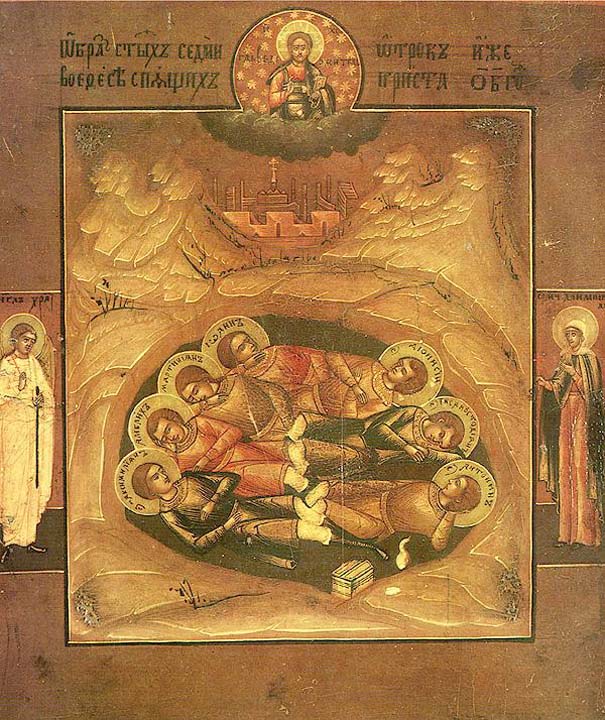
Si nara che l’imperatore Decio, grande persecutore dei cristiani, verso il 250, in occasione di un suo viaggio in Oriente, chiamò davanti al tribunale sette giovani cristiani di Efeso, città un tempo famosa per il tempio di Diana, una delle sette meraviglie del mon¬do, e poi per la devozione alla Madonna. Tra un interrogatorio e l’altro, i sette riuscirono a fuggire ed a nascondersi in una grotta. Furono però scoperti e, per ordine dello stesso imperatore, murati vivi al suo interno. Ai ragazzi allora, non restò che prepararsi a morire in grazia di Dio ed a tal fine si stesero a terra. Caddero però inaspettatamente in un profondissimo sonno. Non appena si svegliarono, si videro attorniati da facce stupite che li osservavano. Il muro della grotta era stato abbattuto da un pastore che voleva ricavarne un ricovero per le sue bestie. I sette, convinti di essersi addormentati il giorno prima, si informarono se fuori ci fosse ancora pericolo, ma dopo qualche battuta si giunse a capo del madornale equivoco: avevano dormito per ben due secoli per risvegliati dunque attorno al 450 sotto l’imperatore Teodosio II, cristiano, ma con poca fede nella risurrezione. La versione cristiana della vicenda dei sette dormienti vi sono principalmente due fonti: la prima è Gregorio di Tours, mentre la seconda versione è contenuta nella Leggenda Aurea, grandiosa opera di Jacopo Da Varazze, du cui si ripota di seguito la versione dei fatti.
“I Sette Dormienti nacquero nella città di Efeso. Quando l’imperatore Decio perseguitava i cristiani andò a Efeso e fece edificare dei templi in mezzo alla città, perché tutti si unissero a lui per sacrificare agli dei. Fece cercare tutti i cristiani e li fece mettere in catene, obbligandoli a scegliere se sacrificare agli dei o morire: tale era il terrore che l'amico rinnegava l’amico, il padre il figlio e il figlio il padre. C’erano in quella città sette cristiani, Massimiano, Malco, Marciano, Dionisio, Giovanni, Serapione e Costantino, che, considerata la situazione, se ne rammaricavano molto. Essendo molto in vista alla corte, non volendo sacrificare agli dei, stavano nascosti in casa, sempre intenti in digiuni e preghiere. Processati in presenza di Decio, e dimostrato che erano realmente cristiani, furono lasciati in libertà, fino al ritorno dell'imperatore, perché avessero il tempo di ravvedersi. Ne approfittarono invece per distribuire tutti i loro averi ai poveri. Decisero di ritirarsi sul monte Celion, dove avrebbero potuto rimanere nascosti. Così rimasero a lungo nascosti, mentre uno di loro serviva gli altri, e ogni volta che andava in città assumeva le vesti e l'aspetto di un mendicante.
Quando Decio tornò in città, mandò a cercare i sette per farli sacrificare. Malco, che serviva loro, ne fu atterrito, tornò dagli altri e riferì le brutali intenzioni dell'imperatore. Dato che tutti avevano paura, Malco dette loro i pani che aveva portato, perché, rifocillatisi, acquistassero più forze per la battaglia. Poi cenarono, sedendo e parlando tra lamenti e lacrime, e, come Dio volle, si addormentarono. La mattina li cercarono, ma senza successo; Decio si doleva di aver perso dei giovani di tale valore. Furono poi accusati di essere nascosti sul monte Celion, di aver distribuito tutti i loro averi ai poveri e di non aver assolutamente cambiato proposito.
Decio allora fece venire i loro genitori, minacciandoli di morte se non avessero detto tutto quello che sapevano. Anche loro fecero le stesse accuse, e si lamentarono che le ricchezze erano state tutte date ai poveri. Decio allora pensò cosa fare di loro, e ispirato da Dio, fece chiudere l'ingresso della caverna con un muro di pietre, perché i sette, rinchiusi là dentro, morIssero di fame e di stenti.
Così fecero gli incaricati, e due cristiani, Teodoro e Rufino, descrissero tutto il loro martirio, e nascosero il testo fra le pietre della prigione. Morto Decio e morti tutti i contemporanei, nel 371, nel trentesimo anno d'impero di Teodosio, si diffuse l'eresia di coloro che negavano la resurrezione dei morti e Teodosio, imperatore cristianissimo, ne fu molto rattristato, poiché vedeva essere messa in pericolo la fede con una tale empietà. Ogni giorno si ritirava a piangere in un luogo appartato, indossando il cilicio. Iddio, vedendo questo, volle consolare quelli che piangevano e confermare la speranza nella resurrezione; apri il tesoro della sua pietà e risvegliò i martiri di cui si è parlato. Mise allora in mente a un efesino di costruire su quel monte alcuni ovili per i suoi pastori. Quando i muratori aprirono la grotta, i santi si svegliarono e si salutarono l’un l’altro, convinti di aver dormito una sola notte, e ricordandosi delle pene del giorno precedente, chiesero a Malco, che si occupava di loro, che cosa aveva deciso Decio in merito della loro sorte.
Ma egli rispose la stessa cosa che aveva risposto la sera prima: - Ci è stato richiesto di sacrificare agli idoli: ecco cosa vuole da noi l' imperatore.
Massimiano rispose: - Ma Dio sa che non sacrificheremo.
Dopo aver confortato i compagni ordinò a Malco di scendere in città a comprare il pane, un po' più che il giorno precedente e tornare a riferire cosa aveva disposto l' imperatore. Marco prese cinque soldi, uscì dalla spelonca, vide le pietre ammassate, se ne stupì, ma pensando ad altro, non vi dette molto peso.
Arrivò, circospetto, alla porta della città, e si meravigliò molto di vedervi esposto il segno della croce; andò allora a un'altra porta e di nuovo vide il segno della croce, e si stupì ancora di più. Andò a vedere tutte le porte, e sempre c'era il segno della croce: la città era cambiata. Si fece il segno di croce e tornò alla prima porta, convinto di star sognando: Si copri la faccia e avvicinatosi ai venditori di pane, sentì che tutti parlavano di Cristo, e, al colmo dello stupore esclamò: - Com'è che ieri nessuno osava neppur nominare Cristo, e oggi tutti proclamano il suo nome? Forse questa non è la città di Efeso, perché è diversa: ma non conosco altre città fatte così.
Ma quando gli fu risposto che si trattava veramente di Efeso, credette di essersi sbagliato, e pensò di tornare ai compagni. Decise comunque di andare dai venditori di pane, ma quando tirò fuori le monete d'argento, i venditori stupiti credettero che il ragazzo avesse trovato un antico tesoro. Malco, vedendo che confabulavano tra di loro, pensò che volessero portarlo dall'imperatore, e allora per la paura li implorò di lasciarlo andare e di tenersi il pane e le monete d'argento.
Allora quelli lo fermarono e gli dissero: - Ma tu da dove vieni? Se hai trovato dei tesori degli antichi imperatori, diccelo, e saremo compari: ti terremo nascosto, altrimenti tutti lo sapranno.
Malco per la paura non sapeva più cosa dire; gli altri, visto che stava zitto, gli misero una fune al collo e lo trascinarono per tutte le strade fino in centro alla città; intanto si diffuse la voce che un giovane aveva scoperto dei tesori.
Tutti si accalcavano attorno a lui, e lui voleva convincerli di non aver trovato nulla; guardava attorno ma nessuno lo riconosceva, e lui pure, guardando la folla, voleva trovare qualche suo parente - che credeva in buona fede fosse vivo e vegeto - e non trovando nessuno stava in mezzo alla gente della città come uno scemo.
Quando lo seppero il vescovo san Martino e il proconsole Antipatro, che era appena giunto in città, dettero disposizione di portare loro, con cautela, quell'uomo e le sue monete d' argento. Mentre era condotto alla chiesa dalle guardie pensava che lo stessero portando dall'imperatore. Il vescovo e il proconsole, meravigliati delle monete d'argento, gli chiesero dove aveva trovato quel tesoro sconosciuto, ma lui rispose che quei soldi venivano dal sacchetto del suoi genitori. Alla domanda da che città venisse, rispose: - Sono di questa città; è ben Efeso, no? - Fai venire i tuoi genitori, - disse allora il proconsole, - che possano giustificarti. Quando però disse i loro nomi, nessuno li conosceva, e pensarono che stesse architettando qualcosa per poi poter scappare. Il procuratore gli disse: - Come vuoi che facciamo a credere che questi soldi siano dei tuoi genitori, se la scritta che c' è sopra dice che hanno più di trecentosettantasette anni?
Risalgono ai primi anni di Decio imperatore e sono del tutto diversi dalle monete d’argento dei nostri giorni. Vorrai mica che i tuoi genitori siano così vecchi? Tu, ragazzo vuoi forse prenderti gioco dei sapienti di Efeso? Ti affiderò alla Giustizia, fino a che non confesserai cosa hai trovato.
Malco allora si gettò ai loro piedi e disse: - Signori, per carità di Dio, ditemi ciò che vi chiedo, e io vi aprirò il mio cuore. L' imperatore Decio, che è stato in questa città, dove è ora? - Non c'è ai giorni nostri, - rispose il vescovo, - un imperatore di nome Decio; ce ne fu uno molto tempo fa.
- Mio signore, questo mi stupisce, e nessuno mi crede. Seguitemi, però, e vi farò vedere i miei compagni, che sono nel monte Celion, e a loro crederete. So di certo che siamo scappati dal cospetto di Decio, e io proprio ieri sera l 'ho visto entrare in questa città sempre che questa città sia proprio Efeso.
Il vescovo pensieroso disse al proconsole: - Dio vuol mostrarci una qualche prodigiosa visione attraverso questo ragazzo. Dunque lo seguirono, e con loro venne una gran folla di gente dalla città. Entrò per primo Malco dai suoi compagni, poi il vescovo, che vide fra le pietre la lettera con due sigilli d'argento. Chiamata la folla attorno la lesse, e tutti quelli che l 'ascoltavano erano pieni di meraviglia. Vedendo i santi di Dio seduti nella grotta freschi come rose, si gettarono a terra a glorificare il Signore. Il vescovo e il proconsole mandarono a dire a Teodosio di venire presto a vedere il grande prodigio compiuto da Dio in quei giorni. Subito alzandosi dal sacco su cui giaceva a terra piangendo, venne da Costantinopoli a Efeso rendendo grazie a Dio; tutti quelli che gli si facevano intorno andarono con lui alla grotta. Appena i santi videro l'imperatore, i loro volti risplendettero, e l'imperatore si gettò ai loro piedi rendendo gloria a Dio; rialzatosi li abbracciò, e pianse su ciascuno di loro dicendo : - Vi guardo ed è come se vedessi il Signore che resuscita Lazzaro.
Allora san Massimiano disse: - Credici, è per causa tua che il Signore ci ha resuscitati proprio alla vigilia della festa della Resurrezione, e credi che la resurrezione dei morti è una verità. In verità noi siamo risorti e viviamo, e come un bambino sta nell'utero della madre senza sentire urti, cosi anche noi fummo vivi, giacendo addormentati, senza sentire alcuno stimolo.
Pronunciate queste parole sotto gli occhi di tutti reclinarono nuovamente il capo a terra, addormentandosi e rendendo lo spirito, come Dio volle. L 'imperatore si rialzò e cadde su di essi piangendo e baciandoli. Avendo l’imperatore deciso di farli riporre in sepolcri d'oro, la notte stessa apparvero all'imperatore dicendo che, come sino a poc'anzi erano giaciuti in terra e dalla terra erano risorti, così li lasciasse, sino a che il Signore non concedesse una seconda resurrezione. L’imperatore allora dispose che quella località fosse adornata di pietre dorate, e che tutti i vescovi che professavano la fede nella resurrezione fossero prosciolti”.
La vicenda di questi intrepidi testimoni della fede è divenuta tanto popolare da trovare spazio anche nell’islamico Mito della Caverna contenuto nel Corano alla Sura XVIII. Ma questo non è che uno dei vari casi di santi cristiani che godono di una certa forma di venerazione anche da parte mussulmana, come anche San Giorgio e Santa Caterina d’Alessandria. A Chenini, paese facilmente raggiungibile da Tataouine, sorge ancora oggi uno splendido edificio a loro dedicato. Edificato verso il 1100 dai Berberi, il paese pare un formicaio su montagne cosparse di grotte e caverne. Oggi disabitato, si può però ancora visitare la Moschea dei Sette Dormienti, costruita intorno al 1250 vicino ad un cimitero con alcune gigantesche tombe, in cui secondo la leggenda riposano le spoglie mortali dei Sette Dormienti. L’Islam li interpreta quali personaggi mitici che, convertitisi al cristianesimo, morirono solo apparentemente per poi risvegliarsi dopo la predicazione di Maometto e convertirsi alla vera fede, cioè a loro giudizio l’Islam. Appagarono così la loro sete di verità e poterono morire in pace.
Indipendendemente da quale tradizione sul loro conto si preferica prendere in considerazone, resta dunque fermo come comune denominatore il loro porsi alla ricerca della Verità e la pazienza di vegliare per aspettare il momento di darle testimonianza.
Autore: Fabio Arduino
Risultati da 1 a 4 di 4
Discussione: 27 luglio - SS. Sette Dormienti di Efeso
-
26-07-07, 20:47 #1**********


- Data Registrazione
- 04 Jun 2003
- Messaggi
- 23,775
-

- 18
-

- 35
- Mentioned
- 2 Post(s)
- Tagged
- 0 Thread(s)
 27 luglio - SS. Sette Dormienti di Efeso
-
26-07-07, 20:50 #2**********
- Data Registrazione
- 04 Jun 2003
- Messaggi
- 23,775
-
- 18
-
- 35
- Mentioned
- 2 Post(s)
- Tagged
- 0 Thread(s)
The Seven Sleepers of Ephesus
The story is one of the many examples of the legend about a man who falls asleep and years after wakes up to find the world changed. It is told in Greek by Symeon Metaphrastes in his "Lives of the Saints" for the month of July. Gregory of Tours did it into Latin. There is a Syriac version by James of Sarug (d. 521), and from the Syriac the story was done into other Eastern languages. There is also an Anglo-Norman poem, "Li set dormanz", written by a certain Chardry, and it occurs again in Jacobus de Voragines's "Golden Legend" (Legenda aurea) and in an Old-Norse fragment. Of all these versions and re-editions it seems that the Greek form of the story, which is the basis of Symeon Metaphrastes, is the source. The story is this: Decius (249-251) once came to Ephesus to enforce his laws against Christians -- a gruesome description of the horrors he made them suffer follows -- here he found seven noble young men, named Maximillian, Jamblichos, Martin, John, Dionysios, Exakostodianos, and Antoninos (so Metaphrastes; the names vary considerably; Gregory of Tours has Achillides, Diomedes, Diogenus, Probatus, Stephanus, Sambatus, and Quiriacus), who were Christians. The emperor tried them and then gave them a short time for consideration, till he came back again to Ephesus. They gave their property to the poor, took a few coins only with them and went into a cave on Mount Anchilos to pray and prepare for death. Decius came back after a journey and inquired after these seven men. They heard of his return and then, as they said their last prayer in the cave before giving themselves up, fell asleep. The emperor told his soldiers to find them, and when found asleep in the cave he ordered it to be closed up with huge stones and sealed; thus they were buried alive. But a Christian came and wrote on the outside the names of the martyrs and their story. Years passed, the empire became Christian, and Theodosius [either the Great (379-395) or the Younger (408-450), Koch, op.cit. infra, p.12], reigned. In his time some heretics denied the resurrection of the body. While this controversy went on, a rich landowner named Adolios had the Sleepers' cave opened, to use it as a cattle-stall. Then they awake, thinking they have slept only one night, and send one of their number (Diomedes) to the city to buy food, that they may eat before they give themselves up. Diomedes comes into Ephesus and the usual story of cross-purposes follows. He is amazed to see crosses over churches, and the people cannot understand whence he got his money coined by Decius. Of course at last it comes out that the last thing he knew was Decius's reign; eventually the bishop and the prefect go up to the cave with him, where they find the six others and the inscription. Theodosius is sent for, and the saints tell him their story. Every one rejoices at this proof of the resurrection of the body. The sleepers, having improved the occasion by a long discourse, then die praising God. The emperor wants to build golden tombs for them, but they appear to him in a dream and ask to be buried in the earth in their cave. The cave is adorned with precious stones, a great church built over it, and every year the feast of the Seven Sleepers is kept.
Koch (op.cit.) has examined the growth of this story and the spread of the legend of miraculously long sleep. Aristotle (Phys., IV, xi) refers to a similar tale about sleepers at Sardes; there are many more examples from various countries (Koch, pp. 24-40, quotes German, British, Slav, Indian, Jewish, Chinese, and Arabian versions). Frederick Barbarossa and Rip Van Winkle are well-known later examples. The Ephesus story is told in the Koran (Sura xviii), and it has had a long history and further developments in Islam (Koch, 123-152), as well as in medieval Christendom (ib., 153-183). Baronius was the first to doubt it (Ann. Eccl. in the Acta SS., July, 386, 48); it was then discredited till modern study of folk-lore gave it an honoured place again as the classical example of a widely spread myth. The Seven Sleepers have feasts in the Byzantine Calendar on 4 August and 22 October; in the Roman Martyrology they are commemorated as Sts. Maximianus, Malchus, Martinianus, Dionysius, Joannes, Serapion, and Constantinus on 27 July.
Bibliography
Metaphrastes' version is in P.G., CXV, 427-448; Gregory of Tours, Passio VII Dormientium in the Anal. Bolland., XII, 371-387; Chardry, Li Set Dormanz, ed. Koch (Leipzig, 1879); Legenda Aurea and Caxton's version for July; Koch, Die Siebenschlafereigende, ihr Ursprung u. ihre Verbreitung (Leipzig, 1883); an exhaustive monograph with a full bibliography.
Fonte: The Catholic Encyclopedia, vol. V, New York, 1909
-
27-07-08, 09:22 #3**********
- Data Registrazione
- 04 Jun 2003
- Messaggi
- 23,775
-
- 18
-
- 35
- Mentioned
- 2 Post(s)
- Tagged
- 0 Thread(s)
Seven Sleepers
 A 19th century German painting of the Seven Sleepers
The Roman Martyrology mentions the Seven Sleepers of Ephesus under the date of 27 July, as follows: "Commemoration of the seven Holy Sleeper of Ephesus, who, it is recounted, after undergoing martyrdom, rest in peace, awaiting the day of resurrection."[1] The Byzantine Calendar commemorates them with feasts on 4 August and 22 October. Some Muslims also venerate them as saints.
A legend about them tells of the falling asleep of seven young men in a cave, who wake up after a great deal of time has passed. The basic outline of the tale appears in Gregory of Tours (b. 538 - d. 594), and in Paul the Deacon's (b. 720 - d. 799) History of the Lombards. The best-known version of the story appears in Jacobus de Voragine's Golden Legend. Their story also appears in the Qur'an (Surah 18, verse 9-26) [1], which also includes a dog among the seven.
The Legend
 Decius orders the walling in of the Seven Sleepers. From a 14th century manuscript.
The outline of the story is that during the persecutions of the Roman emperor Decius, around 250, seven young men were accused of Christianity. They were given some time to recant their faith. Instead they gave their worldly goods to the poor, and retired to a mountain to pray, where they fell asleep. The emperor, seeing that their attitude towards paganism had not improved, ordered the mouth of the cave to be sealed.
Decades passed. At some later time — usually, during the reign of Theodosius (379 - 395) — the landowner decided to open up the sealed mouth of the cave, to use it as a cattle pen. He opened it and found the sleepers inside. They awoke, imagining that they had slept but one day. One of their number returned to Ephesus. He was astounded to find buildings with crosses attached; the townspeople were astounded to find a man trying to spend old coins from the reign of Decius. The bishop was summoned to interview the sleepers; they told him their miracle story, and died praising God.
The career of the legend
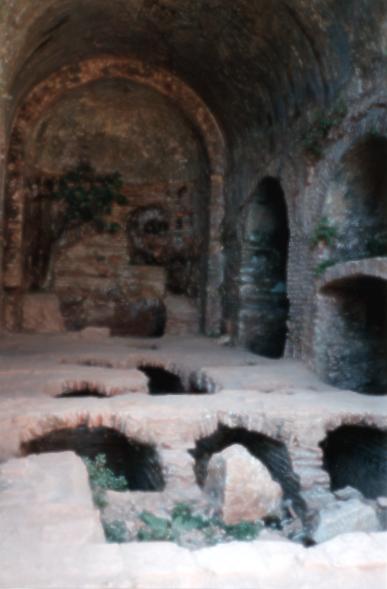 The Cave of the Seven Sleepers, Ephesus, Turkey.
As the earliest versions of the legend spread from Ephesus; an early Christian catacomb came to be associated with it, attracting pilgrims. On the slopes of Mount Pion (Mount Coelian) near Ephesus (near modern Selçuk in Turkey), the 'Grotto' of the Seven Sleepers with ruins of the church built over it was excavated in 1927-28. The excavation brought to light several hundred graves which were dated to the 5th and 6th centuries. Inscriptions dedicated to the Seven Sleepers were found on the walls of the church and in the graves. The 'Grotto' is still shown to tourists.
Syriac Origins
The legend appeared in several Syriac sources before Gregory's lifetime. It was retold by Symeon Metaphrastes.
The Seven Sleepers form the subject of a homily in verse by the Edessan poet Jacob of Saruq ('Sarugh') (died 521), which was published in the Acta Sanctorum. Another 6th century version, in a Syrian manuscript in the British Museum (Cat. Syr. Mss, p. 1090), gives eight sleepers. There are considerable variations as to their names.
Another Syriac version is printed in Land’s Anecdota, iii. 87ff; see also Barhebraeus, Chron. eccles. i. 142ff., and cf Assemani, Bib. Or. i. 335ff.
Dissemination
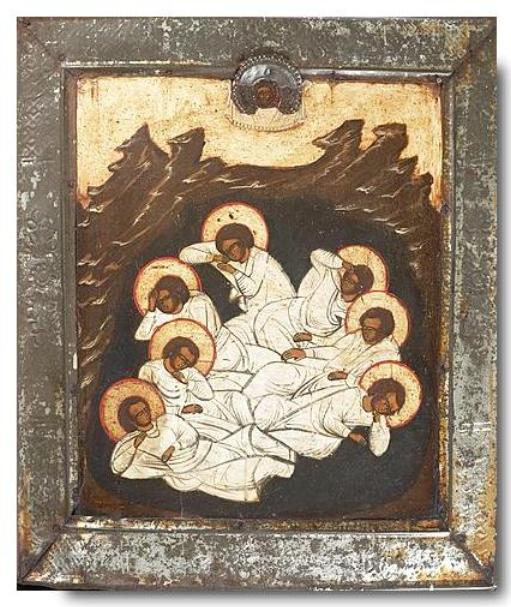 Russian icon
The legend rapidly attained a wide diffusion throughout Christendom, popularized in the West by Gregory of Tours, in his late 6th century collection of miracles, De gloria martyrum (Glory of the Martyrs). Gregory says that he had the legend from “a certain Syrian,“.
In the 7th century, the myth gained an even wider audience by being incorporated into the Qur'an, in Sura 18, Al-Kahf, verse 9 to 14. See Islamic Interpretation.
In the following century, Paul the Deacon told the tale in his History of the Lombards (i.4) but gave it a different setting:
In the farthest boundaries of Germany toward the west-north-west, on the shore of the ocean itself, a cave is seen under a projecting rock, where for an unknown time seven men repose wrapped in a long sleep.
Their dress identifies them as Romans, according to Paul, and none of the local barbarians dare touch them.
During the period of the Crusades, bones from the sepulchres near Ephesus, identified as relics of the Seven Sleepers, were transported to Marseille, France in a large stone coffin, which remained a trophy of the church of Saint Victoire, Marseille.
The Seven Sleepers were included in the Golden Legend compilation, the most popular book of the later Middle Ages, which fixed a precise date for their resurrection, AD 478, in the reign of Theodosius (1).
Early modern literature
The myth had become proverbial in 16th century Protestant culture. The poet John Donne could ask, with a skeptical undertone,
'were we not wean'd till then?
But suck'd on countrey pleasures, childishly?
Or snorted we in the seaven sleepers den?' -John Donne, The good-morrow
Little is heard of the Seven Sleepers during the Enlightenment, but the legend revived with the coming of Romanticism. The Golden Legend may have been the source for retellings of the Seven Sleepers in Thomas de Quincey's Confessions of an English Opium-eater, in a poem by Goethe, Washington Irving's Rip van Winkle, H.G. Wells's The Sleeper Awakes and Woody Allen's Sleeper. It also might have an influence on the motif of the 'king in the mountain'. The tale also appears heavily within Gilbert Morris' Seven Sleepers Series, a ten-part series of Christian parallel books.
Islamic interpretation
The Islamic version is related in Surah (Chapter) Al-Kahf (18, "The Cave"), of the Qur'an. During the time of the Prophet Muhammad, the Jews of Medina challenged him to tell them the story of the sleepers knowing that none of the Arabs knew about it. According to tradition, God then sent the angel Gabriel (or Jibreel) to reveal the story to him through Surah Al-Kahf. After hearing it from him, the Jews confirmed that he told the same story they knew.
The Qur'an states that the period of time these sleepers spent in the cave was three hundred years during which the calendar of their people was changed from solar to lunar and, as a result, the period of their sleep has increased to 309 (lunar) years. When they woke up, they had no idea they slept for centuries and thought they only slept a few hours. When they sent one of them to buy food, the coins he used to buy food were out of circulation and drew the attention of the town's people. After the story was widely known, the sleepers died. The Qur'an also mentions a dog along the sleepers, in the 18th verse of the 18th chapter, Surah Al Kahf.
Thou wouldst have deemed them awake, whilst they were asleep, and We turned them on their right and on their left sides: their dog stretching forth his two fore-legs on the threshold: if thou hadst come up on to them, thou wouldst have certainly turned back from them in flight, and wouldst certainly have been filled with terror of them.
(Surah Al Kahf, Qur'an: 18)
The ninth verse of Surah Al Kahf touch upon this group's extraordinary situation. As the narrative unfolds, it is seen that their experiences are of an unusual and metaphysical nature. Their entire life is full of miraculous developments. The tenth verse tells us that those young people sought refuge in the cave from the existing oppressive system, which did not allow them to express their views, tell the truth, and call to Allah's religion. Thus, they distanced themselves from their society.
Do you consider that the Companions of the Cave and Ar-Raqim were one of the most remarkable of Our Signs? When the young men took refuge in the cave and said: 'Our Lord, give us mercy directly from You and open the way for us to right guidance in our situation.
(Surah Al Kahf, Qur'an: 9-10)
So We sealed their ears with sleep in the cave for a number of years. Then We woke them up again so that we might see which of the two groups would better calculate the time they had stayed there.
(Surah Al Kahf, Qur'an: 11-12)
The reason for this state of sleep was their surrender to fate and peace, because Allah, arranges everything for the benefit of the believers.
The Qur'an also states that the number of sleepers will be known to God, and only a handful of people. It has not been mentioned that there were seven sleepers.
They will say: 'There were three of them, their dog being the fourth.' They will say: 'There were five of them, their dog being the sixth,' guessing at the Unseen. And they will say: 'There were seven of them, their dog being the eighth.' Say: 'My Lord knows best their number. Those who know about them are very few.' So do not enter into any argument concerning them, except in relation to what is clearly known. And do not seek the opinion of any of them regarding them.
(Surat Al Kahf, Qur'an: 22)
Linguistic derivatives in Scandinavian, German and Hungarian
The legend of the seven sleepers has given origin to the word syvsover (literally seven-sleeper) in both Swedish, Norwegian and Danish, as in 'one of the Seven Sleepers of Ephesus'. It has come to refer to someone who "sleeps hard and long". The word secondarily refers to a hibernating rodent, the edible dormouse. The word "Siebenschläfer" in German and "hétalvó" in Hungarian bear a meaning similar to the Scandinavian; they characterize someone who usually sleeps long, waking up later than what is considered necessary or proper. Edible dormouse in German is also Siebenschläfer.
Notes
1. Martyrologium Romanum (Libreria Editrice Vaticana 2001 ISBN 88-209-7210-7).
Fonte: wikipedia
-
27-07-08, 09:28 #4**********
- Data Registrazione
- 04 Jun 2003
- Messaggi
- 23,775
-
- 18
-
- 35
- Mentioned
- 2 Post(s)
- Tagged
- 0 Thread(s)
Istantanee dalla Grotta dei SS. Sette Dormienti, Efeso


 Rispondi Citando
Discussioni Simili
-
La Leggenda dei Sette Santi Dormienti. Cappella dei SS. Cosma e Damiano Angri
Di MaIn nel forum Tradizione CattolicaRisposte: 1Ultimo Messaggio: 24-09-13, 20:20 -
In memoria di San Marco d'Efeso
Di DanielGi. nel forum Chiesa Ortodossa TradizionaleRisposte: 1Ultimo Messaggio: 01-02-12, 10:04 -
18 luglio - SS. Sinforosa e sette figli martiri
Di Augustinus nel forum TradizionalismoRisposte: 3Ultimo Messaggio: 18-07-08, 07:59 -
10 luglio (23 novembre) - SS. Felicita e sette fratelli, martiri
Di Augustinus nel forum TradizionalismoRisposte: 4Ultimo Messaggio: 10-07-08, 09:04 -
Efeso
Di pcosta nel forum Natura e viaggiRisposte: 3Ultimo Messaggio: 21-09-06, 23:40
 Permessi di Scrittura
Powered by vBulletin® Version 4.2.5
Copyright © 2026 vBulletin Solutions Inc. All rights reserved.
Change privacy settings
Copyright © 2026 vBulletin Solutions Inc. All rights reserved.
Change privacy settings
Tutti gli orari sono GMT +2. Adesso sono le 17:30.
