


Definire una generazione
Strauss and Howe define a social generation as the aggregate of all people born over a span of roughly twenty years or about the length of one phase of life: childhood, young adulthood, midlife, and old age. Generations are identified (from first birthyear to last) by looking for cohort groups of this length that share three criteria. First, members of a generation share what the authors call anage location in history: they encounter key historical events and social trends while occupying the same phase of life. In this view, members of a generation are shaped in lasting ways by the eras they encounter as children and young adults and they share certain common beliefs and behaviors. Aware of the experiences and traits that they share with their peers, members of a generation would also share a sense of common perceived membership in that generation.
Archetipi e punti di svolta generazionali
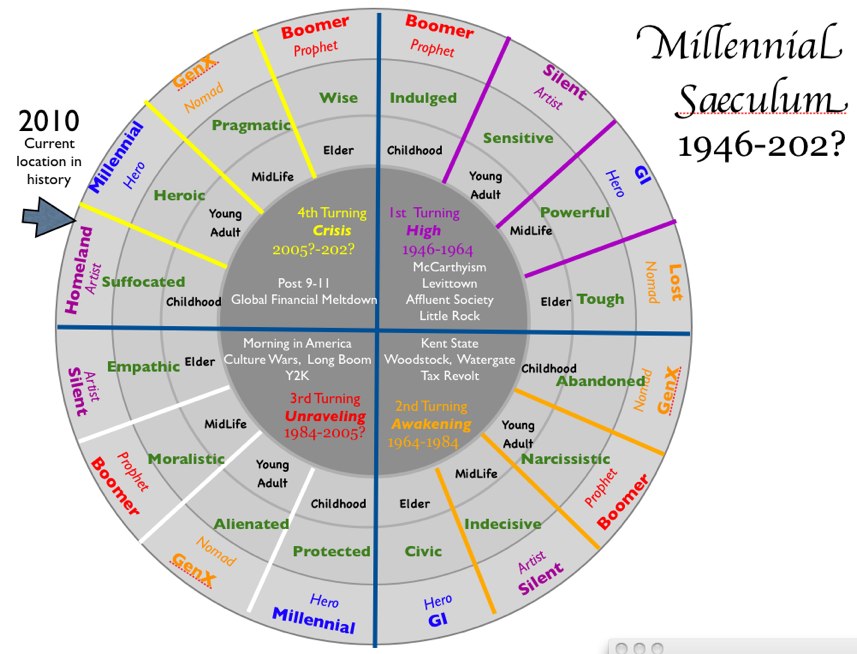
Punti di svolta:While writing Generations, Strauss and Howe discovered a pattern in the historical generations they examined which revolved around generational events which they call turnings. In Generations, and in greater detail in The Fourth Turning, they identify the four-stage cycle of social or mood eras (i.e. turnings).
Picco:According to Strauss and Howe, the First Turning is a High (Picco). This is a post-Crisis era when institutions are strong and individualism is weak. Society is confident about where it wants to go collectively, though those outside the majoritarian center often feel stifled by the conformity.[19]According to the authors, America's most recent First Turning was the post-World War II American High, beginning in 1946 and ending with the assassination of President John F. Kennedy on November 22, 1963.[20]
Presa di coscienza:According to the theory, the Second Turning is an Awakening(Presa di coscienza) This is an era when institutions are attacked in the name of personal and spiritual autonomy. Just when society is reaching its high tide of public progress, people suddenly tire of social discipline and want to recapture a sense of personal authenticity. Young activists look back at the previous High as an era of cultural and spiritual poverty.[21]Strauss & Howe say America’s most recent Awakening was the “Consciousness Revolution,” which spanned from the campus and inner-city revolts of the mid-1960s to the reelection of Ronald Reagan in the mid-1980s.
Dispiegamento:According to Strauss and Howe, the Third Turning is an Unraveling(dispiegamento). The mood of this era is in many ways the opposite of a High: Institutions are weak and distrusted, while individualism is strong and flourishing. Highs come after Crises, when society wants to coalesce and build. Unravelings come after Awakenings, when society wants to atomize and enjoy.[23] They declare that America’s most recent Unraveling was theLong Boom and Culture War, beginning in the mid-1980s and ending in the late 2000s.
Crisi:According to the authors, the Fourth Turning is a Crisis. This is an era in which institutional life is destroyed and rebuilt in response to a perceived threat to the nation’s survival. Civic authority revives, cultural expression redirects towards community purpose, and people begin to locate themselves as members of a larger group.[24] America’s most recent completed Fourth Turning began with the stock market crash of 1929 and climaxed with the end of World War II. The G.I. Generation (a Hero archetype, born 1901 to 1924) came of age during this era. Their confidence, optimism, and collective outlook epitomized the mood of the era.[25] According to the authors, the Millennial Generation (Hero archetype, born 1982 to 2004), show many traits similar to those of the G.I. youth, including rising civic engagement, improving behavior, and collective confidence.
Risultati da 1 a 8 di 8
-
09-05-16, 17:49 #1SOVRANISTA ISRAELIANO


- Data Registrazione
- 04 Apr 2009
- Località
- Territori occupati della Cispadania/North Bank
- Messaggi
- 52,047
-

- 10,074
-

- 19,623
- Mentioned
- 780 Post(s)
- Tagged
- 66 Thread(s)
 La teoria generazionale di William Strauss e Neil Howe
CLAUDIA CONTE, TI AMO!
La teoria generazionale di William Strauss e Neil Howe
CLAUDIA CONTE, TI AMO!
-
09-05-16, 18:02 #2SOVRANISTA ISRAELIANO
- Data Registrazione
- 04 Apr 2009
- Località
- Territori occupati della Cispadania/North Bank
- Messaggi
- 52,047
-
- 10,074
-
- 19,623
- Mentioned
- 780 Post(s)
- Tagged
- 66 Thread(s)
Re: La teoria generazionale di William Strauss e Neil Howe
Cycle
Each turning lasts about 20–22 years. Four turnings comprise a full cycle of approximately 80 to 90 years,[27] which the authors term a saeculum, after the Latin word meaning both “a long human life” and “a natural century.”[28]
Generational change drives the cycle of turnings and determines its periodicity. As each generation ages into the next life phase (and a new social role) society’s mood and behavior fundamentally changes, giving rise to a new turning. Therefore, a symbioticrelationship exists between historical events and generational personas. Historical events shape generations in childhood and young adulthood; then, as parents and leaders in midlife and old age, generations in turn shape history.[29]
Each of the four turnings has a distinct mood that recurs every saeculum. Strauss and Howe describe these turnings as the “seasons of history.” At one extreme is the Awakening, which is analogous to summer, and at the other extreme is the Crisis, which is analogous to winter. The turnings in between are transitional seasons, similar to fall and spring.[30] Strauss and Howe have identified 26 turnings over 7 saecula in Anglo-American history, from the year 1435 through today.
At the heart of Strauss & Howe's ideas is a basic alternation between two different types of eras, Crises and Awakenings. Both of these are defining eras in which people observe that historic events are radically altering their social environment.[31] Crises are periods marked by major secular upheaval, when society focuses on reorganizing the outer world of institutions and public behavior (the last American Crisis was the period spanning the Great Depression and World War II). Awakenings are periods marked by cultural or religious renewal, when society focuses on changing the inner world of values and private behavior (the last American Awakening was the “Consciousness Revolution” of the 1960s and 1970s).[32] During Crises, great peril provokes a societal consensus, an ethic of personal sacrifice, and strong institutional order. During Awakenings, an ethic of individualism emerges, and the institutional order is attacked by new social ideals and spiritual agendas.[33] According to the authors, about every eighty to ninety years—the length of a long human life—a national Crisis occurs in American society. Roughly halfway to the next Crisis, a cultural Awakening occurs (historically, these have often been called Great Awakenings).[32]
In describing this cycle of Crises and Awakenings, Strauss and Howe draw from the work of other historians and social scientists who have identified long cycles in American and European history. The Strauss–Howe cycle of Crises corresponds with long cycles of war identified by such scholars as Arnold J. Toynbee, Quincy Wright, and L.L. Ferrar Jr., and with geopolitical cycles identified by William R. Thompson and George Modelski.[34] Strauss and Howe say their cycle of Awakenings corresponds withAnthony Wallace’s definitive work on revitalization movements,[35] Strauss and Howe also say recurring Crises and Awakenings correspond with two-stroke cycles in politics (Walter Dean Burnham, Arthur Schlesinger Sr. and Jr.), foreign affairs (Frank L. Klingberg), and the economy (Nikolai Kondratieff) as well as with long-term oscillations in crime and substance abuse.[36]
Archetypes
The two different types of eras and two formative age locations associated with them (childhood and young adulthood) produce four generational archetypes that repeat sequentially, in rhythm with the cycle of Crises and Awakenings. In Generations, Strauss and Howe refer to these four archetypes as Idealist, Reactive, Civic, and Adaptive.[37] In The Fourth Turning (1997) they update this terminology to Prophet, Nomad, Hero, and Artist.[38] The generations in each archetype not only share a similar age-location in history, they also share some basic attitudes towards family, risk, culture and values, and civic engagement. In essence, generations shaped by similar early-life experiences develop similar collective personas and follow similar life-trajectories.[39] To date, Strauss and Howe have identified 25 generations in Anglo-American history, each with a corresponding archetype.
Prophet generations are born near the end of a Crisis, during a time of rejuvenated community life and consensus around a new societal order. Prophets grow up as the increasingly indulged children of this post-Crisis era, come of age as self-absorbed young crusaders of an Awakening, focus on morals and principles in midlife, and emerge as elders guiding another Crisis.
Nomad generations are born during an Awakening, a time of social ideals and spiritual agendas, when young adults are passionately attacking the established institutional order. Nomads grow up as under-protected children during this Awakening, come of age as alienated, post-Awakening adults, become pragmatic midlife leaders during a Crisis, and age into resilient post-Crisis elders.
Hero generations are born after an Awakening, during an Unraveling, a time of individual pragmatism, self-reliance, and laissez faire. Heroes grow up as increasingly protected post-Awakening children, come of age as team-oriented young optimists during a Crisis, emerge as energetic, overly-confident midlifers, and age into politically powerful elders attacked by another Awakening.
Artist generations are born after an Unraveling, during a Crisis, a time when great dangers cut down social and political complexity in favor of public consensus, aggressive institutions, and an ethic of personal sacrifice. Artists grow up overprotected by adults preoccupied with the Crisis, come of age as the socialized and conformist young adults of a post-Crisis world, break out as process-oriented midlife leaders during an Awakening, and age into thoughtful post-Awakening elders.

Summary- An average life is 80 years, and consists of four periods of ~20 years
- Childhood → Young adult → Midlife → Elderhood
- A generation is an aggregate of people born every ~20 years
- Baby Boomers → Gen X → Millennials → Post-Millennials ("Homeland Generation")
- Each generation experiences "four turnings" every ~80y
- High → Awakening → Unraveling → Crisis
- A generation is considered "dominant" or "recessive" according to the turning experienced as young adults. But as a youth generation comes of age and defines its collective persona an opposing generational archetype is in its midlife peak of power.
- Dominant: independent behavior + attitudes in defining an era
- Recessive: dependent role in defining an era
- Dominant Generations
- Prophet: Awakening as young adults. Awakening, defined: Institutions are attacked in the name of personal and spiritual autonomy
- Hero: Crisis as young adults. Crisis, defined: Institutional life is destroyed and rebuilt in response to a perceived threat to the nation's survival
- Recessive Generations
- Nomad: Unraveling as young adults. Unraveling, defined: Institutions are weak and distrusted, individualism is strong and flourishing
- Artist: High [when they become] young adults. High, defined: Institutions are strong and individualism is weak
CLAUDIA CONTE, TI AMO!
-
09-05-16, 18:04 #3SOVRANISTA ISRAELIANO
- Data Registrazione
- 04 Apr 2009
- Località
- Territori occupati della Cispadania/North Bank
- Messaggi
- 52,047
-
- 10,074
-
- 19,623
- Mentioned
- 780 Post(s)
- Tagged
- 66 Thread(s)
Re: La teoria generazionale di William Strauss e Neil Howe


 CLAUDIA CONTE, TI AMO!
-
09-05-16, 18:33 #4SOVRANISTA ISRAELIANO
- Data Registrazione
- 04 Apr 2009
- Località
- Territori occupati della Cispadania/North Bank
- Messaggi
- 52,047
-
- 10,074
-
- 19,623
- Mentioned
- 780 Post(s)
- Tagged
- 66 Thread(s)
Re: La teoria generazionale di William Strauss e Neil Howe
Faccio un sunto in italiano....
poi proverò a tracciare dei paralleli con l'Italia e prevedere le prossime fasi
ciascuno di noi attraverso 4 fasi della vita in cui le sue attitudini su come si rapporta con gli altri e pensa si modificano, l'infanzia e l'adolescenza, la gioventù adulta, l'età di mezzo e la vecchiaia, ognuna di questa fase dura circa 20 anni e viene definita dai studiosi una generazione (da cui il nome alla loro teoria), i membri di ciascuna generazione condividono con gli altri l'aver vissuto uno stesso periodo storico, l'aver ascoltato uno stile musicale simile, una moda simile, eventi socio-politico-economici simili, tutti nello stesso periodo di vita, quindi in un certo senso hanno subito un comune imprintamento...
ad esempio io sono nato nel 1976 e nella mia prima fase sono stato imprintato dalla musica rock (che ora non esiste praticamente più), dal consumismo degli anni '80, dalla caduta del Muro di Berlino etc e come me tutti coloro che sono nati negli anni 70...
questo imprinting me lo porterò dietro tutta la vita, quelli nati prima degli anni '70 avranno avuto un altro imprinting e quelli dagli anni '80 in avanti idem.
Poi Howe e Strauss applicano lo stesso principio alla società...
passano quindi dall'individuo al collettivo...
descrivono le svolte che fanno da cesura fra una generazione e l'altra...
e la fanno durare lo stesso periodo di tempo, 20 anni
High:
il primo punto di svolta è high (picco), in questa fase generazionale (sociale, non individuale...) le istituzioni sono forti e l'individualismo debole, le masse sono fiduciose, tutto funziona, gli individui particolari e le teorie particolari non vengono accolte ma emarginate.
Secondo gli autori l'ultimo periodo di picco in USA è stato dal dopoguerra all'assassinio di Kennedy
Awakening:
Presa di coscienza o risveglio, le istituzioni e le credenze collettive si indeboliscono a favore dell'individualismo e chi sta fuori dal coro, è la contestazione in ogni ambito della sfera pubblica, secondo i due autori in USA questa fase è durata dalla metà degli anni '60 fino alla rielezione di Reagan, che consacrò l'onda conservatrice degli anni '80
Unraveling:
Spargimento, dispiegamento...siamo agli antipodi di High, il collettivo è disprezzato, l'individualismo elogiato, in USA corrisponde al periodo dalla metà degli anni '80 alla seconda metà dei 2000
Crisi:
La quarta e ultima fase è quella in cui le istituzioni, già indebolite, perdono definitivamente credibiltà e altre ne sorgono, l'energia è alta, si guarda con ottimismo al futuro, il passato viene dimenticato
Ogni generazione collettiva dura circa 20-25 anni, in complesso 80-90, la vita appunto di una persona, le fasi collettive rispecchiano quelle individuali.
L'aspetto fondamentale della teoria è l'alternanza fra fasi di risveglio e fasi di crisi.CLAUDIA CONTE, TI AMO!
-
09-05-16, 18:55 #5SOVRANISTA ISRAELIANO
- Data Registrazione
- 04 Apr 2009
- Località
- Territori occupati della Cispadania/North Bank
- Messaggi
- 52,047
-
- 10,074
-
- 19,623
- Mentioned
- 780 Post(s)
- Tagged
- 66 Thread(s)
Re: La teoria generazionale di William Strauss e Neil Howe
Le fasi collettive di crisi e risveglio , corrispondenti a quelle individuali di infanzia e giovane età, producono 4 archetipi generazionali cioè tipi di carattere che si ritrovano con altissima frequenza in quella popolazione:
1)Profeta:questa generazione nasce quando la Crisi sta per finire , i profeti sono imprintati dall'ottimismo, crescono sicuri di sè e viziati, da adulti promuovono però una contestazione al sistema e a mano a mano che invecchiano diventano conservatori e moralisti.
2)Nomade:questa generazione nasce nel pieno svolgimento del Risveglio, quindi noi siamo nati qui, un tempo di contestazione al sistema e trascendentalismo, i nomadi crescono spesso soli, con poche sicurezze e a volte alienati, proprio perchè i genitori sono impegnati a contestare l'ordine sociale, da adulti tendono a diventare pragmatici, spesso quando la nuova fase di Crisi si avvicina, da vecchi incazzosi e disillusi di tutto.
3)Eroe:gli eroi nascono dopo la fase del Risveglio e durante l'Unraveling, da noi sarebbero i millenials, un tempo di sicurezza in se stessi e libero mercato, da piccoli sono superprotetti e coccolati, da grandi, quando sopraggiune la fase di Crisi sociale reagiscono con ottimismo ed energia, da anziani saranno soddisfatti e potenti.
4)Artista: questa generazione nasce dopo l'Unraveling e in piena Crisi, sono accuditi da adulti opprimenti e iperprotettivi, da adulti saranno conformisti, solo da vecchi si porranno qualche dubbio...
In sintesi:
La vita media di un uomo sono 80 anni, divisi in infanzia/adolescenza, giovane età, età di mezzo e vecchiaia, ognuno di 20 anni
una generazione è l'aggregato sociale di persone nate in quel "ventennio" o "venticinquennio" storico
Ognuna di queste generazioni attraversa 4 fasi, picco, risveglio, dispiegamento e crisi, della stessa durata, 20 o 25 anni
una generazione è chiamata attiva o passiva in base alle esperienze che fanno nella giovane età, le generazioni dominanti sono i profeti e gli eroi, le passive i nomadi e gli artistiCLAUDIA CONTE, TI AMO!
-
09-05-16, 20:00 #6SOVRANISTA ISRAELIANO
- Data Registrazione
- 04 Apr 2009
- Località
- Territori occupati della Cispadania/North Bank
- Messaggi
- 52,047
-
- 10,074
-
- 19,623
- Mentioned
- 780 Post(s)
- Tagged
- 66 Thread(s)
Re: La teoria generazionale di William Strauss e Neil Howe
Devo digerirla ancora sta teoria generazionale, nn mi convince, è troppo vaga e nello stesso tempo troppo schematizzante...
 CLAUDIA CONTE, TI AMO!
-
27-02-17, 22:33 #7SOVRANISTA ISRAELIANO
- Data Registrazione
- 04 Apr 2009
- Località
- Territori occupati della Cispadania/North Bank
- Messaggi
- 52,047
-
- 10,074
-
- 19,623
- Mentioned
- 780 Post(s)
- Tagged
- 66 Thread(s)
Re: La teoria generazionale di William Strauss e Neil Howe
Proviamo a fare una teoria generazionale anche per il nostro paese...
divido la popolazione in 5 segmenti anagrafici
i giovani (sotto ai 30 anni) che ancora studiano o stanno approcciandosi al mondo del lavoro ma comunque non sono davvero autonomi, i trentenni, gli over 40 li chiamo adulti, gli over 50 i maturi ed infine gli over 60 semplicemente anziani
la teoria è che da piccoli siamo imprintati oltre che dai nostri genitori anche dal contesto esterno e questo imprinting, inconscio quando siamo bimbi e conscio da adolescenti, ce lo portiamo dentro un pò tutta la vita, con le debite eccezioni...
individuiamo le classi anagafriche
i nati negli anni '40, '50, '60 etc e vediamo quali eventi sociali li hanno imprintati
- Nati negli anni '40:da bimbi han vissuto il razionamento alimentare e alcuni i bombardamenti ma poi la pace, la libertà ed un certo (relativo) benessere economico, erano dei piccoli speranzosi che le cose sarebbero andate meglio (anche perchè peggio della guerra...) facendo certo grossi sacrifici e mettendocela tutta perchè non era ancora tempo di welfare, li chiameremo gli OTTIMISTI-ENERGICI
- Nati negli anni '50:da bimbi han vissuto un principio di benessere materiale, l'irrompere della televisione e del consumismo, da adolescenti hanno scoperto l'impegno politico e la critica al sistema, caratteristica la voglia di abbattere la famiglia patriarcale, lo stile di vita parco consigliato loro dai genitori e godere dei "diritti", li chiameremo i CONTESTATORI-PARRICIDI
- Nati negli anni '60:da bimbi han vissuto viziati la società dei consumi, nuovi costumi, libertà, cartoni animati violenti, le lotte politiche anche terroristiche degli adulti, a propensione all'individualismo anarcoide e spaccare tutto è forte in loro, nessun tabù, li chiameremo i RIBELLI VIZIATI
- Nati negli anni '70:una generazione troppo piccola per aver vissuto gli anni di piombo e troppo vecchia per essere stata imprintata dall'11 settembre, le guerre in MedioOriente ed il fondamentalismo islamico, data simbolo l'89, cresciuti in famiglia spesso sfasciate, viziati dal benessere, molto individualisti e pragmatici, europeisti, ottimisti ma terribilmente materialisti ed educati dalla tv commerciale, li chiameremo i MATERIALISTI MODERATI
- Nati negli anni '80, i primi ad aver usato da piccoli il pc, i videogiochi e la tv prima ancora di saper leggere, questi soggetti da piccoli son cresciuti nel benessere ma appena hanno approcciato il mondo del lavoro si sono scontrati, per primi, col precariato e la stagnazione economica, li chiameremo i TRADITI FRUSTRATI
- Nati negli anni '90, han sempre vissuto nell'ansia delle madri divorziate con pochi soldi con cui mantenerli, in una società "liquida" senza punti di riferimento hanno trovato questo mondo e nemmeno si ricordano com'era quello precedente, perciò non sono nemmeno malinconici o arrabbiati ma semplicemente RASSEGNATI SBANDATI
dal punto di vista politico ipotizzeremo poi che ogni classe anagrafiche arrivi a ruoli decisionali ad una certà età secondo questo schema, da prendere con le molle naturalmente:
i ventenni sono usati come manovalanza dai politici
i trentenni contestano, criticano e fanno a spallate per entrare nella stanza dei bottoni
i quarantenni finalmente danno l'assalto al palazzo e conquistano il potere
i cinquantenni si abituano alla poltrona e si moderano
i sessantenni si incollano alla sedia e loro mission principale diventa resistere agli assalti di chi vuole prendere il loro posto
...CLAUDIA CONTE, TI AMO!
-
27-02-17, 22:42 #8SOVRANISTA ISRAELIANO
- Data Registrazione
- 04 Apr 2009
- Località
- Territori occupati della Cispadania/North Bank
- Messaggi
- 52,047
-
- 10,074
-
- 19,623
- Mentioned
- 780 Post(s)
- Tagged
- 66 Thread(s)
Re: La teoria generazionale di William Strauss e Neil Howe
Nel mio schema si capisce come Berlusca vada molto più d'accordo con gente tipo Bertinotti e Giorgio Napolitano che non la Meloni o Salvini, che invece se la intendono alla grande con Renzi (sono speculari)
Berlusca è del '36 ma per comodità lo mettiamo negli ottimisti-energici
gli altri 3 soggetti son dei cinici che per la carriera farebbero tutto, a parole rottamatori e rivoluzionari ma in realtà tutti dei moderati illusi che per ogni problema basta sedersi attorno ad un tavolo ed il compromesso si trova sempreCLAUDIA CONTE, TI AMO!

 Rispondi Citando
Discussioni Simili
-
Neil Young
Di agaragar nel forum MusicaRisposte: 1Ultimo Messaggio: 25-04-08, 11:39 -
La medaglia di Howe non ci appartiene
Di Arancia Meccanica nel forum Destra RadicaleRisposte: 154Ultimo Messaggio: 03-09-07, 16:12 -
solo per la precisione.Andrew Howe Besozzi!
Di Colonnello nel forum Destra RadicaleRisposte: 8Ultimo Messaggio: 03-09-07, 15:21 -
Atletica, Howe argento e primato italiano nel lungo
Di Dottor Zoidberg nel forum TuttosportRisposte: 4Ultimo Messaggio: 01-09-07, 23:42 -
L'Oro nel salto in lungo di Howe
Di Io Robert nel forum Il Seggio ElettoraleRisposte: 87Ultimo Messaggio: 11-08-06, 09:21
 Permessi di Scrittura
Powered by vBulletin® Version 4.2.5
Copyright © 2026 vBulletin Solutions Inc. All rights reserved.
Change privacy settings
Copyright © 2026 vBulletin Solutions Inc. All rights reserved.
Change privacy settings
Tutti gli orari sono GMT +2. Adesso sono le 03:11.
