


THE PROTOCOLS OF THE ELDERS OF ZION ON THE PALESTINIAN AUTHORITY WEBSITE
by Dr Reuven Erlich
Anti-Semitic incitement in the Arab world:
Spreading The Protocols of the Elders of Zion through an official Internet website of the Palestinian Authority
General characteristics
Within the information available on Al-Nakba, an Internet website of the Palestinian State Information Service (SIS), one may find an online version of The Protocols of the Elders of Zion. The website, hostile to Israel, contains inciting publications on the Nakba[1] (the term used by the Palestinians to describe the "catastrophe" of 1948) and is available both in Arabic and in English. The Arabic version, catering to the Arab and Palestinian public, has a higher dosage of inciting contents while the English version, addressing non-Arab target audiences, is more moderate and does not contain The Protocols (see Appendix A for characteristics of the website).
The Palestinian Authority State Information Service is a governmental institution directly affiliated to the presidency of the Palestinian Authority. Founded on February 12, 1996 by a decree issued by Yasser Arafat, then Chairman of the Palestinian Authority, it is the official institution responsible for "organizing and developing information and media activities in the Palestinian territories."[2] The State Information Service is headed by Riyad al-Hassan.
As noted earlier, the Al-Nakba webpage that contains The Protocols only appears in the Arabic version, as a subsection inside a section titled "The Historical Background of the Nakba"; i.e., the Palestinian and Arab reader may infer that the foundation of the State of Israel and the emergence of the problem of Palestinian refugees are nothing but a part of the implementation of the so-called The Protocols of the Elders of Zion.
It should be noted that the connection between "classic" Christian anti-Semitic myths (expressed in The Protocols) and the Israeli-Arab and Israeli-Palestinian conflict is immensely popular in anti-Semitic literature. As early as in the 1950s, translations of The Protocols as well as derivative "research" literature started appearing in Egypt. In the first translation of The Protocols published in Egypt in 1951, Abbas Mahmoud al-Aqqad, one of Egypt's top writers, wrote that all Arabs must learn The Protocols because the Arab world was the principal victim of the Jewish schemes since the end of the 19th century until and after the Nakba.[3] Such a connection of The Protocols with the foundation of the State of Israel and the other "plagues" that befell the Arab world also appears in introductions to modern editions of The Protocols.[4]
The Al-Nakba website, featuring The Protocols, was last updated in 2004 (i.e., in Arafat's era) and it does not appear that the website is being regularly updated. The webpage containing The Protocols of the Elders of Zion was last updated on May 12, 2004 and has not changed since. It should be noted that in Abu Mazen's era, the Palestinian Authority reduced the levels of incitement on television and in newspapers. However, the continuing availability of The Protocols on an official Palestinian Authority website is a clear demonstration that the Palestinian Authority has yet to thoroughly cleanse all the media operating on its behalf, including the Internet, of blatant expressions of incitement against the State of Israel, the Jewish people, and even against the United States and the UK.
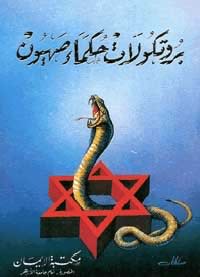
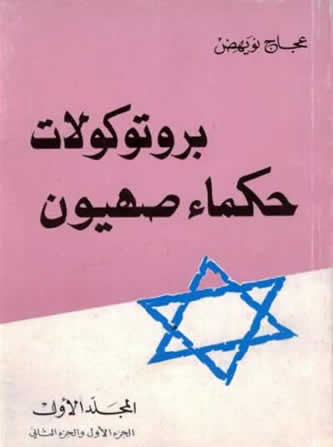
The website contains 24 Protocols translated by 'Ajaj Nuwayhid, a Lebanese Druze and a well-known figure in the Arab-Palestinian national movement (see Appendix D). The translation of The Protocols was taken by the Palestinian SIS from the website of the Islamic Da'wa Party, a Shiite party operating in Iraq. It should be noted that The Protocols, translated and edited by 'Ajaj Nuwayhid, were first published in Beirut in 1967 and later appeared in many editions in Syria and in Lebanon. In Syria, the book was published by the publishing house of Mustafa Tlass, a confidant of former Syrian President Hafez Assad and Syria's Defense Minister for many years.
It should be noted that the Internet serves as an important leverage for the spread of anti-Semitic publications on behalf of various countries, bodies and figures across the Arab/Muslim world. The example at hand well demonstrates how The Protocols are marketed by the Internet among Arab countries (and, subsequently, to Muslim/Arab communities across the world). It is our assessment that the translations of The Protocols spread via the Internet are based mostly upon versions published in Egypt, Syria and Lebanon. These three countries are the predominant source of anti-Semitic inflammatory publications, including The Protocols, which continue to top the bestseller lists in the Arab/Muslim world for over half a century.[5]
End Notes
1. Al-Nakbah - The Catastrophe: This term denotes the colossal failure - the "catastrophe" - of the armies of 7 Arab states. On May 15th 1948, they had launched an aggressive war, aimed at preventing the establishment of the new Jewish-Zionist State of Israel and replacing it with a Palestinian-Arab state (which was never created). The origins of this war lay in the Arabs' (including the Palestinians') total rejection of the UN General Assembly resolution of the 29th November 1947. This stipulated the establishment of a Jewish and an Arab state in (British Mandatory) Palestine. Thus, the Arab armies' invasion into Israel was launched in defiance of the UN and international law. Ever since, the 15th May marks Israel's independence, as opposed to the Palestinian-Arabs' catastrophe.
2. This information is taken from the State Information Service website: http://www.sis.gov.ps/arabic/aboutus.html.
3. Yossef Bodansky, Islamic Anti-Semitism as a Political Instrument (Hebrew; Tel-Aviv, Tammuz Publishing, 2000), p. 47. The book was also published in English by the Freeman Center for Strategic Studies (Houston, 1999).
4. See for example the introduction to the version of The Protocols published by the Syrian Dar al-Awael Publishing House (2005), pp. 11-13. The translation of the introduction appears in the Intelligence and Terrorism Information Center Bulletin dated March 1, 2005. 5. See the Intelligence and Terrorism Information Center website for examples of various Arabic versions of The Protocols: Intelligence and Terrorism Information Center .
--------------------------------------------------------------------------------
Appendix A: Characteristics of the Al-Nakba website
General
The Al-Nakba website belongs to the Palestinian Authority State Information Service (SIS),[6] an official institution of the Palestinian Authority. The website is available in two versions - one in the Arabic language and the other in English. Significant differences exist between the two versions, seeing as each one is addressed to different target audiences. The differences touch upon contents as well as the form of delivery. One of the primary differences is the inclusion of the Arabic translation of The Protocols of the Elders of Zion in the Arabic version, in the section on Zionism. In contrast, the translation of The Protocols does not appear in the English version.
--------------------------------------------------------------------------------
6. In Arabic: Al-Hay'a al-'Amma lil-Isti'lamat.
The operators of the website
The Al-Nakba website is stored on the server nakba.sis.gov.ps. The address alone makes it clear that the server belongs to the State Information Service (SIS), defined under the government domain name (gov) in the Palestinian Authority (ps). The logo that appears on the website (in both of its versions) is another indication of Al-Nakba's being an official Palestinian Authority website.
At the bottom of the posters and banners appearing on the website is the name of the organization in English (State Information Service) and in Arabic. There is also an address for contacting the managers of the website by e-mail (nakba@sis.gov.ps).
The contents of the website in its two versions
The major theme of the website is the Nakba - the events of 1948, the historical developments that preceded them and the problem of the Palestinian refugees. Documents, maps and various studies regarding the Nakba are used to support the Palestinian point of view.
The Arabic version of the website contains more extensive materials than its English counterpart. Several main sections in the Arabic version, such as maps, documents, studies and caricatures, do not appear in the English version at all. Even sections that appear in both versions and could have been expected to be identical do not necessarily contain the same information. Likewise, the wording in the English version is much more moderate than in the Arabic version.
Website updates
Most of Al-Nakba's webpages were last updated during the months of May-June 2004. The front page, providing the tone of the website, was last updated on June 3, 2004 in the Arabic version and on May 10, 2004 in the English version. Certain sections of the website in the English version are still "under construction" and it does not appear the website is being routinely updated. The webpage containing The Protocols of the Elders of Zion was last updated on May 12, 2004.
--------------------------------------------------------------------------------
Appendix B: The Protocols of the Elders of Zion on the Al-Nakba website
General characteristics
The webpage containing The Protocols of the Elders of Zion is only available in the Arabic version, as a subsection in a section titled The Historical Background of the Nakba, in the sub-part dealing with the Zionist movement (between the part dealing with the leaders of Zionism and the part dealing with the Balfour Declaration). The address of the webpage is http://nakba.sis.gov.ps/Zionism/Zionism-5.html.
The webpage contains 24 Protocols preceded by the following foreword: "Following is the translation by historian 'Ajaj Nuwayhid of the version of The Protocols that appeared in the 81st English edition, published in 1958 by Victor Marsden, based on the first edition published in Russian in 1905 by scholar Sergei Nilus."
The address of the website from which the translated Protocols were taken appears at the end of the text: الصفحة الرسمية لحزب الدعوة الاسلامية / تنŸ.
The above-mentioned website proclaims itself to be the official website of the Islamic Da'wa party, which is the shortened name of the Islamic Da'wa Party in Iraq. The website contains announcements on events happening in Iraq, interviews with prominent figures, articles and more. Among other things, on the left side of the website, under the Internet search box, appears a list of links to various articles, including the translation of The Protocols of the Elders of Zion. It is therefore the source of The Protocols that appear on the Palestinian Authority website, both relying on 'Ajaj Nuwayhid's translation and editing.
Think-Israel
Risultati da 1 a 10 di 10
-
06-12-10, 14:17 #1AvampostoOspite
 I Protocolli dei Savi Anziani di Sion nel mondo arabo
-
06-12-10, 14:17 #2AvampostoOspite Rif: I Protocolli dei Savi Anziani di Sion nel mondo arabo
Appendix D: 'Ajaj Nuwayhid - editor and translator of The Protocols of the Elders of Zion to Arabic[7]
'Ajaj Nuwayhid (1897-1982) - lawyer, writer, journalist, translator, public activist and political propagandist. He was born in the Lebanese town of Ras al-Matn to a Druze family whose Arabian ancestors had lived in Yemen's Asir region.[8] He acquired his primary and high-school education in local Christian missionary schools, where he formed both his anti-Semitic worldview and his feeling of affinity with the new Arab nationality that began to emerge in the Fertile Crescent at that time. It is likely that it was his feeling of affinity with the Arab nationality, rather than his Druze roots, that served as his main motivation for his diverse activities during his lifetime.
At the end of World War I, he joined the short-lived Arab government formed by Prince Faisal in Syria (1918-1920). After Faisal and his government were removed by the French, he left for Jerusalem (then under the British mandate) and was appointed (1923) Secretary of the Supreme Muslim Council, headed by Grand Mufti Haj Amin al-Husseini. At the same time, he was qualified as an advocate and opened a law office that remained active until 1948.
In 1932, Nuwayhid resigned his position and founded the weekly Al-Arab as well as a printing house (Matba'at al-Arab). Even though the weekly was independent, it expressed the worldview of the Arab nationality since it served as the periodical of the Arab Al-Istiqlal (independence) party. It was the first Arab party formed in Palestine during the British mandate and Nuwayhid was one of its 12 founders. The party preached to active resistance both against the British and the Zionist movement. The weekly had reporters in several major Arab cities ( Cairo, Damascus, Baghdad etc.); however, it ceased its activities in 1934. In the years 1932-1940, Nuwayhid also served as a reporter for Egyptian weekly Al-Ahram in "Palestine".
'Ajaj Nuwayhid took part in the large strike that broke out in 1936 (and marked the beginning of the so-called Arab Rebellion). He was arrested and put in Sarafand detention camp along with many of his colleagues. After his release, he continued his journalist work and in the years 1940-1944 served as the supervisor of the Arab division of the (British Mandate) Palestine Broadcasting Service. He set a number of conditions for his willingness to fill this position, mainly: the Arab division must remain independent from its counterpart Jewish division and from the mandate regime, and Jews must not be allowed to work in his division.
Following Israel's War of Independence, Nuwayhid had to leave "Palestine". He settled in Jordan and, owing to his close relations with King Abdallah, filled three positions: Head of the King's Office, Manager of the Jordanian Broadcasting Station and Director General of the Jordanian Government's then Publication Center - in the years 1949-1952 (it is probable that the murder of King Abdallah in 1952 was the cause for the termination of his government work). In 1959, Nuwayhid returned to Lebanon, his homeland, where he remained active until the day he died. In 1961, he published a series of articles in Al-Ahrar newspaper titled "Bearers of the Torch" [i.e., banner] in Literature, Science and Thought in Palestine." He also published several books and translated books from English to Arabic, including The Protocols.
The Arabic translation of The Protocols of the Elders of Zion
The crown jewel of Nuwayhid's translation work into Arabic was a translation from English of The Protocols of the Elders of Zion, published posthumously in Beirut, Lebanon in 1967 (in 4 parts divided into two volumes). In this context, there is a particular reference to this translation by Ya'qub al-'Udat, the main source of information on Nuwayhid: "Mr. Nuwayhid dedicated several years of his life to the preparation and translation of The Protocols of the Elders of Zion from English. This is one of the most important Zionist documents, and it appears to have been composed in 1897. [This document] unveils the hidden aims of the Jews, particularly [those included] in the Talmud etc. or [included] in biographies of senior Zionists in Palestine. It [the translation] was praised by the newspapers of the Arab world. In this context, Sa'id 'Aql, the Lebanese philosopher representing the genius of Lebanon, said [in an article] in the daily newspaper Al-Ahrar: "All those involved in politics in this era in the history of the Near East must read the book [i.e., translation] by researcher and scholar 'Ajaj Nuwayhid'".[9]
Ya'qub al-'Udat proceeds to mention that "the General Secretariat of the Arab League exhibited particular interest in the translation of The Protocols." It referred the foreign ministries of all Arab countries to the book in order to spread it among the Arab countries' embassies in the widest extent possible.[10]
Ya'qub al-'Udat, revealing his own anti-Semitic viewpoint, adds that "the appearance of the book was an important event that allowed the diplomat, the student, the researcher, and the Arab reader to explore the Zionist ploy in the world and its stages, hidden and overt. The importance of this book shall be preserved to the day the Arabs succeed in defeating the filthiest cancer ever to appear in their territorial area, both in the ancient and in the new world [i.e., the Jews and Israel]." It should be noted that Ya'qub al-'Udat's "prophecy" has indeed come true and 'Ajaj Nuwayhid's translation of The Protocols has become a bestseller and it is continuing to be published in Arab (including Palestinian) media to this day.
--------------------------------------------------------------------------------
7. This appendix is based primarily on Ya'qub al-'Udat's Min A'lam al-Fikr wal-Adab fi Filastin [(Selection of) the most prominent philosophers and intellectuals in Palestine ], third edition, Dar al-Isra', East Jerusalem, 1992, pp. 641-645, hereinafter: 'Ya'qub al-'Udat." We have also used Ahmed Abu Sa'ad's Mu'jam Asmaa al-Usar wal-Ashkhas wa-Lamahaat min Tarikh al-Aa'ilaat [Dictionary of Family Names and History of Families in Lebanon], Beirut, Dar al-'Ilm lil-Malayin, 1997, pp. 928-929.
8. Nowadays, the members of the family, over 30,000 people, are concentrated in the city of Abha in Saudi Arabia. Other branches of the family reside in Kuwait and in Lebanon.
9. Ya'qub al-'Udat, p. 645.
10. Ibid.
Dr Reuven Erlich (Colonel, Ret.) is Director of the Intelligence and Terrorism Information Center. The Center is located at the Center for Special Studies (C.S.S.), at Gelilot near Tel Aviv, and specializes in information about intelligence and terrorism. Contact him by mail at info@intelligence.org.il or go to the website: http://www.intelligence.org.il/eng/default.htm
Think-Israel
-
06-12-10, 14:19 #3AvampostoOspite Rif: I Protocolli dei Savi Anziani di Sion nel mondo arabo
-
06-12-10, 14:22 #4AvampostoOspite Rif: I Protocolli dei Savi Anziani di Sion nel mondo arabo
I Protocolli dei Savi Anziani di Sion nel mondo arabo e islamico
- di Dagoberto Husayn Bellucci , dir. resp. agenzia di stampa "Islam Italia"
- da Haret Hreik , Beirut - Libano
Il progetto politico rivoluzionario "Eurasia-Islam" le cui coordinate sono state segmento di milizia della nostra esperienza personale fin dall'epoca della nostra collaborazione a riviste quali "Avanguardia" e successivamente " Islam Italia" stabilisce un nesso di continuità ideologica tra l'esperienza delle Rivoluzioni Nazionali e Popolari dell'Ordine Nuovo nazionalsocialista europeo e l'Islam Tradizionale e Rivoluzionario esemplarmente incarnato dalla Repubblica Islamica dell'Iran e dalle nazioni arabe del fronte del rifiuto anti-sionista (che dopo la caduta del regime ba'athista irakeno si riducono alla Siria di Assad e al confinante Libano).
Il continuum storico tra Nazionalsocialismo europeo e Islam rivoluzionario affonda le sue radici nella comune identificazione di un nemico metafisico nel Giudaismo Internazionale e fissa le sue radici nel quadro di una lotta di autodeterminazione nazionale, indipendenza economica e volontà di riscatto.
Fisseremo nella rivolta palestinese degli anni 36-39 il momento storico nel quale si sono inverati rapporti di cooperazione tra le forze dell'Asse e le organizzazioni islamiche.
La rivolta palestinese sarà solamente un epigono di preesistenti relazioni che, fin dai primi anni Venti per quanto concerne il Fascismo italiano e dall'avvento al potere nel Gennaio 1933 per ciò che riguarderà il Nazionalsocialismo tedesco, le forze dell'Ordine Nuovo europeo intratterranno con le avanguardie rivoluzionarie del mondo arabo e musulmano.
La collaborazione che sarà avviata dalla Germania della Rivoluzione crociuncinata con le nazioni islamiche si riferisce anche all'adesione che le principali organizzazioni musulmane garantiranno alla Totalkampf Nazionalsocialista tedesca.
Tale adesione incondizionata , esemplarmente rappresentata dalla costituzione di numerose divisioni di SS musulmane, scandirà le affinità elettive di 'razza' tra Nazionalsocialismo e Islam quali manifestazioni e incarnazioni di Mitofanie eroico-tradizionali.
Il principale ispiratore della rivolta palestinese del triennio 36-39 sarà Haji Alì Amin al Husseini (1893 - 1974 ) il Gran Muftì della Palestina, la massima autorità spirituale del periodo in cui la Terrasanta sarà sottoposta al mandato giudaico-britannico di Sir Herbert Samuel autentico "principe d'Israele" investito dal Governo di S.M. britannica di presiedere all'amministrazione territoriale della terra "promessa" all'organizzazione sionista di Chaim Weizzman che la erediterà successivamente alla seconda guerra di aggressione giudaica contro l'Europa.
Designato fin dal 1921 dalle autorità mandatarie britanniche a diventare la guida religiosa dei musulmani di Palestina il Gran Muftì diverrà successivamente il presidente del Supremo Consiglio Musulmano di Terrasanta organismo direttamente responsabile - come oggi lo è il Waqf - dei Luoghi Sacri dell'Islam ovverosia della sacra Spianata delle Moschee o Haram el Shariff , la collina delle Moschee sul monte Moria dove sorgono le moschee di al-Aqsa e quella di Omar.
Allo scoppio dei tumulti anti-ebraici , provocati proprio da uno scontro avvenuto tra opposti manifestanti nella zona del muro del pianto rivendicato dai sionisti , Haji Amin sarà l'ispiratore principale della rivolta e successivamente il referente dei rivoluzionari palestinesi.
Condannato in contumacia dalle autorità britanniche al Husseini riuscirà a riparare prima in Siria e infine in Iraq dove, nei primi anni quaranta, sarà al lato dell'Organizzazione paramilitare del Quadrato d'Oro diretta da Rashyd el Kailani e da altri giovani ufficiali nazionalisti.
Quando nella primavera del 41 un putsch porterà i dirigenti del Quadrato d'Oro alla presidenza del Consiglio la Gran Bretagna risponderà con un autentica aggressione militare che - in pieno conflitto mondiale - spezzerà le rivendicazioni indipendentiste dei nazionalisti e dei militari iracheni.
A nulla varranno i pochi aiuti militari offerti in ritardo ad al-Kailani dalle potenze dell'Asse. La primavera anti-imperialista di Baghdad verrà sedata dalla repressione britannica e sia al Kailani che il Gran Muftì saranno costretti ad una fuga che , dal vicino Iran li porterà , attraverso i Balcani, in Germania e Italia.
Il Gran Muftì sarà prima a Roma e poi a Berlino dove lancerà i suoi proclami alla Jihàd per i musulmani europei e arabi al fianco delle potenze dell'Asse. Si costituiranno allora i primi nuclei di Waffen SS bosniache e albanesi che prenderanno parte alla Guerra nei Balcani.
Husseini sarà quindi in Croazia e Bosnia a dirigere le operazioni di reclutamento dei volontari che accorreranno numerosi nelle divisioni SS "Handschar" invocando nell'estate del 1942 la mobilitazione totale dei paesi musulmani contro l'Imperialismo anglo-americano e il bolscevismo.
Hitler riconoscerà il valore della Guida spirituale dei palestinesi accordando al suo ospite ampi spazi di manovra politica e di propaganda. Husseini potrà così disporre delle strutture del Partito Nazionalsocialista , parlerà alla moschea di Berlino e terrà conferenze oltre agli accorati appelli anti-sionisti diffusi da radio Berlino.
Arrestato nel 45 il Gran Muftì riuscirà nuovamente a scappare e a raggiungere il Cairo dove parteciperà alla costituzione della Lega Araba
L'antigiudaismo nazionalsocialista sarà preludio all'alleanza in chiave anti-sionista e antimperialista con il mondo arabo e islamico dove saranno evidenti le manifestazioni di solidarietà alla politica dell'Asse e al disegno dell'Ordine Nuovo nazionalsocialista europeo. La Germania nazionalsocialista era estranea a qualsiasi interesse di tipo colonialista in Africa o nel Vicino Oriente seguendo invece , in politica estera, le mire espansionistiche continentali verso l'Europa Orientale come del resto era stato anticipato , fin dalla metà degli anni Venti, da Adolf Hitler che nel suo "Mein Kampf" indicherà espressamente il rifiuto di qualsivoglia tentativo di conquista esterna al continente europeo.
Mentre il fascismo italiano, ancorato ad una visione colonialista e proiettato geopoliticamente nel bacino del mediterraneo, rappresentava una forza politica tendenzialmente ostile agli interessi nazionali del mondo arabo (e la repressione dell'ordine dei Senussi in Libia operata dall'esercito italiano nel periodo compreso tra il 1928 e il 1931 confermerà questa tendenza piccolo-imperialistica italiana) ; il Nazionalsocialismo tedesco rappresenterà per i movimenti indipendentisti e nazionalisti arabi e musulmani un alleato naturale contro il giogo anglo-francese e contro le pretese rivendicazioni ad uno Stato Nazionale degli ebrei e del movimento sionista internazionale.
Adolf Hitler non casualmente dichiarerà - in una delle sue ultime note trascritte da Bormann - che "il nostro alleato italiano ci ha intralciato dappertutto in Africa del Nord. Ci ha impedito di seguire una politica rivoluzionaria. Per forza di cose, questo spazio vitale divenne un monopolio italiano e, in quanto tale, fu preteso dal Duce. Solo noi potevamo liberare i paesi islamici controllati dalla Francia. Ciò avrebbe avuto immense ripercussioni in Egitto e nel Medio Oriente dove gli inglesi regnavano padroni." (1)
I capi nazionalisti arabi attendevano una svolta politica che spezzasse il clima di rassegnazione che regnava nelle principali cancellerie europee: la Gran Bretagna tiranneggiava i palestinesi e imponeva loro il massiccio afflusso di immigrati ebrei , la Francia aveva abdicato - dopo la Dichiarazione Balfour del 1917 e l'infami accordi di pace di Versailles - al suo ruolo di potenza cattolica su Gerusalemme e i Luoghi Santi della Palestina e l'Italia fascista oscillava tra un incondizionato 'balance of power' e una politica rivoluzionaria che veniva preclusa nel Mediterraneo dalle democrazie occidentali. Lo stesso Mussolini pur ritenendo un gravissimo errore politico l'idea di creare un focolare nazionale ebraico in Palestina non rinuncerà - tra il 1927 e il 1937 - a accattivarsi le simpatie di Weizzman e dell'Organizzazione Sionistica Internazionale ospitando anche i futuri quadri della marina militare israeliana che verranno addestrati presso la scuola di marina a Civitavecchia.
Il Nazionalsocialismo tedesco al contrario sembrò interessarsi subito dello scacchiere mediorientale in particolare delle nazioni arabe sottoposte al dominio coloniale francese.
"Dopo le prime agitazioni rivendicative ed il pogrom di Costantina nel 1934, l'Africa del Nord fu sempre più presentata come il tallone d'Achille della Francia. La propaganda nazista - scrive Stefano Fabei (2) - si intensificava ed il giornale cairota "Al Ahràm" , il 9 settembre del 1934, citando il "Telegraph" di Vienna , informava che per mezzo dell'Ufficio di Politica Estera diretta da Alfred Rosemberg, i Tedeschi svolgevano un'attivissima propaganda nel Maghreb, in Siria, in Palestina ed in Libano…"Sono stampati finora sessanta volumi in arabo per essere distribuiti nei paesi arabi. La propaganda nazista mira ad eccitare l'elemento arabo contro gli ebrei e contro la Francia e l'Inghilterra e a preparare la rivolta dell'Africa settentrionale…"
E' all'interno di questa operazione propagandistica - che non tarderà a dare i suoi frutti con le rivolte palestinesi del 36-39 e con la sollevazione irachena del Quadrato d'Oro due anni dopo - che si devono analizzare le fortune incontrate nel mondo islamico da un volume che non mancherà di focalizzare ed individuare nell'ebraismo cosmopolita e nel movimento sionista il principale nemico dell'Islam.
"I Protocolli dei Savi Anziani di Sion" rappresenteranno il programma di occupazione mondiale della setta occulta del Giudaismo : nell'introduzione alla prima edizione del 1903 Sergej Nilus illustrerà in maniera chiara il percorso del Serpente Simbolico indicando quale ultima tappa Costantinopoli prima del ritorno a Gerusalemme.
Gli avvenimenti della Rivoluzione bolscevica - diretta da elementi giudaici - e di quella del movimento laico e nazionalista dei Giovani Turchi confermarono che , dietro alle quinte della storia , una forza misteriosa stava decidendo i destini mondiali. Le "forze occulte" che determinarono l'avvento del comunismo ateo di stato e la vittoria del bolscevismo a Mosca erano le stesse che dirigevano il rapido processo di nazionalizzazione e di laicizzazione della Turchia all'indomani della Grande Guerra che aveva segnato la scomparsa dell'Impero Ottomano.
Dietro al mezzo ebreo Lenin si agitavano schiere di attivisti marxisti di razza ebraica così come in Turchia dietro ad Ataturk si muovevano gli elementi della setta cripto-ebraica dei Dummeh (eredi del messianismo sabbateo che nel XVII° secolo aveva infiammato i ghetti di mezza Europa) e le diverse logge massoniche operative e al servizio di Israele.
L'Internazionale Ebraica rappresentava un potere occulto al di sopra dei Governi nazionali. .L'alta finanza kahalica di Wall Street e quella della City di Londra soccorrevano i confratelli rivoluzionari bolscevichi di Mosca mentre assieme ai potentati ebraici di Parigi continuavano a finanziare il movimento sionista.
"I Protocolli dei Savi Anziani di Sion" identificavano chiaramente obiettivi e strategie del movimento sionista combacianti con l'evoluzione politica internazionale. La Grande Guerra mondiale era stata una Guerra Giudaica d'aggressione ai vecchi Imperi Centrali (Germania e Austria-Ungheria) , alla Russia zarista e all'Impero Ottomano. All'indomani del diktat di Versailles la Germania di Weimar era sottoposta al revanscismo francese in una condizione di vassallaggio , l'Austria-Ungheria non esisteva più come Impero multietnico creando un vuoto nella mitteleuropa foriero di future rivendicazioni e conflitti tra stati inventati sulla carta dagli apprendisti stregoni di Versailles (Cecoslovacchia, Ungheria, Austria, Yugoslavia ognuno di questi stati rappresentava un potenziale pericolo per i vicini oltre ad essere irrimediabilmente troppo deboli per resistere alla ventata rivoluzionaria bolscevica e al contraccolpo delle forze nazionali). L'Impero russo era stato spazzato via dal golpe ebraico di Lenin e dall'instaurazione di uno Stato che rappresentava una perenne minaccia alla stabilità internazionale. L'Impero Ottomano smembrato aveva dovuto cedere i suoi territori arabi al colonialismo franco-britannico ( con la Siria e il Libano caduti sotto il giogo francese e Palestina, Iraq e i territori dell'odierna Giordania sotto dominio britannico).
Di fronte a questi mutamenti nella politica mondiale non era dunque irrazionale l'esistenza di forze "occulte" operanti a livelli sovranazionali e al di fuori dei controlli dei Governi. L'Internazionale Ebraica per dirla con il più lucido studioso italiano dei movimenti occulti ovvero Giovanni Preziosi, direttore per un trentennio della "Vita Italiana" il quale , in un articolo pubblicato nel febbraio 1921 scriveva: "Chi ha letto le pagine precedenti non può che trarne le seguenti conclusioni: a) Esiste da secoli una organizzazione segreta, politica, internazionale, degli Ebrei, oltremodo potente. b) Essa possiede l'ambizione titanica di asservire il mondo al proprio dominio. c) Per raggiungere questo scopo , essa lavora da secoli a disgregare la compagine degli Stati a base nazionale, tenendo a conglomerarli in un complesso internazionale e mondiale, dominato e sfruttato da Israele. d) Il metodo da essa adoperato per indebolire prima e distruggere poi gli Stati politici, consiste nella propaganda fra le masse di idee determinanti la disorganizzazione, fatta secondo un programma abilmente calcolato: dal liberalismo al radicalismo, dal radicalismo al socialismo, dal socialismo al comunismo, dal comunismo all'anarchia (portando all'assurdo i principi di eguaglianza). Durante questi diversi tempi Israele ,chiuso nella duplice cintura della sua religione intollerante e del suo esclusivismo di razza, è rimasto immune da dottrine corrosive. e) I Saggi di Sion disprezzano profondamente i governi politici ed evoluti di Europa, la loro politica, le loro costituzioni democratiche. Per questi Saggi di Sion, il governare è un'arte sublime e segreta , che si conquista mediante una cultura tradizionale impartita a pochi eletti accuratamente selezionati. f) Data questa concezione di governo, le masse hanno poco valore e i loro condottieri sono delle marionette nelle mani dei Saggi di Sion. (…) L'agente maggiore per Israele per l'attuazione del terribile piano è stata ed è la banca. Invero, la banca internazionale ebraica, a mezzo dei suoi complici ha operato in Italia conformemente alle sue caratteristiche generali, mettendo cioè la banca nazionale sotto il dominio dell'alta finanza ebraica internazionale…." (3)
Sarà così grazie alla potenza dell'oro che la razza dei mercanti e degli usurai si assicurerà il potere economico dettando la propria legge alla politica , sottomettendo i Governi degli Stati nazionali europei ai suoi diktat di potenza. Israele attraverso il ricatto , le manovre segrete dei suoi emissari e le quinte colonne ebraiche infiltrate in tutti i posti di governo d'Europa riuscirà a creare le premesse per la creazione in Palestina della cosiddetta "homeland" per il popolo ebraico.
I Protocolli dei Savi di Sion cominciarono così a circolare anche nel mondo arabo e islamico. La prima traduzione di questo documento apparve sul "Raqib Sayyun" di Gerusalemme , un periodico della comunità latino-cattolica mentre una nuova traduzione dal francese apparirà intorno al 1922 al Cairo in forma di libro.
Una precedente edizione sembra sia stata data alle stampe a Damasco nel 1920 sempre per iniziativa dei circoli cristiani che reagivano con sdegno e disappunto all'instaurazione del protettorato britannico sulla Terrasanta.
"A mano a mano che il sionismo assumeva rilievo internazionale , tuttavia, gli antisemiti furono costretti a tenerne conto. - scriverà Sergio Romano nel suo "I falsi Protocolli" (4) - Nacque così , come sappiamo, la tesi secondo cui i Protocolli erano i verbali di riunioni tenutesi a Basilea durante il primo congresso sionista ed erano stati carpiti ad un delegato durante il viaggio di ritorno. La versione si adattava perfettamente al nazionalismo arabo e all'Islam intransigente. In Medio Oriente, dopo la dichiarazione di Balfour, era il sionismo, ancor più dell'Internazionale Ebraica, il nemico da combattere."
E sarà infatti dopo la seconda guerra mondiale e con la proclamazione dello Stato ebraico che i "Protocolli" troveranno terreno fertile in tutto il mondo arabo e islamico: al Cairo appariranno nel 1951 in una edizione che verrà ristampata diverse volte fino a diventare un autentico "best seller" (come li definirà un quotidiano libanese nel 1970). Il Ministero dell'Orientamento popolare e il Servizio di Informazioni della Repubblica Araba Unita creata da Nasser con la Siria ne daranno alle stampe nuove edizioni. In arabo i "Protocolli" vennero successivamente ristampati a Beirut (nel 64 e nel 67), in Arabia Saudita dove re Faysal usava farne dono alle delegazioni diplomatiche e agli ospiti che visitavano il Regno e in Siria dove - nel 1984 - il Generale Mustafà Tlass ,potente Ministro della Difesa e tra i massimi dirigenti del partito Ba'ath al potere a Damasco , darà alle stampe un volume intitolato "Azzima di Sion" nel quale studierà l'omicidio rituale ebraico di padre Thomas avvenuto nel 1840 nell'attuale capitale siriana. La stampa ebraica internazionale reagirà furiosamente istigando un coro di indignate proteste contro il Governo di Assad. Anche in Iran i "Protocolli" cominciarono a circolare fin dal 1948 ricevendo un forte impulso dopo la vittoria della Rivoluzione Islamica : nuove edizioni apparvero nel 79, 81, 85 e 86 per iniziativa di associazioni culturali islamiche. Attualmente i "Protocolli" sono liberamente in vendita nelle librerie del Cairo come a Damasco e a Beirut. In Libano la televisione del movimento sciita Hez'b'Allah ha riprodotto un serial siriano ispirato ai Protocolli mentre in Iran questi sono oggetto di analisi da parte della stampa specializzata e utilizzati dai quotidiani conservatori per lo studio dell'evoluzione politica internazionale.
Non dimentichiamo che questo volume sarebbe certamente un validissimo strumento analitico anche in Europa se - di fatto - non fosse stato messo all'indice dall'Inquisizione culturale sistemica e dalla prassi di aggressione della cultura anticonformista operata dai circoli sionisti.
Noi affermiamo che i "Protocolli dei Savi di Sion" sono un documento programmatico di conquista mondiale redatto da agenti dell'Internazionale Ebraica e conformi al modus operandi del Giudaismo cosmopolita quindi 'veritieri' nella prassi e nelle risultanze storiche….indipendentemente dalla loro indimostrabile "autenticità" che i mass media sionisti e le centrali di disinformazione ebraiche vorrebbero 'provare'.
Non c'è assolutamente un bel niente da dimostrare: l'ideale del Giudaismo è il Governo Mondiale sotto il tallone di Israele… una verità che conferma ancor più nitidamente di ottant'anni or sono la lucidità di analisi dei Protocolli.
"Uomini siate e non pecore matte , si che di voi fra voi 'l giudeo non rida" scriveva Dante Alighieri….
Note -
1 - Adolf Hitler - "Ultimi discorsi" - ediz. di "Ar" - Padova;
2 - Stefano Fabei - "La politica maghrebina del Terzo Reich" - ediz. All'Insegna del Veltro" - Parma 1988;
3 - Giovanni Preziosi - articolo "E in Italia?…" apparso su "La Vita Italiana" del Febbraio 1921 e riprodotto nell'edizione dei "Protocolli dei Savi Anziani di Sion" edita dalla stessa rivista nel 1938. L'edizione in questione riporta anche l'introduzione di Julius Evola il quale sottolineerà come : "…il problema della loro "autenticità" è secondario e da sostituirsi con quello, ben più serio ed essenziale, della loro "veridicità". Giovanni Preziosi già sedici anni or sono, nel pubblicare per la prima volta il testo, aveva ben messo in rilievo questo punto. La conclusione seria e positiva di tutta la polemica , che nel frattempo si è sviluppata, è la seguente: che quand'anche (cioè: dato e non concesso) i "Protocolli" non fossero "autentici" nel senso più stretto del termine, è come se lo fossero, per due ragioni capitali e decisive: 1) Perché i fatti ne dimostrano la verità. 2) Perché la loro corrispondenza con le idee-madre dell'Ebraismo tradizionale e moderno è incontestabile.".
Non casualmente, il 'caso' non esiste, Adolf Hitler scriverà nel suo "Mein Kampf" : "Il modo con cui tutta l'esistenza di un popolo può reggere su una menzogna eterna è posto mirabilmente in chiaro dai "Protocolli dei Savi Anziani di Sion" che gli ebrei perseguitano col loro odio più profondo. "Essi si fondano su una falsificazione" lamenta piagnucolando la "Gazzetta di Francoforte" ed in ciò sta la miglior prova che son veri. Ciò che molti ebrei saprebbero fare inconsciamente è qui consapevolmente dichiarato. Ed è quel che importa. Non importa invece sapere da quale cranio giudaico siano uscite tali rivelazioni, è essenziale però il fatto che essi scoprano con orrenda sicurezza la natura e l'attività del popolo ebraico, e li espongano nei loro rapporti intimi e nei loro scopi finali. La migliore critica è fatta naturalmente dalla realtà. Colui che esamini lo sviluppo storico degli ultimi cento anni alla luce di questo libro, capirà subito la ragione delle alte grida levate dalla stampa giudaica. Quando questo libro diventerà breviario di tutto il popolo, il pericolo ebraico potrà considerarsi scomparso."
4- Sergio Romano - "I falsi protocolli" - ediz. "Il Corbaccio" - Milano 1992;
31/07/2007
I Protocolli dei Savi Anziani di Sion nel mondo arabo e islamico | INSANIA JUDAICA
-
07-12-10, 11:08 #5email non funzionante


- Data Registrazione
- 26 Sep 2010
- Messaggi
- 1,609
-

- 0
-

- 4
- Mentioned
- 3 Post(s)
- Tagged
- 0 Thread(s)
Rif: I Protocolli dei Savi Anziani di Sion nel mondo arabo
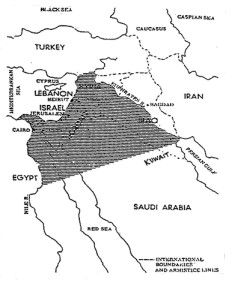
Il sogno sionista della "Grande Israele":
 “Non vi è socialismo senza nazionalizzazione e socializzazione delle industrie” STANIS RUINAS
-
07-12-10, 14:27 #6AvampostoOspite Rif: I Protocolli dei Savi Anziani di Sion nel mondo arabo
 Originariamente Scritto da stanis ruinas

Questi mica hanno capito che se continuano così altro che "Grande Israele"....nemmeno le frontiere del '67 riusciranno a mantenere.
Troppa arroganza: finiranno male, anzi malissimo. :giagia:
-
08-12-10, 11:33 #7email non funzionante
- Data Registrazione
- 26 Sep 2010
- Messaggi
- 1,609
-
- 0
-
- 4
- Mentioned
- 3 Post(s)
- Tagged
- 0 Thread(s)
Rif: I Protocolli dei Savi Anziani di Sion nel mondo arabo
In effetti sembra proprio di no perchè continuano a dimostrarsi arroganti verso il resto del pianeta. C'è gente non riesce proprio a vivere in pace. Originariamente Scritto da Avamposto
“Non vi è socialismo senza nazionalizzazione e socializzazione delle industrie” STANIS RUINAS
-
08-12-10, 11:34 #8email non funzionante
- Data Registrazione
- 26 Sep 2010
- Messaggi
- 1,609
-
- 0
-
- 4
- Mentioned
- 3 Post(s)
- Tagged
- 0 Thread(s)
Rif: I Protocolli dei Savi Anziani di Sion nel mondo arabo
La propaganda araba anti-israeliana e antisemita colpisce anche Obama
Nella sua rassegna di antiche doglianze, Obama non ha menzionato i milioni di musulmani – inclusi i palestinesi della West Bank, a Gaza – che hanno gioito per l’attacco all’America dell’11/9 perpetrato da fanatici islamici. Né si è lamentato per il fiorire di teorie complottiste anti-israeliane e anti-americane legate a quell’attacco verificatosi nel mondo musulmano, anche in Turchia. Ancora nel 2008, i sondaggi rivelavano che il numero dei turchi che indicavano Usa o Israele quali mandanti dell’11 settembre era tanto alto quanto quello dei turchi che davano la colpa a Osama bin Laden e al-Qaeda: in entrambi i casi, 39%.
Ancor più inquietante è stato il fatto che Obama abbia utilizzato la sua visita in Turchia per rompere con la politica Usa di trattare le nazioni che ospitano terroristi come nazioni nemiche. Il presidente Bush aveva dichiarato che non c’è spazio per la neutralità nella guerra contro il terrore: “O siete con noi, o contro di noi”. Ma Obama adesso rassicura i suoi ascoltatori in Turchia e in tutto il mondo musulmano che i loro governi non devono più fare una scelta tra America e al-Qaeda. “Le relazioni americane con il mondo musulmano – ha detto Obama – non possono e non debbono essere basate sull’opposizione ad al-Qaeda”.
La compiacenza di Obama verso la sensibilità araba e musulmana era già stata mostrata in modo alquanto imbarazzante qualche giorno prima, quando compì il gesto, senza precedenti per un presidente degli Stati Uniti, di fare un profondo inchino di fronte al re saudita Abdullah, sovrano di una nazione in cui è illegale portare con sé una Bibbia o costruire una chiesa, e dove alle donne non è permesso portare automobili. L’incidente ebbe luogo al summit economico del G-20 a Londra. Quando arrivarono le critiche per quel gesto di sottomissione al despota arabo, l’amministrazione fu colta di sorpresa e tentò di negare che la cosa fosse mai avvenuta. Purtroppo per la Casa Bianca, una telecamera aveva ripreso la scena.
Lo spostamento di Washington verso il mondo arabo entrò in una nuova fase due mesi più tardi, con il discorso di Obama al Cairo. Da una parte, il presidente difese le campagne militari in Medio Oriente in quanto “imposte dalle circostanze”, condannò la negazione dell’Olocausto e l’odio verso gli ebrei di cui trabocca il mondo arabo (e che i governi arabi promuovono), e si appellò ai palestinesi perché abbandonino la violenza contro Israele. Ma queste dichiarazioni sono state accompagnate da altre che appaiono particolarmente inquietanti alla luce delle mosse fatte in seguito dalla Casa Bianca.
Mentre Obama condannava, giustamente, l’Olocausto, lasciava però l’impressione che la legittimità di Israele derivi unicamente dall’eredità lasciata dall’antisemitismo europeo e dallo sterminio nazista di sei milioni di ebrei. Ciò riecheggia la propaganda araba secondo cui Israele è un problema creato dagli europei, e imposto arbitrariamente al mondo arabo. Ancora una volta Obama stava rilanciando un mito arabo volto a delegittimare lo stato di Israele.
L’Olocausto non è soltanto un’eredità europea. Stati mediorientali come Iran e Iraq si schierarono apertamente con Hitler; generali arabi servirono sotto Rommel, il comandante nazista in Africa; e lo sterminio degli ebrei ebbe il plauso e l’attiva collaborazione di capi arabi. Il fondatore della Fratellanza musulmana, Hassan al-Banna, era un ammiratore di Hitler e nel 1930 aveva adottato una traduzione in arabo del Mein Kampf come testo per i suoi discepoli. Haj Amin al-Husseini, il Grand Mufti di Gerusalemme nonché fondatore del nazionalismo palestinese, era un attivo e vociante sostenitore della “soluzione finale” nazista, e passò gli anni della guerra a Berlino reclutando arabi per la causa del Terzo Reich. Al-Husseini, un uomo il cui nome nella West Bank è riverito come se si trattasse del George Washington della causa palestinese, organizzò pogrom anti ebraici negli anni Venti e Trenta, progettò la realizzazione di un suo personale Auschwitz nel Medio Oriente, e venne bloccato nei suoi intenti soltanto dalla sconfitta di Rommel a El Alamein.
Il ritornello arabo secondo cui Israele non è altro che un tentativo dell’Europa di scaricare i suoi problemi sulle spalle degli arabi non tiene conto – come Obama – del fatto che Gerusalemme è stata la capitale spirituale del popolo ebraico per quasi tremila anni, e che gli ebrei hanno vissuto nella loro patria storica senza interruzione nel corso dei secoli. Gerusalemme è al centro della tradizione spirituale ebraica, e gli ebrei sono stati la sua più numerosa comunità religiosa sin dal 1864. Il primo ministro Benjamin Netanyahu è stato storicamente preciso quando ha ammonito Obama, dicendo che “il popolo ebraico stava costruendo Gerusalemme tremila anni fa, e la sta costruendo adesso. Gerusalemme non è un insediamento. E’ la nostra capitale”. Nel suo discorso del Cairo, Obama ha anche mostrato scarsa considerazione per la storia moderna di Israele, una nazione che non è stata costruita su terra araba – e ancor meno palestinese. Lo stato di Israele venne cerato sulle rovine dell’impero turco.
Nel 1922, la Gran Bretagna creò la Giordania, che racchiudeva l’80 per cento del Mandato di Palestina – una designazione geografica, non etnica. Il territorio del Mandato, nei quattro secoli precedenti, aveva fatto parte dell’impero turco (e non arabo). Poi, nel 1948, un “piano di divisione” dell’Onu distribuì la parte restante del Mandato agli arabi e agli ebrei che vivevano lungo le sponde del Giordano. Il piano, in definitiva, assegnava il 10% del Mandato di Palestina agli ebrei, il 90% agli arabi. Nulla di quelle terre è mai appartenuta a una nazione “palestinese”, o a una qualsiasi entità palestinese. Nei precedenti quattrocento anni non vi fu mai una provincia ottomana chiamata “Palestina”. L’intera regione su cui sorsero Giordania, Iraq, Libano, Siria, Israele, Gaza e la West Bank era conosciuta semplicemente come “Siria ottomana”.
In quello che poi divenne uno schema consueto, gli ebrei accettarono i termini grossolanamente iniqui di tale divisione. La loro fetta di territorio consisteva in tre regioni separate, il 60 per cento delle quali erano deserto. Gli arabi, che già avevano avuto l’80% del Mandato, rifiutarono l’ulteriore parte di terra che era stata loro assegnata, come avrebbero in seguito rifiutato qualsiasi accomodamento suscettibile di legittimare l’esistenza di uno stato ebraico.
Dall'Occidentale
La propaganda araba anti-israeliana e antisemita colpisce anche Obama | esperimento | Il Cannocchiale blog“Non vi è socialismo senza nazionalizzazione e socializzazione delle industrie” STANIS RUINAS
-
14-12-10, 17:09 #9email non funzionante
- Data Registrazione
- 26 Sep 2010
- Messaggi
- 1,609
-
- 0
-
- 4
- Mentioned
- 3 Post(s)
- Tagged
- 0 Thread(s)
Rif: I Protocolli dei Savi Anziani di Sion nel mondo arabo
 “Non vi è socialismo senza nazionalizzazione e socializzazione delle industrie” STANIS RUINAS
-
14-12-10, 17:10 #10email non funzionante
- Data Registrazione
- 26 Sep 2010
- Messaggi
- 1,609
-
- 0
-
- 4
- Mentioned
- 3 Post(s)
- Tagged
- 0 Thread(s)
Rif: I Protocolli dei Savi Anziani di Sion nel mondo arabo
 “Non vi è socialismo senza nazionalizzazione e socializzazione delle industrie” STANIS RUINAS

 Rispondi Citando
Discussioni Simili
-
I Protocolli dei savi anziani di Sion
Di Gianky nel forum StoriaRisposte: 41Ultimo Messaggio: 02-07-13, 20:01 -
I Protocolli Dei Savi Anziani Di Sion
Di Voltaire nel forum Destra RadicaleRisposte: 4Ultimo Messaggio: 15-01-09, 00:04 -
I Protocolli dei Savi Anziani di Sion
Di Siddharta nel forum Destra RadicaleRisposte: 17Ultimo Messaggio: 18-10-08, 20:21 -
I Protocolli dei Savi Anziani di Sion...
Di KriegerfurPDN nel forum EtnonazionalismoRisposte: 5Ultimo Messaggio: 12-11-06, 01:45
 Chi Ha Letto Questa Discussione negli Ultimi 365 Giorni: 0
 Permessi di Scrittura
Powered by vBulletin® Version 4.2.5
Copyright © 2026 vBulletin Solutions Inc. All rights reserved.
Change privacy settings
Copyright © 2026 vBulletin Solutions Inc. All rights reserved.
Change privacy settings
Tutti gli orari sono GMT +2. Adesso sono le 17:41.
