


Questo è South Park, giusto?Originariamente Scritto da Rexal

Risultati da 11 a 20 di 127
Discussione: Una comunista alla FED
-
09-10-13, 17:51 #11Bello e dannato


- Data Registrazione
- 05 Apr 2009
- Località
- Parma - Milano Due - Roma Nord
- Messaggi
- 17,464
-

- 2,606
-

- 4,809
- Mentioned
- 15 Post(s)
- Tagged
- 1 Thread(s)
 Re: Una comunista alla FED
L'arte di essere P.A.
Re: Una comunista alla FED
L'arte di essere P.A.
-
09-10-13, 17:51 #12Life sucks...

- Data Registrazione
- 30 Mar 2009
- Località
- ...and then you die.
- Messaggi
- 55,419
-
- 10,963
-
- 13,230
- Mentioned
- 6 Post(s)
- Tagged
- 0 Thread(s)
Re: Una comunista alla FED
Originariamente Scritto da Pieralvise
Sì...oddio, mancano le basi. Serve Segesto."Bad karma"
-
09-10-13, 23:51 #13Forumista esperto

- Data Registrazione
- 29 Mar 2010
- Località
- Non Rompere il Cazzo :D
- Messaggi
- 18,425
-
- 10,933
-
- 4,881
- Mentioned
- 52 Post(s)
- Tagged
- 1 Thread(s)
Re: Una comunista alla FED
Originariamente Scritto da Pieralvise
si si provvedo subito, Pieralvi' eccoti un video didattico amatoriale, Originariamente Scritto da Rexal
mi sembra proprio il caso (in italiano)
Ultima modifica di Segesto II; 09-10-13 alle 23:52
slava kokaini
-
10-10-13, 00:18 #14Libertarian

- Data Registrazione
- 13 Apr 2009
- Località
- Non oltre il 30° N
- Messaggi
- 29,079
-
- 529
-
- 8,818
- Mentioned
- 80 Post(s)
- Tagged
- 7 Thread(s)
Re: Una comunista alla FED
 I vincenti hanno sempre una soluzione ad ogni problema, i no(n)euro hanno sempre una scusa.
-
10-10-13, 00:20 #15SOVRANISTA ISRAELIANO


- Data Registrazione
- 04 Apr 2009
- Località
- Territori occupati della Cispadania/North Bank
- Messaggi
- 52,066
-
- 10,075
-
- 19,630
- Mentioned
- 783 Post(s)
- Tagged
- 66 Thread(s)
Re: Una comunista alla FED
Per i liberisti son tutti comunisti

dai raga state diventando ridicoli...CLAUDIA CONTE, TI AMO!
-
10-10-13, 00:21 #16Life sucks...
- Data Registrazione
- 30 Mar 2009
- Località
- ...and then you die.
- Messaggi
- 55,419
-
- 10,963
-
- 13,230
- Mentioned
- 6 Post(s)
- Tagged
- 0 Thread(s)
Re: Una comunista alla FED
I liberisti, eh? Originariamente Scritto da Robert
"Bad karma"
-
10-10-13, 00:25 #17SOVRANISTA ISRAELIANO
- Data Registrazione
- 04 Apr 2009
- Località
- Territori occupati della Cispadania/North Bank
- Messaggi
- 52,066
-
- 10,075
-
- 19,630
- Mentioned
- 783 Post(s)
- Tagged
- 66 Thread(s)
Re: Una comunista alla FED
sì, i liberisti Originariamente Scritto da Rexal
cioè questo mi critica la FED perchè continua col QE, ma cosa dovrebbero fare in tempi di recessione dove i soldi spariscono nei paesi emergenti e nelle nuvole della finanza?toglierne ulteriormente dal sistema?sarebbe suicidaCLAUDIA CONTE, TI AMO!
-
10-10-13, 01:07 #18acquenere

- Data Registrazione
- 17 Oct 2010
- Località
- Ragnarok
- Messaggi
- 18,092
-
- 5,927
-
- 5,649
- Mentioned
- 13 Post(s)
- Tagged
- 1 Thread(s)
Re: Una comunista alla FED
raga, io vorrei chiedervi un po' un opinione sulle recenti nazionalizzazioni avenute in italia (cassa d e p )
Ultima modifica di giacomo; 10-10-13 alle 01:08
-
10-10-13, 01:13 #19Vedo la mano invisibile

- Data Registrazione
- 30 Mar 2009
- Località
- Lussemburgo
- Messaggi
- 29,966
-
- 4,733
-
- 5,054
- Mentioned
- 140 Post(s)
- Tagged
- 3 Thread(s)
Re: Una comunista alla FED
Roberta pisella, dovresti capire che se si aggiungesse uno zero a tutte le banconote, o che se ne levasse uno, il numero di pagnotte in un dato luogo cmq non cambia. Originariamente Scritto da Robert
La verità produce effetti anche quando non può essere pronunciata.
L. von Mises
SILENDO LIBERTATEM SERVO
-
10-10-13, 01:41 #20Forumista esperto
- Data Registrazione
- 30 Mar 2009
- Messaggi
- 26,861
-
- 908
-
- 2,652
- Mentioned
- 32 Post(s)
- Tagged
- 5 Thread(s)
Re: Una comunista alla FED
Will Janet Yellen, a Woman and a Keynesian, Succeed Ben Bernanke at the Fed? : The New Yorker
With Ben Bernanke’s term as chairman of the Federal Reserve up at the end of January, 2014, the speculation about the identity of his successor is starting in earnest. Two recent articles in The Economist and at the Washington Post’s Wonkblog have both made Janet Yellen, who is currently Bernanke’s number two on the Fed’s board of governors, the firm favorite for the job. Slate’s Matt Yglesias reckons her accession isn’t even in doubt, saying bluntly, “it’ll be Janet Yellen.”
Other possible candidates include Larry Summers, Tim Geithner, and Bernanke himself, although it’s been widely reported that Geithner isn’t interested and Bernanke doesn’t want to be reappointed. Given Yellen’s résumé, she’s a justifiable favorite. Before taking her current job, in 2010, she served for six years as President of the San Francisco Fed, one of the twelve regional reserve banks. She’s also got political experience and close ties to the Democratic Party. From February of 1997 until August of 1999, during Bill Clinton’s second term, she headed up the White House Council of Economic Advisers.
A couple of things make Yellen’s candidacy intriguing. One of them, obviously, is her gender. Ever since its inception, central banking has been overwhelmingly a man’s world. If you don’t count Moscow, where Vladimir Putin recently appointed one of his aides, Elvira Nabiullina, to run the Central Bank of Russia, Yellen would be the first woman to run the central bank of an advanced nation. Given the Fed’s independence, and its capacity to lend and print money at will—a capacity demonstrated to great effect in recent years—the person who runs the institution is arguably the second most powerful person in the country. (And with Hillary Clinton the bookmakers’ favorite to win the Presidency in 2016, it’s conceivable that in a few years’ time the two most powerful people in the United States could be female.)
But it isn’t just Yellen’s second X chromosome that makes her interesting. In a field noted for its conservatism and adherence to free-market orthodoxy, she has long stood out as a lively and liberal thinker who resisted the rightward shift that many of her colleagues took in the eighties and nineties. More recently, at the Fed, she has strongly supported Bernanke’s unorthodox (but very necessary) efforts to revive the economy and bring down the unemployment rate, and to expand the Fed’s thinking beyond its traditional fixation with inflation. It isn’t widely appreciated by the public at large, but this process has already produced a significant shift toward targeting low unemployment. Last December, the Fed made an explicit commitment to keeping the federal funds rate—a key interest rate—at close to zero until the unemployment rate falls to 6.5 per cent.
In central banking, people who worry primarily about inflation are often referred to as “hawks” and those who prioritize unemployment are called “doves.” If Obama does appoint Yellen to chair the Fed, she will arguably be the most dovish figure to head the central bank since Marriner Eccles, the Mormon banker whom F.D.R. appointed during the depths of the Great Depression. As recently as last month, Yellen gave a speech to the National Association for Business Economics in which she made a provisional case for sticking with an expansionary policy even after the headline unemployment rate comes down, noting, “A decline in the unemployment rate could, for example, primarily reflect the exit from the labor force of discouraged job seekers.”
Don’t get me wrong: Yellen is no radical. In many ways, she strikes me as a traditional American Keynesian—a modern representative of the breed that stretches back through Joseph Stiglitz and Paul Krugman (in his later incarnation) to James Tobin, Robert Solow, and Walter Heller, and, from the founding generation, to Paul Samuelson and Alvin Hansen. Contrary to what some of its conservative critics claim, American Keynesianism isn’t a left-wing creed: like John Maynard Keynes himself, it seeks to preserve the system rather than overthrow it. But in order to do this, it relies on a program of active management of the economy, and using economic models to aid that process.
Shaped by their experiences in the Great Depression, many early U.S. Keynesians saw economics not just as a policy science, but as a blueprint for using the state to prevent slumps and to further social progress. Seeking to remedy market failures, they championed countercyclical monetary and fiscal policies (including, when necessary, sizable stimulus programs), public investments in infrastructure and education, progressive taxation, and a strong social safety net. Simply relying on the market wouldn’t get it done—that was their message.
Yellen’s recent policy pronouncements, and her earlier academic work, are very much in this tradition. Perhaps her most famous paper, which she co-wrote in 1986 with her husband, George Akerlof, a Nobel-winning economist, was about the theory of “efficiency wages.” It argued that, contrary to the free-market model, lower wages can lead to higher unemployment. Ten years later, Yellen and Akerlof challenged the notion that generous welfare benefits were responsible for a surge in illegitimate births, especially in the minority population. The real reason there were more unwed mothers, Yellen and Akerlof argued, was a change in social attitudes, particularly the decline of “shotgun marriages.” If their theory was right, they concluded, “[C]uts in welfare benefits will have little effect on out-of-wedlock births, serving mainly to lower the standard of living of the country’s poorest children. Better family planning education, birth control advice, and requirements forcing fathers to pay child support are more promising policies to reduce out-of-wedlock births.”
Since becoming the vice-chair of the Fed in 2010, Yellen, in arguing for expansionary policies, has consistently highlighted the human costs of the recession, particularly the high levels of unemployment and underemployment. In a speech to a Washington conference in February, she said:These are not just statistics to me. We know that long-term unemployment is devastating to workers and their families. Longer spells of unemployment raise the risk of homelessness and have been a factor contributing to the foreclosure crisis. When you’re unemployed for six months or a year, it is hard to qualify for a lease, so even the option of relocating to find a job is often off the table. The toll is simply terrible on the mental and physical health of workers, on their marriages, and on their children.Of course, being a good economist, she doesn’t rest her case for Fed activism just on humanitarian concerns. Instead, she went on:Long-term unemployment is also a great concern because it has the potential to itself become a headwind restraining the economy. Individuals out of work for an extended period can become less employable as they lose the specific skills acquired in their previous jobs and also lose the habits needed to hold down any job. Those out of work for a long time also tend to lose touch with former co-workers in their previous industry or occupation—contacts that can often help an unemployed worker find a job. Long-term unemployment can make any worker progressively less employable, even after the economy strengthens.In her speech to the National Association for Business Economics last month, she returned to the same theme, noting that “prolonged economic weakness could harm the economy’s productive potential for years to come.” And she coupled this warning with a clear message for her fellow members of the policy-making Federal Open Market Committee: “[W]ith employment so far from its maximum level and with inflation running below the Committee’s two-per-cent objective, I believe it’s appropriate for progress in the labor market to take center stage in the conduct of monetary policy.”
It Yellen does take over from Bernanke next February, there’s no reason to doubt that concern for the unemployed will remain her leitmotif. And that, ultimately, is what makes the prospect of her running the Fed so interesting.
Janet Yellen Biography
Janet L. Yellen is an expert on the economy who is widely believed to be President Barack Obama’s favored choice to replace Ben Bernanke as chairman of the Federal Reserve.
She would be the first woman to run the central bank of the United States, a position often described as the second most powerful position in the nation aside from that of president.
Bernanke’s term as Federal Reserve chairman ends in January 2014, and he is expected to step down instead of accepting a second term. Yellen holds the second-highest position on the Fed Board of Governors and is considered to be one of its most dovish members.
Economic Beliefs
Janet Yellen has been described as a “traditional American Keynesian” who has supported some of Bernanke’s more unorthodox policies in dealing with a troubled economy during The Great Recession.
She is a Democrat who is seen as a monetary policy “dove” whose views on the economy mesh with the Obama administration’s, particularly on high unemployment being a larger threat to the nation’s economy than inflation.
"Reducing unemployment should take center stage," Yellen has said.
"In a field noted for its conservatism and adherence to free-market orthodoxy, she has long stood out as a lively and liberal thinker who resisted the rightward shift that many of her colleagues took in the eighties and nineties," wrote the New Yorker’s John Cassidy.
Catherine Hollander of the National Journal described Yellen as “one of the most dovish members of the Fed's policy-setting committee, supporting continuation of the Fed's unconventional strategy of buying large amounts of bonds to get the economy growing as others ... call for an end to the purchases."
Wrote The Economist magazine: "An accomplished academic, Ms Yellen is a strong backer of Mr Bernanke’s expansionary policies and one of the most dovish members of the FOMC. Last year she made the case for a more sustained attack on unemployment with prolonged zero interest rates, even at the cost of temporarily higher inflation."
Criticism
Janet Yellen has drawn some criticism from conservatives for supporting Bernanke’s moves to purchase Treasury bonds and mortgage-backed securities, controversial efforts known as quantitative easing to boost the economy by lowering interest rates. Critics feel Yellen would act in a similar manner if she becomes chairman of the Federal Reserve.
Republican U.S. Sen. David Vitter of Louisiana, for example, has described efforts to stimulate the economy by keeping interest rates low as an artificial “sugar high” and would be among the lawmakers expected to be skeptical of a Yellen chairmanship.
"The cost of this open ended easy money policy dramatically outweighs the short term benefits,” Yellen has said about the Fed’s stimulus efforts. He has warned such maneuvers will eventually lead to “rampant inflation and potentially a return to a world with twenty percent interest rates."
Professional Career
Janet Yellen is the vice chair of the Federal Reserve System’s Board of Governor’s, a position she has held since October 2010. Her four-year term as vice chair ends on Oct. 4, 2014, according to a biography of her by the board.
Yellen had previously served as president and chief executive officer of the Twelfth District Federal Reserve Bank, in San Francisco.
A short biography of Yellen by the White House Council of Economic Advisers describes her as a “recognized scholar in international economics” who also specializes in macroeconomic issues such as the mechanisms and implications of unemployment.
Yellen is a professor emeritus of economics at the Haas School of Business at the University of California at Berkeley. She has been a faculty member there since 1980.
Yellen also taught at Harvard University from 1971 until 1976.
Work with the Fed
Yellen counseled the Fed Board of Governors on issues such as international trade and finance, specifically the stabilization of international currency exchange rates, from 1977 to 1978.
She was appointed to the board by President Bill Clinton in February 1994, and then named chair of the Council of Economic Advisers by Clinton in 1997.
Yellen also served on the Congressional Budget Office’s Panel of Economic Advisers and as a senior adviser to a Brookings Institution Panel on economic activity.
Education
Yellen graduated summa cum laude from Brown University in 1967 with a degree in economics. She earned a doctoral degree in economics from Yale University in 1971.
Personal Life
Yellen was born on August 13, 1946, in Brooklyn, N.Y.
She is married and has one child, a son, Robert. Her husband is George Akerlof, a Nobel Prize-winning economist and professor at the University of California, Berkeley. He is also a senior fellow at the Brookings Institution.
Meet Janet Yellen: Keynesian economist, Brown grad
yellen hopeNot only should progressives be happy with President Obama’s choice of Janet Yellen to chair the Federal Reserve, so should all Rhode Islanders. She’s not only a Keynesian economist, she’s also a 1967 graduate of Brown University, tweets her alma mater.
And, it turns out that Yellen was a lefty even before enrolling at Brown. According to Business Insider, a high school classmate described her as “a classic ’60s liberal. She has great faith in education as an answer to a lot of societal problems.”
As for her policies and priorities, the Wall Street Journal reports she “focused much of her academic research on the costs and causes of unemployment, has consistently called for the Fed to respond forcefully to high joblessness” and “she said the Fed might need to require the nation’s largest, most complex banks to carry even fatter capital cushions against losses than required by new rules set out by international regulators, a prospect hotly contested by big U.S. banks.”
Sounds pretty good to me. Even better, here’s what the New Yorker wrote about her policies in April:
In a field noted for its conservatism and adherence to free-market orthodoxy, she has long stood out as a lively and liberal thinker who resisted the rightward shift that many of her colleagues took in the eighties and nineties.
And last but certainly not least, here’s what our own progressive Senator Sheldon Whitehouse said about her nomination:
“Janet Yellen is highly qualified to serve as our next Fed chair, and I look forward to supporting her nomination in the Senate. At a time when our economy is still struggling, Ms. Yellen will bring the right priorities, and a lifetime of experience, to help us create jobs and provide a fair deal to the middle class.”


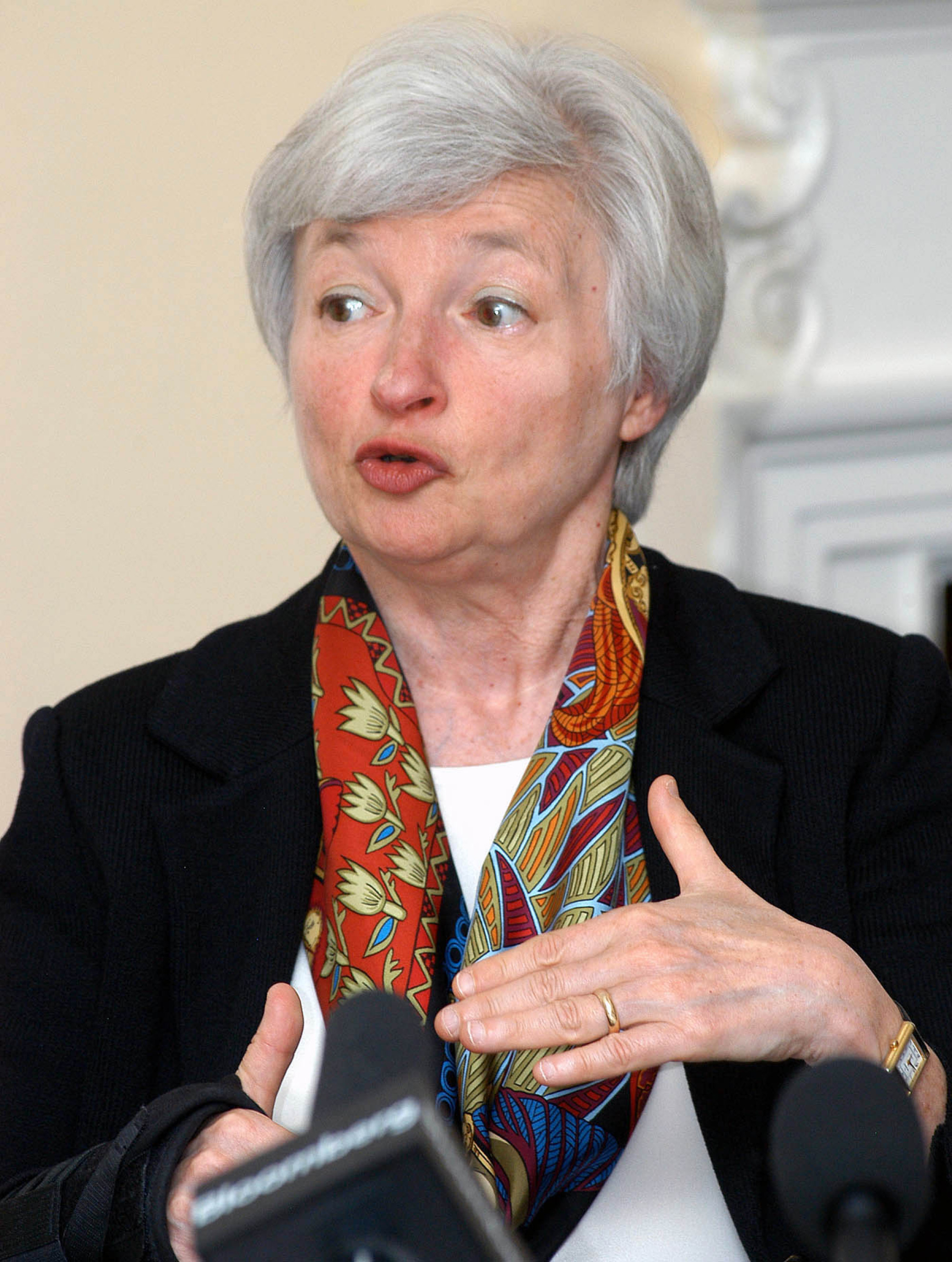
There is perhaps only one thing in their notoriously contentious discipline upon which all economists agree: Janet Yellen is unusually kind and decent. Sir Partha Dasgupta, now a professor at Cambridge who rented his house to her in the late 1970s, says: “If we were neighbours I can easily see myself discussing personal worries with her.”
After a bruising fight within the Democratic party over President Barack Obama’s preferred choice, Lawrence Summers, Ms Yellen is now the frontrunner to replace Ben Bernanke as chair of the US Federal Reserve. Ms Yellen’s trajectory through academia was steady rather than stellar but, at the age of 67, she is poised to take the tiller of the US economy. Yet it is not her warmth that has put Ms Yellen in this position. “I think that Janet is truly brilliant,” says Jim Adams, a professor at the University of Michigan, “and who knows brilliance better than a co-author”.
Janet Yellen: The economist tipped to be the first lady at the Fed - FT.com
Born in a working-class area of Brooklyn, New York, in 1946, her father was a family doctor who worked from the ground floor of their terraced house on Ridge Boulevard; her mother had taught elementary school but quit to look after Ms Yellen and her brother, who was four years older.
The family were Jewish, although not particularly observant. Academic success was prized, and Ms Yellen excelled at the local public high school where she was top of the year in just about everything. She picked up from her mother, who managed the family finances, an interest in stocks, economics and the business pages of the newspaper.
Attending Brown University in Rhode Island, she had intended to study maths but switched to economics because it was still rigorous but less abstract. Ms Yellen graduated with highest honours but her one appearance in the student newspaper, in 1966, was as a protester.
The dean of Pembroke – until 1971, the college for women attending Brown – had suspended a girl for failing to sign out of the college in order to spend the night in a man’s apartment. A photograph shows an earnest Ms Yellen with a Jackie Kennedy bob discussing reform of the Pembroke social code.
She went on to Yale to study for a doctorate with James Tobin, the great Keynesian economist and Nobel Prize winner. Joseph Stiglitz, another Nobel winner, also then at Yale, says Tobin’s views on the interplay of financial markets and the real economy made a deep impression on Yellen. “Janet very much understood the power of markets and the limitations of markets,” he said.
Later, she taught at Harvard (where one of her students was one Lawrence Summers). She became a staff economist at the Fed, but it did not last long, because she met a visiting research fellow called George Akerlof – later a Nobel Prize winner himself – in the cafeteria. They married and after a spell in London teaching at the London School of Economics, the couple eventually washed up in San Francisco, where Akerlof and Yellen were the names on the top of a long series of academic articles in the 1980s. Colleagues say they complemented each other: the intuitive Mr Akerlof came up with wild ideas. The rigorous Ms Yellen channelled them into careful, logical arguments.
Ms Yellen seemed destined for a career of relatively anonymous academic success until, in 1994, aged of 48, there was a phone call from the White House. She began a new career serving in succession as a Fed governor, chair of President Bill Clinton’s Council of Economic Advisers, head of the San Francisco Fed and – now – vice-chair of the Fed board of governors.
Before this summer she had seemed an obvious choice for the chair. Bradford DeLong, a fellow economist at the University of California, Berkeley, said she had “shown a better understanding of the state of the economy and the impact of economic policies than most of her peers at the Fed”.
As well as her record, she would offer the president an opportunity to appoint the first woman to lead the US central bank. Yet the White House wanted Mr Summers, a former Treasury secretary. In part this owes something to Mr Summers’ personal links to the Obama administration: he had been an adviser to the president and enjoyed his trust.
One question often asked about Ms Yellen – often with a scarcely disguised sexist subtext – is whether a person described as “lovely” and “delightful” can be tough enough to run the Fed. Her period in the sharp-elbowed Clinton White House was often difficult, according to those who worked with her.
But staff at the Fed found it amusing to see a Yellen appointment depicted as a soft option compared with the supposedly tempestuous Mr Summers. She has relentlessly pushed for the Fed to consider new communications policies during the past few years, and sometimes ruffled feathers among the staff.
“She was demanding of us, it’s true, but never in the light that ‘you will do this because I want this done’,” says Mary Daly, who worked for Ms Yellen at the San Francisco Fed. “She would never ask more of us than she would of herself, and always for the right reasons – to improve her policy decisions.”
But unlike those driven to prove themselves or fleeing personal demons by climbing the ladder of power, Ms Yellen seems motivated by genuine fascination with the questions she deals in. “I know it does sound too good to be true but she really does analyse issues to see where they take her,” says Michael Katz, a Berkeley colleague.
In private, friends say there is another side. “She has a really good sense of humour. Her husband can make her laugh until she’s almost in tears,” says Laura Tyson, a Berkeley professor who preceded Ms Yellen at the CEA. “I think she’s a well-adjusted person. I think she’s had a happy life.”
It seldom happens that a happy person rises to a position of highest authority. The plot could still twist – but, in the next few weeks, Ms Yellen may become the world’s most powerful economic policy maker.
Che bella scelta!Ultima modifica di Monsieur; 10-10-13 alle 01:51
Perché l'unico tipo di rapporto che riusciva a concepire era di tipo feudale. Non aveva la minima idea di cosa fosse il cameratismo al quale anelava l'anima. (E. M. Forster)


 Rispondi Citando
Discussioni Simili
-
Una comunista alla corte di Fini
Di orpheus nel forum Centrodestra ItalianoRisposte: 13Ultimo Messaggio: 27-03-11, 23:24 -
Una comunista alla corte di Fini
Di orpheus nel forum Politica NazionaleRisposte: 11Ultimo Messaggio: 27-03-11, 19:20 -
L'Unità giornale comunista .. ex-comunista ... o comunista travestito ?
Di la_pergola2000 nel forum RepubblicaniRisposte: 31Ultimo Messaggio: 23-05-08, 12:58 -
Un COMUNISTA STANLINISTA ALLA GUIDA DI POL
Di Gilbert nel forum Prima Repubblica di POLRisposte: 18Ultimo Messaggio: 06-11-06, 14:32 -
Pensierino comunista alla radio...
Di svicolone nel forum Politica NazionaleRisposte: 69Ultimo Messaggio: 02-10-05, 21:36
Tag per Questa Discussione

 Permessi di Scrittura
Powered by vBulletin® Version 4.2.5
Copyright © 2026 vBulletin Solutions Inc. All rights reserved.
Change privacy settings
Copyright © 2026 vBulletin Solutions Inc. All rights reserved.
Change privacy settings
Tutti gli orari sono GMT +2. Adesso sono le 23:13.
