


Collatio III, 15. 16. 18-19, in PL 49, 577-581.
Non è il libero arbitrio, ma è il Signore colui che scioglie le catene degli schiavi; non è la nostra virtù, ma è il Signore colui che solleva gli oppressi; non l’attenta lettura della Bibbia, ma la grazia del Signore dona la vista ai ciechi. Anzi, qui il testo greco del Libro sacro dice letteralmente: Il Signore rende sapienti i ciechi (cf Sal 145, 8). Non la nostra vigilanza ma il Signore custodisce i forestieri; non è la nostra forza, ma il Signore che sostiene tutti quelli che cadono.
Ho detto questo non perché il nostro zelo, le fatiche, gli sforzi siano inutili, in quanto vani e superflui; piuttosto per convincerci che senza l’aiuto del Signore siamo incapaci di applicazione e i nostri sforzi sono inefficaci per ottenere il premio ineffabile della purezza del cuore.
Per arrivare alla mèta, abbiamo assolutamente bisogno dell’aiuto e della misericordia di Dio. Si prepara il cavallo per il giorno della battaglia, ma l’uomo non trionferà nonostante la sua forza.
Gli apostoli compresero benissimo che tutto quanto riguarda la salvezza viene elargito da Dio. Perciò chiesero al Salvatore anche la fede: Signore, pregavano, aumenta la nostra fede (Lc 17, 5). Non aspettavano dal proprio libero arbitrio la pienezza di questa virtù, ma credevano di poterla ricevere soltanto come dono di Dio. Di più: l’autore stesso della nostra salvezza ci insegna a riconoscere l’incostanza, la debolezza, l’insufficienza permanente della nostra fede, quando l’aiuto divino non la fortifichi: Simone, Simone, ecco satana vi ha cercato per vagliarvi come il grano; ma io ho pregato per te, che non venga meno la tua fede (Lc 22, 31-32).
Un altro personaggio evangelico, forte dell’esperienza personale, sentiva la propria fede come sospinta dai flutti dell’incredulità contro gli scogli e pronta a naufragare. Allora pregava così rivolgendosi al Signore: Credo, aiutami nella mia incredulità (Mc 9, 24).
Gli apostoli e le altre figure del vangelo avevano perfettamente capito che nessun bene in noi arriva a compimento senza l’aiuto di Dio. Erano così convinti di non poter neppure conservare la fede con le sole forze del libero arbitrio, che chiedevano al Signore di stabilire in loro la fede e di conservarla.
Se la fede di Pietro aveva bisogno dell’aiuto di Dio per non venir meno, chi sarà tanto cieco e presuntuoso da credere di poterla custodire giorno dopo giorno senza quell’aiuto? Non è forse vero che il Signore stesso dichiara la nostra insufficienza quando dice nel vangelo: Come il tralcio non può far frutto da se stesso se non rimane nella vite, così anche voi se non rimanete in me. Senza di me non potete far nulla.
Quanto è stolto e sacrilego attribuire a noi stessi anziché al soccorso divino una parte minima delle nostre opere di bene. Lo afferma chiaramente la Scrittura quando dice che se la grazia non ci ispira e non coopera con noi, nessuno può produrre frutti spirituali: Ogni dono perfetto viene dall’alto e discende dal Padre della luce (Gc 1, 17).
Leggiamo in Ezechiele: Darò loro un cuore nuovo e uno spirito nuovo metterò dentro di loro; toglierò dal loro petto il cuore di pietra e darò loro un cuore di carne, perché seguano i miei decreti e osservino le mie leggi e li mettano in pratica; saranno il mio popolo e io sarò il loro Dio (Ez 11, 19-20).
Ora qui emerge una verità evidentissima: il primo moto della buona volontà ci viene da un’ispirazione di Dio. Egli ci attira sulla via della salvezza sia direttamente da se stesso, sia attraverso le esortazioni di qualche persona o mediante la forza delle cose. Anche la perfezione della virtù ci viene da Dio. Quello che possiamo mettere noi è la corrispondenza fervida o tiepida - agli impulsi della grazia. E meriteremo premio o castigo secondo che avremo avuto a cuore di accordare con i disegni generosi e pieni di amore della sua Provvidenza la nostra risposta obbediente e capace di dedizione.
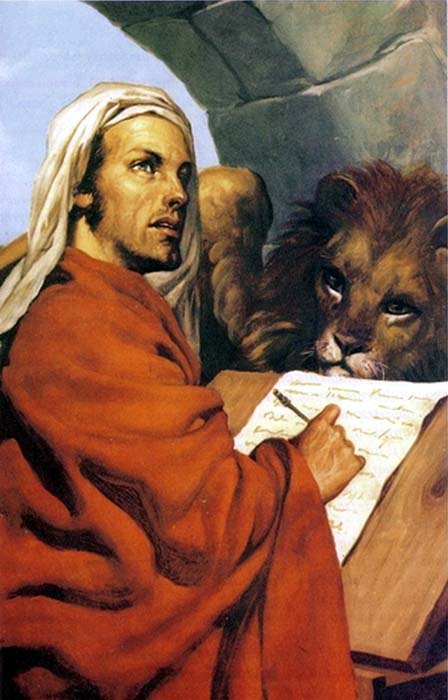
Risultati da 11 a 20 di 31
Discussione: 25 aprile - S. Marco evangelista
-
25-04-05, 08:26 #11**********


- Data Registrazione
- 04 Jun 2003
- Messaggi
- 23,775
-

- 18
-

- 35
- Mentioned
- 2 Post(s)
- Tagged
- 0 Thread(s)
 Dalle Conferenze di san Giovanni Cassiano.
-
24-04-06, 21:05 #12**********
- Data Registrazione
- 04 Jun 2003
- Messaggi
- 23,775
-
- 18
-
- 35
- Mentioned
- 2 Post(s)
- Tagged
- 0 Thread(s)
In rilievo
Aug.
-
25-04-06, 07:33 #13**********
- Data Registrazione
- 04 Jun 2003
- Messaggi
- 23,775
-
- 18
-
- 35
- Mentioned
- 2 Post(s)
- Tagged
- 0 Thread(s)
-
24-04-07, 16:55 #14**********
- Data Registrazione
- 04 Jun 2003
- Messaggi
- 23,775
-
- 18
-
- 35
- Mentioned
- 2 Post(s)
- Tagged
- 0 Thread(s)

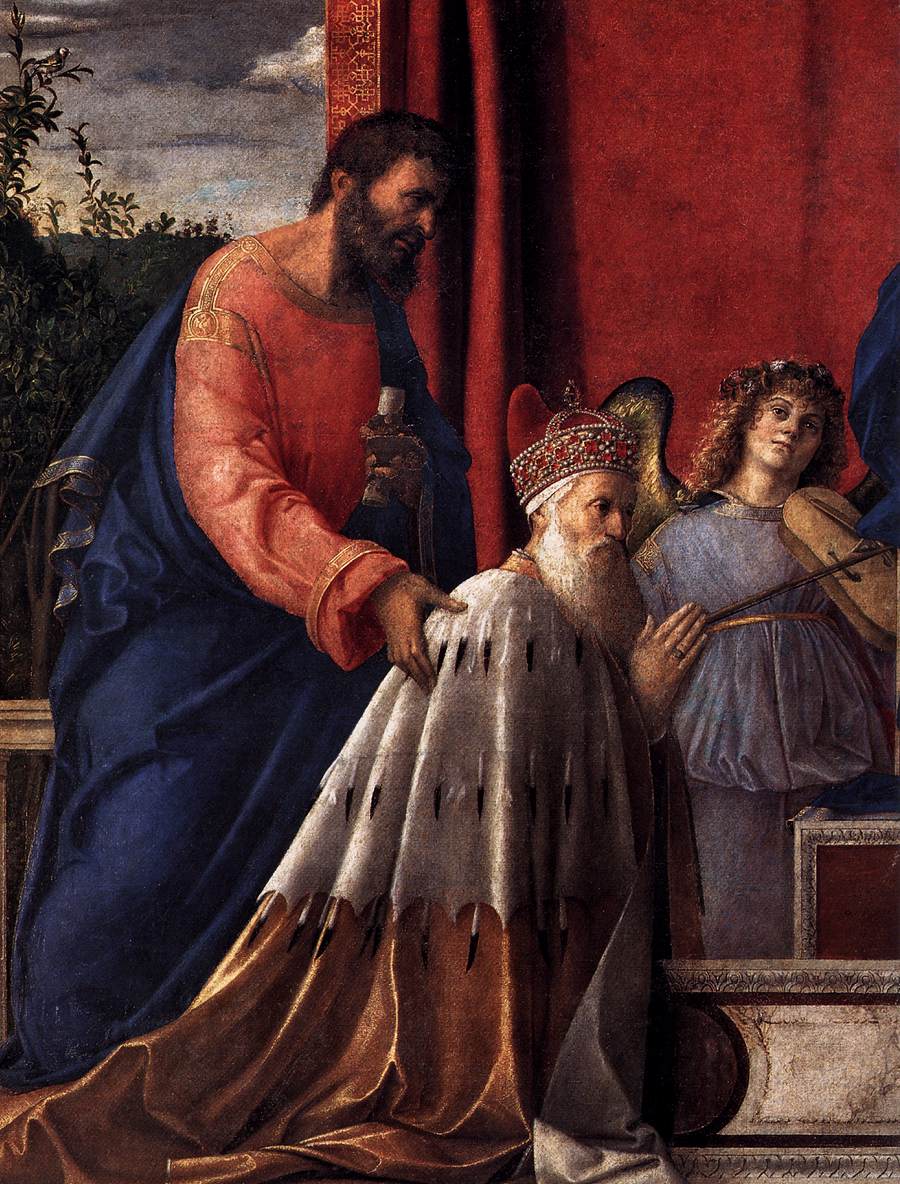 Giovanni Bellini, Altare Barbarigo, 1488, Chiesa di San Pietro Martire, Murano. La pala raffigura la Madonna col Bambino, circondata dai SS. Marco ed Agostino. S. Marco è in atto di presentare alla Vergine il doge Agostino Barbarigo
-
26-06-07, 14:34 #15**********
- Data Registrazione
- 04 Jun 2003
- Messaggi
- 23,775
-
- 18
-
- 35
- Mentioned
- 2 Post(s)
- Tagged
- 0 Thread(s)
Oggi, 25 giugno, nell'antico calendario liturgico proprio del Patriarcato di Venezia - peraltro ancora in vigore per la celebrazione della messa con il messale del 1962 -, ricorre la festa dell'apparizione (o "invenzione") di san Marco. La festa è poi stata abolita dopo il Concilio, anche se i precedenti storici di questa abolizione sono abbastanza remoti. Ma la Repubblica non consentì mai che fosse tolta la memoria del glorioso miracolo avvenuto il 25 giugno 1094. Si riporta qui una pagina di Silvio Tramontin, tratta dalla Biblioteca Agiografica Veneziana, sui fatti e le relative testimonianze. Il Coordinamento di Una Voce delle Venezie, per il suo statuto, invoca san Marco nel giorno della sua apparizione: secondo le testimonianze il corpo dell'Evangelista apparve rivestito dei paramenti sacerdotali "come se stesse per cantar messa", la messa di quella tradizione liturgica in cui ci riconosciamo e che intendiamo salvaguardare e promuovere.
Una Voce Venetia
________________
L' "inventio" di san Marco
di Silvio Tramontin
Ma le vicende del corpo di san Marco non erano ancora finite.
La primitiva chiesa a pianta centrale e anche ornata di affreschi o mosaici "multis ac variis coloribus" se vogliamo stare al racconto della "translatio" era andata distrutta durante l'incendio scoppiato nel 972 in seguito ad una rivolta popolare contro il doge Pietro Candiano IV e si era anche perduta ogni memoria circa il luogo ove la preziosa reliquia poteva essere stata posta anche perché esso era stato tenuto nascosto e noto a pochi per paura di un furto. Bernardo Giustinian, scrivendo quattro secoli dopo gli avvenimenti, riferirà una diceria che egli definirà però ingiusta: circolavano voci che c'era stato un furto delle sacre spoglie quasi a contrappeso del furto veneziano "ut quem aliunde sustulimus is furtim quoque fuerit a nobis ablatus". I veneziani sono disperati per tale fatto, tanto più che la nuova basilica è già ricostruita e sarebbe proprio un peccato aver perduto colui per il quale quella reggia era stata fabbricata. Dopo varie e inutili ricerche allora, nel giugno del 1094 il doge Vitale Falier stabilisce un digiuno di tre giorni con processione solenne nel quarto perché Venezia possa riavere il suo tesoro. Nei documenti locali è raccontato il fervore del popolo che invoca con preghiere e lacrime il miracolo. E il prodigio si compie. Le pietre di una colonna "calloprecia" ("ea est columna pluribus ex lapidibus compacta" come avverte Bernardo Giustinian, quasi a rendere più facile e comprensibile il miracolo e concordando del resto con i cronisti più antichi) a poco a poco si smuovono, cadono e lasciano apparire l'arca dove si trovava la salma. Un manoscritto anonimo del millecento e quindi contemporaneo precisa che si trattava di una delle poche colonne rimaste dell'antica chiesa e che il fatto avvenne il 25 giugno.
Altri miracoli fioriscono attorno a questo; un profumo meraviglioso che si spande nella basilica, un'indemoniata guarita al tocco dell'arca, naufraghi scampati da morte sicura, etc. Dal 25 giugno all'8 ottobre, se vogliamo prestar fede al monaco autore della "Translatio Sancti Nicolai" (sec. XII), il corpo rivestito dei paramenti sacerdotali, "totus integer et paratus quasi missam cantaret" (ancora tutto intatto e come se stesse per cantar messa), rimase esposto alla venerazione dei fedeli e l'ultimo giorno fu recato processionalmente nella cripta della splendida chiesa che, dopo essere stata ricostruita da capo a fondo dal doge Domenico Contarini (1043-1071), e ornata di mosaici dal doge Domenico Selvo (1071-1084), poteva essere solennemente consacrata (8 ottobre 1094). In quell'occasione furono anche coniate alcune monete col nome dell'imperatore Enrico IV, il simbolo del leone e l'iscrizione "Anno incarnacione ihesu xpi millesimo nonagesimo quarto die octavo inchoante mense octubrio tempore vitalis Faletri ducis" (alcune furono trovate nel 1811 quando si fece la ricognizione del corpo).
L'iscrizione del tempo, in caratteri romani, nella cornice di marmo rosso, sotto la ringhiera della navata principale poteva ben asserire
ISTORIIS AURO FORMA SPECIE TABULARUM
HOC TEMPLUM MARCI FORE DIC DECUS ECCLESIARUM
(Puoi ben dire che questo tempio di san Marco per la bellezza e l'eleganza dei suoi mosaici, delle storie che vi sono rappresentate e dell'oro che vi risplende è la più bella delle chiese).
da Silvio Tramontin, San Marco, in Culto dei Santi a Venezia, “Biblioteca Agiografica Veneziana 2”, Venezia, Studium Cattolico Veneziano, 1965, p. 57 s.
FONTE
-
25-04-08, 09:43 #16**********
- Data Registrazione
- 04 Jun 2003
- Messaggi
- 23,775
-
- 18
-
- 35
- Mentioned
- 2 Post(s)
- Tagged
- 0 Thread(s)
 Tintoretto, Sogno di S. Marco, 1562-66, Gallerie dell'Accademia, Venezia
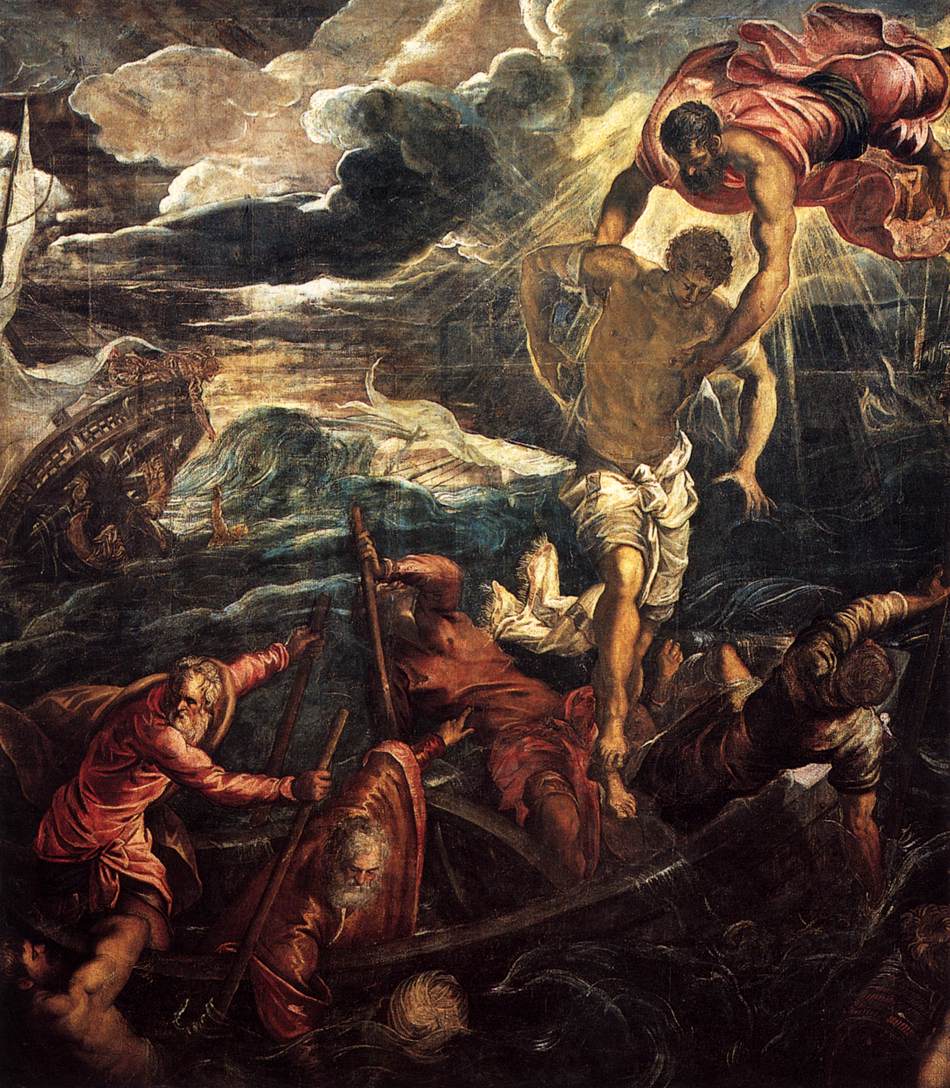

 Tintoretto, S. Marco salva un saraceno dal naufragio, 1562-66, Gallerie dell'Accademia, Venezia


 Tintoretto, Scoperta o invenzione del corpo di S. Marco , 1562-66, Pinacoteca di Brera, Milano
-
25-04-08, 09:43 #17**********
- Data Registrazione
- 04 Jun 2003
- Messaggi
- 23,775
-
- 18
-
- 35
- Mentioned
- 2 Post(s)
- Tagged
- 0 Thread(s)

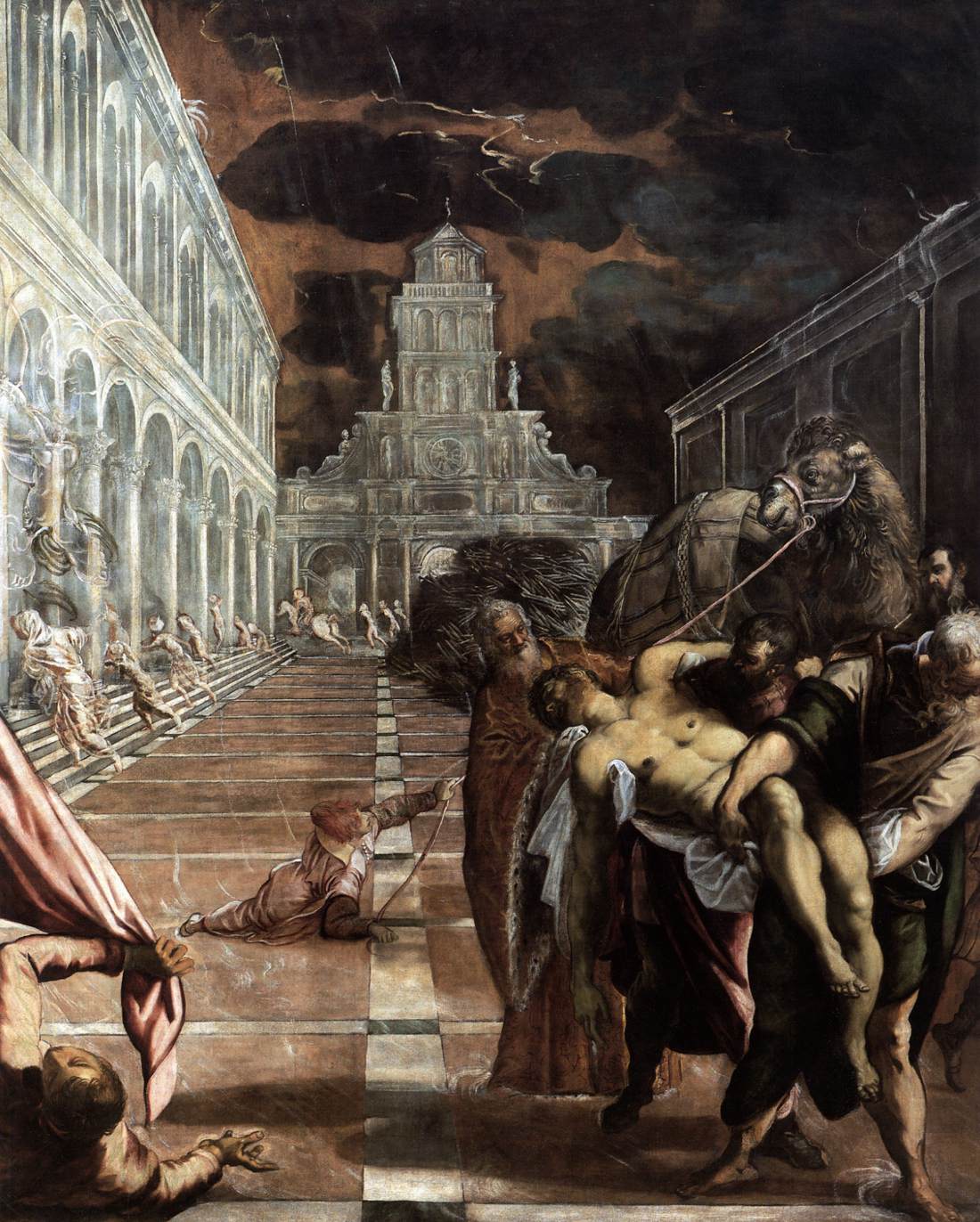
 Tintoretto, Trafugamento del corpo di S. Marco , 1562-66, Gallerie dell'Accademia, Venezia


 Tintoretto, Miracolo S. Marco che libera che uno schiavo, 1548, Gallerie dell'Accademia, Venezia
 Tintoretto, SS. Marco e Giovanni evangelisti, 1557, Santa Maria del Giglio, Venezia
-
25-04-08, 09:56 #18**********
- Data Registrazione
- 04 Jun 2003
- Messaggi
- 23,775
-
- 18
-
- 35
- Mentioned
- 2 Post(s)
- Tagged
- 0 Thread(s)
St. Mark
(Greek Markos, Latin Marcus).
It is assumed in this article that the individual referred to in Acts as John Mark (xii, 12, 25; xv, 37), John (xiii, 5, 13), Mark (xv, 39), is identical with the Mark mentioned by St. Paul (Colossians 4:10; 2 Timothy 4:11; Philemon 24) and by St. Peter (1 Peter 5:13). Their identity is not questioned by any ancient writer of note, while it is strongly suggested, on the one hand by the fact that Mark of the Pauline Epistles was the cousin (ho anepsios) of Barnabas (Colossians 4:10), to whom Mark of Acts seems to have been bound by some special tie (Acts 15:37, 39); on the other by the probability that the Mark, whom St. Peter calls his son (1 Peter 5:13), is no other than the son of Mary, the Apostle's old friend in Jerusalem (Acts 21:12). To the Jewish name John was added the Roman pronomen Marcus, and by the latter he was commonly known to the readers of Acts (xv, 37, ton kaloumenon Markon) and of the Epistles. Mark's mother was a prominent member of the infant Church at Jerusalem; it was to her house that Peter turned on his release from prison; the house was approached by a porch (pulon), there was a slave girl (paidiske), probably the portress, to open the door, and the house was a meeting-place for the brethren, "many" of whom were praying there the night St. Peter arrived from prison (Acts 12:12-13).
When, on the occasion of the famine of A.D. 45-46, Barnabas and Saul had completed their ministration in Jerusalem, they took Mark with them on their return to Antioch (Acts 12:25). Not long after, when they started on St. Paul's first Apostolic journey, they had Mark with them as some sort of assistant (hupereten, Acts 13:5); but the vagueness and variety of meaning of the Greek term makes it uncertain in what precise capacity he acted. Neither selected by the Holy Spirit, nor delegated by the Church of Antioch, as were Barnabas and Saul (Acts 13:2-4), he was probably taken by the Apostles as one who could be of general help. The context of Acts, xiii, 5, suggests that he helped even in preaching the Word. When Paul and Barnabas resolved to push on from Perga into central Asia Minor, Mark, departed from them, if indeed he had not already done so at Paphos, and returned to Jerusalem (Acts 13:13). What his reasons were for turning back, we cannot say with certainty; Acts, xv, 38, seems to suggest that he feared the toil. At any rate, the incident was not forgotten by St. Paul, who refused on account of it to take Mark with him on the second Apostolic journey. This refusal led to the separation of Paul and Barnabas, and the latter, taking Mark with him, sailed to Cyprus (Acts 15:37-40). At this point (A.D. 49-50) we lose sight of Mark in Acts, and we meet him no more in the New Testament, till he appears some ten years afterwards as the fellow-worker of St. Paul, and in the company of St. Peter, at Rome.
St. Paul, writing to the Colossians during his first Roman imprisonment (A.D. 59-61), says: "Aristarchus, my fellow prisoner, saluteth you, and Mark, the cousin of Barnabas, touching whom you have received commandments; if he come unto you, receive him" (Colossians 4:10). At the time this was written, Mark was evidently in Rome, but had some intention of visiting Asia Minor. About the same time St. Paul sends greetings to Philemon from Mark, whom he names among his fellow-workers (sunergoi, Philem., 24). The Evangelist's intention of visiting Asia Minor was probably carried out, for St. Paul, writing shortly before his death to Timothy at Ephesus, bids him pick up Mark and bring him with him to Rome, adding "for he is profitable to me for the ministry" (2 Timothy 4:11). If Mark came to Rome at this time, he was probably there when St. Paul was martyred. Turning to I Peter, v, 13, we read: "The Church that is in Babylon, elected together with you, saluteth you, and (so doth) Mark my son" (Markos, o huios aou). This letter was addressed to various Churches of Asia Minor (1 Peter 1:1), and we may conclude that Mark was known to them. Hence, though he had refused to penetrate into Asia Minor with Paul and Barnabas, St. Paul makes it probable, and St. Peter certain, that he went afterwards, and the fact that St. Peter sends Mark's greeting to a number of Churches implies that he must have been widely known there. In calling Mark his "son", Peter may possibly imply that he had baptized him, though in that case teknon might be expected rather than huios (cf. 1 Corinthians 4:17; 1 Timothy 1:2, 18; 2 Timothy 1:2; 2:1; Titus 1:4; Philemon 10). The term need not be taken to imply more than affectionate regard for a younger man, who had long ago sat at Peter's feet in Jerusalem, and whose mother had been the Apostle's friend (Acts 12:12). As to the Babylon from which Peter writers, and in which Mark is present with him, there can be no reasonable doubt that it is Rome. The view of St. Jerome: "St. Peter also mentions this Mark in his First Epistle, while referring figuratively to Rome under the title of Babylon" (De vir. Illustr., viii), is supported by all the early Father who refer to the subject. It may be said to have been questioned for the first time by Erasmus, whom a number of Protestant writers then followed, that they might the more readily deny the Roman connection of St. Peter. Thus, we find Mark in Rome with St. Peter at a time when he was widely known to the Churches of Asia Minor. If we suppose him, as we may, to have gone to Asia Minor after the date of the Epistle to the Colossians, remained there for some time, and returned to Rome before I Peter was written, the Petrine and Pauline references to the Evangelist are quite intelligible and consistent.
When we turn to tradition, Papias (Eusebius, "Hist. eccl.", III, xxxix) asserts not later than A.D. 130, on the authority of an "elder", that Mark had been the interpreter (hermeneutes) of Peter, and wrote down accurately, though not in order, the teaching of Peter (see below, MARK, GOSPEL OF SAINT, II). A widespread, if somewhat late, tradition represents St. Mark as the founder of the Church of Alexandria. Though strangely enough Clement and Origen make no reference to the saint's connection with their city, it is attested by Eusebius (op. cit., II, xvi, xxiv), by St. Jerome ("De Vir. Illust.", viii), by the Apostolic Constitutions (VII, xlvi), by Epiphanius ("Hær;.", li, 6) and by many later authorities. The "Martyrologium Romanum" (25 April) records: "At Alexandria the anniversary of Blessed Mark the Evangelist . . . at Alexandria of St. Anianus Bishop, the disciple of Blessed Mark and his successor in the episcopate, who fell asleep in the Lord." The date at which Mark came to Alexandria is uncertain. The Chronicle of Eusebius assigns it to the first years of Claudius (A.D. 41-4), and later on states that St. Mark's first successor, Anianus, succeeded to the See of Alexandria in the eighth year of Nero (61-2). This would make Mark Bishop of Alexandria for a period of about twenty years. This is not impossible, if we might suppose in accordance with some early evidence that St. Peter came to Rome in A.D. 42, Mark perhaps accompanying him. But Acts raise considerable difficulties. On the assumption that the founder of the Church of Alexandria was identical with the companion of Paul and Barnabas, we find him at Jerusalem and Antioch about A.D. 46 (Acts 12:25), in Salamis about 47 (Acts 13:5), at Antioch again about 49 or 50 (Acts 15:37-9), and when he quitted Antioch, on the separation of Paul and Barnabas, it was not to Alexandria but to Cyprus that he turned (Acts 15:39). There is nothing indeed to prove absolutely that all this is inconsistent with his being Bishop of Alexandria at the time, but seeing that the chronology of the Apostolic age is admittedly uncertain, and that we have no earlier authority than Eusebius for the date of the foundation of the Alexandrian Church, we may perhaps conclude with more probability that it was founded somewhat later. There is abundance of time between A.D. 50 and 60, a period during which the New Testament is silent in regard to St. Mark, for his activity in Egypt.
In the preface to his Gospel in manuscripts of the Vulgate, Mark is represented as having been a Jewish priest: "Mark the Evangelist, who exercised the priestly office in Israel, a Levite by race". Early authorities, however, are silent upon the point, and it is perhaps only an inference from his relation to Barnabas the Levite (Acts 4:36). Papias (in Eusebius, "Hist. eccl.", III, xxxix) says, on the authority of "the elder", that Mark neither heard the Lord nor followed Him (oute gar ekouse tou kurion oute parekoluthesen auto), and the same statement is made in the Dialogue of Adamantius (fourth century, Leipzig, 1901, p. 8), by Eusebius ("Demonst. Evang.", III, v), by St. Jerome ("In Matth."), by St. Augustine ("De Consens. Evang."), and is suggested by the Muratorian Fragment. Later tradition, however, makes Mark one of the seventy-two disciples, and St. Epiphanius ("Hær", li, 6) says he was one of those who withdrew from Christ (John 6:67). The later tradition can have no weight against the earlier evidence, but the statement that Mark neither heard the Lord nor followed Him need not be pressed too strictly, nor force us to believe that he never saw Christ. Many indeed are of opinion that the young man who fled naked from Gethsemane (Mark 14:51) was Mark himself. Early in the third century Hippolytus ("Philosophumena", VII, xxx) refers to Mark as ho kolobodaktulos, i.e. "stump-fingered" or "mutilated in the finger(s)", and later authorities allude to the same defect. Various explanations of the epithet have been suggested: that Mark, after he embraced Christianity, cut off his thumb to unfit himself for the Jewish priesthood; that his fingers were naturally stumpy; that some defect in his toes is alluded to; that the epithet is to be regarded as metaphorical, and means "deserted" (cf. Acts 13:13).
The date of Mark's death is uncertain. St. Jerome ("De Vir. Illustr.", viii) assigns it to the eighth year of Nero (62-63) (Mortuus est octavo Neronis anno et sepultus Alexandriæ), but this is probably only an inference from the statement of Eusebius ("Hist. eccl.", II, xxiv), that in that year Anianus succeeded St. Mark in the See of Alexandria. Certainly, if St. Mark was alive when II Timothy was written (2 Timothy 4:11), he cannot have died in 61-62. Nor does Eusebius say he did; the historian may merely mean that St. Mark then resigned his see, and left Alexandria to join Peter and Paul at Rome. As to the manner of his death, the "Acts" of Mark give the saint the glory of martyrdom, and say that he died while being dragged through the streets of Alexandria; so too the Paschal Chronicle. But we have no evidence earlier than the fourth century that the saint was martyred. This earlier silence, however, is not at all decisive against the truth of the later traditions. For the saint's alleged connection with Aquileia, see "Acta SS.", XI, pp. 346-7, and for the removal of his body from Alexandria to Venice and his cultus there, ibid., pp. 352-8. In Christian literature and art St. Mark is symbolically represented by a lion. The Latin and Greek Churches celebrate his feast on 25 April, but the Greek Church keeps also the feast of John Mark on 27 September.
Fonte: The Catholic Encyclopedia, vol. IX, 1910, New York
-
25-04-08, 10:02 #19**********
- Data Registrazione
- 04 Jun 2003
- Messaggi
- 23,775
-
- 18
-
- 35
- Mentioned
- 2 Post(s)
- Tagged
- 0 Thread(s)
Gospel of Saint Mark
The subject will be treated under the following heads:
- Contents, Selection and Arrangement of Matter;
- Authorship;
- Original Language, Vocabulary, and Style;
- State of Text and Integrity;
- Place and Date of Composition;
- Destination and Purpose;
- Relation to Matthew and Luke.
I. CONTENTS, SELECTION AND ARRANGEMENT OF MATTER
The Second Gospel, like the other two Synoptics, deals chiefly with the Galilean ministry of Christ, and the events of the last week at Jerusalem. In a brief introduction, the ministry of the Precursor and the immediate preparation of Christ for His official work by His Baptism and temptation are touched upon (i, 1-13); then follows the body of the Gospel, dealing with the public ministry, Passion, Death, and Resurrection of Jesus (i, 14-xvi, 8); and lastly the work in its present form gives a summary account of some appearances of the risen Lord, and ends with a reference to the Ascension and the universal preaching of the Gospel (xvi, 9-20). The body of the Gospel falls naturally into three divisions: the ministry in Galilee and adjoining districts: Phoenicia, Decapolis, and the country north towards Cæarea Philippi (i, 14-ix, 49); the ministry in Judea and (kai peran, with B, Aleph, C*, L, Psi, in x, 1) Peræ;, and the journey to Jerusalem (x, 1-xi, 10); the events of the last week at Jerusalem (xi, 11-xvi, 8).
Beginning with the public ministry (cf. Acts 1:22; 10:37), St. Mark passes in silence over the preliminary events recorded by the other Synoptists: the conception and birth of the Baptist, the genealogy, conception, and birth of Jesus, the coming of the Magi, etc. He is much more concerned with Christ's acts than with His discourses, only two of these being given at any considerable length (iv, 3-32; xiii, 5-37). The miracles are narrated most graphically and thrown into great prominence, almost a fourth of the entire Gospel (in the Vulg., 164 verses out of 677) being devoted to them, and there seems to be a desire to impress the readers from the outset with Christ's almighty power and dominion over all nature. The very first chapter records three miracles: the casting out of an unclean spirit, the cure of Peter's mother-in-law, and the healing of a leper, besides alluding summarily to many others (i, 32-34); and, of the eighteen miracles recorded altogether in the Gospel, all but three (ix, 16-28; x, 46-52; xi, 12-14) occur in the first eight chapters. Only two of these miracles (vii, 31-37; viii, 22-26) are peculiar to Mark, but, in regard to nearly all, there are graphic touches and minute details not found in the other Synoptics. Of the parables proper Mark has only four: the sower (iv, 3-9), the seed growing secretly (iv, 26-29), the mustard seed (iv, 30-32), and the wicked husbandman (xii, 1-9); the second of these is wanting in the other Gospels. Special attention is paid throughout to the human feelings and emotions of Christ, and to the effect produced by His miracles upon the crowd. The weaknesses of the Apostles are far more apparent than in the parallel narratives of Matt. and Luke, this being, probably due to the graphic and candid discourses of Peter, upon which tradition represents Mark as relying.
The repeated notes of time and place (e.g., i, 14, 19, 20, 21, 29, 32, 35) seem to show that the Evangelist meant to arrange in chronological order at least a number of the events which he records. Occasionally the note of time is wanting (e.g. i, 40; iii, 1; iv, 1; x, 1, 2, 13) or vague (e.g. ii, 1, 23; iv, 35), and in such cases he may of course depart from the order of events. But the very fact that in some instances he speaks thus vaguely and indefinitely makes it all the more necessary to take his definite notes of time and sequence in other cases as indicating chronological order. We are here confronted, however, with the testimony of Papias, who quotes an elder (presbyter), with whom he apparently agrees, as saying that Mark did not write in order: "And the elder said this also: Mark, having become interpreter of Peter, wrote down accurately everything that he remembered, without, however, recording in order what was either said or done by Christ. For neither did he hear the Lord, nor did he follow Him, but afterwards, as I said, (he attended) Peter, who adapted his instructions to the needs (of his hearers), but had no design of giving a connected account of the Lord's oracles [v. l. "words"]. So then Mark made no mistake [Schmiedel, "committed no fault"], while he thus wrote down some things (enia as he remembered them; for he made it his one care not to omit anything that he had heard, or set down any false statement therein" (Eusebius, "Hist. Eccl.", III, xxxix). Some indeed have understood this famous passage to mean merely that Mark did not write a literary work, but simply a string of notes connected in the simplest fashion (cf. Swete, "The Gospel acc. to Mark", pp. lx-lxi). The present writer, however, is convinced that what Papias and the elder deny to our Gospel is chronological order, since for no other order would it have been necessary that Mark should have heard or followed Christ. But the passage need not be understood to mean more than that Mark occasionally departs from chronological order, a thing we are quite prepared to admit. What Papias and the elder considered to be the true order we cannot say; they can hardly have fancied it to be represented in the First Gospel, which so evidently groups (e.g. viii-ix), nor, it would seem, in the Third, since Luke, like Mark, had not been a disciple of Christ. It may well be that, belonging as they did to Asia Minor, they had the Gospel of St. John and its chronology in mind. At any rate, their judgment upon the Second Gospel, even if be just, does not prevent us from holding that Mark, to some extent, arranges the events of Christ's like in chronological order.
II. AUTHORSHIP
All early tradition connects the Second Gospel with two names, those of St. Mark and St. Peter, Mark being held to have written what Peter had preached. We have just seen that this was the view of Papias and the elder to whom he refers. Papias wrote not later than about A.D. 130, so that the testimony of the elder probably brings us back to the first century, and shows the Second Gospel known in Asia Minor and attributed to St. Mark at that early time. So Irenæus says: "Mark, the disciple and interpreter of Peter, himself also handed down to us in writing what was preached by Peter" ("Adv. Hær.", III, i; ibid., x, 6). St. Clement of Alexandria, relying on the authority of "the elder presbyters", tells us that, when Peter had publicly preached in Rome, many of those who heard him exhorted Mark, as one who had long followed Peter and remembered what he had said, to write it down, and that Mark "composed the Gospel and gave it to those who had asked for it" (Eusebius, "Hist. Eccl.", VI, xiv). Origen says (ibid., VI, xxv) that Mark wrote as Peter directed him (os Petros huphegesato auto), and Eusebius himself reports the tradition that Peter approved or authorized Mark's work ("Hist. Eccl.", II, xv). To these early Eastern witnesses may be added, from the West, the author of the Muratorian Fragment, which in its first line almost certainly refers to Mark's presence at Peter's discourses and his composition of the Gospel accordingly (Quibus tamen interfuit et ita posuit); Tertullian, who states: "The Gospel which Mark published (edidit is affirmed to be Peter's, whose interpreter Mark was" ("Contra Marc.", IV, v); St. Jerome, who in one place says that Mark wrote a short Gospel at the request of the brethren at Rome, and that Peter authorized it to be read in the Churches ("De Vir. Ill.", viii), and in another that Mark's Gospel was composed, Peter narrating and Mark writing (Petro narrante et illo scribente--"Ad Hedib.", ep. cxx). In every one of these ancient authorities Mark is regarded as the writer of the Gospel, which is looked upon at the same time as having Apostolic authority, because substantially at least it had come from St. Peter. In the light of this traditional connexion of he Gospel with St. Peter, there can be no doubt that it is to it St. Justin Martyr, writing in the middle of the second century, refers ("Dial.", 106), when he sags that Christ gave the title of "Boanerges" to the sons of Zebedee (a fact mentioned in the New Testament only in Mark 3:17), and that this is written in the "memoirs" of Peter (en tois apopnemaneumasin autou--after he had just named Peter). Though St. Justin does not name Mark as the writer of the memoirs, the fact that his disciple Tatian used our present Mark, including even the last twelve verses, in the composition of the "Diatessaron", makes it practically certain that St. Justin knew our present Second Gospel, and like the other Fathers connected it with St. Peter.
If, then, a consistent and widespread early tradition is to count for anything, St. Mark wrote a work based upon St. Peter's preaching. It is absurd to seek to destroy the force of this tradition by suggesting that all the subsequent authorities relied upon Papias, who may have been deceived. Apart from the utter improbability that Papias, who had spoken with many disciples of the Apostles, could have been deceived on such a question, the fact that Irenæus seems to place the composition of Mark's work after Peter's death, while Origen and other represent the Apostle as approving of it (see below, V), shows that all do not draw from the same source. Moreover, Clement of Alexandria mentions as his source, not any single authority, but "the elders from the beginning" (ton anekathen presbuteron--Euseb., "Hist. Eccl.", VI, xiv). The only question, then, that can be raised with any shadow of reason, is whether St. Mark's work was identical with our present Second Gospel, and on this there is no room for doubt. Early Christian literature knows no trace of an Urmarkus different from our present Gospel, and it is impossible that a work giving the Prince of the Apostles' account of Christ's words and deeds could have disappeared utterly, without leaving any trace behind. Nor can it be said that the original Mark has been worked up into our present Second Gospel, for then, St. Mark not being the actual writer of the present work and its substance being due to St. Peter, there would have been no reason to attribute it to Mark, and it would undoubtedly have been known in the Church, not by the title it bears, but as the "Gospel according to Peter".
Internal evidence strongly confirms the view that our present Second Gospel is the work referred to by Papias. That work, as has been seen, was based on Peter's discourses. Now we learn from Acts (i, 21-22; x, 37-41) that Peter's preaching dealt chiefly with the public life, Death, Resurrection, and Ascension of Christ. So our present Mark, confining itself to the same limits, omitting all reference to Christ's birth and private life, such as is found in the opening chapters of Matthew and Luke, and commencing with the preaching of the Baptist, ends with Christ's Resurrection and Ascension. Again (1) the graphic and vivid touches peculiar to our present Second Gospel, its minute notes in regard to (2) persons, (3) places, (4) times, and (5) numbers, point to an eyewitness like Peter as the source of the writer's information. Thus we are told (1) how Jesus took Peter's mother-in-law by the hand and raised her up (i, 31), how with anger He looked round about on His critics (iii, 5), how He took little children into His arms and blessed them and laid His hands upon them (ix, 35; x, 16), how those who carried the paralytic uncovered the roof (ii, 3, 4), how Christ commanded that the multitude should sit down upon the green grass, and how they sat down in companies, in hundred and in fifties (vi, 39-40); (2) how James and John left their father in the boat with the hired servants (i, 20), how they came into the house of Simon and Andrew, with James and John (i, 29), how the blind man at Jericho was the son of Timeus (x, 46), how Simon of Cyrene was the father of Alexander and Rufus (xv, 21); (3) how there was no room even about the door of the house where Jesus was (ii, 2), how Jesus sat in the sea and all the multitude was by the sea on the land (iv, 1), how Jesus was in the stern of the boat asleep on the pillow (iv, 38); (4) how on the evening of the Sabbath, when the sun had set, the sick were brought to be cured (i, 32), how in the morning, long before day, Christ rose up (i, 35), how He was crucified at the third hour (xv, 25), how the women came to the tomb very early, when the sun had risen (xvi, 2); (5) how the paralytic was carried by four (ii, 3), how the swine were about two thousand in number (v. 13), how Christ began to send forth the Apostles, two and two (vi, 7). This mass of information which is wanting in the other Synoptics, and of which the above instances are only a sample, proved beyond doubt that the writer of the Second Gospel must have drawn from some independent source, and that this source must have been an eyewitness. And when we reflect that incidents connected with Peter, such as the cure of his mother-in-law and his three denials, are told with special details in this Gospel; that the accounts of the raising to life of the daughter of Jaïrus, of the Transfiguration, and of the Agony in the Garden, three occasions on which only Peter and James and John were present, show special signs of first-hand knowledge (cf. Swete, op. cit., p. xliv) such as might be expected in the work of a disciple of Peter (Matthew and Luke may also have relied upon the Petrine tradition for their accounts of these events, but naturally Peter's disciple would be more intimately acquainted with the tradition); finally, when we remember that, though the Second Gospel records with special fullness Peter's three denials, it alone among the Gospels omit all reference to the promise or bestowal upon him of the primacy (cf. Matthew 16:18-19; Luke 22:32; John 21:15-17), we are led to conclude that the eyewitness to whom St. Mark was indebted for his special information was St. Peter himself, and that our present Second Gospel, like Mark's work referred to by Papias, is based upon Peter's discourse. This internal evidence, if it does not actually prove the traditional view regarding the Petrine origin of the Second Gospel, is altogether consistent with it and tends strongly to confirm it.
III. ORIGINAL LANGUAGE, VOCABULARY, AND STYLE
It has always been the common opinion that the Second Gospel was written in Greek, and there is no solid reason to doubt the correctness of this view. We learn from Juvenal (Sat., III, 60 sq.; VI, 187 sqq.) and Martial (Epig., XIV, 58) that Greek was very widely spoken at Rome in the first century. Various influences were at work to spread the language in the capital of the Empire. "Indeed, there was a double tendency which embraced at once classes at both ends of the social scale. On the one hand among slaves and the trading classes there were swarms of Greek and Greek-speaking Orientals. On the other hand in the higher ranks it was the fashion to speak Greek; children were taught it by Greek nurses; and in after life the use of it was carried to the pitch of affectation" (Sanday and Headlam, "Romans", p. lii). We know, too, that it was in Greek St. Paul wrote to the Romans, and from Rome St. Clement wrote to the Church of Corinth in the same language. It is true that some cursive Greek manuscripts of the tenth century or later speak of the Second Gospel as written in Latin (egrathe Romaisti en Rome, but scant and late evidence like this, which is probably only a deduction from the fact that the Gospel was written at Rome, can be allowed on weight. Equally improbable seems the view of Blass (Philol. of the Gosp., 196 sqq.) that the Gospel was originally written in Aramaic. The arguments advanced by Blass (cf. also Allen in "Expositor", 6th series, I, 436 sqq.) merely show at most that Mark may have thought in Aramaic; and naturally his simple, colloquial Greek discloses much of the native Aramaic tinge. Blass indeed urges that the various readings in the manuscripts of Mark, and the variations in Patristic quotations from the Gospel, are relics of different translations of an Aramaic original, but the instances he adduces in support of this are quite inconclusive. An Aramaic original is absolutely incompatible with the testimony of Papias, who evidently contrasts the work of Peter's interpreter with the Aramaic work of Matthew. It is incompatible, too, with the testimony of all the other Fathers, who represent the Gospel as written by Peter's interpreter for the Christians of Rome.
The vocabulary of the Second Gospel embraces 1330 distinct words, of which 60 are proper names. Eighty words, exclusive of proper names, are not found elsewhere in the New Testament; this, however, is a small number in comparison with more than 250 peculiar words found in the Gospel of St. Luke. Of St. Mark's words, 150 are shared only by the other two Synoptists; 15 are shared only by St. John (Gospel); and 12 others by one or other of the Synoptists and St. John. Though the words found but once in the New Testament (apax legomena) are not relatively numerous in the Second Gospel, they are often remarkable; we meet with words rare in later Greek such as (eiten, paidiothen, with colloquialisms like (kenturion, xestes, spekoulator), and with transliterations such as korban, taleitha koum, ephphatha, rabbounei (cf. Swete, op. cit., p. xlvii). Of the words peculiar to St. Mark about one-fourth are non-classical, while among those peculiar to St. Matthew or to St. Luke the proportion of non-classical words is only about one-seventh (cf. Hawkins, "Hor. Synopt.", 171). On the whole, the vocabulary of the Second Gospel points to the writer as a foreigner who was well acquainted with colloquial Greek, but a comparative stranger to the literary use of the language.
St. Mark's style is clear, direct, terse, and picturesque, if at times a little harsh. He makes very frequent use of participles, is fond of the historical present, of direct narration, of double negatives, of the copious use of adverbs to define and emphasize his expressions. He varies his tenses very freely, sometimes to bring out different shades of meaning (vii, 35; xv, 44), sometimes apparently to give life to a dialogue (ix, 34; xi, 27). The style is often most compressed, a great deal being conveyed in very few words (i, 13, 27; xii, 38-40), yet at other times adverbs and synonyms and even repetitions are used to heighten the impression and lend colour to the picture. Clauses are generally strung together in the simplest way by kai; de is not used half as frequently as in Matthew or Luke; while oun occurs only five times in the entire Gospel. Latinisms are met with more frequently than in the other Gospels, but this does not prove that Mark wrote in Latin or even understood the language. It proves merely that he was familiar with the common Greek of the Roman Empire, which freely adopted Latin words and, to some extent, Latin phraseology (cf. Blass, "Philol. of the Gosp.", 211 sq.), Indeed such familiarity with what we may call Roman Greek strongly confirms the traditional view that Mark was an "interpreter" who spent some time at Rome.
IV. STATE OF TEXT AND INTEGRITY
The text of the Second Gospel, as indeed of all the Gospels, is excellently attested. It is contained in all the primary unical manuscripts, C, however, not having the text complete, in all the more important later unicals, in the great mass of cursives; in all the ancient versions: Latin (both Vet. It., in its best manuscripts, and Vulg.), Syriac (Pesh., Curet., Sin., Harcl., Palest.), Coptic (Memph. and Theb.), Armenian, Gothic, and Ethiopic; and it is largely attested by Patristic quotations. Some textual problems, however, still remain, e.g. whether Gerasenon or Gergesenon is to be read in v, 1, eporei or epoiei in vi, 20, and whether the difficult autou, attested by B, Aleph, A, L, or autes is to be read in vi, 20. But the great textual problem of the Gospel concerns the genuineness of the last twelve verses. Three conclusions of the Gospel are known: the long conclusion, as in our Bibles, containing verses 9-20, the short one ending with verse 8 (ephoboumto gar), and an intermediate form which (with some slight variations) runs as follows: "And they immediately made known all that had been commanded to those about Peter. And after this, Jesus Himself appeared to them, and through them sent forth from East to West the holy and incorruptible proclamation of the eternal salvation." Now this third form may be dismissed at once. Four unical manuscripts, dating from the seventh to the ninth century, give it, indeed, after xvi, 9, but each of them also makes reference to the longer ending as an alternative (for particulars cf. Swete, op. cit., pp. cv-cvii). It stands also in the margin of the cursive Manuscript 274, in the margin of the Harclean Syriac and of two manuscripts of the Memphitic version; and in a few manuscripts of the Ethiopic it stands between verse 8 and the ordinary conclusion. Only one authority, the Old Latin k, gives it alone (in a very corrupt rendering), without any reference to the longer form. Such evidence, especially when compared with that for the other two endings, can have no weight, and in fact, no scholar regards this intermediate conclusion as having any titles to acceptance.
We may pass on, then, to consider how the case stands between the long conclusion and the short, i.e. between accepting xvi, 9-20, as a genuine portion of the original Gospel, or making the original end with xvi, 8. In favour of the short ending Eusebius ("Quaest. ad Marin.") is appealed to as saying that an apologist might get rid of any difficulty arising from a comparison of Matt. xxviii, 1, with Mark, xvi, 9, in regard to the hour of Christ's Resurrection, by pointing out that the passage in Mark beginning with verse 9 is not contained in all the manuscripts of the Gospel. The historian then goes on himself to say that in nearly all the manuscripts of Mark, at least, in the accurate ones (schedon en apasi tois antigraphois ... ta goun akribe, the Gospel ends with xvi, 8. It is true, Eusebius gives a second reply which the apologist might make, and which supposes the genuineness of the disputed passage, and he says that this latter reply might be made by one "who did not dare to set aside anything whatever that was found in any way in the Gospel writing". But the whole passage shows clearly enough that Eusebius was inclined to reject everything after xvi, 8. It is commonly held, too, that he did not apply his canons to the disputed verses, thereby showing clearly that he did not regard them as a portion of the original text (see, however, Scriv., "Introd.", II, 1894, 339). St. Jerome also says in one place ("Ad. Hedib.") that the passage was wanting in nearly all Greek manuscripts (omnibus Græciæ; libris poene hoc capitulum in fine non habentibus), but he quotes it elsewhere ("Comment. on Matt."; "Ad Hedib."), and, as we know, he incorporated it in the Vulgate. It is quite clear that the whole passage, where Jerome makes the statement about the disputed verses being absent from Greek manuscripts, is borrowed almost verbatim from Eusebius, and it may be doubted whether his statement really adds any independent weight to the statement of Eusebius. It seems most likely also that Victor of Antioch, the first commentator of the Second Gospel, regarded xvi, 8, as the conclusion. If we add to this that the Gospel ends with xvi, 8, in the two oldest Greek manuscripts, B and Aleph, in the Sin. Syriac and in a few Ethiopic manuscripts, and that the cursive Manuscript 22 and some Armenian manuscripts indicate doubt as to whether the true ending is at verse 8 or verse 20, we have mentioned all the evidence that can be adduced in favour of the short conclusion. The external evidence in favour of the long, or ordinary, conclusion is exceedingly strong. The passage stands in all the great unicals except B and Aleph--in A, C, (D), E, F, G, H, K, M, (N), S, U, V, X, Gamma, Delta, (Pi, Sigma), Omega, Beth--in all the cursives, in all the Latin manuscripts (O.L. and Vulg.) except k, in all the Syriac versions except the Sinaitic (in the Pesh., Curet., Harcl., Palest.), in the Coptic, Gothic, and most manuscripts of the Armenian. It is cited or alluded to, in the fourth century, by Aphraates, the Syriac Table of Canons, Macarius Magnes, Didymus, the Syriac Acts of the Apostles, Leontius, Pseudo-Ephraem, Cyril of Jerusalem, Epiphanius, Ambrose, Augustine, and Chrysostom; in the third century, by Hippolytus, Vincentius, the "Acts of Pilate", the "Apostolic Constitutions", and probably by Celsus; in the second, by Irenæus most explicitly as the end of Mark's Gospel ("In fine autem evangelii ait Marcus et quidem dominus Jesus", etc.--Mark xvi, 19), by Tatian in the "Diatessaron", and most probably by Justin ("Apol. I", 45) and Hermas (Pastor, IX, xxv, 2). Moreover, in the fourth century certainly, and probably in the third, the passage was used in the Liturgy of the Greek Church, sufficient evidence that no doubt whatever was entertained as to its genuineness. Thus, if the authenticity of the passage were to be judged by external evidence alone, there could hardly be any doubt about it.
Much has been made of the silence of some third and fourth century Father, their silence being interpreted to mean that they either did not know the passage or rejected it. Thus Tertullian, SS. Cyprian, Athanasius, Basil the Great, Gregory of Nazianzus, and Cyril of Alexandria are appealed to. In the case of Tertullian and Cyprian there is room for some doubt, as they might naturally enough to be expected to have quoted or alluded to Mark, xvi, 16, if they received it; but the passage can hardly have been unknown to Athanasius (298-373), since it was received by Didymus (309-394), his contemporary in Alexandria (P.G., XXXIX, 687), nor to Basil, seeing it was received by his younger brother Gregory of Nyssa (P.G., XLVI, 652), nor to Gregory of Nazianzus, since it was known to his younger brother Cæsarius (P.G., XXXVIII, 1178); and as to Cyril of Alexandria, he actually quotes it from Nestorius (P.G., LXXVI, 85). The only serious difficulties are created by its omission in B and Aleph and by the statements of Eusebius and Jerome. But Tischendorf proved to demonstration (Proleg., p. xx, 1 sqq.) that the two famous manuscripts are not here two independent witnesses, because the scribe of B copies the leaf in Aleph on which our passage stands. Moreover, in both manuscripts, the scribe, though concluding with verse 8, betrays knowledge that something more followed either in his archetype or in other manuscripts, for in B, contrary to his custom, he leaves more than a column vacant after verse 8, and in Aleph verse 8 is followed by an elaborate arabesque, such as is met with nowhere else in the whole manuscript, showing that the scribe was aware of the existence of some conclusion which he meant deliberately to exclude (cf. Cornely, "Introd.", iii, 96-99; Salmon, "Introd.", 144-48). Thus both manuscripts bear witness to the existence of a conclusion following after verse 8, which they omit. Whether B and Aleph are two of the fifty manuscripts which Constantine commissioned Eusebius to have copies for his new capital we cannot be sure; but at all events they were written at a time when the authority of Eusebius was paramount in Biblical criticism, and probably their authority is but the authority of Eusebius. The real difficulty, therefore, against the passage, from external evidence, is reduced to what Eusebius and St. Jerome say about its omission in so many Greek manuscripts, and these, as Eusebius says, the accurate ones. But whatever be the explanation of this omission, it must be remembered that, as we have seen above, the disputed verses were widely known and received long before the time of Eusebius. Dean Burgon, while contending for the genuineness of the verses, suggested that the omission might have come about as follows. One of the ancient church lessons ended with Mark, xvi, 8, and Burgon suggested that the telos, which would stand at the end of such lesson, may have misled some scribe who had before him a copy of the Four Gospels in which Mark stood last, and from which the last leaf, containing the disputed verses, was missing. Given one such defective copy, and supposing it fell into the hands of ignorant scribes, the error might easily be spread. Others have suggested that the omission is probably to be traced to Alexandria. That Church ended the Lenten fast and commenced the celebration of Easter at midnight, contrary to the custom of most Churches, which waited for cock-crow (cf. Dionysius of Alexandria in P.G., X, 1272 sq.). Now Mark, xvi, 9: "But he rising early", etc., might easily be taken to favour the practice of the other Churches, and it is suggested that the Alexandrians may have omitted verse 9 and what follows from their lectionaries, and from these the omission might pass on into manuscripts of the Gospel. Whether there be any force in these suggestions, they point at any rate to ways in which it was possible that the passage, though genuine, should have been absent from a number of manuscripts in the time of Eusebius; while, on the other and, if the verses were not written by St. Mar, it is extremely hard to understand how they could have been so widely received in the second century as to be accepted by Tatian and Irenæus, and probably by Justin and Hermas, and find a place in the Old Latin and Syriac Versions.
When we turn to the internal evidence, the number, and still more the character, of the peculiarities is certainly striking. The following words or phrases occur nowhere else in the Gospel: prote sabbaton (v. 9), not found again in the New Testament, instead of te[s] mia[s] [ton] sabbaton (v. 2), ekeinos used absolutely (10, 11, 20), poreuomai (10, 12, 15), theaomai (11, 14), apisteo (11, 16), meta tauta and eteros (12), parakoloutheo and en to onomati (17), ho kurios (19, 20), pantachou, sunergeo, bebaioo, epakoloutheo (20). Instead of the usual connexion by kai and an occasional de, we have meta de tauta (12), husteron [de] (14), ho men oun (19), ekeinoi de (20). Then it is urged that the subject of verse 9 has not been mentioned immediately before; that Mary Magdalen seems now to be introduced for the first time, though in fact she has been mentioned three times in the preceding sixteen verses; that no reference is made to an appearance of the Lord in Galilee, though this was to be expected in view of the message of verse 7. Comparatively little importance attached to the last three points, for the subject of verse 9 is sufficiently obvious from the context; the reference to Magdalen as the woman out of whom Christ had cast seven devils is explicable here, as showing the loving mercy of the Lord to one who before had been so wretched; and the mention of an appearance in Galilee was hardly necessary. the important thing being to prove, as this passage does, that Christ was really risen from the dead, and that His Apostles, almost against their wills, were forced to believe the fact. But, even when this is said, the cumulative force of the evidence against the Marcan origin of the passage is considerable. Some explanation indeed can be offered of nearly every point (cf. Knabenbauer, "Comm. in Marc.", 445-47), but it is the fact that in the short space of twelve verse so many points require explanation that constitutes the strength of the evidence. There is nothing strange about the use, in a passage like this, of many words rare with he author. Only in the last character is apisteo used by St. Luke also (Luke 24:11, 41), eteros is used only once in St. John's Gospel (xix, 37), and parakoloutheo is used only once by St. Luke (i, 3). Besides, in other passages St. Mark uses many words that are not found in the Gospel outside the particular passage. In the ten verses, Mark, iv, 20-29, the writer has found fourteen words (fifteen, if phanerousthai of xvi, 12, be not Marcan) which occur nowhere else in the Gospel. But, as was said, it is the combination of so many peculiar features, not only of vocabulary, but of matter and construction, that leaves room for doubt as to the Marcan authorship of the verses.
In weighing the internal evidence, however, account must be take of the improbability of the Evangelist's concluding with verse 8. Apart from the unlikelihood of his ending with the participle gar, he could never deliberately close his account of the "good news" (i, 1) with the note of terror ascribed in xvi, 8, to some of Christ's followers. Nor could an Evangelist, especially a disciple of St. Peter, willingly conclude his Gospel without mentioning some appearance of the risen Lord (Acts 1:22; 10:37-41). If, then, Mark concluded with verse 8, it must have been because he died or was interrupted before he could write more. But tradition points to his living on after the Gospel was completed, since it represents him as bringing the work with him to Egypt or as handing it over to the Roman Christians who had asked for it. Nor is it easy to understand how, if he lived on, he could have been so interrupted as to be effectually prevented from adding, sooner or later, even a short conclusion. Not many minutes would have been needed to write such a passage as xvi, 9-20, and even if it was his desire, as Zahn without reason suggests (Introd., II, 479), to add some considerable portions to the work, it is still inconceivable how he could have either circulated it himself or allowed his friends to circulate it without providing it with at least a temporary and provisional conclusion. In every hypothesis, then, xvi, 8, seems an impossible ending, and we are forced to conclude either that the true ending is lost or that we have it in the disputed verses. Now, it is not easy to see how it could have been lost. Zahn affirms that it has never been established nor made probable that even a single complete sentence of the New Testament has disappeared altogether from the text transmitted by the Church (Introd., II, 477). In the present case, if the true ending were lost during Mark's lifetime, the question at once occurs: Why did he not replace it? And it is difficult to understand how it could have been lost after his death, for before then, unless he died within a few days from the completion of the Gospel, it must have been copied, and it is most unlikely that the same verses could have disappeared from several copies.
It will be seen from this survey of the question that there is no justification for the confident statement of Zahn that "It may be regarded as one of the most certain of critical conclusions, that the words ephobounto gar, xvi, 8, are the last words in the book which were written by the author himself" (Introd., II, 467). Whatever be the fact, it is not at all certain that Mark did not write the disputed verses. It may be that he did not; that they are from the pen of some other inspired writer, and were appended to the Gospel in the first century or the beginning of the second. An Armenian manuscript, written in A.D. 986, ascribes them to a presbyter named Ariston, who may be the same with the presbyter Aristion, mentioned by Papias as a contemporary of St. John in Asia. Catholics are not bound to hold that the verses were written by St. Mark. But they are canonical Scripture, for the Council of Trent (Sess. IV), in defining that all the parts of the Sacred Books are to be received as sacred and canonical, had especially in view the disputed parts of the Gospels, of which this conclusion of Mark is one (cf. Theiner, "Acta gen. Conc. Trid.", I, 71 sq.). Hence, whoever wrote the verses, they are inspired, and must be received as such by every Catholic.
V. PLACE AND DATE OF COMPOSITION
It is certain that the Gospel was written at Rome. St. Chrysostom indeed speaks of Egypt as the place of composition ("Hom. I. on Matt.", 3), but he probably misunderstood Eusebius, who says that Mark was sent to Egypt and preached there the Gospel which he had written ("Hist. Eccl.", II, xvi). Some few modern scholars have adopted the suggestion of Richard Simon ("Hist. crit. du Texte du N.T.", 1689, 107) that the Evangelist may have published both a Roman and an Egyptian edition of the Gospel. But this view is sufficiently refuted by the silence of the Alexandrian Fathers. Other opinions, such as that the Gospel was written in Asia Minor or at Syrian Antioch, are not deserving of any consideration.
The date of the Gospel is uncertain. The external evidence is not decisive, and the internal does not assist very much. St. Clement of Alexandria, Origen, Eusebius, Tertullian, and St. Jerome signify that it was written before St. Peter's death. The subscription of many of the later unical and cursive manuscripts states that it was written in the tenth or twelfth year after the Ascension (A.D. 38-40). The "Paschal Chronicle" assigns it to A.D. 40, and the "Chronicle" of Eusebius to the third year of Claudius (A.D. 43). Possibly these early dates may be only a deduction from the tradition that Peter came to Rome in the second year of Claudius, A.D. 42 (cf. Euseb., "Hist. Eccl.", II, xiv; Jer., "De Vir. Ill.", i). St. Irenæus, on the other hand, seems to place the composition of the Gospel after the death of Peter and Paul (meta de ten touton exodon--"Adv. Hær.", III, i). Papias, too, asserting that Mark wrote according to his recollection of Peter's discourses, has been taken to imply that Peter was dead. This, however, does not necessarily follow from the words of Papias, for Peter might have been absent from Rome. Besides, Clement of Alexandria (Eusebius, "Hist. Eccl.", VI, xiv) seems to say that Peter was alive and in Rome at the time Mark wrote, though he gave the Evangelist no help in his work. There is left, therefore, the testimony of St. Irenæus against that of all the other early witnesses; and it is an interesting fact that most present-day Rationalist and Protestant scholars prefer to follow Irenæus and accept the later date for Mark's Gospel, though they reject almost unanimously the saint's testimony, given in the same context and supported by all antiquity, in favour of the priority of Matthew's Gospel to Mark's. Various attempts have been made to explain the passage in Irenæus so as to bring him into agreement with the other early authorities (see, e.g. Cornely, "Introd.", iii, 76-78; Patrizi, "De Evang.", I, 38), but to the present writer they appear unsuccessful if the existing text must be regarded as correct. It seems much more reasonable, however, to believe that Irenæus was mistaken than that all the other authorities are in error, and hence the external evidence would show that Mark wrote before Peter's death (A.D. 64 or 67).
From internal evidence we can conclude that the Gospel was written before A.D. 70, for there is no allusion to the destruction of the Temple of Jerusalem, such as might naturally be expected in view of the prediction in xiii, 2, if that event had already taken place. On the other hand, if xvi, 20: "But they going forth preached everywhere", be from St. Mark's pen, the Gospel cannot well have been written before the close of the first Apostolic journey of St. Paul (A.D. 49 or 50), for it is seen from Acts, xiv, 26; xv, 3, that only then had the conversion of the Gentiles begun on any large scale. Of course it is possible that previous to this the Apostles had preached far and wide among the dispersed Jews, but, on the whole, it seems more probable that the last verse of the Gospel, occurring in a work intended for European readers, cannot have been written before St. Paul's arrival in Europe (A.D. 50-51). Taking the external and internal evidence together, we may conclude that the date of the Gospel probably lies somewhere between A.D. 50 and 67.
VI. DESTINATION AND PURPOSE
Tradition represents the Gospel as written primarily for Roman Christians (see above, II), and internal evidence, if it does not quite prove the truth of this view, is altogether in accord with it. The language and customs of the Jews are supposed to be unknown to at least some of the readers. Hence terms like Boanerges (iii, 17), korban (vii, 11), ephphatha (vii, 34) are interpreted; Jewish customs are explained to illustrate the narrative (vii, 3-4; xiv, 12); the situation of the Mount of Olives in relation to the Temple is pointed out (xiii, 3); the genealogy of Christ is omitted; and the Old Testament is quoted only once (i, 2-3; xv, 28, is omitted by B, Aleph, A, C, D, X). Moreover, the evidence, as far as it goes, points to Roman readers. Pilate and his office are supposed to be known (15:1--cf. Matthew 27:2; Luke 3:1); other coins are reduced to their value in Roman money (xii, 42); Simon of Cyrene is said to be the father of Alexander and Rufus (xv, 21), a fact of no importance in itself, but mentioned probably because Rufus was known to the Roman Christians (Romans 16:13); finally, Latinisms, or uses of vulgar Greek, such as must have been particularly common in a cosmopolitan city like Rome, occur more frequently than in the other Gospels (v, 9, 15; vi, 37; xv, 39, 44; etc.).
The Second Gospel has no such statement of its purpose as is found in the Third and Fourth (Luke 1:1-3; John 20:31). The Tübingen critics long regarded it as a "Tendency" writing, composed for the purpose of mediating between and reconciling the Petrine and Pauline parties in the early Church. Other Rationalists have seen in it an attempt to allay the disappointment of Christians at the delay of Christ's Coming, and have held that its object was to set forth the Lord's earthly life in such a manner as to show that apart from His glorious return He had sufficiently attested the Messianic character of His mission. But there is no need to have recourse to Rationalists to learn the purpose of the Gospel. The Fathers witness that it was written to put into permanent form for the Roman Church the discourses of St. Peter, nor is there reason to doubt this. And the Gospel itself shows clearly enough that Mark meant, by the selection he made from Peter's discourses, to prove to the Roman Christians, and still more perhaps to those who might think of becoming Christians, that Jesus was the Almighty Son of God. To this end, instead of quoting prophecy, as Matthew does to prove that Jesus was the Messias, he sets forth in graphic language Christ's power over all nature, as evidenced by His miracles. The dominant note of the whole Gospel is sounded in the very first verse: "The beginning of the gospel of Jesus Christ, Son of God" (the words "Son of God" are removed from the text by Westcott and Hort, but quite improperly--cf. Knabenb., "Comm. in Marc.", 23), and the Evangelist's main purpose throughout seems to be to prove the truth of this title and of the centurion's verdict: "Indeed this man was (the) son of God" (xv, 39).
VII. RELATION TO MATTHEW AND LUKE
The three Synoptic Gospels cover to a large extent the same ground. Mark, however, has nothing corresponding to the first two chapters of Matthew or the first two of Luke, very little to represent most of the long discourses of Christ in Matthew, and perhaps nothing quite parallel to the long section in Luke, ix, 51-xviii, 14. On the other hand, he has very little that is not found in either or both of the other two Synoptists, the amount of matter that is peculiar to the Second Gospel, if it were all put together, amounting only to less than sixty verses. In the arrangement of the common matter the three Gospels differ very considerably up to the point where Herod Antipas is said to have heard of the fame of Jesus (Matthew 13:58; Mark 4:13; Luke 9:6). From this point onward the order of events is practically the same in all three, except that Matthew (xxvi, 10) seems to say that Jesus cleansed the Temple the day of His triumphal entry into Jerusalem and cursed the fig tree only on the following day, while Mark assigns both events to the following day, and places the cursing of the fig tree before the cleansing of the Temple; and while Matthew seems to say that the effect of the curse and the astonishment of the disciples thereat followed immediately. Mark says that it was only on the following day the disciples saw that the tree was withered from the roots (Matthew 21:12-20; Mark 11:11-21). It is often said, too, that Luke departs from Mark's arrangement in placing the disclosure of the traitor after the institution of the Blessed Eucharist, but it, as seems certain, the traitor was referred to many times during the Supper, this difference may be more apparent than real (Mark 14:18-24; Luke 22:19-23). And not only is there this considerable agreement as to subject-matter and arrangement, but in many passages, some of considerable length, there is such coincidence of words and phrases that it is impossible to believe the accounts to be wholly independent. On the other hand, side by side with this coincidence, there is strange and frequently recurring divergence. "Let any passage common to the three Synoptists be put to the test. The phenomena presented will be much as follows: first, perhaps, we shall have three, five, or more words identical; then as many wholly distinct; then two clauses or more expressed in the same words, but differing in order; then a clause contained in one or two, and not in the third; then several words identical; then a clause or two not only wholly distinct, but apparently inconsistent; and so forth; with recurrences of the same arbitrary and anomalous alterations, coincidences, and transpositions.
The question then arises, how are we to explain this very remarkable relation of the three Gospels to each other, and, in particular, for our present purpose, how are we to explain the relation of Mark of the other two? For a full discussion of this most important literary problem see SYNOPTICS. It can barely be touched here, but cannot be wholly passed over in silence. At the outset may be put aside, in the writer's opinion, the theory of the common dependence of the three Gospels upon oral tradition, for, except in a very modified form, it is incapable by itself alone of explaining all the phenomena to be accounted for. It seems impossible that an oral tradition could account for the extraordinary similarity between, e.g. Mark, ii, 10-11, and its parallels. Literary dependence or connexion of some kind must be admitted, and the questions is, what is the nature of that dependence or connexion? Does Mark depend upon Matthew, or upon both Matthew and Luke, or was it prior to and utilized in both, or are all three, perhaps, connected through their common dependence upon earlier documents or through a combination of some of these causes? In reply, it is to be noted, in the first place, that all early tradition represents St. Matthew's Gospel as the first written; and this must be understood of our present Matthew, for Eusebius, with the work of Papias before him, had no doubt whatever that it was our present Matthew which Papias held to have been written in Hebrew (Aramaic). The order of the Gospels, according to the Fathers and early writers who refer to the subject, was Matthew, Mark, Luke, John. Clement of Alexandria is alone in signifying that Luke wrote before Mark (Eusebius, "Hist. Eccl.", VI, xiv, in P.G., XX, 552), and not a single ancient writer held that Mark wrote before Matthew. St. Augustine, assuming the priority of Matthew, attempted to account for the relations of the first two Gospels by holding that the second is a compendium of the first (Matthæum secutus tanquam pedisequus et breviator--"De Consens. Evang.", I, ii). But, as soon as the serious study of the Synoptic Problem began, it was seen that this view could not explain the facts, and it was abandoned. The dependence of Mark's Gospel upon Matthew's however, though not after the manner of a compendium, is still strenuously advocated. Zahn holds that the Second Gospel is dependent on the Aramaic Matthew as well as upon Peter's discourses for its matter, and, to some extent, for its order; and that the Greek Matthew is in turn dependent upon Mark for its phraseology. So, too, Besler ("Einleitung in das N.T.", 1889) and Bonaccorsi ("I tre primi Vangeli", 1904). It will be seen at once that this view is in accordance with tradition in regard to the priority of Matthew, and it also explains the similarities in the first two Gospels. Its chief weakness seems to the present writer to lie in its inability to explain some of Mark's omissions. It is very hard to see, for instance, why, if St. Mark had the First Gospel before him, he omitted all reference to the cure of the centurion's servant (Matthew 8:5-13). This miracle, by reason of its relation to a Roman officer, ought to have had very special interest for Roman readers, and it is extremely difficult to account for its omission by St. Mark, if he had St. Matthew's Gospel before him. Again, St. Matthew relates that when, after the feeding of the five thousand, Jesus had come to the disciples, walking on water, those who were in the boat "came and adored him, saying: Indeed Thou art [the] Son of God" (Matthew 14:33). Now, Mark's report of the incident is: "And he went up to them into the ship, and the wind ceased; and they were exceedingly amazed within themselves: for they understood not concerning the loaves, but their heart was blinded" (Mark 6:51-52). Thus Mark makes no reference to the adoration, nor to the striking confession of the disciples that Jesus was [the] Son of God. How can we account for this, if he had Matthew's report before him? Once more, Matthew relates that, on the occasion of Peter's confession of Christ near Cæsarea Philippi, Peter said: "Thou art the Christ, the Son of the living God" (Matthew 16:16). But Mark's report of this magnificent confession is merely: "Peter answering said to him: Thou art the Christ" (Mark 8:29). It appears impossible to account for the omission here of the words: "the Son of the living God", words which make the special glory of this confession, if Mark made use of the First Gospel. It would seem, therefore, that the view which makes the Second Gospel dependent upon the First is not satisfactory.
The prevailing view at the present among Protestant scholars and not a few Catholics, in America and England as well as in Germany, is that St. Mark's Gospel is prior to St. Matthew's, and used in it as well as in St. Luke's. Thus Gigot writes: "The Gospel according to Mark was written first and utilized by the other two Synoptics" ("The New York Review", Sept.-Dec., 1907). So too Bacon, Yale Divinity School: "It appears that the narrative material of Matthew is simply that of Mark transferred to form a framework for the masses of discourse" ... "We find here positive proof of dependence by our Matthew on our Mark" (Introd. to the N.T., 1905, 186-89). Allen, art. "Matthew" in "The International Critical Commentary", speaks of the priority of the Second to the other two Synoptic Gospels as "the one solid result of literary criticism"; and Burkitt in "The Gospel History" (1907), 37, writes: "We are bound to conclude that Mark contains the whole of a document which Matthew and Luke have independently used, and, further, that Mark contains very little else beside. This conclusion is extremely important; it is the one solid contribution made by the scholarship of the nineteenth century towards the solution of the Synoptic Problem". See also Hawkins, "Horæ Synopt." (1899), 122; Salmond in Hast., "Dict. of the Bible", III, 261; Plummer, "Gospel of Matthew" (1909), p. xi; Stanton, "The Gospels as Historical Documents" (1909), 30-37; Jackson, "Cambridge Biblical Essays" (1909), 455.
Yet, notwithstanding the wide acceptance this theory has gained, it may be doubted whether it can enable us to explain all the phenomena of the first two, Gospels; Orr, "The Resurrection of Jesus" (1908), 61-72, does not think it can, nor does Zahn (Introd., II, 601-17), some of whose arguments against it have not yet been grappled with. It offers indeed a ready explanation of the similarities in language between the two Gospels, but so does Zahn's theory of the dependence of the Greek Matthew upon Mark. It helps also to explain the order of the two Gospels, and to account for certain omissions in Matthew (cf. especially Allen, op. cit., pp. xxxi-xxxiv). But it leaves many differences unexplained. Why, for instance, should Matthew, if he had Mark's Gospel before him, omit reference to the singular fact recorded by Mark that Christ in the desert was with the wild beasts (Mark 1:13)? Why should he omit (Matthew 4:17) from Mark's summary of Christ's first preaching, "Repent and believe in the Gospel" (Mark 1:15), the very important words "Believe in the Gospel", which were so appropriate to the occasion? Why should he (iv, 21) omit oligon and tautologically add "two brothers" to Mark, i, 19, or fail (iv, 22) to mention "the hired servants" with whom the sons of Zebedee left their father in the boat (Mark 1:20), especially since, as Zahn remarks, the mention would have helped to save their desertion of their father from the appearance of being unfilial. Why, again, should he omit viii, 28-34, the curious fact that though the Gadarene demoniac after his cure wished to follow in the company of Jesus, he was not permitted, but told to go home and announce to his friends what great things the Lord had done for him (Mark 5:18-19). How is it that Matthew has no reference to the widow's mite and Christ's touching comment thereon (Mark 12:41-44) nor to the number of the swine (Matthew 8:3-34; Mark 5:13), nor to the disagreement of the witnesses who appeared against Christ? (Matthew 26:60; Mark 14:56, 59).
It is surely strange too, if he had Mark's Gospel before him, that he should seem to represent so differently the time of the women's visit to the tomb, the situation of the angel that appeared to them and the purpose for which they came (Matthew 28:1-6; Mark 16:1-6). Again, even when we admit that Matthew is grouping in chapters viii-ix, it is hard to see any satisfactory reason why, if he had Mark's Gospel before him, he should so deal with the Marcan account of Christ's earliest recorded miracles as not only to omit the first altogether, but to make the third and second with Mark respectively the first and third with himself (Matthew 8:1-15; Mark 1:23-31; 40-45). Allen indeed. (op. cit., p. xv-xvi) attempts an explanation of this strange omission and inversion in the eighth chapter of Matthew, but it is not convincing. For other difficulties see Zahn, "Introd.", II, 616-617. On the whole, then, it appears premature to regard this theory of the priority of Mark as finally established, especially when we bear in mind that it is opposed to all the early evidence of the priority of Matthew. The question is still sub judice, and notwithstanding the immense labour bestowed upon it, further patient inquiry is needed.
It may possibly be that the solution of the peculiar relations between Matthew and Mark is to be found neither in the dependence of both upon oral tradition nor in the dependence of either upon the other, but in the use by one or both of previous documents. If we may suppose, and Luke, i, 1, gives ground for the supposition, that Matthew had access to a document written probably in Aramaic, embodying the Petrine tradition, he may have combined with it one or more other documents, containing chiefly Christ's discourses, to form his Aramaic Gospel. But the same Petrine tradition, perhaps in a Greek form, might have been known to Mark also; for the early authorities hardly oblige us to hold that he made no use of pre-existing documents. Papias (apud Eus., "H.E." III, 39; P.G. XX, 297) speaks of him as writing down some things as he remembered them, and if Clement of Alexandria (ap. Eus., "H.E." VI, 14; P.G. XX, 552) represents the Romans as thinking that he could write everything from memory, it does not at all follow that he did. Let us suppose, then, that Matthew embodied the Petrine tradition in his Aramaic Gospel, and that Mark afterwards used it or rather a Greek form of it somewhat different, combining with it reminiscences of Peter's discourses. If, in addition to this, we suppose the Greek translator of Matthew to have made use of our present Mark for his phraseology, we have quite a possible means of accounting for the similarities and dissimilarities of our first two Gospels, and we are free at the same time to accept the traditional view in regard to the priority of Matthew. Luke might then be held to have used our present Mark or perhaps an earlier form of the Petrine tradition, combining with it a source or sources which it does not belong to the present article to consider.
Of course the existence of early documents, such as are here supposed, cannot be directly proved, unless the spade should chance to disclose them; but it is not at all improbable. It is reasonable to think that not many years elapsed after Christ's death before attempts were made to put into written form some account of His words and works. Luke tells us that many such attempts had been made before he wrote; and it needs no effort to believe that the Petrine form of the Gospel had been committed to writing before the Apostles separated; that it disappeared afterwards would not be wonderful, seeing that it was embodied in the Gospels. It is hardly necessary to add that the use of earlier documents by an inspired writer is quite intelligible. Grace does not dispense with nature nor, as a rule, inspiration with ordinary, natural means. The writer of the Second Book of Machabees states distinctly that his book is an abridgment of an earlier work (2 Maccabees 2:24, 27), and St. Luke tells us that before undertaking to write his Gospel he had inquired diligently into all things from the beginning (Luke 1:1).
There is no reason, therefore, why Catholics should be timid about admitting, if necessary, the dependence of the inspired evangelists upon earlier documents, and, in view of the difficulties against the other theories, it is well to bear this possibility in mind in attempting to account for the puzzling relations of Mark to the other two synoptists.
Bibliography
See the article GOSPEL OF ST. LUKE for the decision of the Biblical Commission (26 January, 1913).
Fonte: The Catholic Encyclopedia, vol. IX, 1910, New York
-
25-04-08, 10:39 #20**********
- Data Registrazione
- 04 Jun 2003
- Messaggi
- 23,775
-
- 18
-
- 35
- Mentioned
- 2 Post(s)
- Tagged
- 0 Thread(s)

 Bartolomeo Vivarini, Trittico di S. Marco, 1474, Santa Maria Gloriosa dei Frari, Venezia

 Bartolomeo Vivarini, S. Marco mentre legge, 1470 circa, Metropolitan Museum of Art, New York
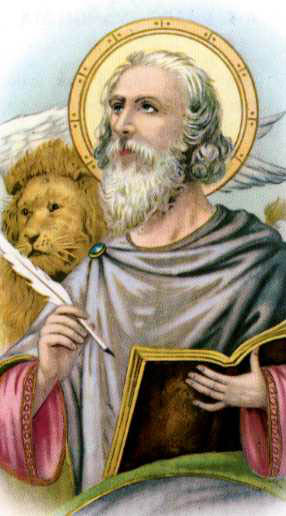

 Rispondi Citando
Discussioni Simili
-
23 Aprile San Giorgio. 25 Aprile San Marco.
Di Juv nel forum Padania!Risposte: 32Ultimo Messaggio: 23-04-25, 22:10 -
25 aprile: con San Marco, per San Marco
Di Guelfo Nero nel forum Tradizione CattolicaRisposte: 12Ultimo Messaggio: 26-04-20, 04:27 -
25 aprile: buon san marco evangelista!!
Di AGmichele (POL) nel forum Centrodestra ItalianoRisposte: 5Ultimo Messaggio: 26-04-20, 03:43 -
SANTI - 25 Aprile - San Marco, Evangelista
Di IL VANDEANO nel forum CattoliciRisposte: 8Ultimo Messaggio: 25-04-19, 23:33 -
31 gennaio - Traslazione di S. Marco, evangelista
Di Augustinus nel forum TradizionalismoRisposte: 3Ultimo Messaggio: 31-01-09, 10:57
 Permessi di Scrittura
Powered by vBulletin® Version 4.2.5
Copyright © 2026 vBulletin Solutions Inc. All rights reserved.
Change privacy settings
Copyright © 2026 vBulletin Solutions Inc. All rights reserved.
Change privacy settings
Tutti gli orari sono GMT +2. Adesso sono le 00:35.
