


Maria e la passione e morte del Figlio
Seguiamo il racconto dell’intensa "com-passio matris" della Vergine nelle "rivelazioni apocrife" particolarmente significative de Il Vangelo segreto di Maria, opera già nota nei primi secoli.
Siamo giunti al sesto dei sette "quadri" individuati come componenti la narrazione apocrifa della vita della Madonna:
- origini e nascita di Maria
- Maria al tempio
- il matrimonio con Giuseppe
- l’Annunciazione
- Maria, Madre-vergine
- Maria nella passione e risurrezione di Gesù
- dormizione e Assunzione della Vergine.
Parleremo dunque ora della partecipazione di Maria alla passione, morte e risurrezione del Figlio, secondo alcuni scritti apocrifi.
Dei sette "quadri" sopra nominati, questo è il più povero di riferimenti; anzi, sarebbe più esatto affermare che l’apporto in notizie e contenuti su quella parte di vita della Madonna che va dall’episodio di Gesù dodicenne nel tempio (termine di tempo convenzionale nella narrazione dei cosiddetti "Vangeli dell’infanzia") ai fatti della passione e risurrezione inclusi, è praticamente inesistente.
Tuttavia, non mancano rari accenni agli eventi della passione, morte (e specialmente della risurrezione) del Signore; anche se si ha l’impressione che gli autori degli apocrifi trovino difficoltà a delineare la partecipazione di Maria e a confrontarla con i misteri del Figlio, pur non mancando qualche spunto teologicamente rilevante.
Del resto, i Vangeli canonici al riguardo non ci dicono molto di più.
I giorni della passione e morte di Gesù
Il Vangelo di Nicodemo (scritto presumibilmente intorno all’anno 100-150 e tramandato nella prima parte anche separatamente, sotto il titolo Atti di Pilato), descrive accuratamente il processo di Gesù di fronte a Ponzio Pilato e, più in breve, la crocifissione. Quando rievoca la presenza di Maria sotto la croce, impoverisce con una esegesi estrapolata sia Giovanni 19,25-28 (episodio che narra l’affidamento, da parte di Gesù morente, del discepolo prediletto alla madre e della madre al discepolo), sia i sinottici; così né Maria, che si domanda come potrà programmare il suo futuro, né Giovanni avvertono il significato spirituale e soteriologico delle parole di Gesù. Il dato positivo è, invece, il collegamento della passione globalmente intesa con la profezia di Simeone, riportata in Luca 2, 34-35 (cf Vangelo di Nicodemo, XI, 5).
Un altro apocrifo, nel "Transito colbertino" dello Pseudo-Clemente (cf II, 1), riesce ad accostare bene il nucleo del dialogo tra Gesù e Maria: «a Giovanni, perché vergine nel corpo, Gesù consegna la madre dicendo: "Ecco tua madre", e alla madre: "Ecco tuo figlio". Da quell’istante Maria divenne oggetto costante delle sollecitudini di Giovanni per tutta la sua vita».
Per trovare maggiori riferimenti alla parte avuta dalla Madre di Gesù nella passione e morte del Signore, dobbiamo cercare tra le "rivelazioni apocrife" di tempi a noi più vicini: pensiamo, per tutte, a Il Vangelo segreto di Maria (un manoscritto scoperto solo nel 1884, ma già citato dai primi Padri della Chiesa e conosciuto già nel IV secolo dalla monaca spagnola Egeria, nel quale sono narrati aspetti inediti della vita di Gesù e si raccolgono le esperienze più segrete della sua santa Madre).
Altre suggestive pagine "apocrife" sulla partecipazione di Maria alla passione e morte di Gesù sono contenute nell’opera maggiore della mistica Maria Valtorta (la cui prima edizione risale al 1959, ed oggi è pubblicata in dieci volumi con il titolo L’Evangelo come mi è stato rivelato).
Infine, nulla ci dice al riguardo la monaca stigmatizzata tedesca Anna Katharina Emmerick nella sua Vita della santa Vergine Maria dove, dopo averci narrato le vicende della Madonna dalla storia dei suoi progenitori fino al ritorno della santa Famiglia dall’Egitto (cap. I-VIII), passa direttamente a parlare di Maria ad Efeso (cap. IX).
La sofferenza della Vergine nella passione del Signore,
secondo Il Vangelo segreto di Maria
Riportiamo intanto alcuni stralci della narrazione de Il Vangelo segreto di Maria (San Paolo, 2001), riprendendoli dal capitolo "In piedi, accanto alla croce" (pp. 187-229). È Maria stessa che racconta all’apostolo Giovanni l’intensità drammatica con la quale ha vissuto i giorni della passione e morte di Gesù.
«La Passione di Gesù fu certo infinitamente più dura della mia. Egli era Dio e io non lo ero. Egli era l’Agnello che prendeva su di sé i peccati del mondo e io una semplice donna che aveva avuto l’enorme privilegio di essere sua madre. Ero proprio sua madre, e se c’era un momento in cui far valere la mia condizione privilegiata, era quello [della sua Passione].
«Non mi ero appellata alla mia maternità quando, nei momenti di gloria, tutti lo esaltavano e si battevano per servirlo. Allora lui non aveva bisogno di me. Adesso, invece, proprio quando perfino voi [apostoli], i compagni più vicini, dubitavate di lui, avevo il diritto di rivendicare il mio ruolo di madre. Del resto, il privilegio per chi ama è aiutare l’essere amato; non c’è ricompensa più grande.
«In nessun istante di quella notte [del tradimento di Giuda e dell’inizio della sua passione], né del giorno seguente si interruppe la comunicazione fra noi. Non so se lui lo sentisse: lo saprò quando mi riunirò con lui in cielo che, come intuisco, avverrà presto. So solo che, a partire da un determinato momento, sentii che il mio spirito era unito al suo e che questa era una grazia che il Signore mi aveva concesso per recargli sollievo.
«Per questo, anch’io come lui nel Getsemani caddi in ginocchio e pregai con angoscia e terrore. Avvertivo la sua profonda solitudine, sentivo il sangue che scorreva sulla sua fronte. Con lui, mentre pregava nell’orto degli Ulivi, supplicai il Padre di allontanargli il calice senza farlo soffrire; ma gli dissi anche che, prima di tutto, fosse fatta la sua volontà. Potei quasi udire le grida di quelli che arrivavano armati di spade e bastoni. Sentii perfettamente un bacio miserabile, il bacio del traditore, sulla sua guancia e sulla mia; e tremai come mai lo avevo fatto prima, poiché per la prima volta avvertii il respiro del Maligno vicino al mio volto.
«E poi tutto il resto che tu, [Giovanni], già conosci e che fu la sua spaventosa passione [...]. Sì, quella notte seppi ciò che stava succedendo: il grande scontro fra il bene e il male. E quella notte seppi che il mio piede avrebbe schiacciato la testa del serpente, mentre questi, disperato per la sconfitta, mi mordeva inutilmente il tallone. La mia forza, quella forza che sa avere solo una donna che è madre, aiutò mio figlio a vincere il serpente, il Maligno [...]» (Il Vangelo secondo Maria, pp. 208-210).
La Madonna continua quindi a riferire a Giovanni l’infinita dolorosa partecipazione che lei ha vissuto, momento dopo momento, nel seguito della passione del figlio, fino al Calvario: «[Con le altre donne che seguivano Gesù], stordite e senza sapere cosa fare, ci lasciammo guidare dalla gente e ci dirigemmo verso il monte del Teschio, fuori dalle mura della città. Ben presto si seppe cosa stava succedendo nel gran frastuono che si era creato tutt’intorno: la comitiva con il reo era uscita dalla Torre Antonia e si dirigeva verso il Calvario. Andavano tutti molto in fretta per evitare il temuto contraccolpo dei supposti seguaci di mio figlio; ma di questi seguaci non restava nemmeno l’ombra: sembrava che ci fossimo solo noi donne, confuse fra la gente, senza paura ma con il cuore che batteva forte forte [...].
«A un certo punto vidi mio figlio Gesù quasi accanto. Non potemmo dirci nulla, ma solo guardarci. Fu sufficiente. Io vidi il suo dolore e lui il mio. Sentivo che si appoggiava a me e resistetti al peso di tutto un Dio che ha bisogno dell’aiuto di un essere umano, perché quel Dio è anche un uomo e quell’essere umano è sua madre. Temetti che il peso mi schiacciasse, ma mi afferrai a Dio Padre; e mentre lui mi sosteneva, io sostenevo Dio suo Figlio, come se attraverso di me la Divinità si mettesse in contatto con se stessa, ben decisa a mantenere fino alla fine questa dolorosa situazione che era necessaria perché mio figlio bevesse fino in fondo il calice dell’amarezza.
«Se lo portarono via subito; ed io non lo vidi cadere più volte, come poi mi hanno raccontato. Vidi però la donna che, impietosita, deterse il suo volto con un telo [...].
La madre di Gesù presso la croce
«Arrivammo così ai piedi della roccia, detta del Teschio, dove venivano crocifissi i malfattori. C’erano già due uomini inchiodati sulle rispettive croci, e nel centro era ritto un palo verticale sopra il quale sarebbe stato appeso mio figlio [...]. Lo vidi quando cominciarono a sollevarlo. Si fece un gran silenzio intorno, finché finirono di inchiodarlo. Allora, improvvisamente, scoppiarono le grida: gli insulti erano terribili e gli stessi soldati dovettero intervenire per allontanare i suoi nemici più crudeli e accaniti. Io, nonostante mi aspettassi di tutto, non riuscivo a credere a ciò che vedevo e ascoltavo: vidi persino una donna del popolo proferire bestialità in atteggiamento minaccioso nei suoi confronti; e vidi un tale che, paralitico, era stato guarito da Gesù, sputargli addosso e maledirlo. Allora caddi a terra sfinita [...].
«Quando poi tu, Giovanni, ed io potemmo raggiungere le prime file, ciò che vidi mi colpì nel corpo e nell’anima come se mi avessero inferto in una sola volta tutti i colpi che lui aveva ricevuto, poco prima, nel cortile della Torre Antonia. Questa volta, però, anche se non mi restava neppure un briciolo di forza, non crollai, poiché il suo sguardo mi trovò subito e tutti e due ci sostenemmo a vicenda.
«Non so se prima avesse detto qualcosa, poiché era sulla croce già da un po’ di tempo, quando riuscimmo ad avvicinarci a lui; ma ciò che tu ed io, insieme alle altre donne, potemmo ascoltare da Gesù morente non lo potrò mai dimenticare. Disse, con l’ultimo filo di voce: "Donna, ecco tuo figlio" – "Figlio, ecco tua madre".
«Perché quell’affidamento reciproco? Ci ho messo molto tempo a capirlo, perché era come se qualcuno avesse la pretesa di soppiantarlo nel mio cuore [...]. Ma, abituata come ero a trattare con Dio, imparai che era arrivato il momento dell’oblazione totale e che, quindi, anche il sentimento più profondo di una madre doveva essere offerto, perché solo Dio regnasse nel mio cuore, in modo assoluto. La mia opera, mio figlio, moriva; e Dio, che me lo aveva dato, me lo toglieva. Me lo toglieva e mi chiedeva di accettare un altro, degli altri, al suo posto e di amare questi altri, compresi gli assassini di mio figlio, come lui li amava. Per questo, mentre lui moriva, anch’io morivo; mentre lui sperimentava l’unione assoluta con il Padre, anch’io perdevo tutto perché, da quel momento, non mi restasse altro che un "solo Dio" che sulla croce si era portato via anche i legittimi sentimenti di una madre» (Il Vangelo di Maria, pp. 214-219). Il seguito di questa commovente narrazione de Il Vangelo segreto di Maria alla prossima puntata, insieme a pagine parimenti intense di altri autori di scritti apocrifi.
Simone Moreno
FONTE: Madre di Dio, 2007, fasc. 7
Risultati da 41 a 50 di 57
Discussione: Pasqua di Resurrezione
-
23-03-08, 11:24 #41**********


- Data Registrazione
- 04 Jun 2003
- Messaggi
- 23,775
-

- 18
-

- 35
- Mentioned
- 2 Post(s)
- Tagged
- 0 Thread(s)

-
23-03-08, 11:35 #42**********
- Data Registrazione
- 04 Jun 2003
- Messaggi
- 23,775
-
- 18
-
- 35
- Mentioned
- 2 Post(s)
- Tagged
- 0 Thread(s)

 Piero della Francesca, Resurrezione, 1463 circa, Pinacoteca Comunale, San Sepolcro
 Annibale Carracci, Le Sante donne al sepolcro, Hermitage, San Pietroburgo
 Peter von Cornelius, Le Sante donne (le tre Marie) al sepolcro, 1822, Neue Pinakothek, Monaco
-
23-03-08, 12:12 #43**********
- Data Registrazione
- 04 Jun 2003
- Messaggi
- 23,775
-
- 18
-
- 35
- Mentioned
- 2 Post(s)
- Tagged
- 0 Thread(s)
Resurrection of Jesus Christ
Resurrection is the rising again from the dead, the resumption of life. In this article, we shall treat only of the Resurrection of Jesus Christ. (The General Resurrection of the Body will be covered in another article.) The fact of Christ's Resurrection, the theories opposed to this fact, its characteristics, and the reasons for its importance must be considered in distinct paragraphs.
I. THE FACT OF CHRIST'S RESURRECTION
The main sources which directly attest the fact of Christ's Resurrection are the Four Gospels and the Epistles of St. Paul. Easter morning is so rich in incident, and so crowded with interested persons, that its complete history presents a rather complicated tableau. It is not surprising, therefore, that the partial accounts contained in each of the Four Gospels appear at first sight hard to harmonize. But whatever exegetic view as to the visit to the sepulchre by the pious women and the appearance of the angels we may defend, we cannot deny the Evangelists' agreement as to the fact that the risen Christ appeared to one or more persons. According to St. Matthew, He appeared to the holy women, and again on a mountain in Galilee; according to St. Mark, He was seen by Mary Magdalen, by the two disciples at Emmaus, and the Eleven before his Ascension into heaven; according to St. Luke, He walked with the disciples to Emmaus, appeared to Peter and to the assembled disciples in Jerusalem; according to St. John, Jesus appeared to Mary Magdalen, to the ten Apostles on Easter Sunday, to the Eleven a week later, and to the seven disciples at the Sea of Tiberias. St. Paul (1 Corinthians 15:3-8) enumerates another series of apparitions of Jesus after His Resurrection; he was seen by Cephas, by the Eleven, by more than 500 brethren, many of whom were still alive at the time of the Apostle's writing, by James, by all the Apostles, and lastly by Paul himself.
Here is an outline of a possible harmony of the Evangelists' account concerning the principal events of Easter Sunday:
- The holy women carrying the spices previously prepared start out for the sepulchre before dawn, and reach it after sunrise; they are anxious about the heavy stone, but know nothing of the official guard of the sepulchre (Matthew 28:1-3; Mark 16:1-3; Luke 24:1; John 20:1).
- The angel frightened the guards by his brightness, put them to flight, rolled away the stone, and seated himself not upon (ep autou), but above (epano autou) the stone (Matthew 28:2-4).
- Mary Magdalen, Mary the Mother of James, and Salome approach the sepulchre, and see the stone rolled back, whereupon Mary Magdalen immediately returns to inform the Apostles (Mark 16:4; Luke 24:2; John 20:1-2).
- The other two holy women enter the sepulchre, find an angel seated in the vestibule, who shows them the empty sepulchre, announces the Resurrection, and commissions them to tell the disciples and Peter that they shall see Jesus in Galilee (Matthew 28:5-7; Mark 16:5-7).
- A second group of holy women, consisting of Joanna and her companions, arrive at the sepulchre, where they have probably agreed to meet the first group, enter the empty interior, and are admonished by two angels that Jesus has risen according to His prediction (Luke 24:10).
- Not long after, Peter and John, who were notified by Mary Magdalen, arrive at the sepulchre and find the linen cloth in such a position as to exclude the supposition that the body was stolen; for they lay simply flat on the ground, showing that the sacred body had vanished out of them without touching them. When John notices this he believes (John 20:3-10).
- Mary Magdalen returns to the sepulchre, sees first two angels within, and then Jesus Himself (John 20:11-l6; Mark 16:9).
- The two groups of pious women, who probably met on their return to the city, are favored with the sight of Christ arisen, who commissions them to tell His brethren that they will see him in Galilee (Matthew 28:8-10; Mark 16:8).
- The holy women relate their experiences to the Apostles, but find no belief (Mark 16:10-11; Luke 24:9-11).
- Jesus appears to the disciples, at Emmaus, and they return to Jerusalem; the Apostles appear to waver between doubt and belief (Mark 16:12-13; Luke 24:13-35).
- Christ appears to Peter, and therefore Peter and John firmly believe in the Resurrection (Luke 24:34; John 20:8).
- After the return of the disciples from Emmaus, Jesus appears to all the Apostles excepting Thomas (Mark 16:14; Luke 24:36-43; John 20:19-25).
The harmony of the other apparitions of Christ after His Resurrection presents no special difficulties.
Briefly, therefore, the fact of Christ's Resurrection is attested by more than 500 eyewitnesses, whose experience, simplicity, and uprightness of life rendered them incapable of inventing such a fable, who lived at a time when any attempt to deceive could have been easily discovered, who had nothing in this life to gain, but everything to lose by their testimony, whose moral courage exhibited in their apostolic life can be explained only by their intimate conviction of the objective truth of their message. Again the fact of Christ's Resurrection is attested by the eloquent silence of the Synagogue which had done everything to prevent deception, which could have easily discovered deception, if there had been any, which opposed only sleeping witnesses to the testimony of the Apostles, which did not punish the alleged carelessness of the official guard, and which could not answer the testimony of the Apostles except by threatening them "that they speak no more in this name to any man" (Acts 4:17). Finally the thousands and millions, both Jews and Gentiles, who believed the testimony of the Apostles in spite of all the disadvantages following from such a belief, in short the origin of the Church, requires for its explanation the reality of Christ's Resurrection, fot the rise of the Church without the Resurrection would have been a greater miracle than the Resurrection itself.
II. OPPOSING THEORIES
By what means can the evidence for Christ's Resurrection by overthrown? Three theories of explanation have been advanced, though the first two have hardly any adherents in our day.
(1)The Swoon Theory
There is the theory of those who assert that Christ did not really die upon the cross, that His supposed death was only a temporary swoon, and that His Resurrection was simply a return to consciousness. This was advocated by Paulus ("Exegetisches Handbuch", 1842, II, p. 929) and in a modified form by Hase ("Gesch. Jesu", n. 112), but it does not agree with the data furnished by the Gospels. The scourging and the crown of thorns, the carrying of the cross and the crucifixion, the three hours on the cross and the piercing of the Sufferer's side cannot have brought on a mere swoon. His real death is attested by the centurion and the soldiers, by the friends of Jesus and by his most bitter enemies. His stay in a sealed sepulchre for thirty-six hours, in an atmosphere poisoned by the exhalations of a hundred pounds of spices, which would have of itself sufficed to cause death. Moreover, if Jesus had merely returned from a swoon, the feelings of Easter morning would have been those of sympathy rather than those of joy and triumph, the Apostles would have been roused to the duties of a sick chamber rather than to apostolic work, the life of the powerful wonderworker would have ended in ignoble solitude and inglorious obscurity, and His vaunted sinlessness would have changed into His silent approval of a lie as the foundation stone of His Church. No wonder that later critics of the Resurrection, like Strauss, have heaped contempt on the old theory of a swoon.
(2) The Imposition Theory
The disciples, it is said, stole the body of Jesus from the grave, and then proclaimed to men that their Lord had risen. This theory was anticipated by the Jews who "gave a great sum of money to the soldiers, saying: Say you, His disciples came by night, and stole him away when we were asleep" (Matthew 28:12 sq.). The same was urged by Celsus (Orig., "Contra Cels.", II, 56) with some difference of detail. But to assume that the Apostles with a burden of this kind upon their consciences could have preached a kingdom of truth and righteousness as the one great effort of their lives, and that for the sake of that kingdom they could have suffered even unto death, is to assume one of those moral impossibilities which may pass for a moment in the heat of controversy, but must be dismissed without delay in the hour of good reflection.
(3) The Vision Theory
This theory as generally understood by its advocates does not allow visions caused by a Divine intervention, but only such as are the product of human agencies. For if a Divine intervention be admitted, we may as well believe, as far as principles are concerned, that God raised Jesus from the dead. But where in the present instance are the human agencies which might cause these visions? The idea of a resurrection from the grave was familiar to the disciples from their Jewish faith; they had also vague intimations in the prophecies of the Old Testament; finally, Jesus Himself had always associated His Resurrection with the predictions of his death. On the other hand, the disciples' state of mind was one of great excitement; they treasured the memory of Christ with a fondness which made it almost impossible for them to believe that He was gone. In short, their whole mental condition was such as needed only the application of a spark to kindle the flame. The spark was applied by Mary Magdalen, and the flame at once spread with the rapidity and force of a conflagration. What she believed that she had seen, others immediately believed that they must see. Their expectations were fulfilled, and the conviction seized the members of the early Church that the Lord had really risen from the dead.
Such is the vision theory commonly defended by recent critics of the Resurrection. But however ingeniously it may be devised, it is quite impossible from an historical point of view.
- It is incompatible with the state of mind of the Apostles; the theory presupposes faith and expectancy on the part of the Apostles, while in point of fact the disciples' faith and expectancy followed their vision of the risen Christ.
- It is inconsistent with the nature of Christ's manifestations; they ought to have been connected with heavenly glory, or they should have continued the former intimate relations of Jesus with His disciples, while actually and consistently they presented quite a new phase that could not have been expected.
- It does not agree with the conditions of the early Christian community; after the first excitement of Easter Sunday, the disciples as a body are noted for their cool deliberation rather than the exalted enthusiasm of a community of visionaries.
- It is incompatible with the length of time during which the apparitions lasted; visions such as the critics suppose have never been known to last long, while some of Christ's manifestations lasted a considerable period.
- It is not consistent with the fact that the manifestations were made to numbers at the same instant.
- It does not agree with the place where most of the manifestations were made: visionary appearances would have been expected in Galilee, while most apparitions of Jesus occurred in Judea.
- It is inconsistent with the fact that the visions came to a sudden end on the day of Ascension.
Keim admits that enthusiasm, nervousness, and mental excitement on the part of the disciples do not supply a rational explanation of the facts as related in the Gospels. According to him, the visions were directly granted by God and the glorified Christ; they may even include a "corporeal appearance" for those who fear that without this they would lose all. But Keim's theory satisfies neither the Church, since it abandons all the proofs of a bodily Resurrection of Jesus, nor the enemies of the Church, since it admits many of the Church's dogmas; nor again is it consistent with itself, since it grants God's special intervention in proof of the Church's faith, though it starts with the denial of the bodily Resurrection of Jesus, which is one of the principal objects of that faith.
(4) Modernist View
The Holy Office describes and condemns in the thirty-sixth and thirty-seventh propositions of the Decree "Lamentabili", the views advocated by a fourth class of opponents of the Resurrection. The former of these propositions reads: "The Resurrection of our Saviour is not properly a fact of the historical order, but a fact of the purely supernatural order neither proved nor provable, which Christian consciousness has little by little inferred from other facts." This statement agrees with, and is further explained by the words of Loisy ("Autour d'un petit livre", p. viii, 120-121, 169; "L'Evangile et l'Eglise", pp. 74-78; 120-121; 171). According to Loisy, firstly, the entrance into life immortal of one risen from the dead is not subject to observation; it is a supernatural, hyper-historical fact, not capable of historical proof. The proofs alleged for the Resurrection of Jesus Christ are inadequate; the empty sepulchre is only an indirect argument, while the apparitions of the risen Christ are open to suspicion on a priori grounds, being sensible impressions of a supernatural reality; and they are doubtful evidence from a critical point of view, on account of the discrepancies in the various Scriptural narratives and the mixed character of the detail connected with the apparitions. Secondly, if one prescinds from the faith of the Apostles, the testimony of the New Testament does not furnish a certain argument for the fact of the Resurrection. This faith of the Apostles is concerned not so much with the Resurrection of Jesus Christ as with His immortal life; being based on the apparitions, which are unsatisfactory evidence from an historical point of view, its force is appreciated only by faith itself; being a development of the idea of an immortal Messias, it is an evolution of Christian consciousness, though it is at the same time a corrective of the scandal of the Cross. The Holy Office rejects this view of the Resurrection when it condemns the thirty-seventh proposition in the Decree "Lamentabili": "The faith in the Resurrection of Christ pointed at the beginning no so much to the fact of the Resurrection, as to the immortal life of Christ with God".
Besides the authoritative rejection of the foregoing view, we may submit the following three considerations which render it untenable: First, the contention that the Resurrection of Christ cannot be proved historically is not in accord with science. Science does not know enough about the limitations and the properties of a body raised from the dead to immortal life to warrant the assertion that such a body cannot be perceived by the senses; again in the case of Christ, the empty sepulchre with all its concrete circumstances cannot be explained except by a miraculous Divine intervention as supernatural in its character as the Resurrection of Jesus. Secondly, history does not allow us to regard the belief in the Resurrection as the result of a gradual evolution in Christian consciousness. The apparitions were not a mere projection of the disciples' Messianic hope and expectation; their Messianic hope and expectations had to be revived by the apparitions. Again, the Apostles did not begin with preaching the immortal life of Christ with God, but they preached Christ's Resurrection from the very beginning, they insisted on it as a fundamental fact and they described even some of the details connected with this fact: Acts, ii, 24, 31; iii, 15,26; iv, 10; v, 30; x, 39-40; xiii, 30, 37; xvii, 31-2; Rom., i,4; iv, 25; vi, 4,9; viii, 11, 34; x, 7; xiv, 9; I Cor., xv, 4, 13 sqq.; etc. Thirdly, the denial of the historical certainty of Christ's Resurrection involves several historical blunders: it questions the objective reality of the apparitions without any historical grounds for such a doubt; it denies the fact of the empty sepulchre in spite of solid historical evidence to the contrary; it questions even the fact of Christ's burial in Joseph's sepulchre, though this fact is based on the clear and simply unimpeachable testimony of history.
III. CHARACTER OF CHRIST'S RESURRECTION
The Resurrection of Christ has much in common with the general resurrection; even the transformation of His body and of His bodily life is of the same kind as that which awaits the blessed in their resurrection. But the following peculiarities must be noted:
- Christ's Resurrection is necessarily a glorious one; it implies not merely the reunion of body and soul, but also the glorification of the body.
- Christ's body was to know no corruption, but rose again soon after death, when sufficient time had elapsed to leave no doubt as to the reality of His death.
- Christ was the first to rise unto life immortal; those raised before Him died again (Colossians 1:18; 1 Corinthians 15:20).
- As the Divine power which raised Christ from the grave was His own power, He rose from the dead by His own power (John 2:19; 10:17-18).
- Since the Resurrection had been promised as the main proof of Christ's Divine mission, it has a greater dogmatic importance than any other fact. "If Christ be not risen again, then is our preaching vain, and your faith is also vain" (1 Corinthians 15:14).
IV. IMPORTANCE OF THE RESURRECTION
Besides being the fundamental argument for our Christian belief, the Resurrection is important for the following reasons:
- It shows the justice of God who exalted Christ to a life of glory, as Christ had humbled Himself unto death (Phil., ii, 8-9).
- The Resurrection completed the mystery of our salvation and redemption; by His death Christ freed us from sin, and by His Resurrection He restored to us the most important privileges lost by sin (Romans 4:25).
- By His Resurrection we acknowledge Christ as the immortal God, the efficient and exemplary cause of our own resurrection (1 Corinthians 15:21; Philippians 3:20-21), and as the model and the support of our new life of grace (Romans 6:4-6; 9-11).
Fonte: The Catholic Encyclopedia, vol. XII, 1911, New York
-
23-03-08, 12:18 #44**********
- Data Registrazione
- 04 Jun 2003
- Messaggi
- 23,775
-
- 18
-
- 35
- Mentioned
- 2 Post(s)
- Tagged
- 0 Thread(s)
Easter
The English term, according to the Ven. Bede (De temporum ratione, I, v), relates to Estre, a Teutonic goddess of the rising light of day and spring, which deity, however, is otherwise unknown, even in the Edda (Simrock, Mythol., 362); Anglo-Saxon, eâster, eâstron; Old High German, ôstra, ôstrara, ôstrarûn; German, Ostern. April was called easter-monadh. The plural eâstron is used, because the feast lasts seven days. Like the French plural Pâques, it is a translation from the Latin Festa Paschalia, the entire octave of Easter. The Greek term for Easter, pascha, has nothing in common with the verb paschein, "to suffer," although by the later symbolic writers it was connected with it; it is the Aramaic form of the Hebrew pesach (transitus, passover). The Greeks called Easter the pascha anastasimon; Good Friday the pascha staurosimon. The respective terms used by the Latins are Pascha resurrectionis and Pascha crucifixionis. In the Roman and Monastic Breviaries the feast bears the title Dominica Resurrectionis; in the Mozarbic Breviary, In Lætatione Diei Pasch Resurrectionis; in the Ambrosian Breviary, In Die Sancto Paschæ. The Romance languages have adopted the Hebrew-Greek term: Latin, Pascha; Italian, Pasqua; Spanish, Pascua; French, Also some Celtic and Teutonic nations use it: Scottish, Pask; Dutch, Paschen; The correct word in Dutch is actually Paasen Danish, Paaske; Swedish, Pask; even in the German provinces of the Lower Rhine the people call the feast Paisken not Ostern. The word is, principally in Spain and Italy, identified with the word "solemnity" and extended to other feasts, e.g. Sp., Pascua florida, Palm Sunday; Pascua de Pentecostes, Pentecost; Pascua de la Natividad, Christmas; Pascua de Epifania, Epiphany. In some parts of France also First Communion is called Pâques, whatever time of the year administered.
THE FEAST
Easter is the principal feast of the ecclesiastical year. Leo I (Sermo xlvii in Exodum) calls it the greatest feast (festum festorum), and says that Christmas is celebrated only in preparation for Easter. It is the centre of the greater part of the ecclesiastical year. The order of Sundays from Septuagesima to the last Sunday after Pentecost, the feast of the Ascension, Pentecost, Corpus Christi, and all other movable feasts, from that of the Prayer of Jesus in the Garden (Tuesday after Septuagesima) to the feast of the Sacred Heart (Friday after the octave of Corpus Christi), depend upon the Easter date. Commemorating the slaying of the true Lamb of God and the Resurrection of Christ, the corner-stone upon which faith is built, it is also the oldest feast of the Christian Church, as old as Christianity, the connecting link between the Old and New Testaments. That the Apostolic Fathers do not mention it and that we first hear of it principally through the controversy of the Quartodecimans are purely accidental. The connection between the Jewish Passover and the Christian feast of Easter is real and ideal. Real, since Christ died on the first Jewish Easter Day; ideal, like the relation between type and reality, because Christ's death and Resurrection had its figures and types in the Old Law, particularly in the paschal lamb, which was eaten towards evening of the 14th of Nisan. In fact, the Jewish feast was taken over into the Christian Easter celebration; the liturgy (Exsultet) sings of the passing of Israel through the Red Sea, the paschal lamb, the column of fire, etc. Apart, however, from the Jewish feast, the Christians would have celebrated the anniversary of the death and the Resurrection of Christ. But for such a feast it was necessary to know the exact calendar date of Christ's death. To know this day was very simple for the Jews; it was the day after the 14th of the first month, the 15th of Nisan of their calendar. But in other countries of the vast Roman Empire there were other systems of chronology. The Romans from 45 B.C. had used the reformed Julian calendar; there were also the Egyptian and the Syro-Macedonian calendar. The foundation of the Jewish calendar was the lunar year of 354 days, whilst the other systems depended on the solar year. In consequence the first days of the Jewish months and years did not coincide with any fixed days of the Roman solar year. Every fourth year of the Jewish system had an intercalary month. Since this month was inserted, not according to some scientific method or some definite rule, but arbitrarily, by command of the Sanhedrin, a distant Jewish date can never with certainty be transposed into the corresponding Julian or Gregorian date (Ideler, Chronologie, I, 570 sq.). The connection between the Jewish and the Christian Pasch explains the movable character of this feast. Easter has no fixed date, like Christmas, because the 15th of Nisan of the Semitic calendar was shifting from date to date on the Julian calendar. Since Christ, the true Paschal Lamb, had been slain on the very day when the Jews, in celebration of their Passover, immolated the figurative lamb, the Jewish Christians in the Orient followed the Jewish method, and commemorated the death of Christ on the 15th of Nisan and His Resurrection on the 17th of Nisan, no matter on what day of the week they fell. For this observance they claimed the authority of St. John and St. Philip.
In the rest of the empire another consideration predominated. Every Sunday of the year was a commemoration of the Resurrection of Christ, which had occurred on a Sunday. Because the Sunday after 14 Nisan was the historical day of the Resurrection, at Rome this Sunday became the Christian feast of Easter. Easter was celebrated in Rome and Alexandria on the first Sunday after the first full moon after the spring equinox, and the Roman Church claimed for this observance the authority of Sts. Peter and Paul. The spring equinox in Rome fell on 25 March; in Alexandria on 21 March. At Antioch Easter was kept on the Sunday after the Jewish Passover. (See EASTER CONTROVERSY.) In Gaul a number of bishops, wishing to escape the difficulties of the paschal computation, seem to have assigned Easter to a fixed date of the Roman calendar, celebrating the death of Christ on 25 March, His Resurrection on 27 March (Marinus Dumiensis in P.L., LXXII, 47-51), since already in the third century 25 March was considered the day of the Crucifixion (Computus Pseudocyprianus, ed. Lersch, Chronologie, II, 61). This practice was of short duration. Many calendars in the Middle Ages contain these same dates (25 March, 27 March) for purely historical, not liturgical, reasons (Grotenfend, Zeitrechnung, II, 46, 60, 72, 106, 110, etc.). The Montanists in Asia Minor kept Easter on the Sunday after 6 April (Schmid, Osterfestberechnung in der abendlandischen Kirche). The First Council of Nicaea (325) decreed that the Roman practice should be observed throughout the Church. But even at Rome the Easter term was changed repeatedly. Those who continued to keep Easter with the Jews were called Quartodecimans (14 Nisan) and were excluded from the Church. The computus paschalis, the method of determining the date of Easter and the dependent feasts, was of old considered so important that Durandus (Rit. div. off., 8, c.i.) declares a priest unworthy of the name who does not know the computus paschalis. The movable character of Easter (22 March to 25 April) gives rise to inconveniences, especially in modern times. For decades scientists and other people have worked in vain for a simplification of the computus, assigning Easter to the first Sunday in April or to the Sunday nearest the 7th of April. Some even wish to put every Sunday to a certain date of the month, e.g. beginning with New Year's always on a Sunday, etc. [See L. Günther, "Zeitschrift Weltall" (1903); Sandhage and P. Dueren in "Pastor bonus" (Trier, 1906); C. Tondini, "L'Italia e la questione del Calendario" (Florence, 1905)].
THE EASTER OFFICE AND MASS
The first Vespers of Easter are connected now with the Mass of Holy Saturday, because that Mass was formerly celebrated in the evening (see HOLY SATURDAY); they consist of only one psalm (cxvi) and the Magnificat. The Matins have only one Nocturn; the Office is short, because the clergy were busy with catechumens, the reconciliation of sinners, and the distribution of alms, which were given plentifully by the rich on Easter Day. This peculiarity of reciting only one Nocturn was extended by some churches from the octave of Easter to the entire paschal time, and soon to all the feasts of the Apostles and similar high feasts of the entire ecclesiastical year. This observance is found in the German Breviaries far up into the nineteenth century ("Brev. Monaster.", 1830; Baumer, "Breview", 312). The octave of Easter ceases with None of Saturday and on Sunday the three Nocturns with the eighteen psalms of the ordinary Sunday Office are recited. Many churches, however, during the Middle Ages and later (Brev. Monaster., 1830), on Low Sunday (Dominica in Albis) repeated the short Nocturn of Easter Week. Before the usus Romanae Curiae (Baumer, 301). was spread by the Franciscans over the entire Church the eighteen (or twenty-four) psalms of the regular Sunday Matins were, three by three, distributed over the Matins of Easter Week (Bäumer, 301). This observance is still one of the peculiarities of the Carmelite Breviary. The simplified Breviary of the Roman Cria (twelfth century) established the custom of repeating Psalms i, ii, iii, every day of the octave. From the ninth to the thirteenth century in most dioceses, during the entire Easter Week the two precepts of hearing Mass and of abstaining from servile work were observed (Kellner, Heortologie, 17); later on this law was limited to two days (Monday and Tuesday), and since the end of the eighteenth century, to Monday only. In the United States even Monday is no holiday of obligation. The first three days of Easter Week are doubles of the first class, the other days semi-doubles. During this week, in the Roman Office, through immemorial custom the hymns are omitted, or rather were never inserted. The ancient ecclesiastical Office contained no hymns, and out of respect for the great solemnity of Easter and the ancient jubilus "Haec Dies", the Roman Church did not touch the old Easter Office by introducing hymns. Therefore to the present day the Office of Easter consists only of psalms, antiphons, and the great lessons of Matins. Only the "Victimae Paschali" was adopted in most of the churches and religious orders in the Second Vespers. The Mozarabic and Ambrosian Offices use the Ambrosian hymn "Hic est dies versus Dei" in Lauds and Vespers, the Monastic Breviary, "Ad coenam Agni providi" at Vespers, "Chorus novae Jerusalem" at Matins, and "Aurora lucis rutilat" at Lauds. The Monastic Breviary has also three Nocturns on Easter Day. Besides the hymns the chapter is omitted and the Little Hours have no antiphons; the place of the hymns, chapters, and little responses is taken by the jubilus, "Haec Dies quam fecit Dominus, exultemus et laetemur in ea". The Masses of Easter Week have a sequence of dramatic character, "Victimae paschali", which was composed by Wipo, a Burgundian priest at the courts of Conrad II and Henry III. The present Preface is abridged from the longer Preface of the Gregorian Sacramentary. The "Communicantes" and "Hanc igitur" contain references to the solemn baptism of Easter eve. To the "Benedicamus Domino" of Lauds and Vespers and to the "Ite Missa est" of the Mass two alleluias are added during the entire octave. Every day of the octave has a special Mass; an old manuscript Spanish missal of 855 contains three Masses for Easter Sunday; the Gallican missals have two Masses for every day of the week, one of which was celebrated at four in the morning, preceded by a procession (Migne, La Liturgie Catholique, Paris, 1863, p. 952). In the Gelasian Sacramentary every day of Easter Week has its own Preface (Probst, Sacramentarien, p. 226).
To have a correct idea of the Easter celebration and its Masses, we must remember that it was intimately connected with the solemn rite of baptism. The preparatory liturgical acts commenced on the eve and were continued during the night. When the number of persons to be baptized was great, the sacramental ceremonies and the Easter celebration were united. This connection was severed at a time when, the discipline having changed, even the recollection of the old traditions was lost. The greater part of the ceremonies was transferred to the morning hours of Holy Saturday. This change, however, did not produce a new liturgical creation adapted to the new order of things. The old baptismal ceremonies were left untouched and have now, apparently, no other reason for preservation than their antiquity. The gap left in the liturgical services after the solemnities of the night had been transferred to the morning of Holy Saturday was filled in France, Germany, and in some other countries by a twofold new ceremony, which, however, was never adopted in Rome.
First, there was the commemoration of the Resurrection of Christ. At midnight, before Matins, the clergy in silence entered the dark church and removed the cross from the sepulchre to the high altar. Then the candles were lit, the doors opened, and a solemn procession was held with the cross through the church, the cloister, or cemetery. Whilst the procession moved from the altar to the door, the beautiful old antiphon, "Cum Rex gloriae", was sung, the first part softly (humili ac depressâ voce), to symbolize the sadness of the souls in limbo; from Advenisti desiderabilis the singers raised their voices in jubilation whilst the acolytes rang small bells which they carried. The full text of this antiphon, which has disappeared from the liturgy, follows:
Cum rex gloriae Christus infernum debellaturus intraret, et chorus angelicus ante faciem ejus protas principum tolli praeciperet, sanctorum populus, qui tenebatur in morte captivus, voce lacrimabili clamabat dicens: Advenisti desiderabilis, quem expectabamus in tenebris, ut educered hac nocte vinculatos de claustris. Te nostra vocabant suspiria, te large requirebant lamenta, tu factus est spes desperatis, magna consolatio in tormentis. Alleluja.
When the procession returned, in many churches the "Attollite portas" (Ps. xxiii) was sung at the door, in order to symbolize the victorious entry of Christ into limbo and hell. After the procession Matins were sung. In later centuries the Blessed Sacrament took the place of the cross in the procession. This ceremony is, with the approval of the Holy See, still held in Germany on the eve of Easter with simpler ceremonies, in the form of a popular devotion.
Second, the visitation of the Sepulchre. After the third lesson of the Nocturn two clerics, representing the holy women, went to the empty sepulchre where another cleric (angel) announced to them that the Saviour was risen. The two then brought the message to the choir, whereupon two priests, impersonating Peter and John, ran to the tomb and, finding it empty, shoed to the people the linen in which the body had been wrapped. Then the choir sang the "Te Deum" and the "Victimae paschali". In some churches, e.g. at Rouen, the apparition of Christ to Mary Magdalen was also represented. Out of this solemn ceremony, which dates back to the tenth century, grew the numerous Easter plays. (Nord-Amerikanisches Pastoralblatt, Oct., 1907, p. 149, has a long article on these two ceremonies.) The Easter plays in the beginning used only the words of the Gospels and the "Victimae paschali"; in the course of development they became regular dramas, in Latin or vernacular verses, which contained the negotiation between the vender of unguents and the three women, the dialogue between Pilate and the Jews asking for soldiers to guard the Sepulchre, the contest of Peter and John running to the tomb, the risen Saviour appearing to Magdalen, and the descent of Christ into hell. Towards the end of the Middle Ages the tone of these plays became worldly, and they were filled with long burlesque speeches of salve-dealers, Jews, soldiers, and demons (Creizenach, Gesch, des neuen Dramas, Halle, 1893).
The procession combined with the solemn Second Vespers of Easter Sunday is very old. There was great variety in the manner of solemnizing these Vespers. The service commenced with the nine Kyrie Eleisons, sung as in the Easter Mass, even sometimes with the corresponding trope lux et origo boni. After the third psalm the whole choir went in procession to the baptismal chapel, where the fourth psalm, the "Victimae paschali", and the Magnificat were sung: thence the procession moved to the great cross at the entrance to the sanctuary (choir), and from there, after the fifth psalm and the Magnificat were sung, to the empty sepulchre, where the services were concluded. The Carmelites and a number of French dioceses, e.g. Paris, Lyons, Besançon, Chartres, Laval, have, with the permission of the Holy See, retained these solemn Easter Vespers since the re-introduction of the Roman Breviary. But they are celebrated differently in every diocese, very much modernized in some churches. At Lyons the Magnificat is sung three times. In Cologne and Trier the solemn Vespers of Easter were abolished in the nineteenth century (Nord-Amerikanisches Pastoralblatt, April, 1908, p. 50). Whilst the Latin Rite admits only commemorations in Lauds, Mass, and Vespers from Wednesday in Easter Week and excludes any commemoration on the first three days of the week, the Greek and Russian Churches transfer the occurring Offices (canons) of the saints from Matins to Complin during the entire octave, even on Easter Sunday. After the Anti-pascha (Low Sunday), the canons and other canticles of Easter are continued in the entire Office up to Ascension Day, and the canons of the saints take only the second place in Matins. Also the Greeks and Russians have a solemn procession at midnight, before Matins, during which they sing at the door of the church Ps. lxvii, repeating after each verse the Easter antiphon. When the procession leaves, the church is dark; when it returns, hundreds of candles and coloured lamps are lit to represent the splendour of Christ's Resurrection. After Lauds all those who are present give each other the Easter kiss, not excluding even the beggar. One says: "Christ is risen"; the other answers: "He is truly risen"; and these words are the Russians' greeting during Easter time. A similar custom had, through the influence of the Byzantine court, been adopted at Rome for a time. The greeting was: Surrexit Dominus vere; R. Et apparuit Simoni. (Maximilianus, Princ. Sax., Praelect. de liturg. Orient., I, 114; Martene, De antiq. Eccl. rit., c. xxv, 5.) The Armenian Church during the entire time from Easter to Pentecost celebrates the Resurrection alone to the exclusion of all feasts of the saints. On Easter Monday they keep All Souls' Day, the Saturday of the same week the Decollation of St. John, the third Sunday after Easter the founding of the first Christian Church on Sion and of the Church in general, the fifth Sunday the Apparition of the Holy Cross at Jerusalem, then on Thursday the Ascension of Christ, and the Sunday after the feast of the great Vision of St. Gregory. From Easter to Ascension the Armenians never fast or do they abstain from meat (C. Tondini de Quaranghi, Calendrier de la Nation Arménienne). In the Mozarabic Rite of Spain, after the Pater Noster on Easter Day and during the week the priest intones the particula "Regnum" and sings "Vicit Leo de Tribu Juda radix David Alleluja". The people answer: "Qui sedes super Cherubim radix David. Alleluja". This is sung three times (Missale Mozarab.). In some cities of Spain before sunrise two processions leave the principal church; one with the image of Mary covered by a black veil; another with the Blessed Sacrament. The processions move on in silence until they meet at a predetermined place; then the veil is removed from the image of Mary and the clergy with the people sing the "regina Coeli" (Guéranger, Kirchenjarh, VII, 166). For the sanctuary at Emmaus in the Holy Land the Holy See has approved a special feast on Easter Monday, "Solemnitas manifestationis D.N.I. Chr. Resurg., Titul. Eccles. dupl. I Cl.", with proper Mass and Office (Cal. Rom. Seraph. in Terrae S. Custodia, 1907).
PECULIAR CUSTOMS OF EASTER TIME
1. Risus Paschalis
This strange custom originated in Bavaria in the fifteenth century. The priest inserted in his sermon funny stories which would cause his hearers to laugh (Ostermärlein), e.g. a description of how the devil tries to keep the doors of hell locked against the descending Christ. Then the speaker would draw the moral from the story. This Easter laughter, giving rise to grave abuses of the word of God, was prohibited by Clement X (1670-1676) and in the eighteenth century by Maximilian III and the bishops of Bavaria (Wagner, De Risu Paschali, Königsberg, 1705; Linsemeier, Predigt in Deutschland, Munich, 1886).
2. Easter Eggs
Because the use of eggs was forbidden during Lent, they were brought to the table on Easter Day, coloured red to symbolize the Easter joy. This custom is found not only in the Latin but also in the Oriental Churches. The symbolic meaning of a new creation of mankind by Jesus risen from the dead was probably an invention of later times. The custom may have its origin in paganism, for a great many pagan customs, celebrating the return of spring, gravitated to Easter. The egg is the emblem of the germinating life of early spring. Easter eggs, the children are told, come from Rome with the bells which on Thursday go to Rome and return Saturday morning. The sponsors in some countries give Easter eggs to their god-children. Coloured eggs are used by children at Easter in a sort of game which consists in testing the strength of the shells (Kraus, Real-Encyklop die, s. v. Ei). Both coloured and uncoloured eggs are used in some parts of the United States for this game, known as "egg-picking". Another practice is the "egg-rolling" by children on Easter Monday on the lawn of the White House in Washington.
3. The Easter Rabbit
The Easter Rabbit lays the eggs, for which reason they are hidden in a nest or in the garden. The rabbit is a pagan symbol and has always been an emblem of fertility (Simrock, Mythologie, 551).
4. Handball
In France handball playing was one of the Easter amusements, found also in Germany (Simrock, op. cit., 575). The ball may represent the sun, which is believed to take three leaps in rising on Easter morning. Bishops, priests, and monks, after the strict discipline of Lent, used to play ball during Easter week (Beleth, Expl. Div. off., 120). This was called libertas Decembrica, because formerly in December, the masters used to play ball with their servants, maids, and shepherds. The ball game was connected with a dance, in which even bishops and abbots took part. At Auxerre, Besançon, etc. the dance was performed in church to the strains of the "Victimae paschali". In England, also, the game of ball was a favourite Easter sport in which the municipal corporation engaged with due parade and dignity. And at Bury St. Edmunds, within recent years, the game was kept up with great spirit by twelve old women. After the game and the dance a banquet was given, during which a homily on the feast was read. All these customs disappeared for obvious reasons (Kirchenlex., IV, 1414).
5. Men and women
On Easter Monday the women had a right to strike their husbands, on Tuesday the men struck their wives, as in December the servants scolded their masters. Husbands and wives did this "ut ostendant sese mutuo debere corrigere, ne illo tempore alter ab altero thori debitum exigat" (Beleth, I, c. cxx; Durandus, I, c. vi, 86). In the northern parts of England the men parade the streets on Easter Sunday and claim the privilege of lifting every woman three times from the ground, receiving in payment a kiss or a silver sixpence. The same is done by the women to the men on the next day. In the Neumark (Germany) on Easter Day the men servants whip the maid servants with switches; on Monday the maids whip the men. They secure their release with Easter eggs. These customs are probably of pre-Christian origin (Reinsberg-Düringsfeld, Das festliche Jahr, 118).
6. The Easter Fire
The Easter Fire is lit on the top of mountains (Easter mountain, Osterberg) and must be kindled from new fire, drawn from wood by friction (nodfyr); this is a custom of pagan origin in vogue all over Europe, signifying the victory of spring over winter. The bishops issued severe edicts against the sacrilegious Easter fires (Conc. Germanicum, a. 742, c.v.; Council of Lestines, a. 743, n. 15), but did not succeed in abolishing them everywhere. The Church adopted the observance into the Easter ceremonies, referring it to the fiery column in the desert and to the Resurrection of Christ; the new fire on Holy Saturday is drawn from flint, symbolizing the Resurrection of the Light of the World from the tomb closed by a stone (Missale Rom.). In some places a figure was thrown into the Easter fire, symbolizing winter, but to the Christians on the Rhine, in Tyrol and Bohemia, Judas the traitor (Reinsberg-Düringfeld, Das festliche Jahr, 112 sq.).
7. Processions and awakenings
At Puy in France, from time immemorial to the tenth century, it was customary, when at the first psalm of Matins a canon was absent from the choir, for some of the canons and vicars, taking with them the processional cross and the holy water, to go to the house of the absentee, sing the "Haec Dies", sprinkle him with water, if he was still in bed, and lead him to the church. In punishment he had to give a breakfast to his conductors. A similar custom is found in the fifteenth century at Nantes and Angers, where it was prohibited by the diocesan synods in 1431 and 1448. In some parts of Germany parents and children try to surprise each other in bed on Easter morning to apply the health-giving switches (Freyde, Ostern in deutscher Sage, Sitte und Dichtung, 1893).
8. Blessing of food
In both the Oriental and Latin Churches, it is customary to have those victuals which were prohibited during Lent blessed by the priests before eating them on Easter Day, especially meat, eggs, butter, and cheese (Ritualbucher, Paderborn, 1904; Maximilianus, Liturg. or., 117). Those who ate before the food was blessed, according to popular belief, were punished by God, sometimes instantaneously (Migne, Liturgie, s.v. P&aicrc;ques).
9. House blessings
On the eve of Easter the homes are blessed (Rit. Rom., tit. 8, c. iv) in memory of the passing of the angel in Egypt and the signing of the door-posts with the blood of the paschal lamb. The parish priest visits the houses of his parish; the papal apartments are also blessed on this day. The room, however, in which the pope is found by the visiting cardinal is blessed by the pontiff himself (Moroni, Dizionariq, s.v. Pasqua).
10. Sports and celebrations
The Greeks and Russians after their long, severe Lent make Easter a day of popular sports. At Constantinople the cemetery of Pera is the noisy rendezvous of the Greeks; there are music, dances, and all the pleasures of an Oriental popular resort; the same custom prevails in the cities of Russia. In Russia anyone can enter the belfries on Easter and ring the bells, a privilege of which many persons avail themselves.
Bibliography
DUCHESNE, Orig. du Culte Chret. (Paris, 1889); KELLNER, Heortologie (Freiburg im Br., 1906); PROBST, Die altesten römischen Sacramentarien und Ordines (Munster, 1892); GUERANGER, Das Kirchenjahr, Ger. tr. (Mainz, 1878), V, 7; KRAUS, Real-Encyk.; BERNARD, Cours de Liturgie Romaine; HAMPSON, Calendarium Medii AEvi (London, 1857); Kirchenlex., IX, cols. 1121-41; NILLES, Calendarium utriusque Ecclesiae (Innsbruck, 1897); MIGNE, La Liturgie Catholique (Paris, 1863); BINTERIM, Denkwurdigkeiten (Mainz, 1837); GROTEFEND, Zeitrechnung (Hanover, 1891-1898); LERSCH, Einleitung in die Chronologie (Freiburg, 1899); BACH, Die Osterberechnung (Freiburg, 1907); SCHWARTZ, Christliche und judische Ostertafeln (Berlin, 1905); Suntne Latini Quartodecimani? (Prague, 1906); DUCHESNE, La question de la Paque du Concile de Nicee in Revue des quest. histor. (1880), 5 sq.; KRUSCH, Studien zur christlish- mittelalterlichen Chronologie (Leipzig, 1880); ROCK, The Church of Our Fathers (London, 1905), IV; ALBERS, Festtage des Herrn und seiner Heiligen (Paderborn, 1890).
Fonte: The Catholic Encyclopedia, vol. V, 1909, New York
-
23-03-08, 12:22 #45**********
- Data Registrazione
- 04 Jun 2003
- Messaggi
- 23,775
-
- 18
-
- 35
- Mentioned
- 2 Post(s)
- Tagged
- 0 Thread(s)
Exultet
The hymn in praise of the paschal candle sung by the deacon, in the liturgy of Holy Saturday. In the missal the title of the hymn is "Praeconium", as appears from the formula used at the blessing of the deacon: "ut digne et competenter annunties suum Paschale praeconium . Outside Rome, the use of the paschal candle appears to have been very ancient in Italy, Gaul, Spain, and perhaps, from the reference by St. Augustine (De Civ. Dei, XV, xxii), in Africa. The Liber Pontificalis attributes its introduction in the local Roman Church to Pope Zosimus. The formula used for the "Praeconium" was not always the "Exultet", though it is perhaps true to say that this formula has survived, where other contemporary formulae have disappeared. In the "Liber Ordinum", for instance, the formula is of the nature of a benediction, and the Gelasian Sacramentary has the prayer "Deus mundi conditor", not found elsewhere, but containing the remarkable "praise of the bee -- possibly a Vergilian reminiscence -- which is found with more or less modification in all the texts of the "Praeconium" down to the present day. The regularity of the metrical cursus of the "Exultet" would lead us to place the date of its composition perhaps as early as the fifth century, and not later than the seventh. The earliest manuscript in which it appears are those of the three Gallican Sacramentaries: -- the Bobbio Missal (seventh century), the Missale Gothicum and the Missale Gallicanum Vetus (both of the eighth century). The earliest manuscript of the Gregorian Sacramentary (Vat. Reg. 337) does not contain the "Exultet", but it was added in the supplement to what has been loosely called the Sacramentary of Adrian, and probably drawn up under the direction of Alcuin.
As it stands in the liturgy, it may be compared with two other forms, the Blessing of Palms, and the Blessing of the Baptismal Font. The order is, briefly:
- An invitation to those present to join with the deacon in the invocation of the blessing of God, that the praises of the candle may be worthily celebrated. This invitation, wanting in the two blessings just mentioned, may be likened to an amplified "Orate fratres", and its antiquity is attested by its presence in the Ambrosian form, which otherwise differs from the Roman. This section closes with the "Per omnia saecula saeculorum", leading into . . .
- "Dominus vobiscum etc., "Sursum corda etc., "Gratias agamus" etc. This section serves as the introduction to the body of the "Praeconium", cast in the Eucharistic form to emphasize its solemnity.
- The "Praeconium, proper, which is of the nature of a Preface, or, as it is called in the Missale Gallicanum Vetus, a contestatio. First, a parallel is drawn between the Passover of the Old and the New Covenants, the candle being here a type of the Pillar of Fire. And here the language of the liturgy rises into heights to which it is hard to find a parallel in Christian literature. We are drawn out of cold dogmatic statement into the warmth of the deepest mysticism, to the region where, in the light of paradise, even the sin of Adam may be regarded as truly necessary and a happy fault". Secondly, the candle itself is offered as a burnt-sacrifice, a type of Christ, marked by grains of incense as with the five glorious wounds of His Passion. And, lastly, the Praeconium ends with a general intercession for those present, for the clergy, for the pope, and for the Christian rulers. For these last the text as it stands cannot now be used. The head of the Holy Roman Empire alone could be prayed for in this formula, and the resignation (1804) of the prerogatives of that august position, by the Emperor Francis II of Austria, has left that position unfilled to the present day.
It remains to notice three accessories of the "Exultet": the ceremonial carried on during its performance; the music to which it has been sung; and the so called "Exultet-rolls" on which it was sometimes written. The deacon is vested in a white dalmatic, the rest of the sacred ministers are vested in purple. The affixing of five grains of incense at the words incensi hujus sacrificium has probably arisen from a misconception of the meaning of the text. The lighting of the candle is followed by the lighting of all the lamps and candles of the church, extinguished since the close of Matins. The chant is usually an elaborate form of the well-known recitative of the Preface. In some uses a long bravura was introduced upon the word accendit, to fill in the pause, which must otherwise occur during the lighting of the candle. In Italy the Praeconium was sung from long strips of parchment, gradually unrolled as the deacon proceeded. These "Exultet Rolls" were decorated with illuminations and with the portraits of contemporary reigning sovereigns, whose names were mentioned in the course of the "Praeconium". The use of these rolls, as far as is known at present, was confined to Italy. The best examples date from the tenth and eleventh centuries.
Fonte: The Catholic Encyclopedia, vol. V, 1909, New York
-
23-03-08, 12:25 #46**********
- Data Registrazione
- 04 Jun 2003
- Messaggi
- 23,775
-
- 18
-
- 35
- Mentioned
- 2 Post(s)
- Tagged
- 0 Thread(s)
Paschal Candle
The blessing of the "paschal candle", which is a column of wax of exceptional size, usually fixed in a great candlestick specially destined for that purpose, is a notable feature of the service on Holy Saturday. The blessing is performed by the deacon, wearing a white dalmatic. A long Eucharistic prayer, the "Præconium paschali" or "Exultet", is chanted by him, and in the course of this chanting the candle is first ornamented with five grains of incense and then lighted with the newly blessed fire. At a later stage in the service, during the blessing of the font, the same candle is plunged three times into the water with the words: Descendat in hanc plenitudinem fontis virtus Spiritus Sancti" (May the power of the Holy Spirit come down into the fulness of this fountain). From Holy Saturday until Ascension Day the paschal candle is left with its candlestick in the sanctuary, standing upon the Gospel side of the altar, and it is lighted during high Mass and solemn Vespers on Sundays. It is extinguished after the Gospel on Ascension Day and is then removed.
The results of recent research seem all to point to the necessity of assigning a very high antiquity to the paschal candle. Dom Germain Morin (Revue Bénédictine, Jan., 1891, and Sept., 1892) has successfully vindicated, against Mgr. Duchesne and others, the authenticity of the letter of St. Jerome to Presidius, deacon of Placentia (Migne, P. L., XXX, 188), in which the saint replies to a request that he would compose a, carmen cerei, in other words, a form of blessing like our "Exultet". Clearly this reference to a carmen cerei (poem of the candle) must presuppose the existence, in 384, of the candle itself which was to be blessed by the deacon with such a form, and the saint's reply makes it probable that the practice was neither of recent introduction nor peculiar to the church of Placentia. Again St. Augustine (De Civit. Dei, XV, xxii) mentions casually that he had composed a laus cerei in verse; and from specimens of similar compositions -- all of them, however, bearing a close family resemblence to our "Exultet "-which are found in the works of Ennodius (Opusc., 14 and 81), it appears that there can be no sufficient ground for doubting the correctness of this statement. Moreover, Mgr. Mercati has now shown good reason for believing that the existing "Præconium paschale" of the Ambrosian Rite was composed in substance by St. Ambrose himself or else founded upon hymns of which he was the author (see "Studi e Testi", XII, 37-38). There is, therefore, no occasion to refuse to Pope Zosimus (c. 417) the credit of having conceded the use of the paschal candle to the suburbicarian churches of Rome, although the mention of this fact is only found in the second edition of the "Liber Pontificalis". Mgr. Duchesne urges that this institution has left no trace in the earliest purely Roman Ordines, such as the Einsiedeln Ordo and that of Saint-Amand; but these speak of two faculæ; (torches) which were carried to the font before the pope and were plunged into the water as is now done with the paschal candle. The question of size or number does not seem to be very vital. The earliest council which speaks upon the subject, viz., the Fourth of Toledo (A.D. 633, cap. ix), seems to couple together the blessing of the lucerna and cereus as of equal importance and seems also to connect them both symbolically with some sacramentum, i.e. mystery of baptismal illumination and with the Resurrection of Christ. And undoubtedly the paschal candle must have derived its origin from the splendours of the celebration of Easter Eve in the early Christian centuries. As pointed out in the article HOLY WEEK, our present morning service on Holy Saturday can be shown to represent by anticipation a service which in primitive times took place late in the evening; and which culminated in the blessing; of the font and the baptism of the catechumens, followed immediately by Mass shortly after midnight on Easter morning. Already in the time of Constantine we are told by Eusebius (De Vita Constantini, IV, xxii) that the emperor "transformed the night of the sacred vigil into the brilliancy of day, by lighting throughout the whole city pillars of wax (kerou kionas), while burning lamps illuminated every part, so that this mystic vigil was rendered brighter than the brightest daylight". Other Fathers, like St. Gregory Nazianzus and St. Gregory of Nyssa, also give vivid descriptions of the illumination of the Easter vigil. Further, it is certain, from evidence that stretches back as far as Tertullian and Justin Martyr, that upon this Easter eve the catechumens were baptized and that this ceremony of baptism was spoken of as photismos, i.e., illumination. Indeed, it seems highly probable that this is already referred to in Heb., x, 22, where the words "being illuminated" seem to be used in the sense of being baptized (cf. St. Cyril of Jerusalem, Cat. i, n. 15). Whether consciously designed for that purpose or not, the paschal candle typified Jesus Christ, "the true light which enlighteneth every man that cometh into this world", surrounded by His illuminated, i.e. newly baptized disciples, each holding a smaller light. In the virgin wax a later symbolism recognized the most pure flesh which Christ derived from His blessed Mother, in the wick the human soul of Christ, and in the flame the divinity of the Second Person of the Blessed Trinity. Moreover, the five grains of incense set cross-wise in the candle recalled the sacred wounds retained in Christ's glorified body and the lighting of the candle with new fire itself served as a lively image of the resurrection.
Of the practice of medieval and later times regarding the paschal candle much might be said. We learn on the authority of Bede, speaking of the year 701, that it was usual in Rome to inscribe the date and other particulars of the calendar either upon the candle itself or on a parchment affixed to it. Further, in many Italian basilicas the paschal candlestick was a marble construction which was a permanent adjunct of the ambo or pulpit. Several of these still survive, as in San Lorenzo fuori della mura at Rome. Naturally the medieval tendency was to glorify the paschal candle by making it bigger and bigger. At Durham we are told of a magnificent erection with dragons and shields and seven branches, which was so big that it had to stand in the centre of the choir. The Sarum Processional of 1517 directs that the paschal candle, no doubt that of Salisbury cathedral, is to be thirty-six feet in height, while we learn from Machyn's diary that in 1558, under Queen Mary, three hundred weight of wax was used for the paschal candle of Westminster Abbey. In England these great candles, after they had been used for the last time in blessing the font on Whitsun Eve, were generally melted down and made into tapers to be used gratuitously at the funerals of the poor (see Wilkins, "Concilia", I, 571, and II, 298) At Rome the Agnus Deis were made out of the remains of the paschal candles, and Mgr. Duchesne seems to regard these consecrated discs of wax as likely to be even older than the paschal candle itself.
Bibliography
BERLIÈRE in Messager des Fidèles (Maredsous, 1888), 107 ssq.; MÜHLBAUER, Geschichte und Bedeutung der Wachslichter bei den kirch. Funktionen, 184 sqq.; MORIN in Revue Bénédictine (Maredsous, Jan., 1891, and Sept., 1892); IDEM in Rassegna Gregoriana, II (Rome, 1903) 193-194; MERCATI in Studi e Testi, No. XII (Rome, 1904), 24-43, where is also printed an Hispano-Visigothic formula of the Præconium Paschale belonging seventh century; CABROL, Le Livre de la Prière Antique (Paris, 1902); THURSTON in The Month (London), April, 1896; IDEM, Lent and Holy Week (London, 1904); MARTÈNE, De antiquis ecclesiæ ritibus, IV, xxiv.
Fonte: The Catholic Encyclopedia, vol. XI, 1911, New York
-
23-03-08, 13:21 #47**********
- Data Registrazione
- 04 Jun 2003
- Messaggi
- 23,775
-
- 18
-
- 35
- Mentioned
- 2 Post(s)
- Tagged
- 0 Thread(s)
Paschal Tide
I. LITURGICAL ASPECT
The fifty days from Easter Sunday to Pentecost are called by the older liturgists "Quinquagesima paschalis" or "Quin. laetitiae". The octave of Easter which closer after Saturday has its own peculiar Office. Since this octave is part and complement of the Easter Solemnity. Paschal Tide in the liturgical books commences with the First Vespers of Low Sunday and ends before the First Vespers of Trinity Sunday. On Easter Sunday the Armenian Church keeps the Commemoration of All the Faithful Departed and on Saturday of Easter Week the Decollation of St. John. The Greek Church on Friday of Easter Week celebrates the feast of Our Lady, the Living Fountain (shrine at Constantinople).
The Sundays from Easter to Ascension Day, besides being called the First, Second (etc.) Sunday after Easter, have their own peculiar titles.
- The first is the "Dominica in albis", or Low Sunday. In the Dioceses of Portugal and Brazil (also in the province of St. Louis, Mo.) on the Monday after Low Sunday is celebrated the feast of the Joys or Exultation of Mary at the Resurrection of her Son (double of the second class). The Russians, on Tuesday of this week, go in procession to the cemeteries and place Easter eggs on the graves [Maltzew, "Fasten-und Blumen-Triodion" (Berlin, 1899), 791].
- In the Latin Church the second Sunday is called from its Gospel the Sunday of the Good Shepherd and from the Introit "Misericordias Domini"; in many dioceses (Seville, Capuchins) it is called the feast of Our Lady Mother of the Good Shepherd (d. 2nd cl.); at Jerusalem and in the churches of the Franciscans it is called the feast of the Holy Sepulchre of Christ; in the Greek Church it is called ion myrophoron (Sunday of the women who brought ointments to the sepulchre of Christ); the Armenians celebrate on this Sunday the dedication of the first Christian church on Mount Sion.
- The third Sunday is called from the Introit "Jubilate" and the Latin Church has assigned to it the feast of the Patronage of St. Joseph (d. 2nd cl.); the Greeks call it the Sunday of the Paralytic, from its Gospel. The Oriental Churches on Wednesday after the third Sunday celebrate with a very solemn Office and an octave the Mesopentekoste, the completion of the first half of Paschal Tide; it is the feast of the manifestation of the Messiah, the victory of Christ and the Church over Judaism ["Zeitschrift für katholische Theologie" (1895), 169-177]; the Slav nations in this day have a solemn procession and benediction of their rivers (Nilles, "Kal." II, 361).
- The fourth Sunday is called "Cantate"; by the Orientals it is called Sunday of the Samaritan Woman.
- The fifth Sunday, "Vocem jucunditatis" in the Orient, Sunday of the Man Born Blind. In the Latin Church follow the Rogation Days; in the Greek Church on Tuesday is kept the apodosis or conclusion of the feast of Easter. The Greeks sing the Canons of Easter up to this Tuesday in the same manner as during Easter Week, whilst in the Latin Church the specific Easter Office terminates on Saturday following the feast. Thursday is the feast of the Ascension. The Friday of this week, in Germany, is called "Witterfreitag"; the fields are blessed against frost and thunderstorms.
- Sunday within the octave of Ascension is called "Exaudi" from the Introit; in some dioceses it is called Feast of Our Lady, Queen of the Apostles (double major) or of the Cenacle (Charleston and Savannah, first class); in Rome it was called Sunday of the Roses ("Pascha rosarum" or "rosatum"), since in the Pantheon rose-leaves were thrown from the rotunda into the church; in the Greek and Russian Churches it is the feast of the 318 Fathers of the first Nicene Council; the Armenians call it the "second feast of the flowers", a repetition of Palm Sunday. By older liturgists the week before Pentecost is called "Hebdomada expectationis", week of the expectation of the Holy Ghost. On the Vigil of Pentecost the baptismal water is blessed in the Latin Church; in the Oriental Churches it this Saturday is the psychosabbaton (All Soul's Day); on this day the Greeks bless wheat cakes and have processions to the cemeteries.
Paschal Tide is a season of joy. The colour for the Office de tempore is white; the Te Deum and Gloria are recited every day even in the ferial Office. On Sundays the "Asperges" is replaced by the "Vidi Aquam" which recalls the solemn baptism of Easter eve. There is no feast day from Easter until Ascension. The Armenians during this period do away even with the abstinence on Fridays. Prayers are said standing, not kneeling. Instead of the "Angelus" the "Regina Caeli" is recited. From Easter to Ascension many churches, about the tenth century, said only one Nocturn at Matins; even some particular churches in the city of Rome adopted this custom from the Teutons (Bäumer, "Gesch. des Breviers", 312). Gregory VII limited this privilege to the week of Easter and of Pentecost. Some dioceses in Germany however, retained it far into the nineteenth century for 40 days after Easter. In every Nocturn the three psalms are said under one antiphon. The Alleluia appears as an independent antiphon; an Alleluia is also added to all the antiphons, responsories, and versicles, except to the versicles of the preces at Prime and Compline. Instead of the "suffragia sanctorum" in the semidouble and ferial Offices a commemoration of the Holy Cross is used. The iambic hymns have a special Easter doxology. The feasts of the holy Apostles and martyrs have their own commune from Easter to Pentecost. At Mass the Alleluia is added to the Introit, Offertory and Communion; in place of the Gradual two Alleluias are sung followed by two verses, each with an Alleluia; there is also a special Preface for Paschal Time.
II. IN CANON LAW
Paschal Tide is the period during which every member of the faithful who has attained the year of discretion is bound by the positive law of the Church to receive Holy Communion (Easter duty). During the early Middle Ages from the time of the Synod of Agde (508), it was customary to receive Holy Communion at least three times a year -- Christmas, Easter, and Pentecost. A positive precept was issued by the Fourth Lateran Council (1215) and confirmed by the Council of Trent (Sess. XIII, can. ix). According to these decrees the faithful of either sex, after coming to the age of discretion, must receive at least at Easter the Sacrament of the Eucharist (unless by the advice of the parish priest they abstain for a while). Otherwise during life they are to be prevented from entering the church and when dead are to be denied Christian burial. The paschal precept is to be fulfilled in one's parish church. Although the precept of the Fourth Lateran to confess to the parish priest fell into disuse and permission was given to confess anywhere, the precept of receiving Easter Communion in the parish church is still in force where there are canonically-erected parishes. The term Paschal Tide was usually interpreted to mean the two weeks between Palm and Low Sundays (Synod of Avignon, 1337); by St. Antonine of Florence it was restricted to Easter Sunday, Monday and Tuesday by Angelo da Chiavasso it was defined as the period from Maundy Thursday to Low Sunday. Eugene IV, 8 July, 1440, authoritatively interpreted it to mean the two weeks between Palm and Low Sundays [G. Allmang, "Kölner Pastoralblatt" (Nov., 1910) 327 sq.]. In later centuries the time has been variously extended: at Naples from Palm Sunday to Ascension; at Palermo from Ash Wednesday to Low Sunday. In Germany, at an early date, the second Sunday after Easter terminated Paschal Tide, for which reason it was called "Predigerkirchweih", because the hard Easter labour was over, or "Buch Sunday", the obstinate sinners putting off the fulfillment of the precept to the last day. In the United States upon petition of the Fathers of the First Provincial Council of Baltimore Paschal Tide was extended by Pius VIII to the period from the first Sunday in Lent to Trinity Sunday (II Plen. Coun. Balt., n. 257); in England it lasts from Ash Wednesday until Low Sunday; in Ireland from Ash Wednesday until the octave of SS. Peter and Paul, 6 July (O'Kane "Rubrics of the Roman Ritual", n. 737; Slater, "Moral Theology" 578, 599); in Canada the duration of the Paschal Tide is the same as in the United States.
Bibliography
Kirchenlex., s.v.. Oesterliche Zeit; NILLES, Kal. man., II, 337 sqq.; TONDINI, Calendrier liturgique de la nation arnénienne (Rome, 1906); BAUMSTARK, Festbrevier und Kirchenjahr der syrischen Jakobiten (Paderborn, 1910).
Fonte: The Catholic Encyclopedia, vol. XI, 1911, New York
-
23-03-08, 13:23 #48**********
- Data Registrazione
- 04 Jun 2003
- Messaggi
- 23,775
-
- 18
-
- 35
- Mentioned
- 2 Post(s)
- Tagged
- 0 Thread(s)
Regina Coeli (Queen of Heaven)
The opening words of the Eastertide anthem of the Blessed Virgin, the recitation of which is prescribed in the Roman Breviary from Compline of Holy Saturday until None of the Saturday after Pentecost inclusively. In choro, the anthem is to be sung standing. In illustration of the view that the anthem forms a "syntonic strophe", that is, one depending on the accent of the word and not the quantity of the syllable, It goes as follows:
Regina coeli laetare,
Alleluia,
Quia quem meruisti portare.
Alleluia,
Resurrexit,
Sicut dixit,
Alleluia.
Ora pro nobis Deum.
Alleluia.
In the first two verses ("Regina" and "Quia") the accent falls on the second, fourth, and seventh syllables (the word quia being counted as a single syllable); in the second two verses ("Resurrexit", "Sicut dixit"), on the first and third syllables. The Alleluia serves as a refrain. Of unknown authorship, the anthem has been traced back to the twelfth century. It was in Franciscan use, after Compline, in the first half of the following century. Together with the other Marian anthems, it was incorporated in the Minorite-Roman Curia Office, which, by the activity of the Franciscans, was soon popularized everywhere, and which, by the order of Nicholas III (1277-80), replaced all the older Office-books in all the churches of Rome. Batiffol ("History of the Roman Breviary", tr., London, 1898, pp. 158-228) admits that "we owe a just debt of gratitude to those who gave us the antiphons of the Blessed Virgin" (p. 225), which he considers "four exquisite compositions, though in a style enfeebled by sentimentality" (p. 218). The anthems are indeed exquisite, although (as may appropriately be noted in the connection) they run through the gamut of medieval literary style, from the classical hexameters of the "Alma Redemptoris Mater" through the richly-rhymed accentual rhythm and regular strophes of the "Ave Regina Coelorum", the irregular syntonic strophe of the "Regina Coeli", down to the sonorous prose rhythms (with rhyming closes) of the Salve Regina. "In the 16th century, the antiphons of our Lady were employed to replace the little office at all the hours" (Baudot, "The Roman Breviary", London, 1909, p. 71). The "Regina Coeli" takes the place of the "Angelus" during the Paschal Time.
The authorship of the "Regina Coeli" being unknown, legend says the St. Gregory the Great (d. 604) heard the first three lines chanted by angels on a certain Easter morning in Rome while he walked barefoot in a great religious procession and that the saint thereupon added the fourth line: "Ora pro nobis Deum. Alleluia." (See also SALVE REGINA for a similar attribution of authorship). The authorship has also been ascribed to Gregory V, but without good reason. The beautiful plainsong melodies (a simple and an ornate form) are variously given in the Ratisbon antiphonary and in the Solesmes "Liber Usualis" of 1908, the ornate form in the latter work, with rhythmical signs added, being very attractive. The official or "typical" melody will be found (p. 126) in the Vatican Antiphonary (1911). Only one form of melody is given. The different syllabic lengths of the lines make the anthem difficult to translate with fidelity into English verse. The anthem has often been treated musically by both polyphonic and modern composers.
Fonte: The Catholic Encyclopedia, vol. XII, 1911, New York
-
23-03-08, 17:23 #49**********
- Data Registrazione
- 04 Jun 2003
- Messaggi
- 23,775
-
- 18
-
- 35
- Mentioned
- 2 Post(s)
- Tagged
- 0 Thread(s)


 Tiziano, Cena di Emmaus, 1535, Musée du Louvre, Parigi


 Harmensz Rembrandt van Rijn, Cena di Emmaus, 1648, Louvre, Parigi
-
23-03-08, 17:44 #50**********
- Data Registrazione
- 04 Jun 2003
- Messaggi
- 23,775
-
- 18
-
- 35
- Mentioned
- 2 Post(s)
- Tagged
- 0 Thread(s)

 Harmensz Rembrandt van Rijn, Cristo a Emmaus o Pellegrini di Emmaus, 1629 circa, Musée Jacquemart-André, Parigi

 Harmensz Rembrandt van Rijn, Pellegrini di Emmaus, 1660 circa, Musée du Louvre, Parigi


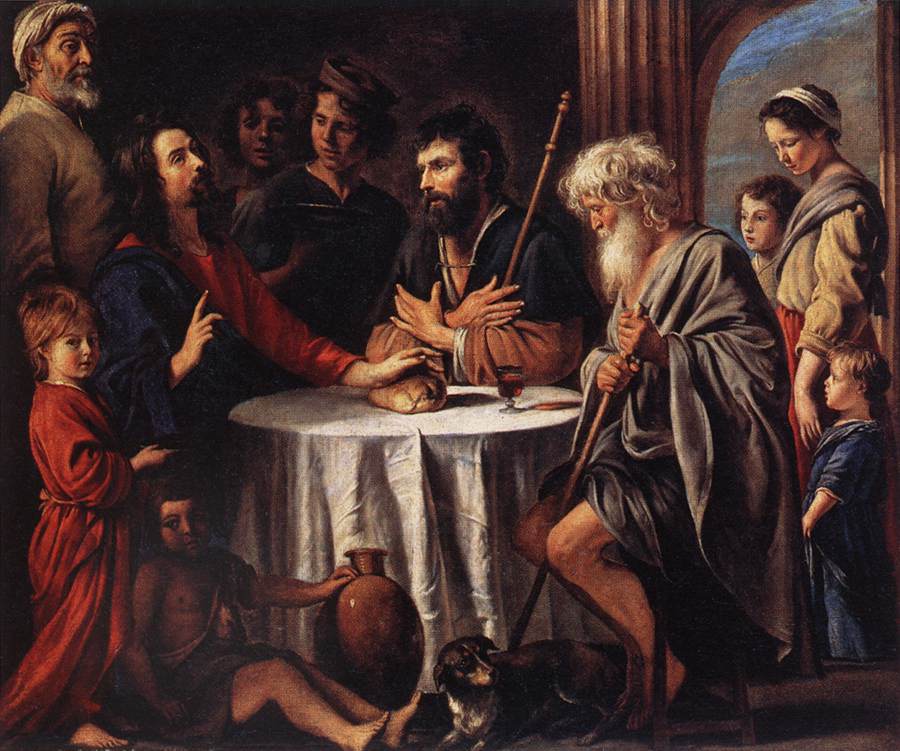 Fratelli Le Nain, Pellegrini di Emmaus, 1645, Musée du Louvre, Parigi
 Jean Restout, La cena di Emmaus, 1735, Palais des Beaux-Arts, Lille

 Rispondi Citando
Discussioni Simili
-
Pasqua di Resurrezione
Di Celtic nel forum Centrodestra ItalianoRisposte: 5Ultimo Messaggio: 19-04-20, 02:56 -
Pasqua di Resurrezione
Di Celtic nel forum Destra RadicaleRisposte: 54Ultimo Messaggio: 13-04-09, 10:43 -
Pasqua di Resurrezione
Di Celtic nel forum Destra RadicaleRisposte: 7Ultimo Messaggio: 12-04-09, 19:27 -
Pasqua di Resurrezione
Di Colombo da Priverno nel forum CattoliciRisposte: 6Ultimo Messaggio: 26-03-08, 14:50 -
Pasqua senza resurrezione ....
Di Niccolò nel forum FondoscalaRisposte: 0Ultimo Messaggio: 16-04-06, 11:52
 Permessi di Scrittura
Powered by vBulletin® Version 4.2.5
Copyright © 2026 vBulletin Solutions Inc. All rights reserved.
Change privacy settings
Copyright © 2026 vBulletin Solutions Inc. All rights reserved.
Change privacy settings
Tutti gli orari sono GMT +2. Adesso sono le 01:57.
