


Lotus: From a Pond to a Palace Dome
Article of the Month - March 2006


Om Mani Padme Hum on the Petals of a Lotus 'In the beginning were the waters. Matter readied itself. The sun glowed. And, a lotus slowly opened, holding the universe on its golden pericarp.' This is precisely the Indian myth of creation as also of the birth of her most majestic flower abounding in supreme beauty, sublime grace and the aura of transcendence. Waters rise but the lotus rises above them. The sun burns and freezing winters mount but the lotus neither sweats nor shivers. And, cyclones move the earth but the rising dust, enshrouding everything from the earth to the sky, does not reach it. Nothing pollutes its purity, nor affects anything its celestial quiescence. Neither the winds shake it nor does frost freeze. Depths below and heights above do not frighten it. Detached it couches over its resplendent bed stretching far and wide cradling on its bosom the forms from the world around and the formlessness from above. When a Buddha's devotee chants: 'Aum mani padme hum', he knows that 'padma' - lotus, is the 'mani' - gem, as having material status the lotus belongs to form, but in it is revealed more characteristically the formless spiritual element, the supreme jewel - the 'mani', that unfolds within, as do lotus petals.
It is this unique significance of lotus that it has more symbolic applications - material and spiritual, than has any other symbol in India's arts, religions and systems of thought. This lotus, in which gods discovered their grace and majesty, poets, painters and sculptors, the subtlest expression of beauty, and mystics, dimensions of mysticism and intricate cosmic existence, is primarily the flower of India - more than the thing of her lakes and ponds, the theme of her myths, legends and texts. Flowers of the botanical family named nymphaeaceae, to which lotus belongs, are found in many Asian, European, Australian and African countries, but these flowers figure neither in theirs arts, literature, myths, legends, or culture, nor in their actual life and system of thought - whatever the reason - lacking in beauty, profundity, or capability to inspire. A yellow lotus is found in abundance in the Central American provinces but like other flowers it is a mere botanical thing. India does not have yellow lotus but her texts and myths abound in some kind of golden lotuses. Maybe, at some point of time, India, too, had a yellow lotus, perhaps a little more brilliant than the American yellow. The surviving Indian lotus is found in red, blue and white colors, its petals varying in number from a few to the mythical thousand. The red lotus is named 'kokanada rakta-kamala'; blue, 'indivara'; and white, 'pundarika'.
Myths of Its Origins
The Legend of Samudra-Manthana
Though just a flower, lotus has many legends in regard to its mythical origin, which its great spiritual significance and the status with which a flower is not usually endowed, has inspired. More prominent is the legend of 'Samudra-manthana' - ocean churning.
The Lotus Goddess of the Cosmic Sea
It is said that once gods and demons reached an agreement that they would jointly churn the ocean to obtain from it nectar that it hid in its bottom. When the churning was in process, ocean revealed fourteen precious jewels and lotus with Lakshmi mounting it was one of them.
Seshashyai Vishnu (With Chromatic Aberration) Thus, lotus was born from the womb of the ocean. The Bhagavata, Matsya and several other Puranas have a different version of the origin of lotus. After the Great Deluge, Vishnu appeared on the surface of the milk-white waters of the Kshirasagara - ocean of milk. He wished the Creation were rendered. Instantly, from his naval rose a lotus carried upon a mighty stem with Brahma, the Creator, mounting it. The first lotus thus grew from the body of Lord Vishnu.
A Shiva-related legend claims its origin from Shiva's seed. Once Shiva was engaged in love with Parvati for many thousand years and did not come out of his chamber. In his absence, demons grew stronger and defeated and humiliated gods on every occasion. Finally, gods went to Shiva and prayed him to stop his love-game and to come to their rescue. Shiva agreed but the problem was where the semen was shed. Agni - fire proposed to bear it but before long it became unbearable and hence Agni let it fall on the earth. Instantly, the spot where it fell turned into a huge lake with abundant lotuses, and thus was born the divine flower. Lotus is also related to Kuber, the lord of riches. As the tradition has it, 'Padam' - lotus, was one of Kuber's 'Nidhis' - treasures. To assist Vishnu, the sustainer of the world, Kuber sent 'Padam' to the earth where it emerged as lotus flower. This symbolism closely corresponds to the emergence of Lakshmi, the Lotus goddess, Vishnu's female aspect and primary instrument of sustaining universe.
Lotus: A Continuous Presence Over 5000 Years
Rock-shelter drawing, Abachand, Sagar, M.P.
Whatever myths of its origin, lotus as a flower had an early presence, at least during the Indus days if not before. Scholars have discovered in the rock-shelter drawings a few motifs, which they feel were representations of lotus. The often illustrated is the drawing looking like a trident from Abchand, Sagar, in Madhya Pradesh. More convincing than the drawing is their argument. They contend that caves' dwellers could not have been unacquainted with lotus, when they had seen and were attracted to a fish and crocodile - the other inhabitants of water, and drew them on their walls.
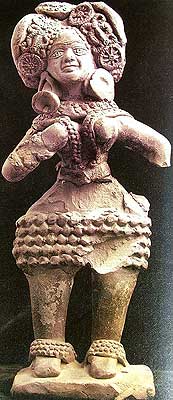
Mother Goddess: Lotus motifs in hair-dress, Late Harappan
By Indus days, however, lotus, both as a decorative motif and as symbol, seems to have become quite popular. The pottery excavated from Mohanjo daro in Indus Valley is found painted with designs composed of lotus-petal-type leaf-patterns. The characteristic Indus terracotta seals bear motifs, which correspond to lotus. A late mother-goddess figurine from Mathura, an obvious continuity of the Indus cult and model, has well-defined lotus motifs in its coiffeur.
Risultati da 1 a 4 di 4
Discussione: il loto
-
22-01-07, 17:58 #1Vittima del kali yuga


- Data Registrazione
- 25 Feb 2006
- Località
- Il desiderio, è come un fuoco insaziabile. Grazie alla barca della conoscenza certamente varcherai tutto l'oceano del male (b. gità)
- Messaggi
- 13,954
-

- 0
-

- 0
- Mentioned
- 0 Post(s)
- Tagged
- 0 Thread(s)
 il loto
-
22-01-07, 17:59 #2Vittima del kali yuga
- Data Registrazione
- 25 Feb 2006
- Località
- Il desiderio, è come un fuoco insaziabile. Grazie alla barca della conoscenza certamente varcherai tutto l'oceano del male (b. gità)
- Messaggi
- 13,954
-
- 0
-
- 0
- Mentioned
- 0 Post(s)
- Tagged
- 0 Thread(s)
Lotus in Early Texts

Bani Thani (An Indian Mona Lisa?)
Allusions to lotus in texts of subsequent days are abundant. The Rig-Veda alludes to white and blue lotuses as 'pundarika' and 'pushkara'. Here the twin gods Ashvina are referred to as 'Puskarasrajau' - the lotus-garlanded ones. The Rig-Veda has referred to 'pushkara' and 'pundarika' also in relation to gods Varuna, Surya and others, and sage Vasishtha. The Rig-Vedic allusion to Agni in relation to lotus is, however, more significant - "O, Agni, in the beginning 'atharvan' churned thee out of the lotus, the bearer of all" (RV 6.16.13). Here lotus, attaining wider dimensions, becomes suggestive of water. The Atharva-Veda mentions red lotus, and the Yajur-Veda, garlands made of white lotuses. Epics - the Ramayana and the Mahabharata, and other early texts have numerous lotus-related contexts. Lotus significantly figures in the entire body of Sanskrit literature - poetry and drama, though primarily for its aesthetic beauty in which poets found an apt parallel to the beauty of the woman and sometimes of the divine or celestial beings.
Lotus in Buddhist Art

The Pillar of Ashoka
Lotus, however, emerges as a mighty factor influencing various arts from third century B. C. after the Mauryan emperor Ashoka had the capitals of his pillars designed with the motif of lotus to serve as the base for the animal figures surmounting pillar's apex.

Maya Devi and Buddha's Birth
Before Buddha was conceived, Maya, his mother, dreamt that a white young elephant, with a lotus in its trunk, entered her womb. And, after his birth, Buddha is said to have got up and walked seven steps, and wherever the foot was laid, a lotus rose.

Hermitage with Lotus suspending on sides, Sunga, 2nd century B.C., Mathura Thus, lotus attained great significance in Buddhism even before Buddha was born, and emperor Ashoka must have been acquainted with it when he chose a lotus motif for his pillars. The influence was immense. In the entire Sunga art, after Ashoka, across third to first century B. C., at Bharhut, Sanchi, Amaravati and other Buddhist centers, lotus surpassed almost all other art motifs. The variedly conceived and carved lotus motifs served sometimes as components to a theme and at other times as an independent art-subject. Medallions, squares and other geometric patterns, designed with lotuses or lotus creepers, entwining in them figures of 'yakshas', elephants, goddesses and various celestial beings, carved on railings, gateways, pillars, pilasters etc. were the common features of the art of this period. Lotus buds and flowers, along with leaves, featured as decorative elements also in sculptures portraying different 'jatakas' and other themes - a hermitage, for example.

Gajalakshmi From Bharhut and Sanchi,
3rd - 2nd Century B.C.
Sanchi and Bharhut have small but elaborately carved relief's of the Lotus goddess - obviously Lakshmi or Gaja-Lakshmi. These icons of the deity, datable to circa second century B. C., are perhaps the earliest, preceding by several centuries her Puranic concept as the consort of Lord Vishnu.

Lady from Ajanta with Lotus
It suggests that not only lotus but also the Lotus goddess emerged first in the Buddhist art and in Brahmanical art after centuries. In the subsequent Gandhara art, from first century B. C. to second-third century A. D., and Kushana art during first-second centuries, lotus was the most favored seat for the images of Buddha and Bodhisattvas. Lotus continued, and perhaps with greater thrust, also as the decorative motif in the concurrent art and in the art of the subsequent phase. Besides sculptures, murals, more particularly at Ajanta and Bagh, presented a very wide range of decorative designs rendered using lotus motifs.

Lokanath on Lotus, 9th Century
By now, iconographic norms had concretized and Bodhisattvas - Avalokiteshvara or Avalokiteshvara Padmapani, the one carrying a lotus in his hand, and Lokanatha, were conceived as carrying lotuses in their hand, though in Padmapani iconography it was its essence, whereas in the Lokanatha, just a feature.
After the Mahayana Buddhism gained prominence, the lotus-seat emerged almost as an essentiality of the images of Buddha and Bodhisattvas. Tibetan Buddhism broke all iconographic norms. Now, even the images of minor Buddhist deities were cast with a lotus seat, and those of Bodhisattvas, other than Avalokiteshvara, with a lotus in hand. The unique mysticism with which lotus was endowed, was the reason of its massive presence in the Mahayana sect. Lama Anagarika Govinda of the Foundation of Tibetan Mysticism perceived in lotus the living synthesis of the deepest and the highest, darkness and light, material and immaterial, limitation of the individuality and boundlessness of universality, the forms and the formless, and samsara and nirvana. Such mystic character of lotus inspired the Buddhist mind - of the devotee and the artist, to bow to it in reverence.
Lotus in other Asian Countries

Lotus Seated Ganesha, Central Java, 10th Century
Asian countries other than India had lotuses in their lakes, but their arts incorporated this majestic flower in their vocabulary only after it reached them through Indian art-sources, mainly the Buddhist. At Ankor Wat in Cambodia and at Java, lotus has been used as part of the iconography of Lakshmi, Ganesh and various other Brahmanical deities.
-
22-01-07, 18:02 #3Vittima del kali yuga
- Data Registrazione
- 25 Feb 2006
- Località
- Il desiderio, è come un fuoco insaziabile. Grazie alla barca della conoscenza certamente varcherai tutto l'oceano del male (b. gità)
- Messaggi
- 13,954
-
- 0
-
- 0
- Mentioned
- 0 Post(s)
- Tagged
- 0 Thread(s)

Kuan Yin
But, to most other Asian countries - Burma, China, Japan, Nepal, Tibet, or Sri Lanka, lotus emigrated as an aspect of Buddhist art - often as the pedestal of the Buddha or Bodhisattva images and sometimes as the divine attribute of Bodhisattva Avalokiteshvara. In China, Avalokiteshvara is known as Guan Yin or Kwan-yin, and in Japan, as Kannon or Kwannon. In India, Avalokiteshvara is a male deity, but in the entire far East, Avalokiteshvara, by whatever name, is revered as the female deity representing compassion.

A Modern Advertisement
Burma had Buddhism since pre-Christian era. A follower of Hinayana, Burma little believed in the later poly-deity cult of Mahayana, and hence majority of its divine images comprised those of Buddha, some with a lotus seat. All other Asian countries pursued Mahayana, with a wide range of deities. Obviously, images of many of them had lotus as their seat. It sometimes formed also an aspect of a deity's iconography. Tibet incorporated lotus pedestals with almost all deities. Now in this phase of globalization of fashions and tastes, lotus is fast emerging as a symbol of beauty and a chosen instrument of media and market aesthetics able to attract the eye to a product, and many sales promoting campaigns world-over are being designed with lotus as their cardinal motif.
Lotus in Brahmanical Perception

Kamalasana Saraswati
Whatever symbolic thrust Buddhism attached to lotus, its real glorification began with Puranas. Puranas discovered its many new dimensions. Besides that the lotus seat multiplied a god's magnificence and divine aura, it also made a god, as acclaimed Vishnudharmottara Purana, propitious. This was perhaps in recognition to the fact that lotus stood basically for the divine element in which were manifested fertility, prosperity, fruition, and riches, and hence when associated with a divinity, it multiplied such divinity's power also to propitiate. With the lotus consecrated on it, the auspicious 'ghata' elevated to the status of 'purnaghata' - from the earth, which 'ghata' symbolized, to the cosmic totality. Now, lotus had the divine birth - as an element of Lord Vishnu's body; integral part of his consort Lakshmi; multiplication of Shiva's seed; or inhabitant of heaven sent to the earth to incarnate as a flower. Puranas' lotus had manly vigour equalizing it to Vishnu's 'chakra', mace and conch, and placing it above his 'vaijayanti' and 'parijata', which only adorned him but were not his attribute, as was lotus; as also feminine tenderness, in which the presence of the tender-most female - Lakshmi, revealed. Vishnu kept it close to his bosom so that Lakshmi was always in his heart. Now, divine forms did not define the form or beauty of lotus - lotus defined theirs. Goddess Saraswati defined her purity with lotus as its metaphor,
Surya - The Sun God
and Surya and Agni, their propitiousness, for being the representative element of water.

Guru Brahma
Lotus alone was capable of balancing their heat and thus rendering them propitious. Brahma could assume Creator's role with elements of cosmos in full control when he appeared 'yogi'-like seated in a lotus, obviously because lotus had emerged from the unfathomable depths of ocean, as creation did out of the non-form.

Ganesha Seated with Consort on Lotus
In analogy, lotus represented the unfoldment of creation and upheld Brahma to effect it. Ganesh could bless a beginning to be detriment free, and his mouse would effect it by removing all obstacles, but auspiciousness would land only when lotus is his support.
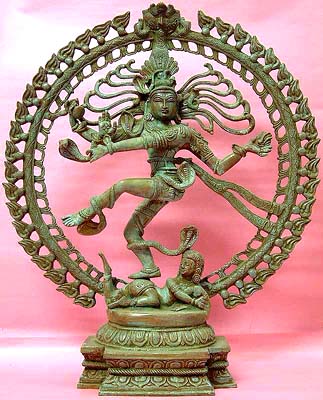
Antiquated Nataraja
Shiva danced with fire in hands to dissolve but with the lotus under his feet, for love and beauty, which was the essence of his being.

Mahabhairavi, Lotus seated, 11th Century
So lotus relieved Mahabhairavi of her awe-striking frame and added to her iconography a tender aspect.

Padmavati, A Transformation of Lakshmi
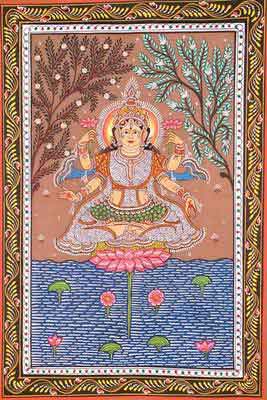
It was in lotus that 'Kamalanayana' or 'Kamalaksha' Vishnu discovered the form of his eye and the beauty and tenderness of his feet. In his incarnation as Rama, Vishnu offered to Devi, when worshipping her for his victory over Ravana, one of his eyes in place of the missing lotus that he had kept for the last rite. Devi accepted his eye for the lotus and the 'yajna' was accomplished. Lotus not only effected Lakshmi's transformation as Padmavati but her very form was defined in a lotus-born diction:
Slender as a lotus-fiber; Lotus-eyed; In the lotus posture; Pollen dusting her feet; She dwells in the pendant lotus of the heart.
She is Shri or Lakshmi.
-
22-01-07, 18:03 #4Vittima del kali yuga
- Data Registrazione
- 25 Feb 2006
- Località
- Il desiderio, è come un fuoco insaziabile. Grazie alla barca della conoscenza certamente varcherai tutto l'oceano del male (b. gità)
- Messaggi
- 13,954
-
- 0
-
- 0
- Mentioned
- 0 Post(s)
- Tagged
- 0 Thread(s)
Lotus defined the form of many of the 'yantras' and 'mandalas' - cosmic diagrams and graphics, revealing definite process of cosmic laws and energies which acted alike on sensible and supersensible levels. The lotus, when reduced to the abstraction of a 'yantra', determined the symbolic character of form and living image of cosmic forces.

Jain Ayagapatta (cosmic diagram), Kushan Period
The tradition of identifying in lotus the diagrams of cosmic energy began by the early centuries of the Common Era - Jain Ayagapattas, Buddhist 'mandalas' etc., being their examples.

The Tantrika Sadhana for Kindling 'Kundalini' Lotus had special significance in 'kundalini-sadhana' - kindling of inherent vital energies. The 'yogi' perceived various steps of such 'sadhana' - from 'muladhara' to 'nirvikalpa samadhi', as the stages of lotus when unfolding. 'Muladhara' is the base and 'nirvikalpa samadhi', the state of being when the subject and the object become one. Steps from 'muladhara' to 'nirvikalpa samadhi', known as 'chakras', are seven. Indian tradition conceives body as composed of five elements: the earth, water, fire, air, and the sky. First five steps of 'kundalini-sadhana' represent these body elements. The 'muladhara' is the seat of the earth and is conceived as crimson lotus with four petals; 'svadhisthana', the seat of water, as vermilion lotus with six petals; 'manipur', the seat of fire, as blue-black lotus with ten petals; 'suddha', situated close to the heart, the seat of air, as ruddy lotus with twelve petals; 'visuddha', close to throat, the seat of the sky, as purple lotus with sixteen petals; the sixth - 'ajna', the point between eye-brows where meditating mind fixes itself, as white lotus with two petals; and, the last - 'nirvikalpa samadhi', as the lotus abounding in all colors and with a thousand petals.
Lotus in India's Classical Dances
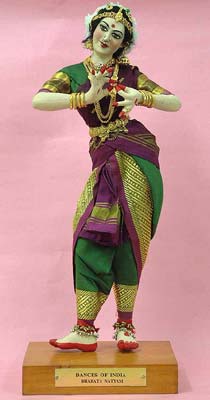
Dances Of India - Bharat Natyam
The symbology of lotus extends also to Indian music and dances. In the 'Bharatanatyam' recital - one of the principal classical dances of India, 'padams' - lotuses define its fifth stage when the dance-moves begin widening requiring expanded room for a fuller display of the composition.
In the terminology of music this stage is known as 'padams' - lotuses. This was actually the stage when the dancer - while dancing for the deity in the temple, as in ancient India a dance was, as a rule, performed for the deity, reached the door of the 'garbhagraha' - sanctum sanctorum. In classical temple architecture, the entrance to the 'garbhagraha' was defined by an elaborate lotus motif. The movement across lotus led to the realization of the deity within, and its outer half, stretching opposite the sanctum, led to the light beyond. The lotus, both in dance and temple architecture, was thus conceived as the instrument of light and spiritual realization.
Lotus in Indian Architecture

Sacred Space
Most extensive has been the use of various lotus motifs in devising the 'shikharas' - spiral towers, of the Hindu and Jain temples in the entire North, East and West. Dravidian architecture of South used lotus motifs but not to define the 'shikharas' of its temples. Its 'shikharas' were differently conceived. The apex of the 'shikhara' in a Northern Indian style temple, known as 'amalaka', just below 'kalasha' - finial, was invariably designed as lotus - inverted or otherwise, and was always one of the most magnificent members of temple art.

The Taj Mahal
This aspect of temple architecture and its over-all beauty has been so imposing that Islamic rulers of India, to include Mughals, imported the style of dome for their mosques, tombs, castles and other structures, from the Islamic world but designed its apex with lotus - usually an inverted one.
Bibliography:
- Heinrich Zimmer: The Art of Indian Asia.
- Kapila Vatsyayan: The Squares and the Circle of Indian Arts.
- Moti Chandra: Jain Miniature Painting from Western India.
- Dr. S, N, Saxena: Lotus in Indian Painting.
- Navaneet Patnaik: The Garden of Life.
- Vijay K. Malhotra: Kamala, Shashvat Sanskritik Pratika.
- Dr. Daljeet-P.C. Jain: Monuments of India.
- Masterpieces from the National Museum Collection.
- Arts of Asia, Vol. 33, No. 4 Hong Kong.
http://www.exoticindiaart.com/article/lotus/





 Rispondi Citando
Discussioni Simili
-
[I° Festa del Loto-Dibattiti] 11 settembre 2001: a caccia della verità
Di Makaveli nel forum Prima Repubblica di POLRisposte: 1Ultimo Messaggio: 14-09-13, 10:07 -
Sul simbolismo del «Loto»
Di SATTWA nel forum Filosofie e Religioni d'OrienteRisposte: 0Ultimo Messaggio: 16-03-08, 12:11 -
il loto
Di stuart mill nel forum Esoterismo e TradizioneRisposte: 3Ultimo Messaggio: 22-01-07, 18:05 -
Agosto: il fiore di loto, dove abitano le fate delle acque.
Di benelos nel forum Natura e viaggiRisposte: 0Ultimo Messaggio: 06-08-05, 00:32 -
Con Wolfowitz gli USA rafforzano il loto potere
Di Der Wehrwolf nel forum EtnonazionalismoRisposte: 1Ultimo Messaggio: 25-03-05, 23:09
 Permessi di Scrittura
Powered by vBulletin® Version 4.2.5
Copyright © 2026 vBulletin Solutions Inc. All rights reserved.
Change privacy settings
Copyright © 2026 vBulletin Solutions Inc. All rights reserved.
Change privacy settings
Tutti gli orari sono GMT +2. Adesso sono le 07:40.
