


Dal sito SANTI E BEATI:
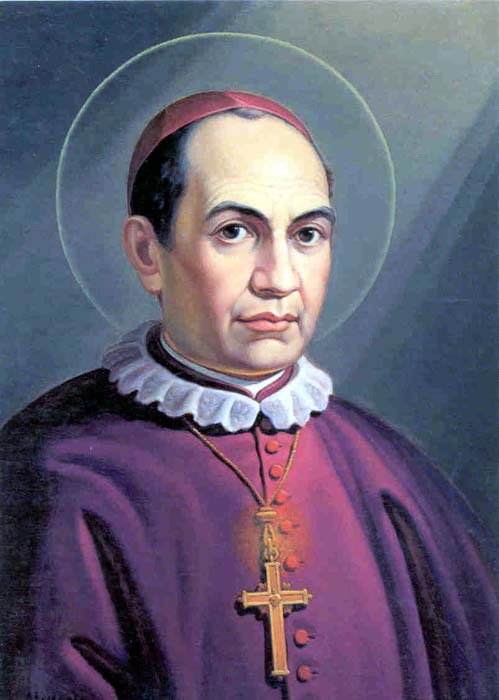
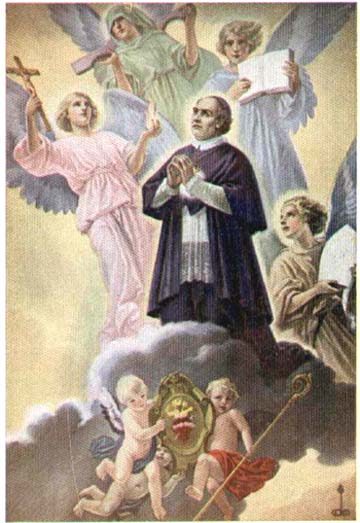
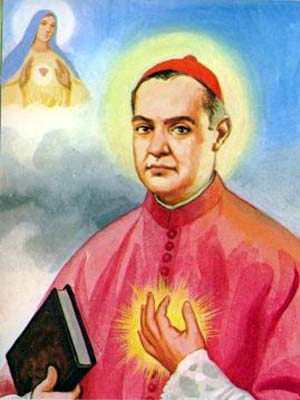
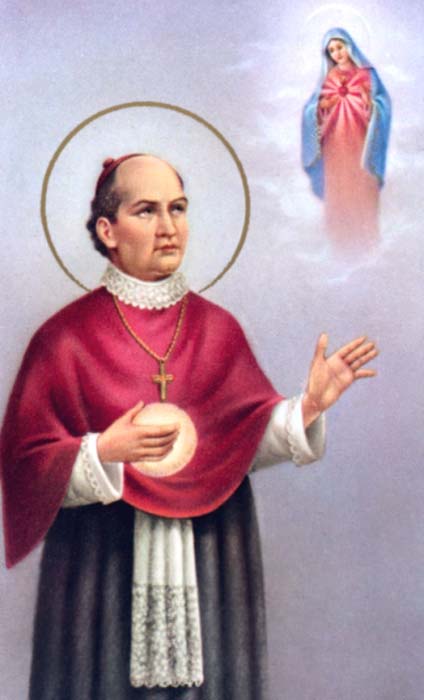
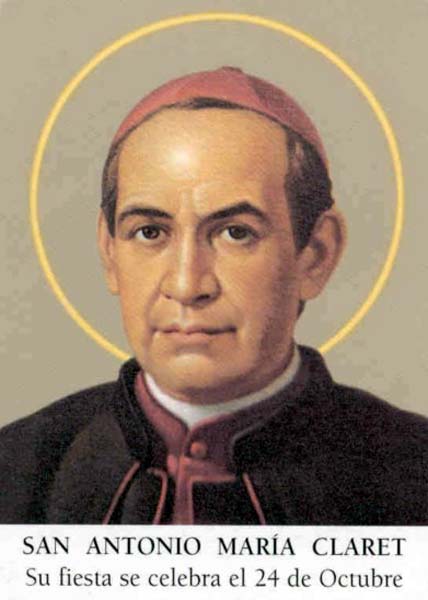
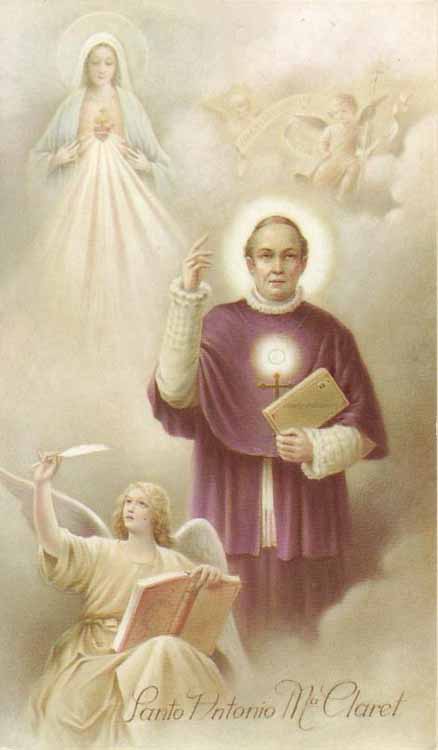
Sant'Antonio María Claret y Clará, Vescovo
24 ottobre - Memoria Facoltativa
Sallent (Catalogna, Spagna), 23 dicembre 1807 - Fontfroide (Francia), 24 ottobre 1870
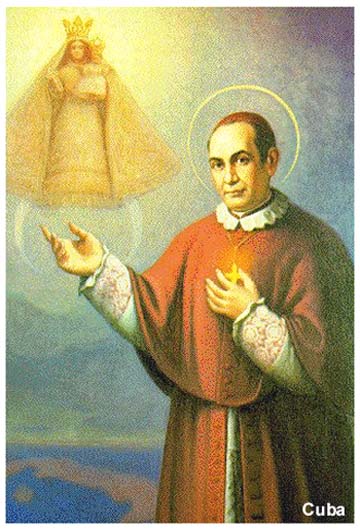
Una figura del secolo XIX al cui nome è tuttora legata una congregazione religiosa diffusa in tutti i continenti, quella dei Missionari del Cuore Immacolato di Maria, detti appunto Clarettiani. Di origine catalana, appena ordinato sacerdote Claret si reca a Roma, a Propaganda Fide, per essere inviato missionario. Ma la salute precaria lo costringe a tornare in patria. Così per sette anni si dedica alla predicazione delle missioni popolari tra la Catalogna e le Isole Canarie. È tra i giovani raggiunti in questa attività apostolica che nasce l’idea della congregazione. Nel 1849 viene nominato arcivescovo di Santiago di Cuba. Morirà il 24 ottobre 1870. (Avvenire)
Etimologia: Antonio = nato prima, o che fa fronte ai suoi avversari, dal greco
Emblema: Bastone pastorale
Martirologio Romano: Sant’Antonio Maria Claret, vescovo: ordinato sacerdote, per molti anni percorse la regione della Catalogna in Spagna predicando al popolo; istituì la Società dei Missionari Figli del Cuore Immacolato della Beata Maria Vergine e, divenuto vescovo di Santiago nell’isola di Cuba, si adoperò con grande merito per la salvezza delle anime. Tornato in Spagna, sostenne ancora molte fatiche per la Chiesa, morendo infine esule tra i monaci cistercensi di Fontfroide vicino a Narbonne nella Francia meridionale.
Martirologio tradizionale (23 ottobre): Sant'Antonio Maria Claret, Vescovo e Confessore, il cui giorno natalizio si celebra nel giorno seguente.
(24 ottobre): Nel monastero di Fontfroide, nella diocesi di Carcassona, in Francia, sant'Antonio Maria Claret, già Arcivescovo di Cuba, Fondatore dei Missionari Figli del Cuore Immacolato di Maria, glorioso per la mansuetudine e lo zelo delle anime, che Pio dodicesimo, Pontefice Massimo, iscrisse nei fasti dei Santi. La sua festa però si celebra nel giorno precedente.
Nato in una famiglia profondamente cristiana di tessitori catalani con dieci figli. Viene ordinato nel 1835, a 28 anni. Va a Roma nel 1839 e si rivolge a Propaganda Fide per essere inviato come missionario in qualsiasi parte del mondo. Non potendo raggiungere questo obiettivo, entra come novizio tra i Gesuiti, ma dopo pochi mesi deve tornare in patria perché malato. Per sette anni predica numerosissime missioni popolari in tutta la Catalogna e le isole Canarie conquistando un'immensa popolarità, anche come taumaturgo. Sa mettere insieme la gente dando vita ad associazioni e gruppi. Nel 1849 fonda una Congregazione apostolica: i Figli dell’Immacolato Cuore di Maria Oggi anche conosciuti come Missionari Clarettiani. All'inizio del terzo millennio, essi lavorano in 65 paesi dei cinque continenti. Nel 1936/ 39, durante la guerra civile spagnola, 271vengono uccisi per causa della fede. Tra questi spiccano i 51 Martiri di Barbastro, beatificati da Giovanni Paolo II il 1992. (Vedi in questa web: Martiri Spagnoli Clarettiani di Barbastro).
Nominato nel 1849 arcivescovo di Santiago di Cuba (all'epoca appartenente alla corona di Spagna), arriva in diocesi nel febbraio di 1851. Nel suo strenuo lavoro apostolico affronta i gravi problemi morali, religiosi e sociali dell'Isola: concubinato, povertà, schiavitù, ignoranza, ecc., ai quali si aggiungono due calamità che colpiscono la popolazione: epidemie e terremoti.
Ripercorre la sua vasta diocesi per ben quattro volte missionando instancabilmente con un gruppo di santi missionari. Le sue preoccupazioni pastorali si riversano anche in gran parte nel potenziamento del seminario e nella riformazione del clero. Nell'ambito sociale, promuove l'agricoltura, anche con diverse pubblicazioni e creando una fattoria-modello a Camagüey. Oltre a questo crea in ogni parrocchia una cassa di risparmio, opera pioniera in America Latina. Promuove l'educazione cercando Istituti religiosi e creando egli stesso insieme alla Venerabile Maria Antonia Paris la congregazione delle Religiose di Maria Immacolata (Missionarie Clarettiane). La sua strenua fortezza nel difendere i diritti della Chiesa e i diritti umani li crea numerosi nemici tra i politici e i corrotti. E così subisce minacce e attentati, tra i quali uno ad Holguin, dove viene gravemente ferito al volto. Nel 1857 la regina lo richiama a Madrid come suo confessore. In questa tappa continua ad annunziare il Vangelo nella capitale e in tutta la penisola.
Esiliato in Francia nel 1868 arriva con la regina a Parigi e, anche qui, prosegue le sue predicazioni.
Poi partecipa in Roma al concilio Vaticano I dove difende con ardore l'infallibilità del Romano Pontefice.
Perseguitato ancora dalla rivoluzione, si rifugia nel monastero di Fontfroide presso Narbona, dove spira santamente il 24 ottobre del 1870.
Sulla tomba vengono scolpite le parole di papa Gregorio VII: "Ho amato la giustizia e odiato l’iniquità, per questo muoio in esilio". Il suo corpo si venera nella Casa Madre dei Clarettiani a Vic (Barcellona).
Fu beatificato da Pio XI il 25 febbraio 1934.
E l'8 maggio 1950, Pio XII lo proclama santo, e dice del Claret: "spirito grande, sorto come per appianare i contrasti: poté essere umile di nascita e glorioso agli occhi del mondo; piccolo nella persona però di anima gigante; modesto nell'apparenza, ma capacissimo d'imporre rispetto anche ai grandi della terra; forte di carattere però con la soave dolcezza di chi sa dell'austerità e della penitenza; sempre alla presenza di Dio, anche in mezzo ad una prodigiosa attività esteriore; calunniato e ammirato, festeggiato e perseguitato. E tra tante meraviglie, quale luce soave che tutto illumina, la sua devozione alla Madre di Dio".
Autore: P. Jesús Bermejo, CMF
Risultati da 1 a 10 di 15
-
23-10-07, 22:13 #1**********


- Data Registrazione
- 04 Jun 2003
- Messaggi
- 23,775
-

- 18
-

- 35
- Mentioned
- 2 Post(s)
- Tagged
- 0 Thread(s)
 23 ottobre (24 ottobre) - S. Antonio Maria Claret, vescovo
-
23-10-07, 22:14 #2**********
- Data Registrazione
- 04 Jun 2003
- Messaggi
- 23,775
-
- 18
-
- 35
- Mentioned
- 2 Post(s)
- Tagged
- 0 Thread(s)

-
23-10-07, 22:18 #3**********
- Data Registrazione
- 04 Jun 2003
- Messaggi
- 23,775
-
- 18
-
- 35
- Mentioned
- 2 Post(s)
- Tagged
- 0 Thread(s)
Ven. Antonio María Claret y Clará
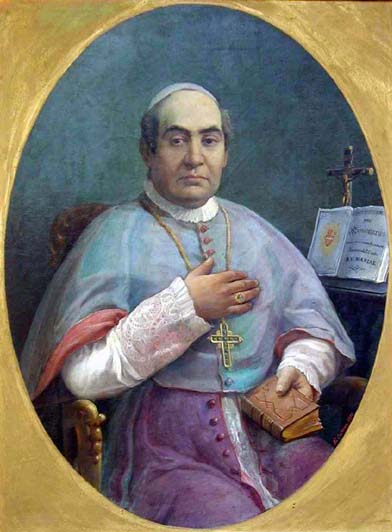
Spanish prelate and missionary, born at Sallent, near Barcelona, 23 Dec., 1807; d. at Fontfroide, Narbonne, France, on 24 Oct., 1870. Son of a small woollen manufacturer, he received an elementary education in his native village, and at the age of twelve became a weaver. A little later he went to Barcelona to specialize in his trade, and remained there till he was twenty. Meanwhile he devoted his spare time to study and became proficient in Latin, French, and engraving; in addition he enlisted in the army as a volunteer. Recognizing a call to a higher life, he left Barcelona, entered the seminary at Vich in 1829, and was ordained on 13 June, 1835. He received a benefice in his native parish, where he continued to study theology till 1839. He now wished to become a Carthusian; missionary work, however, appealing strongly to him he proceeded to Rome. There he entered the Jesuit novitiate but finding himself unsuited for that manner of life, he returned shortly to Spain and exercised his ministry at Valadrau and Gerona, attracting notice by his efforts on behalf of the poor. Recalled by his superiors to Vich, he was engaged in missionary work throughout Catalonia. In 1848 he was sent to the Canary Islands where he gave retreats for fifteen months. Returning to Vich he established the Congregation of the Missionary Sons of the Immaculate Heart of Mary (16 July, 1849), and founded the great religious library at Barcelona which bears his name, and which has issued several million cheap copies of the best ancient and modern Catholic works.
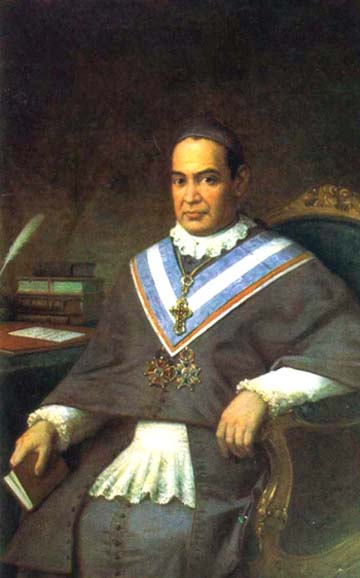
Such had been the fruit of his zealous labours and so great the wonders he had worked, that Pius IX at the request of the Spanish sovereign appointed him Archbishop of Santiago de Cuba in 1851. He was consecrated at Vich and embarked at Barcelona on 28 Dec. Having arrived at his destination he began at once a work of thorough reform. The seminary was reorganized, clerical discipline strengthened, and over nine thousand marriages validated within the first two years. He erected a hospital and numerous schools. Three times he made a visitation of the entire diocese, giving local missions incessantly. Naturally his zeal stirred up the enmity and calumnies of the irreligious, as had happened previously in Spain. No less than fifteen attempts were made on his life, and at Holguin his cheek was laid open from ear to chin by a would-be assassin's knife. In February, 1857, he was recalled to Spain by Isabella II, who made him her confessor. He obtained permission to resign his see and was appointed to the titular see of Trajanopolis. His influence was now directed solely to help the poor and to propagate learning; he lived frugally and took up his residence in an Italian hospice. For nine years he was rector of the Escorial monastery where he established an excellent scientific laboratory, a museum of natural history, a library, college, and schools of music and languages. His further plans were frustrated by the revolution of 1868. He continued his popular missions and distribution of good books wherever he went in accompanying the Spanish Court. When Isabella recognized the new Government of United Italy he left the Court and hastened to take his place by the side of the pope; at the latter's command, however, he returned to Madrid with faculties for absolving the queen from the censures she had incurred. In 1869 he went to Rome to prepare for the Vatican Council. Owing to failing health he withdrew to Prades in France, where he was still harassed by his calumnious Spanish enemies; shortly afterwards he retired to the Cistercian abbey at Fontfroide where he expired.
His zealous life and the wonders he wrought both before and after his death testified to his sanctity. Informations were begun in 1887 and he was declared Venerable by Leo XIII in 1899. His relics were transferred to the mission house at Vich in 1897, at which time his heart was found incorrupt, and his grave is constantly visited by many pilgrims. In addition to the Congregation of the Missionary Sons of the Heart of Mary (approved definitively by Pius IX, 11 Feb., 1870) which has now over 110 houses and 2000 members, with missions in W. Africa, and in Chocó (Columbia), Archbishop Claret founded or drew up the rules of several communities of nuns. By his sermons and writings he contributed greatly to bring about the revival of the Catalan language. His printed works number over 130, of which we may mention: "La escala de Jacob"; "Maximas de moral la más pura"; "Avisos"; "Catecismo explicado con láminas"; "La llave de oro"; "Selectos panegíricos" (11 vols.); "Sermones de misión" (3 vols.); "Misión de la mujer"; "Vida de Sta. Mónica"; "La Virgen del Pilar y los Francmasones"; and his "Autobiografia", written by order of his spiritual director, but still unpublished.
[Note: Antonio María Claret was canonized by Pope Pius XII in 1950.]
Bibliography
AGUILAR, Vida admirable del Venerable Antonio María Claret (Madrid, 1894); BLANCH, Vida del Venerable Antonio María Claret (Barcelona, 1906); CLOTET, Compendio de la vida del Siervo de Dios Antonio María Claret (Barcelona, 1880); Memorias ineditas del Padre Clotet in the archives of the missionaries of Aranda de Duero; VILLABA HERVAS, Recuerdos de cinco lustros 1843-1868 (Madrid, 1896); Estudi bibliografich de los obres del Venerable Sallenti (Barcelona, 1907).
Fonte: The Catholic Encyclopedia, vol. XVI (Index Volume), New York, 1914
-
24-10-07, 07:54 #4**********
- Data Registrazione
- 04 Jun 2003
- Messaggi
- 23,775
-
- 18
-
- 35
- Mentioned
- 2 Post(s)
- Tagged
- 0 Thread(s)

-
24-10-07, 18:40 #5**********
- Data Registrazione
- 04 Jun 2003
- Messaggi
- 23,775
-
- 18
-
- 35
- Mentioned
- 2 Post(s)
- Tagged
- 0 Thread(s)
St. Anthony Mary Claret – October 24
Prof. Plinio Corrêa de Oliveira
Biographical selection:
Anthony Mary Claret (1807-1870), Bishop and Confessor. From 1850 to 1857, he was Archbishop of Cuba and he predicted its chastisement. He returned to the court of Queen Isabella II as confessor, and went into exile with her in 1868.
 St. Anthony Mary Claret
He was a champion of papal infallibility and the fight against Freemasonry. A great devotee of Our Lady, he founded the Missionary Sons of the Immaculate Heart of Mary, known today as the Claretians. In 1869 and 1870, St. Anthony Mary Claret participated in the First Vatican Council. He died in the Cistercian monastery of Fontfroide in southern France on October 24, 1870.
Comments of Prof. Plinio:
A long time ago the Claretian Priests of the city of Rio Claro [in the State of Sao Paulo, Brazil] invited me to give a talk on their founder. I bought a small biography of him and read it on the trip. Many things can be said about this great Saint. He was one of these men who, aside from having founded a religious congregation, dominated his epoch by the mere fact of his existence.
He was a short, energetic Spaniard, a peppery Catalonian. At age 17 he traveled to the lively trade center of Barcelona to further himself in the weaving profession of his father. He became so involved in the technology and business that he could think of almost nothing else.
During this period of his life, he was a mediocre Catholic even though he maintained a devotion to Our Lady. One hot day in the summer of 1826, Anthony was wading in the sea when a huge wave engulfed him and carried him out into the deep. He could not swim, but called out to the Blessed Virgin for help, and found himself carried back to the shore, half drowned and semi-conscious. When he came to himself he realized how close he had come to dying. He began to consider the mediocrity of his life and he converted.
He was ordained a priest and became a missionary. He revealed himself an orator with eminent qualities who appealed to the simple people. He had a very powerful voice that could be heard in the far corners of the public squares where he used to preach to the multitudes that gathered to hear him. The churches could not contain all those people, and at times even the squares overflowed. He used to go from city to city preaching, and many times the inhabitants of one city followed him along the road to the halfway point, where he was met by inhabitants of the next city who had come to welcome him and accompany him to their city.
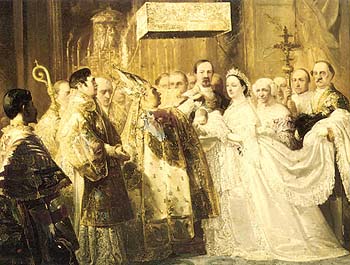 The Saint acquired great influence over the Queen and the Royal Family. Above, he baptizes one of its members
The preaching of St. Anthony Mary Claret attracted and held the people. His words were zealous, rich with learning and natural eloquence, and filled with extraordinary charismas. Very often he would move his audience to tears. At times he would prophesize, interrupting a sermon, for example, to tell a lady: “You think that you still have a long time to live, but you are mistaken. You will die in six months.” At other times he would exorcise demons, saying, for instance, “I will expel the Devil that hovers over this audience.” As he pronounced the words of the exorcism, strange noises, lightning, and other phenomena were heard and seen by the multitude. Of course, these charismas impressed and attracted the people.
He realized that he was called to preach the truths of the Faith to the simple people. Doing this, he gave an edifying example to other religious Orders that were influenced by Liberalism and rejecting the Church’s traditional preaching methods in order to adapt themselves to the modern world. St. Anthony Mary Claret achieved a fabulous result using the traditional methods. His implicit reply to those who attacked the traditional methods was simple: the people don’t come to you because of the old methods, but because you are liberals.
He also understood that he was called to increase the zeal of the people, not to organize or direct it. He would pass through the provinces planting the seed of the love of God, leaving the job of watering that seed and making it grow to others.
Only weeks after founding his missionary congregation of the Sons of the Immaculate Heart of Mary, notice arrived from Rome that he had been nominated to become Archbishop of Santiago, the primatial see of Cuba. He was consecrated Bishop, made an Archbishop, and sent to Cuba. As soon as he arrived, he started to correct the bad customs and indifferent morals of the people and began a real conversion of the Island.
 Through the maneuvers of Freemasonry, Queen Isabella II was deposed and exiled with her family and confessor
The Freemasonry that was deeply entrenched in Cuba could not tolerate this, and intensely attacked St. Anthony Mary Claret. He suffered all kinds of persecutions, including several attempts on his life. The opposition of the enemies of the Church was so strong that finally the Queen of Spain decided it would be more prudent to remove him from the Island and return him to Spain. At her request, he was offered the appointment of Patriarch of India, which would make him confessor and spiritual director of the Royal Court of Madrid.
As his ship left the shore of Cuba, St. Anthony Mary Claret cursed the Island whose inhabitants had refused God. It was not long before this curse took effect. With its independence, Cuba rejected the life-giving spiritual sap it had received from Spain, and quickly became a center of corruption and immorality, a tourist site for Americans seeking dissolute vacations. This was the case until Communism took over the Cuban government and implanted its regime. You can see that the curse launched by St. Anthony Mary Claret was realized quite impressively.
The chaplain of the Spanish Court had the title of Patriarch of India, but it was just an honorific title with nothing to do with India. Queen Isabella II was supporting the liberal side of the Spanish Royal House that was fighting against the good Carlist movement. As so often happens with liberals, they play the game of Freemasonry, and if they stop, Masonry takes them out of the game. Even though she was liberal, the Queen began to be influenced by St. Anthony Claret and gradually took a different position. When her policies started to become anti-liberal, the Masons removed her from power and sent her out of Spain in exile. It was St. Anthony Claret who provoked this political earthquake.
It was also during that time in Spain he exercised a very successful missionary apostolate and more firmly established the Congregation of the Sons of the Immaculate Heart of Mary.
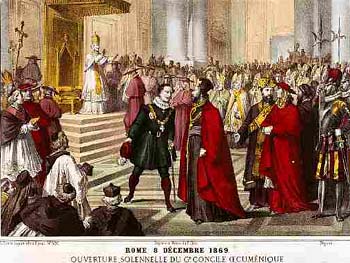 Pope Pius IX opening Vatican Council I, Scala, Art Resource, NY
The deposing of Isabella II was in part a victory for the good cause. The Masonry knew that Spain was not yet ready to accept a Republic, and wanted to establish a Constitutional Monarchy first in order to prepare the way for a stable Republic. Because it was forced to depose the Queen, it was obliged to make the Republic prematurely. This caused a deep crystallization in public opinion against the Republic, which led to the restoration of the Monarchy some time later. The Republic would have triumphed earlier in Spain without the action of St. Anthony Mary Claret.
Even as he grew old and suffered sicknesses, his incredible energy and gifts to move the people with his words continued. He was also granted many special graces, in particular, the grace of conserving the Sacramental Species within his heart. From one Communion to another, the Eucharistic Species were preserved incorrupt in his body so that he always had the Blessed Sacrament in his heart.
In his last days, he participated in Vatican Council I, which the Pope had convened at the Vatican in December of 1869. Seeing many liberal Bishops opposing the matter of Papal Infallibility that was being discussed, he became indignant and strongly censured them in a speech. Hearing the errors being spoken on this topic, he was so overcome with indignation that the blood rushed to his head and he suffered a stroke from which he never recovered. He died some months later.
 We should call on St. Anthony Mary Claret for his help under different titles
St. Anthony Mary Claret is our patron Saint under many different titles:
• the patron of those who are leading mediocre lives and need to convert to serve the Catholic cause;
• the patron of the faithful who promote devotion to Our Lady;
• the patron of counter-revolutionaries because of his action in Cuba and Spain;
•the patron of the those who follow the traditional methods of Catholic apostolate with the simple people and spurn the liberal novelties;
• the patron of those who fight for the Papacy against liberal Bishops.
Since it was this same current of Bishops that endured and took power in the Catholic Church at Vatican Council II, St. Anthony Mary Claret is also a great protector and intercessor of those who are called to fight the errors of Vatican II and its consequences.
We should call on St. Anthony Mary Claret for his help under these different titles.
FONTE
-
23-10-08, 06:30 #6**********
- Data Registrazione
- 04 Jun 2003
- Messaggi
- 23,775
-
- 18
-
- 35
- Mentioned
- 2 Post(s)
- Tagged
- 0 Thread(s)
Dalle «Opere» di sant'Antonio Maria Claret, vescovo
(L'Egoismo vinto, Roma 1869, 60)
Mossi dal fuoco dello Spirito Santo, gli apostoli percorsero tutta la terra. Accesi dallo stesso fuoco i missionari apostolici raggiunsero, raggiungono e raggiungeranno i confini del mondo da un polo all'altro della terra per annunziare la parola di Dio, così da poter giustamente applicare a sé quelle parole dell'apostolo Paolo: «L'amore di Cristo ci spinge» (2 Cor 5, 14). La carità di Cristo ci sprona, ci spinge a correre e a volare, portati sulle ali di un santo zelo. Chi ama davvero, ama Dio e il prossimo. Chi é davvero zelante é anche amante, ma in un grado più alto, secondo il grado dell'amore; di modo che quanto più arde d'amore, tanto più é spinto dallo zelo. Se qualcuno non ha zelo, questo sta a testimoniare che nel suo cuore l'amore e la carità sono spenti. Chi é zelante, brama e compie cose sublimi e lavora perché Dio sia sempre più conosciuto, amato e servito in questa e nell'altra vita. Questo santo amore, infatti non ha fine. La stessa cosa fa con il prossimo. Desidera e procura sollecitamente che tutti siano contenti su questa terra e felici e beati nella patria celeste; che tutti si salvino, che nessuno si perda per l'eternità, né offenda Dio e resti, sia pure un istante, nel peccato. Così fecero i santi apostoli e tutti quelli che furono mossi da spirito apostolico.
Io dico a me stesso: Il figlio del Cuore immacolato di Maria é una persona che arde di carità e dovunque passa brucia. Desidera effettivamente e si dà da fare con tutte le forze per infiammare gli uomini con il fuoco dell'amor divino. Non si lascia distogliere da nulla, gode delle privazioni, affronta le fatiche, abbraccia i travagli, si rallegra delle calunnie, é felice nei tormenti. A null'altro pensa se non come seguire Gesù Cristo e imitarlo nella preghiera, nella fatica, nella sopportazione e nel cercare sempre e solo la gloria di Dio e la salvezza delle anime. L'amore di Cristo ci spinge.
-
23-10-08, 06:33 #7**********
- Data Registrazione
- 04 Jun 2003
- Messaggi
- 23,775
-
- 18
-
- 35
- Mentioned
- 2 Post(s)
- Tagged
- 0 Thread(s)

-
23-10-08, 06:43 #8**********
- Data Registrazione
- 04 Jun 2003
- Messaggi
- 23,775
-
- 18
-
- 35
- Mentioned
- 2 Post(s)
- Tagged
- 0 Thread(s)
PIO XII
ALLOCUZIONE AI PELLEGRINI CONVENUTI A ROMA
PER LA CANONIZZAZIONE DEL BEATO ANTONIO MARÍA CLARET *
Lunedì 8 maggio 1950
Desde casi todas las regiones de España habéis venido, amados hijos, para asistir al solemne triunfo de aquel cuyo nombre está queriendo brotar en estos momentos de los labios de todos: de San Antonio María Claret. Y Nos, al acogeros con la mayor cordialidad y el más paternal afecto, deseamos daros la bienvenida y expresaros la satisfacción con que hemos otorgado los máximos honores de los altares a tan eminente figura, honra de su Patria y de la Iglesia.
No es de aquellos a quienes la gloria va a descubrir, por haber vivido ignorados o escondidos. Antonio María Claret, hijo de padres cristianísimos, pero modestos, en su infancia y en su juventud trabó conocimiento con el telar y el taller; pero muy pronto, los muchos dones que el Creador había depositado en su alma privilegiada, y la generosidad con que él correspondió a la voz divina, le elevaron sobre el nivel común.
Eran tiempos difíciles y confusos; por eso su primer ministerio en su patria chica —Sallent— no fue tan sencillo; y más aún si se considera que también en su alma ardiente fraguaba algo que él mismo no acababa de ver con claridad; de aquí su primer viaje a Roma, su tentativa misional y su regreso iluminado con un ideal, que pronto se concretaría en su obra principal, sus Misioneros Hijos del Inmaculado Corazón de María, que habían de ser los herederos de su celo insaciable, de su fervor altísimo y de su amor a las almas.
Cualidades tan excelsas requerían más amplio escenario, y Nuestro gran Predecesor Pío IX vio en él un «pastor según el corazón de Dios», eligiéndole para la sede metropolitana de Santiago de Cuba, donde Antonio María Claret fue el prelado ejemplar, enamorado de su clero y de su Seminario, favorecedor de nuevas Instituciones religiosas para el bien de su grey, heroico entre los terrores del terremoto y del cólera, celador incansable de la pureza de la vida cristiana entre sus ovejas, a las que dejó el mejor testimonio, el de su propia sangre derramada en atentado sacrílego.
Pero la Providencia le quería en lugar aún más visible, confesor y consejero de una Reina; y en tan delicada posición Antonio María Claret siguió siendo el de siempre: fervoroso, mortificado, pobre, prudente, y sobre todo amantísimo de esta Sede Apostólica, por cuyo amor abandonó voluntariamente su codiciable puesto con la misma fidelidad con que, en el ocaso de su vida, haría vibrar de emoción —aquí en esta misma Basílica— a todo el Concilio Vaticano, al escuchar la vigorosa defensa de la infalibilidad pontificia, hecha por aquel anciano y prestigioso campeón de la fe.
Alma grande, nacida como para ensamblar contrastes: pudo ser humilde de origen y glorioso a los ojos del mundo; pequeño de cuerpo, pero de espíritu gigante; de apariencia modesta, pero capacísimo de imponer respeto incluso a los grandes de la tierra; fuerte de carácter, pero con la suave dulzura de quien sabe el freno de la austeridad y de la penitencia; siempre en la presencia de Dios, aun en medio de su prodigiosa actividad exterior; calumniado y admirado, festejado y perseguido. Y entre tantas maravillas, como luz suave que todo lo ilumina, su devoción a la Madre de Dios.
No son nuestros tiempos menos difíciles que los del Santo Arzobispo de Cuba, confesor de la Reina de España y fundador insigne; por eso juzgamos providencial el poder hoy ponerle como modelo para todos, pero especialmente para vosotros —sus paisanos y devotos—; y más en especial para sus celosos hijos e hijas, cuyos respectivos Institutos, con todas sus obras y con todas las almas que de ellas se benefician, queremos paternalmente bendecir.
Que la Bendición de Dios Omnipotente descienda, hijos amadísimos, sobre todos vosotros, sobre todos aquellos que recordáis y que amáis, sobre vuestra querida patria, sobre vuestras santas intenciones y justos deseos, y que permanezca para siempre.
------------------------------------------------------------------------
* AAS 42 (1950) 479-481
-
23-10-08, 06:53 #9**********
- Data Registrazione
- 04 Jun 2003
- Messaggi
- 23,775
-
- 18
-
- 35
- Mentioned
- 2 Post(s)
- Tagged
- 0 Thread(s)
A mero titolo documentale ....
PAULUS PP. VI
LITTERAE APOSTOLICAE
SANCTA AMICITIA*
SANCTUS ANTONIUS MARIA CLARET, EPISCOPUS ET CONFESSOR, PRAECIPUUS DEFINITUR PATRONUS CONGREGATIONIS SORORUM ADORATRICUM ANCILLARUM A SANCTISSIMO SACRAMENTO ET CARITATE.
Ad perpetuam rei memoriam.— Sancta amicitia, quae perfecta fuit animorum Deo pariter adhaerentium coniunctio, Antonium Mariam Claret, Episcopum eumque praeclarum religiosi instituti auctorem, mortalis vita e diebus cum Maria Michaëla ab Augusto Sacramento sociavit, cui etiam lectissimae feminae novae in Ecclesia conditae familiae laus debetur. Constat enim inspectis litterarum monumentis eundem Caelitem non solum patrem vitaeque magistrum, sed adiutorem et consiliarium etiam in opere efficiendo et solidando, multae cum urgerent difficultates, forti illi mulieri prudenter affuisse. Ipse primum Congregationis Ancillarum a SS. Sacramento et Caritate leges recognovit, quas postea ad iuris normam exquisitas Apostolica Sedes probavit; ipse providum se praebuit custodem et instituti omnis et earum domorum, quas conditrix ad cultus Eucharistici incrementum itemque ad bonum salutemque periclitantium puellarum excelso animo aperuerat. Atque nunc, in gloriam Dei assumptus, tamquam peculiaris habetur et colitur Patronus a Sanctae Michaëlae filiabus, neque ullum potest esse dubium, quin ipse validiore sane subsidio iuvet opus, quod vivens in terris fovisse cognoscitur. His quidem de causis dilecta in Christo filia Generalis Antistita huiusce Congregationis, nomine religiosi consilii, saeculari appropinquante anno gloriosae mortis fundatricis, scripsit ad Nos, ut per publicum decretum personam ac munus Sancti Antonii Mariae debita in luce collocantes, eius patrocinium ad res, domus, alumnas omnes pertinens confirmaremus. Quod votum benignissime admittere statuimus, hoc etiam religiosis virginibus suadentes, ut ipsius stent Matris exemplo ideoque sincera Patronum excolant veneratione. Itaque, ex Sacrae Rituum Congregationis consulto, certa scientia ac matura deliberatione Nostra, deque Apostolicae potestatis plenitudine, harum Litterarum vi perpetuumque in modum, Sanctum Antonium Mariam Claret, Episcopum et Confessorem, principalem apud Deum totius Congregationis Sororum Adoratricum Ancillarum a SS. Sacramento et Caritate caelestem Patronum confirmamus, seu constituimus ac declaramus, omnibus adiectis iuribus et privilegiis liturgicis, quae praecipuis religiosorum coetuum Patronis rite competunt. Contrariis quibusvis nihil obstantibus. Haec edicimus, statuimus, decernentes praesentes Litteras firmas, validas atque efficaces iugiter exstare ac permanere; suosque plenos atque integros effectus sortiri et obtinere; illisque, ad quos spectant seu spectare poterunt, nunc et in posterum plenissime suffragari, sicque rite iudicandum esse ac definiendum; irritumque ex nunc et illane fieri, si quidquam secus, super his, a quovis, auctoritate qualibet scienter sive ignoranter attentari contingerit.
Datum Romae, apud Sanctum Petrum, sub anulo Piscatoris, die XII mensis Maii, anno MCMLXIV, Pontificatus Nostri primo.
HAMLETUS I. Card. CICOGNANI
a publicis Ecclesiae negotiis
-------------------------------------------------------------------------
*A.A.S., vol. LVI (1964), n. 13, pp. 800-801
-
23-10-08, 06:54 #10**********
- Data Registrazione
- 04 Jun 2003
- Messaggi
- 23,775
-
- 18
-
- 35
- Mentioned
- 2 Post(s)
- Tagged
- 0 Thread(s)
GIOVANNI PAOLO II
DISCORSO AI MISSIONARI FIGLI DELL'IMMACOLATO
CUORE DI MARIA (CLARETIANI)
13 ottobre 1979
Cari Missionari Figli dell’Immacolato Cuore di Maria.
Durante la celebrazione del vostro recente Capitolo Generale, avete manifestato il desiderio di incontrare il Papa, per esprimergli la vostra adesione ed obbedienza, la vostra disponibilità apostolica e la vostra totale apertura alle direttive che voglia darvi. Ricevete prima di tutto il mio ringraziamento per questo atteggiamento interiore così degno di religiosi, di missionari, di figli di Colei che è la Madre di Cristo e della Chiesa.
Con questo Capitolo appena concluso, termina il processo di rinnovamento ed adattamento delle vostre Costituzioni, iniziato durante il Capitolo speciale del 1967 e proseguito nel 1973. Avete fatto sì di portare a termine questo rinnovamento con l’aiuto dello Spirito Santo e la guida della Chiesa, seguendo in questo il vostro fondatore, Sant’Antonio Maria Claret, che rinnovò le Costituzioni prime, con speciale osservanza delle osservazioni della Santa Sede (Historia CMF, Madrid 1967, vol. I, p. 232).
Il compito di rinnovamento delle Costituzioni non è stato facile perché volevate salvare da una parte la fedeltà all’ispirazione autentica del Fondatore, i suoi obiettivi, il suo spirito e la genuina tradizione dell’Istituto e, dall’altra, rispondere alle esigenze attuali della Chiesa di fronte ad un mondo che vive un processo di cambiamento accelerato.
Il rinnovamento del testo costituzionale vi ha obbligato ad approfondire il vostro carisma, ed avete così acquistato una più chiara coscienza della vostra identità nella Chiesa e delle possibilità di inserimento nell’edificazione del Regno di Cristo, secondo la vostra missione specifica.
Siete una Congregazione Missionaria, una Congregazione di Evangelizzatori. Perciò dovete fare della evangelizzazione la ragione d’essere del vostro Istituto. Una evangelizzazione condotta sempre sotto la guida della Chiesa; evangelizzazione universale, per “tutti gli abitanti del mondo” (Const. 1857, n. 2); evangelizzazione che tenga ben in conto le necessità di oggi, e dia loro risposte evangeliche; evangelizzazione che impieghi i mezzi più adeguati; evangelizzazione fatta testimonianza, con uno stile di vita veramente religioso; evangelizzazione preceduta e accompagnata dalla preghiera; stimolata dall’amore per Cristo e per gli uomini; attuata sotto la protezione di Colei che è la Stella degli evangelizzatori.
Amati figli: ricordate sempre che Gesù deve essere mostrato a fedeli e infedeli grazie a voi. Per poterlo fare adeguatamente, seguitelo ed imitatelo sempre più da vicino, nella vita, nel lavoro e nella sofferenza, cercando sempre e unicamente la maggior gloria di Dio e la salvezza degli uomini.
Come il vostro santo Fondatore, coltivate nella preghiera una speciale amicizia apostolica con Gesù Cristo, perché possiate offrire al mondo la Parola, che venne interiorizzata nell’intimità silenziosa.
Nella vostra missione evangelizzatrice, seguite gli orientamenti contenuti nell’Evangelii Nuntiandi, la magna carta dell’Evangelizzazione, del mio predecessore, il Papa Paolo VI. Siccome il vostro campo di apostolato è tanto vasto e diversificato, tenete in conto le necessità locali e gli orientamenti della Gerarchia, all’interno delle chiese particolari.
Infine, come il vostro Fondatore, lasciate che la Vergine Maria accenda nel focolare della sua carità, la fiamma del vostro impegno. Sia lo spirito di vostra Madre a parlare in voi, affinché annunciando il Vangelo degnamente e fruttuosamente, vi chiamiate e siate davvero suoi figli.
Con questi auguri e speranze, vi incoraggio nel vostro cammino e impartisco a voi e a tutti i membri della vostra Congregazione, la mia affettuosa Benedizione.


 Rispondi Citando
Discussioni Simili
-
17 ottobre (16 ottobre) - S. Margherita Maria Alacocque
Di Augustinus nel forum TradizionalismoRisposte: 16Ultimo Messaggio: 17-10-18, 19:56 -
31 ottobre - S. Volfango di Ratisbona, vescovo
Di Augustinus nel forum TradizionalismoRisposte: 5Ultimo Messaggio: 31-10-17, 23:58 -
25 ottobre - S. Gaudenzio di Brescia, vescovo
Di Augustinus nel forum TradizionalismoRisposte: 1Ultimo Messaggio: 25-10-08, 07:03 -
7 Ottobre 2005- 7 Ottobre 2008 Antonio Vive
Di Cuib Evita nel forum Destra RadicaleRisposte: 4Ultimo Messaggio: 10-10-08, 00:48 -
7 giugno - S. Antonio Maria Gianelli, vescovo e fondatore
Di Augustinus nel forum TradizionalismoRisposte: 2Ultimo Messaggio: 07-06-08, 08:26
 Permessi di Scrittura
Powered by vBulletin® Version 4.2.5
Copyright © 2026 vBulletin Solutions Inc. All rights reserved.
Change privacy settings
Copyright © 2026 vBulletin Solutions Inc. All rights reserved.
Change privacy settings
Tutti gli orari sono GMT +2. Adesso sono le 06:35.
