


(Lib. 10, in PG 74, 434)
Cristo aveva compiuto la sua missione sulla terra, e per noi era ormai venuto il momento di entrare in comunione con la natura del Verbo cioè di passare dalla vita naturale di prima a quella che trascende l'esistenza umana. Ma a ciò non potevamo arrivare se non divenendo partecipi dello Spirito Santo.
Il tempo più adatto alla missione dello Spirito e alla sua venuta su di noi era quello che seguì l'ascensione di Cristo al cielo.
Finché Cristo infatti viveva ancora con il suo corpo insieme ai fedeli, egli stesso, a mio parere, dispensava loro ogni bene. Quando invece giunse il momento stabilito di salire al Padre celeste, era necessario che gli fosse presente ai suoi seguaci per mezzo dello Spirito ed abitasse per mezzo della fede nei nostri cuori, perché, avendolo in noi, potessimo dire con fiducia «Abbà, Padre» e praticassimo con facilità ogni virtù e inoltre fossimo trovati forti e invincibili contro le insidie del diavolo e gli attacchi degli uomini, dal momento che possedevamo lo Spirito Santo onnipotente.
Che lo Spirito infatti trasformi in un'altra natura coloro nei quali abita e li rinnovi nella loro vita è facile dimostrarlo con testimonianze sia dell'Antico che del Nuovo Testamento.
Samuele infatti, ispirato, rivolgendo la parola a Saul, dice: Lo Spirito del Signore ti investirà e sarai trasformato in altro uomo (cfr. 1 Sam 10, 6). San Paolo poi dice: E noi tutti, a viso scoperto, riflettendo come in uno specchio la gloria del Signore, veniamo trasformati in quella medesima immagine, di gloria in gloria, secondo l'azione dello Spirito del Signore. Il Signore poi è Spirito (cfr. 2 Cor 3, 17-18).
Vedi come lo Spirito trasforma, per così dire, in un'altra immagine coloro nei quali abita? Infatti porta con facilità dal gusto delle cose terrene a quello delle sole cose celesti e da una imbelle timidezza ad una forza d'animo piena di coraggio e di grande generosità.
I discepoli erano così disposti e così rinfrancati nell'animo dallo Spirito Santo, da non essere per nulla vinti dagli assalti dei persecutori, ma fortemente stretti all'amore di Cristo.
E' vero dunque quello che dice il Salvatore: E' meglio per voi che io me ne ritorni in cielo (cfr. Gv 16, 7). Quello infatti era il tempo in cui sarebbe disceso lo Spirito Santo.
Risultati da 31 a 40 di 57
Discussione: Pentecoste
-
22-05-07, 08:57 #31**********


- Data Registrazione
- 04 Jun 2003
- Messaggi
- 23,775
-

- 18
-

- 35
- Mentioned
- 2 Post(s)
- Tagged
- 0 Thread(s)
 Dal «Commento sul vangelo di Giovanni» di san Cirillo di Alessandria, vescovo
-
22-05-07, 08:58 #32**********
- Data Registrazione
- 04 Jun 2003
- Messaggi
- 23,775
-
- 18
-
- 35
- Mentioned
- 2 Post(s)
- Tagged
- 0 Thread(s)
Dal «Trattato sulla Trinità» di sant'Ilario, vescovo
(Lib. 2, 1, 33. 35, in PL 10, 50-51. 73-75)
Il Signore comandò di battezzare nel nome del Padre e del Figlio e dello Spirito Santo. Il catecumeno viene battezzato professando perciò la fede nel Creatore, nell'Unigenito, nel Dono.
Unico è il Creatore di tutto. Uno infatti Dio Padre da cui hanno principio tutte le cose. Unico è anche l'Unigenito, il Signore Nostro Gesù Cristo, per mezzo del quale tutte le cose furono create, e unico lo Spirito dato in dono a tutti.
Tutto è ordinato secondo le sue virtù e meriti; una la potenza da cui tutto procede; una la prole per la quale tutto è stato fatto; uno il dono della perfetta speranza.
Non si troverà nulla che manchi ad una perfezione infinita. Nell'ambito della Trinità, Padre, Figlio e Spirito Santo, tutto è perfettissimo: l'immensità nell'eterno, la manifestazione nell'immagine, il godimento nel dono.
Ascoltiamo dalle parole dello stesso Signore quale sia il suo compito nei nostri confronti. Dice: «Molte cose ho ancora da dirvi, ma per il momento non siete capaci di portarne il peso» (Gv 16, 12). E' bene per voi che io me ne vada, se me ne vado vi manderò il Consolatore (cfr. Gv 16, 7). Ancora: «Io pregherò il Padre ed egli vi darà un altro Consolatore perché rimanga con voi per sempre, lo Spirito di verità» (Gv 14, 16-17). «Egli vi guiderà alla verità tutta intera, perché non parlerà da sé, ma dirà tutto ciò che avrà udito e vi annunzierà le cose future. Egli mi glorificherà, perché prenderà del mio» (Gv 16, 13-14).
Insieme a tante altre promesse vi sono queste destinate ad aprire l'intelligenza delle alte cose. In queste parole vengono formulati sia la volontà del donatore, come pure la natura e il modo stesso del dono.
Siccome la nostra limitatezza non ci permette di intendere né il Padre, né il Figlio, il dono dello Spirito Santo stabilisce un certo contatto tra noi e Dio, e così illumina la nostra fede nelle difficoltà relative all'incarnazione di Dio.
Lo si riceve dunque per conoscere. I sensi per il corpo umano sarebbero inutili se venissero meno i requisiti per il loro esercizio. Se non c'è luce o non è giorno, gli occhi non servono a nulla; gli orecchi in assenza di parole o di suono non possono svolgere il loro compito; le narici se non vi sono emanazioni odorifere, non servono a niente. E questo avviene non perché venga loro a mancare la capacità naturale, ma perché la loro funzione è condizionata da particolari elementi. Allo stesso modo l'anima dell'uomo, se non avrà attinto per mezzo della fede il dono dello Spirito Santo, ha sì la capacità di intendere Dio, ma le manca la luce per conoscerlo.
Il dono, che è in Cristo, è dato interamente a tutti. Resta ovunque a nostra disposizione e ci è concesso nella misura in cui vorremo accoglierlo. Dimorerà in noi nella misura in cui ciascuno di noi vorrà meritarlo.
Questo dono resta con noi fino alla fine del mondo, è il conforto della nostra attesa, è il pegno della speranza futura nella realizzazione dei suoi doni, è la luce delle nostre menti, lo splendore delle nostre anime.
-
23-05-07, 09:00 #33**********
- Data Registrazione
- 04 Jun 2003
- Messaggi
- 23,775
-
- 18
-
- 35
- Mentioned
- 2 Post(s)
- Tagged
- 0 Thread(s)
Dai Discorsi di Giovanni Taulero
"I discepoli furono pieni di Spirito Santo". E cominciarono a parlare dei prodigi di Dio. Questo è l'amabile giorno in cui lo Spirito Santo fu mandato sotto forma di lingue di fuoco ai santi discepoli e a tutti coloro che erano riuniti con essi; il giorno in cui fu ridato l'amabile tesoro che era stato perduto nel paradiso per istigazione del nemico e per l'umana fragilità. Fu ridonato proprio a Pentecoste. Il modo con cui ciò avvenne è stupendo già solo esternamente; quanto al mistero che era là nascosto e racchiuso sotto quei prodigi esteriori, nessuna intelligenza, nessun concetto, nessuna creatura arriverebbe a conoscerlo, a concepirlo e ad esprimerlo. Lo Spirito Santo è un'immensità talmente inafferrabile e deliziosa che tutte le grandezze e immensità che qualunque ragione può concepire secondo una qualche immagine, non sono nulla, Cielo, terra e tutto ciò che vi si può cogliere svaniscono in paragone. Tutta la somma delle creature di fronte allo Spirito Santo sono molto meno che il minimo atomo rispetto all'universo. Anzi, l'universo intero è mille volte inferiore di fronte al minimo che si può pensare dello Spirito Santo.
Perciò là dove lo Spirito Santo deve essere ricevuto, lui in persona deve preparare il posto, creare per mezzo di sé la stessa ricettività e accogliere pure sé medesimo. L'ineffabile abisso di Dio è tale che egli può essere ricevuto solo in sé stesso, e solo lui può essere il luogo dell'accoglienza e delle creature a cui egli si dona. La casa fu riempita dal vento impetuoso. Dio colma in totalità. Dove egli arriva colma ogni capacità di ricevere e satura ogni dimensione dell'uomo.
"I discepoli furono tutti pieni di Spirito Santo". Qui c'è da notare quale fosse la situazione in cui si trovavano questi credenti quando furono così saziati: è quella che ogni uomo deve avere. Essi erano riuniti, rinchiusi, stavano tranquillamente seduti, quando fu mandato loro lo Spirito Santo. Questo amabile Spirito Santo viene dato a ciascuno così spesso e tutte le volte in cui con tutte le forze ci stacchiamo da ogni creatura e ci volgiamo a Dio. Nello stesso istante che l'uomo fa ciò, immediatamente viene lo Spirito Santo con la sua raggiera dei doni e invade subito tutti gli angoli e il fondo dell'anima. Viceversa, nello stesso istante e in quel medesimo attimo in cui l'uomo si allontana da Dio per avvicinarsi alle creature, (si tratti di sé o di qualunque altra) immediatamente lo Spirito Santo fugge e se ne va con ogni sua ricchezza e tutto il suo tesoro.
La casa in cui sedevano i discepoli fu riempita completamente. Questa dimora sta anzitutto a simboleggiare la santa Chiesa, che è l'abitazione di Dio; ma essa significa anche ciascun uomo in cui abita lo Spirito Santo. Quanti appartamenti e camere vi sono in una casa, altrettante facoltà, sensi e operazioni vi sono nell'uomo. In tutti questi viene lo Spirito Santo in maniera speciale. Appena arriva, preme, eccita l'uomo, desta in lui determinate inclinazioni, lo lavora e lo illumina.
Questa intima visita e questa azione interiore non vengono percepite da tutti secondo un'uguale esperienza. Benché lo spirito Santo abiti in ogni brav'uomo, chi vuol poter divenire consapevole dell'operazione divina, sentire e gustare la sua presenza, deve concentrarsi in sé stesso, sbarrare l'uscio a tutte le sollecitazioni esterne; occorre che lasci spazio dentro di sé all'operazione dello Spirito nella quiete e nel silenzio. Allora l'uomo comincerà ad aver coscienza dello spirito di Dio che si manifesterà a lui. Quanto più uno si dedica, di ora in ora, a questo movimento di concentrazione, tanto più avverte la manifestazione interiore, sempre crescente, dello Spirito Santo che tuttavia gli era stato donato interamente fin dagli inizi.
Gli uomini saggi e beati non gustano altro che Dio e le realtà divine. Essi hanno nel proprio fondo un vero anelito per Dio. Anche quando vanno fuori, essi restano sempre dentro raccolti e custodiscono lo Spirito Santo e la pace comunque si applichino in una qualche attività. "I discepoli erano riuniti." Quella circostanza deve insegnarci come raccogliere tutte le nostre facoltà, sia interne sia esterne, perché lo Spirito Santo trovi posto per operare. Egli infatti compie prodigi meravigliosi dove incontra spazio disponibile.
I discepoli stavano seduti quando venne lo Spirito Santo. Così devi sederti anche tu in verità, e mettere tutte le creature, gioia e sofferenza, volere o non volere, nella volontà di Dio. Questo è un discorso che conviene per qualsiasi uomo intento alle realtà spirituali. Costui non sarà tale se non avrà con Dio una sola volontà e gli rimarrà conforme e unito sul serio. Anzi, questo è l'obbligo comune ad ogni credente che voglia essere salvato: egli non deve tendere a niente che sia contrario al beneplacito divino. Ci si domanda se tutti coloro che hanno fatto voti religiosi siano obbligati ad essere perfetti oppure no. Ora maestro Tommaso ci insegna che essi sono obbligati a vivere e a tendere alla perfezione.
Sappiate ora che quando lo Spirito Santo viene in un uomo, porta sempre con sé grande amore, luce, gusto e consolazione, perché si chiama il Consolatore. Appena l'insensato se ne accorge, vi sì precipita sopra con piacere; ciò lo soddisfa ed egli ama il piacere. Ma così smarrisce il vero fondo, cioè Dio origine di tutti i doni. Invece l'uomo prudente non si comporta in tal modo con i doni divini; egli si volge completamente alla Sorgente, penetra attraverso tutti i doni e le grazie fino ad una luminosa purità; non bada né a questo né a quello, ma semplicemente a Dio, senza far caso agli eventi accidentali che gli capiteranno di fuori. Ci conceda Dio che tutti noi possiamo ricevere lo Spirito Santo nel modo più nobile.
-
23-05-07, 09:01 #34**********
- Data Registrazione
- 04 Jun 2003
- Messaggi
- 23,775
-
- 18
-
- 35
- Mentioned
- 2 Post(s)
- Tagged
- 0 Thread(s)
Dai Discorsi di Guerrìco d'Igny
Dio è ineffabile, ineffabile è la sua misericordia. A questo suo nome corrispondono le sue opere. Sì, l'amore di Dio ha per noi tenerezze indicibili. Era poca cosa per il Padre aver consegnato il Figlio perché riscattasse lo schiavo. Volle dare anche lo Spirito Santo, perché rendesse figlio lo schiavo mediante l'adozione. Il Padre dette il Figlio per redimerci e donò lo Spirito Santo per conferirci il privilegio dell'adozione; infine riserva tutto sé stesso come eredità destinata a questi suoi figli adottivi. O Dio, prodigo di sé, se così si può dire, tanto desidera l'uomo! Prodigo davvero dato che non dispensa solo quello che è suo, ma anche sé stesso per ricuperare l'uomo. E lo fa non per sé quanto proprio per l'uomo. Davvero prodigo, perché come non risparmiò il proprio Figlio, ma lo ha dato per tutti noi, così non ha neppure risparmiato lo Spirito Santo, se oso parlare così, ma lo ha effuso su ogni umano, con una abbondanza stupenda e assolutamente inedita.
Fu certo munifico, prodigo di sé quel figlio che cedette tanto il patrimonio quanto sé stesso alle prostitute. Ma per ritrovare il figlio perduto, il Padre fu più munifico di quanto lo fu il figlio nel perdersi: ammesso che grazia e denaro, spirito e carne, Dio e l'uomo sopportino di venire a confronto. Contempla la profusione di grazia che lo Spirito effonde nell'universo non solo per confermare il giusto, ma per giustificare il peccatore. Il volto della terra è rinnovato, quando lo Spirito crea una nuova umanità. Anzi, la destra dell'Altissimo ogni giorno è all'opera, perché peccatori incalliti e donne depravate precedono i giusti nel Regno di Dio, gli ultimi diventano i primi. Il dono non segue il medesimo regime del peccato; perché laddove "ha abbondato il peccato, ha sovrabbondato la grazia". Dio non si limita a rimettere i peccati, ma accumula meriti e valorizzazioni. La redenzione eleva i caduti ad una altezza inarrivabile rispetto a quella della prima creazione.
Signore, la tua misericordia vale più della vita, "un giorno nei tuoi atri è più che mille altrove". La tua povertà rende i tuoi poveri più beati di quanto non possa fare il mondo con la sua strabocchevole dovizia, perché è un’abbondanza che straripa e fugge via travolgendo nella sua corsa chi le sì era attaccato. D'altre delizie era ricca quella povera famiglia di Cristo, inondata dall'impeto del fiume che rallegra la città di Dio, quando, come oggi, lo Spirito simile a torrente, riempì tutta la casa dove si trovavano gli Apostoli. La verità divina attuava la promessa annunciata dal profeta: "Ecco, io farò scorrere verso di essa, come un fiume, la prosperità, come un torrente in pien la ricchezza dei popoli". Che fiotti di grazia in quei cuori attraversati da simile fiumana! E poi che fluire sgorgava da quei petti turgidi di fiumi di acqua viva.
La tenerezza della carità si spande fuori dal cuore degli apostoli, ma non basta: dalle loro bocche prorompe l'impeto di una parola veemente che travolge ogni tentativo di opposizione o di replica avversaria. Di Stefano è scritto che: "Non riuscivano a resistere alla sapienza ispirata con cui egli parlava". A simili gioie, fratelli, vi invita il vostro Consolatore. Egli anela di poter dissetare con il torrente delle sue voluttà i suoi amanti assetati. "Chi ha sete venga e beva" egli dice. Inarrestabile generosità dì Dio! Liberalità senza confini del suo amore. Lo Spirito, le cui primizie dette agli apostoli in quella Pentecoste, egli l'offre a chiunque. Il suo tesoro, la fonte di acqua viva spalanca ad ogni vivente come se si sentisse debitore verso i prudenti e gli insensati: "O voi tutti assetati, venite all'acqua."
Non fa distinzione di persone, non bada a categorie, non cerca meriti. Unicamente si decida a venire chi sa d'aver sete.
-
26-05-07, 17:21 #35**********
- Data Registrazione
- 04 Jun 2003
- Messaggi
- 23,775
-
- 18
-
- 35
- Mentioned
- 2 Post(s)
- Tagged
- 0 Thread(s)
Holy Ghost
I. SYNOPSIS OF THE DOGMA
The doctrine of the Catholic Church concerning the Holy Ghost forms an integral part of her teaching on the mystery of the Holy Trinity, of which St. Augustine (De Trin., I, iii, 5), speaking with diffidence, says: "In no other subject is the danger of erring so great, or the progress so difficult, or the fruit of a careful study so appreciable". The essential points of the dogma may be resumed in the following propositions:
1. The Holy Ghost is the Third Person of the Blessed Trinity.
2. Though really distinct, as a Person, from the Father and the Son, He is consubstantial with Them; being God like Them, He possesses with Them one and the same Divine Essence or Nature.
3. He proceeds, not by way of generation, but by way of spiration, from the Father and the Son together, as from a single principle.
Such is the belief the Catholic faith demands.
II. CHIEF ERRORS
All the theories and all the Christian sects that have contradicted or impugned, in any way, the dogma of the Trinity, have, as a logical consequence, threatened likewise the faith in the Holy Ghost. Among these, history mentions the following:
1. In the second and third centuries, the dynamic or modalistic Monarchians (certain Ebionites, it is said, Theodotus of Byzantium, Paul of Samosata, Praxeas, Noëtus, Sabellius, and the Patripassians generally) held that the same Divine Person, according to His different operations or manifestations, is in turn called the Father, the Son, and the Holy Ghost; so they recognized a purely nominal Trinity.
2. In the fourth century and later, the Arians and their numerous heretical offspring: Anomans or Eunomians, Semi-Arians, Acacians, etc., while admitting the triple personality, denied the consubstantiality. Arianism had been preceded by the Subordination theory of some ante-Nicene writers, who affirmed a difference and a gradation between the Divine Persons other than those that arise from their relations in point of origin.
3. In the sixteenth century, the Socinians explicitly rejected, in the name of reason, along with all the mysteries of Christianity, the doctrine of Three Persons in One God.
4. Mention may also be made of the teachings of Johannes Philoponus (sixth century), Roscellinus, Gilbert de la Porrée, Joachim of Flora (eleventh and twelfth centuries), and, in modern times, Günther, who, by denying or obscuring the doctrine of the numerical unity of the Divine Nature, it reality set up a triple deity.
In addition to these systems and these writers, who came in conflict with the true doctrine about the Holy Ghost only indirectly and as a logical result of previous errors, there were others who attacked the truth directly:
a) Towards the middle of the fourth century, Macedonius, Bishop of Constantinople, and, after him a number of Semi-Arians, while apparently admitting the Divinity of the Word, denied that of the Holy Ghost. They placed Him among the spirits, inferior ministers of God, but higher than the angels. They were, under the name of Pneumatomachians, condemned by the Council of Constantinople, in 381 (Mansi, III, col. 560).
b) Since the days of Photius, the schismatic Greeks maintain that the Holy Ghost, true God like the Father and the Son, proceeds from the former alone.
III. THE THIRD PERSON OF THE BLESSED TRINITY
This heading implies two truths:
1. The Holy Ghost is a Person really distinct as such from the Father and the Son;
2. He is God and consubstantial with the Father and the Son.
The first statement is directly opposed to Monarchianism and to Socinianism; the second to Subordinationism, to the different forms of Arianism, and to Macedonianism in particular. The same arguments drawn from Scripture and Tradition may be used generally to prove either assertion. We will, therefore, bring forward the proofs of the two truths together, but first call particular attention to some passages that demonstrate more explicitly the distinction of personality.
A. Scripture
In the New Testament the word spirit and, perhaps, even the expression spirit of God signify at times the soul or man himself, inasmuch as he is under the influence of God and aspires to things above; more frequently, especially in St. Paul, they signify God acting in man; but they are used, besides, to designate not only a working of God in general, but a Divine Person, Who i&neither the Father nor the Son, Who is named together with the Father, or the Son, or with Both, without the context allowing them to be identified. A few instances are given here. We read in John, xiv, 16, 17: "And I will ask the Father, and he shall give you another Paraclete, that he may abide with, you for ever. The spirit of truth, whom the world cannot receive"; and in John, xv, 26: "But when the Paraclete cometh, whom I will send you from the Father, the Spirit of truth, who proceedeth from the Father, he shall give testimony of me." St. Peter addresses his first epistle, i, 1-2, "to the strangers dispersed . . . elect, according to the foreknowledge of God the Father, unto the sanctification of the Spirit, unto obedience and sprinkling of the blood of Jesus Christ". The Spirit of consolation and of truth is also clearly distinguished in John 16:7, 13-15, from the Son, from Whom He receives all He is to teach the Apostles, and from the Father, who has nothing that the Son also does not possess. Both send Him, but He is not separated from Them, for the Father and the Son come with Him when He descends into our souls (John 14:23).
Many other texts declare quite as clearly that the Holy Ghost is a Person, a Person distinct from the Father and the Son, and yet One God with Them. In several places St. Paul speaks of Him as if speaking of God. In Acts 28:25, he says to the Jews: "Well did the Holy Ghost speak to our fathers by Isaias the prophet"; now the prophecy contained in the next two verses is taken from Isaias 6:9-10, where it is put in the mouth of the "King the Lord of hosts". In other places he uses the words God and Holy Ghost as plainly synonymous. Thus he writes, I Corinthians 3:16: "Know you not, that you are the temple of God, and that the Spirit of God dwelleth in you?" and in 6:19: "Or know you not, that your members are the temple of the Holy Ghost, who is in you . . . ?" St. Peter asserts the same identity when he thus remonstrates with Ananias (Acts 5:3-4): "Why hath Satan tempted thy heart, that thou shouldst lie to the Holy Ghost . . . ? Thou hast not lied to men, but to God." The sacred writers attribute to the Holy Ghost all the works characteristic of Divine power. It is in His name, as in the name of the Father and of the Son, that baptism is to be given (Matthew 28:19). It is by His operation that the greatest of Divine mysteries, the Incarnation of the Word, is accomplished (Matthew 1:18, 20; Luke 1:35). It is also in His name and by His power that sins are forgiven and souls sanctified: "Receive ye the Holy Ghost. Whose sins you shall forgive, they are forgiven them" (John 20:22-23); "But you are washed, but you are sanctified, but you are justified in the name of our Lord Jesus Christ, and the Spirit of our God" (1 Corinthians 6:11); "The charity of God is poured forth in our hearts, by the Holy Ghost, who is given to us" (Romans 5:5). He is essentially the Spirit of truth (John 14:16-17; 15:26), Whose office it is to strengthen faith (Acts 6:5), to bestow wisdom (Acts 6:3), to give testimony of Christ, that is to say, to confirm His teaching inwardly (John 15:26), and to teach the Apostles the full meaning of it (John 14:26; 16:13). With these Apostles He will abide for ever (John 14:16). Having descended on them at Pentecost, He will guide them in their work (Acts 8:29), for He will inspire the new prophets (Acts 11:28; 13:9), as He inspired the Prophets of the Old Law (Acts 7:51). He is the source of graces and gifts (1 Corinthians 12:3-11); He, in particular, grants the gift of tongues (Acts 2:4; 10:44-47). And as he dwells in our bodies sanctifies them (1 Corinthians 3:16; 6:19),so will and them he raise them again, one day, from the dead (Romans 8:11). But he operates especially in the soul, giving it a new life (Romans 8:9 sq.), being the pledge that God has given us that we are his children (Romans 8:14-16; 2 Corinthians 1:22; 5:5; Galatians 4:6). He is the Spirit of God, and at the same time the Spirit of Christ (Romans 8:9); because He is in God, He knows the deepest mysteries of God (1 Corinthians 2:10-11), and He possesses all knowledge. St. Paul ends his Second Epistle to the Corinthians (13:13) with this formula of benediction, which might be called a blessing of the Trinity: "The grace of our Lord Jesus Christ, and the charity of God, and the communication of the Holy Ghost be with you all." -- Cf. Tixeront, "Hist. des dogmes", Paris, 1905, I, 80, 89, 90,100,101.
B. Tradition
While corroborating and explaining the testimony of Scripture, Tradition brings more clearly before us the various stages of the evolution of this doctrine.
As early as the first century, St. Clement of Rome gives us important teaching about the Holy Ghost. His "Epistle to the Corinthians" not only tells us that the Spirit inspired and guided the holy writers (viii, 1; xlv, 2); that He is the voice of Jesus Christ speaking to us in the Old Testament (xxii, 1 sq.); but it contains further, two very explicit statements about the Trinity. In c. xlvi, 6 (Funk, "Patres apostolici", 2nd ed., I,158), we read that "we have only one God, one Christ, one only Spirit of grace within us, one same vocation in Christ". In lviii, 2 (Funk, ibid., 172), the author makes this solemn affirmation; zo gar ho theos, kai zo ho kyrios Iesous Christos kai to pneuma to hagion, he te pistis kai he elpis ton eklekton, oti . . . which we may compare with the formula so frequently met with in the Old Testament: zo kyrios. From this it follows that, in Clement's view, kyrios was equally applicable to ho theos (the Father), ho kyrios Iesous Christos, and to pneuma to hagion; and that we have three witnesses of equal authority, whose Trinity, moreover, is the foundation of Christian faith and hope.
The same doctrine is declared, in the second and third centuries, by the lips of the martyrs, and is found in the writings of the Fathers. St. Polycarp (d. 155), in his torments, thus professed his faith in the Three Adorable Persons ("Martyrium sancti Polycarpi" in Funk op. cit., I, 330): "Lord God Almighty, Father of Thy blessed and well beloved Son, Jesus Christ . . . in everything I praise Thee, I bless Thee, I glorify Thee by the eternal and celestial pontiff Jesus Christ, Thy well beloved Son, by whom, to Thee, with Him and with the Holy Ghost, glory now and for ever!"
St. Epipodius spoke more distinctly still (Ruinart, "Acta mart.", Verona edition, p. 65): "I confess that Christ is God with the Father and the Holy Ghost, and it is fitting that I should give back my soul to Him Who is my Creator and my Redeemer."
Among the apologists, Athenagoras mentions the Holy Ghost along with, and on the same plane as, the Father and the Son. "Who would not be astonished", says he (Legat. pro christian., n. 10, in P.G., VI, col. 909), "to hear us called atheists, us who confess God the Father, God the Son and the Holy Ghost, and hold them one in power and distinct in order [. . . ten en te henosei dynamin, kai ten en te taxei diairesin]?"
Theophilus of Antioch, who sometimes gives to the Holy Ghost, as to the Son, the name of Wisdom (sophia), mentions besides (Ad Autol., lib. I, n. 7, and II, n. 18, in P.G., VI, col. 1035, 1081) the three terms theos, logos, sophia and, being the first to apply the characteristic word that was afterwards adopted, says expressly (ibid., II, 15) that they form a trinity (trias).
Irenæus looks upon the Holy Ghost as eternal (Adv. Hær., V, xii, n. 2, in P.G., VII, 1153), existing in God ante omnem constitutionem, and produced by him at the beginning of His ways (ibid., IV, xx, 3). Considered with regard to the Father, the Holy Ghost is his wisdom (IV, xx, 3); the Son and He are the "two hands" by which God created man (IV, præf., n. 4; IV, xx, 20; V, vi, 1). Considered with regard to the Church, the same Spirit is truth, grace, a pledge of immortality, a principle of union with God; intimately united to the Church, He gives the sacraments their efficacy and virtue (III, xvii, 2, xxiv, 1; IV, xxxiii, 7; V, viii, 1).
St. Hippolytus, though he does not speak at all clearly of the Holy Ghost regarded as a distinct person, supposes him, however, to be God, as well as the Father and the Son (Contra Noët., viii, xii, in P.G., X, 816, 820).
Tertullian is one of the writers of this age whose tendency to Subordinationism is most apparent, and that in spite of his being the author of the definitive formula: "Three persons, one substance". And yet his teaching on the Holy Ghost is in every way remarkable. He seems to have been the first among the Fathers to affirm His Divinity in a clear and absolutely precise manner. In his work "Adversus Praxean" lie dwells at length on the greatness of the Paraclete. The Holy Ghost, he says, is God (c. xiii in P.L., II, 193); of the substance of the Father (iii, iv in P.L., II, 181-2); one and the same God with the Father and the Son (ii in P.L., II, 180); proceeding from the Father through the Son (iv, viii in P.L., II, 182, 187); teaching all truth (ii in P.L., II, 179).
St. Gregory Thaumaturgus, or at least the Ekthesis tes pisteos, which is commonly attributed to him, and which dates from the period 260-270, gives us this remarkable passage (P.G., X, 933 sqq.): "One is God, Father of the living Word, of the subsisting Wisdom. . . . One the Lord, one of one, God of God, invisible of invisible. . .One the Holy Ghost, having His subsistence from God. . . . Perfect Trinity, which in eternity, glory, and power, is neither divided, nor separated. . . . Unchanging and immutable Trinity."
In 304, the martyr St. Vincent said (Ruinart, op. cit., 325): "I confess the Lord Jesus Christ, Son of the Father most High, one of one; I recognize Him as one God with the Father and the Holy Ghost."
But we must come down towards the year 360 to find the doctrine on the Holy Ghost explained both fully and clearly. It is St. Athanasius who does so in his "Letters to Serapion" (P.G., XXVI, col. 525 sq.). He had been informed that certain Christians held that the Third Person of the Blessed Trinity was a creature. To refute them he questions the Scriptures, and they furnish him with arguments as solid as they are numerous. They tell him, in particular, that the Holy Ghost is united to the Son by relations just like those existing between the Son and the Father; that He is sent by the Son; that He is His mouth-piece and glorifies Him; that, unlike creatures, He has not been made out of nothing, but comes forth from God; that He performs a sanctifying work among men, of which no creature is capable; that in possessing Him we possess God; that the Father created everything by Him; that, in fine, He is immutable, has the attributes of immensity, oneness, and has a right to all the appellations that are used to express the dignity of the Son. Most of these conclusions he supports by means of Scriptural texts, a few from amongst which are given above. But the writer lays special stress on what is read in Matthew 28:19. "The Lord", he writes (Ad Serap., III, n. 6, in P.G., XXVI, 633 sq.), "founded the Faith of the Church on the Trinity, when He said to His Apostles: 'Going therefore, teach ye all nations; baptizing them in the name of the Father, and of the Son, and of the Holy Ghost.' If the Holy Ghost were a creature, Christ would not have associated Him with the Father; He would have avoided making a heterogeneous Trinity, composed of unlike elements. What did God stand in need of? Did He need to join to Himself a being of different nature? . . . No, the Trinity is not composed of the Creator and the creature."
A little later, St. Basil, Didymus of Alexandria, St. Epiphanius, St. Gregory of Nazianzus, St. Ambrose, and St. Gregory of Nyssa took up the same thesis ex professo, supporting it for the most part with the same proofs. All these writings had prepared the way for the Council of Constantinople which, in 381, condemned the Pneumatomachians and solemnly proclaimed the true doctrine. This teaching forms part of the Creed of Constantinople, as it is called, where the symbol refers to the Holy Ghost, "Who is also our Lord and Who gives life; Who proceeds from the Father, Who is adored and glorified together with the Father and the Son; Who spoke by the prophets". Was this creed, with these particular words, approved by the council of 381? Formerly that was the common opinion, and even in recent times it has been held by authorities like Hefele, Hergenröther, and Funk; other historians, amongst whom are Harnack and Duchesne, are of the contrary opinion; but all agree in admitting that the creed of which we are speaking was received and approved by the Council of Chalcedon, in 451, and that, at least from that time, it became the official formula of Catholic orthodoxy.
IV. PROCESSION OF THE HOLY GHOST
We need not dwell at length on the precise meaning of the Procession in God. (See TRINITY.) It will suffice here to remark that by this word we mean the relation of origin that exists between one Divine Person and another, or between one and the two others as its principle of origin. The Son proceeds from the Father; the Holy Ghost proceeds from the Father and the Son. The latter truth will be specially treated here.
A
That the Holy Ghost proceeds from the Father has always been admitted by all Christians; the truth is expressly stated in John, xv, 26. But the Greeks, after Photius, deny that He proceeds from the Son. And yet such is manifestly the teaching of Holy Scripture and the Fathers.
(1) In the New Testament
(a) The Holy Ghost is called the Spirit of Christ (Romans 8:9), the Spirit of the Son (Galatians 4:6), the Spirit of Jesus (Acts 16:7). These terms imply a relation of the Spirit to the Son, which can only be a relation of origin. This conclusion is so much the more indisputable as all admit the similar argument to explain why the Holy Ghost is called the Spirit of the Father. Thus St. Augustine argues (In Joan., tr. xcix, 6, 7 in P.L., XXXV, 1888): "You hear the Lord himself declare: 'It is not you that speak, but the Spirit of your Father that speaketh in you'. Likewise you hear the Apostle declare: 'God hath sent the Spirit of His Son into your hearts. Could there then be two spirits, one the spirit of the Father, the other the spirit of the Son? Certainly not. Just as there is only one Father, just as there is only one Lord or one Son, so there is only one Spirit, Who is, consequently, the Spirit of both. . . Why then should you refuse to believe that He proceeds also from the Son, since He is also the Spirit of the Son? If He did not proceed from Him, Jesus, when He appeared to His disciples after His Resurrection, would not have breathed on them, saying: 'Receive ye the Holy Ghost'. What, indeed, does this breathing signify, but that the Spirit proceeds also from Him?" St. Athanasius had argued in exactly the same way (De Trinit. et Spir. S., n. 19, in P.G., XXVI, 1212), and concluded: "We say that the Son of God is also the source of the Spirit."
(b) The Holy Ghost receives from the Son, according to John 16:13-15: "When he, the Spirit of truth, is come he will teach you all truth. For he shall not speak of himself; but what things soever he shall hear, he shall speak; and the things that are to come, he shall shew you. He shall glorify me; because he shall receive of mine, and shall shew it to you. All things whatsoever the Father hath, are mine. Therefore I said, that he shall receive of mine, and shew it to you." Now, one Divine Person can receive from another only by Procession, being related to that other as to a principle. What the Paraclete will receive from the Son is immanent knowledge, which He will afterwards manifest exteriorly. But this immanent knowledge is the very essence of the Holy Ghost. The latter, therefore, has His origin in the Son, the Holy Ghost proceeds from the Son. "He shall not speak of Himself", says St. Augustine (In Joan., tr. xcix, 4, in P.L., XXXV, 1887), "because He is not from Himself, but He shall tell you all He shall have heard. He shall hear from him from whom He proceeds. In His case, to hear is to know, and to know is to be. He derives His knowledge from Him from Whom He derives His essence." St. Cyril of Alexandria remarks that the words: "He shall receive of mine" signify "the nature" which the Holy Ghost has from the Son, as the Son has His from the Father (De Trinit., dialog. vi, in P.G., LXXV, 1011). Besides, Jesus gives this reason of His assertion: "He shall receive of mine": "All things whatsoever the Father hath, are mine Now, since the Father has with regard to the Holy Ghost the relation we term Active Spiration, the Son has it also; and in the Holy Ghost there exists, consequently, with regard to both, Passive Spiration or Procession.
(2) The same truth has been constantly held by the Fathers
This fact is undisputed as far as the Western Fathers are concerned; but the Greeks deny it in the case of the Easterns. We will cite, therefore, a few witnesses from among the latter. The testimony of St. Athanasius has been quoted above, to the effect that "the Son is the source of the Spirit", and the statement of Cyril of Alexandria that the Holy Ghost has His "nature" from the Son. The latter saint further asserts (Thesaur., assert. xxxiv in P.G., LXXV, 585); "When the Holy Ghost comes into our hearts, He makes us like to God, because He proceeds from the Father and the Son"; and again (Epist., xvii, Ad Nestorium, De excommunicatione in P.G., LXXVII, 117): "The Holy Ghost is not unconnected with the Son, for He is called the Spirit of Truth, and Christ is the Truth; so He proceeds from Him as well as from God the Father." St. Basil (De Spirit. S., xviii, in P.G., XXXII, 147) wishes us not to depart from the traditional order in mentioning the Three Divine Persons, because "as the Son is to the Father, so is the Spirit to the Son, in accordance with the ancient order of the names in the formula of baptism". St. Epiphanius writes (Ancor., viii, in P. G., XLIII, 29, 30) that the Paraclete "is not to be considered as unconnected with the Father and the Son, for He is with Them one in substance and divinity", and states that "He is from the Father and the Son"; a little further, he adds (op. cit., xi, in P.G., XLIII, 35): "No one knows the Spirit, besides the Father, except the Son, from Whom He proceeds and of Whom He receives." Lastly, a council held at Seleucia in 410 proclaims its faith "in the Holy Living Spirit, the Holy Living Paraclete, Who proceeds from the Father and the Son" (Lamy, "Concilium Seleuciæ", Louvain, 1868).
However, when we compare the Latin writers, as a body, with the Eastern writers, we notice a difference in language: while the former almost unanimously affirm that the Holy Ghost proceeds from the Father and from the Son, the latter generally say that He proceeds from the Father through the Son. In reality the thought expressed by both Greeks and Latins is one and the same, only the manner of expressing it is slightly different: the Greek formula ek tou patros dia tou ouiou expresses directly the order according to which the Father and the Son are the principle of the Holy Ghost, and implies their equality as principle; the Latin formula expresses directly this equality, and implies the order. As the Son Himself proceeds from the Father, it is from the Father that He receives, with everything else, the virtue that makes Him the principle of the Holy Ghost. Thus, the Father alone is principium absque principio, aitia anarchos prokatarktike, and, comparatively, the Son is an intermediate principle. The distinct use of the two prepositions, ek (from) and dia (through), implies nothing else. In the thirteenth and fourteenth centuries, the Greek theologians Blemmidus, Beccus, Calecas, and Bessarion called attention to this, explaining that the two particles have the same signification, but that from is better suited to the First Person, Who is the source of the others, and through to the Second Person, Who comes from the Father. Long before their time St. Basil had written (De Spir. S., viii, 21, in P.G., XXXII, 106): "The expression di ou expresses acknowledgment of the primordial principle [ tes prokatarktikes aitias]"; and St. Chrysostom (Hom. v in Joan., n. 2, in P.G., LIX, 56): "If it be said through Him, it is said solely in order that no one may imagine that the Son is not generated": It may be added that the terminology used by the Eastern and Western writers, respectively, to express the idea is far from being invariable. Just as Cyril, Epiphanius, and other Greeks affirm the Procession ex utroque, so several Latin writers did not consider they were departing from the teaching of their Church in expressing themselves like the Greeks. Thus Tertullian (Contra Prax., iv, in P.L., II, 182): "Spiritum non aliunde puto quam a Patre per Filium"; and St. Hilary (De Trinit., lib., XII, n. 57, in P.L., X, 472), addressing himself to the Father, protests that he wishes to adore, with Him and the Son "Thy Holy Spirit, Who comes from Thee through thy only Son". And yet the same writer had said, a little higher (op. cit., lib. II, 29, in P.L., X, 69), "that we must confess the Holy Ghost coming from the Father and the Son", a clear proof that the two formulæ were regarded as substantially equivalent.
B
Proceeding both from the Father and the Son, the Holy Ghost, nevertheless, proceeds from Them as from a single principle. This truth is, at the very least insinuated in the passage of John, xvi, 15 (cited above), where Christ establishes a necessary connection between His own sharing in all the Father has and the Procession of the Holy Ghost. Hence it follows, indeed, that the Holy Ghost proceeds from the two other Persons, not in so far as They are distinct, but inasmuch as Their Divine perfection is numerically one. Besides, such is the explicit teaching of ecclesiastical tradition, which is concisely put by St. Augustine (De Trin., lib. V, c. xiv, in P.L., XLII, 921): "As the Father and the Son are only one God and, relatively to the creature, only one Creator and one Lord, so, relatively to the Holy Ghost, They are only one principle." This doctrine was defined in the following words by the Second Ecumenical Council of Lyons [Denzinger, "Enchiridion" (1908), n. 460]: "We confess that the Holy Ghost proceeds eternally from the Father and the Son, not as from two principles, but as from one principle, not by two spirations, but by one single spiration." The teaching was again laid down by the Council of Florence (ibid., n. 691), and by Eugene IV in his Bull "Cantate Domino" (ibid., n. 703 sq.).
C
It is likewise an article of faith that the Holy Ghost does not proceed, like the Second Person of the Trinity, by way of generation. Not only is the Second Person alone called Son in the Scriptures, not only is He alone said to be begotten, but He is also called the only Son of God; the ancient symbol that bears the name of Saint Athanasius states expressly that "the Holy Ghost comes from the Father and from the Son not made not created, not generated, but proceeding". As we are utterly incapable of otherwise fixing the meaning of the mysterious mode affecting this relation of origin, we apply to it the name spiration, the signification of which is principally negative and by way of contrast, in the sense that it affirms a Procession peculiar to the Holy Ghost and exclusive of filiation. But though we distinguish absolutely and essentially between generation and spiration, it is a very delicate and difficult task to say what the difference is. St. Thomas (I, Q. xxvii), following St. Augustine (Do Trin., XV, xxvii), finds the explanation and, as it the were, the epitome, of the doctrine in principle that, in God, the Son proceeds through the Intellect and the Holy Ghost through the Will. The Son is, in the language of Scripture, the image of the Invisible God, His Word, His uncreated wisdom. God contemplates Himself and knows Himself from all eternity, and, knowing Himself, He forms within Himself a substantial idea of Himself, and this substantial thought is His Word. Now every act of knowledge is accomplished by the production in the intellect of a representation of the object known; from this head, then the process offers a certain analogy with generation, which is the production by a living being of a being partaking of the same nature; and the analogy is only so much the more striking when there is question of this act of Divine knowledge, the eternal term of which is a substantial being, consubstantial within the knowing subject. As to the Holy Ghost, according to the common doctrine of theologians, He proceeds through the will. The Holy Spirit, as His name indicates, is Holy in virtue of His origin, His spiration; He comes therefore from a holy principle; now holiness resides in the will, as wisdom is in the intellect. That is also the reason why He is so often called par excellence, in the writings of the Fathers, Love and Charity. The Father and the Son love one another from all eternity, with a perfect ineffable love; the term of this infinite fruitful mutual love is Their Spirit Who is co-eternal and con-substantial with Them. Only, the Holy Ghost is not indebted to the manner of His Procession precisely for this perfect resemblance to His principle, in other words for His consubstantiality; for to will or love an object does not formally imply the production of its immanent image in the soul that loves, but rather a tendency, a movement of the will towards the thing loved, to be united to it and enjoy it. So, making every allowance for the feebleness of our intellects in knowing, and the unsuitability of our words for expressing the mysteries of the Divine life, if we can grasp how the word generation, freed from all the imperfections of the material order may be applied by analogy to the Procession of the Word, so we may see that the term can in no way befittingly applied to the Procession of the Holy Ghost.
V. FILIOQUE
Having treated of the part taken by the Son in the Procession of the Holy Ghost, we come next to consider the introduction of the expression Filioque into the Creed of Constantinople. The author of the addition is unknown, but the first trace of it is found in Spain. The Filioque was successively introduced into the Symbol of the Council of Toledo in 447, then, in pursuance of an order of another synod held in the same place (589), it was inserted in the Niceno-Constantinopolitan Creed. Admitted likewise into the Symbol Quicumque, it began to appear in France in the eighth century. It was chanted in 767, in Charlemagne's chapel at Gentilly, where it was heard by ambassadors from Constantine Copronymnus. The Greeks were astonished and protested, explanations were given by the Latins, and many discussions followed. The Archbishop of Aquileia, Paulinus, defended the addition at the Council of Friuli, in 796. It was afterwards accepted by a council held at Aachen, in 809. However, as it proved a stumbling-block to the Greeks Pope Leo III disapproved of it; and, though he entirely agreed with the Franks on the question of the doctrine, he advised them to omit the new word. He himself caused two large silver tablets, on which the creed with the disputed expression omitted was engraved to be erected in St. Peter's. His advice was unheeded by the Franks; and, as the conduct and schism of Photius seemed to justify the Westerns in paying no more regard to the feelings of the Greeks, the addition of the words was accepted by the Roman Church under Benedict VIII (cf. Funk, "Kirchengeschichte", Paderborn, 1902, p. 243).
The Greeks have always blamed the Latins for making the addition. They considered that, quite apart from the question of doctrine involved by the expression, the insertion was made in violation of a decree of the Council of Ephesus, forbidding anyone "to produce, write, or compose a confession of faith other than the one defined by the Fathers of Nicæa". Such a reason will not bear examination. Supposing the truth of the dogma (established above), it is inadmissible that the Church could or would have deprived herself of the right to mention it in the symbol. If the opinion be adhered to, and it has strong arguments to support it, which considers that the developments of the Creed in what concerns the Holy Ghost were approved by the Council of Constantinople (381), at once it might be laid down that the bishops at Ephesus (431) certainly did not think of condemning or blaming those of Constantinople. But, from the fact that the disputed expression was authorized by the Council of Chalcedon, in 451, we conclude that the prohibition of the Council of Ephesus was never understood, and ought not to be understood, in an absolute sense. It may be considered either as a doctrinal, or as a merely disciplinary pronouncement. In the first case it would exclude any addition or modification opposed to, or at variance with, the deposit of Revelation; and such seems to be its historic import, for it was proposed and accepted by the Fathers to oppose a formula tainted with Nestorianism. In the second case considered as a disciplinary measure, it can bind only those who are not the depositaries of the supreme power in the Church. The latter, as it is their duty to teach the revealed truth and to preserve it from error, possess, by Divine authority, the power and right to draw up and propose to the faithful such confessions of faith as circumstances may demand. This right is as unconfinable as it is inalienable.
VI. GIFTS OF THE HOLY GHOST
This title and the theory connected with it, like the theory of the fruits of the Holy Ghost and that of the sins against the Holy Ghost, imply what theologians call appropriation. By this term is meant attributing especially to one Divine Person perfections and exterior works which seem to us more clearly or more immediately to be connected with Him, when we consider His personal characteristics, but which in reality are common to the Three Persons. It is in this sense that we attribute to the Father the perfection of omnipotence, with its most striking manifestations, e.g. the Creation, because He is the principle of the two other Persons; to the Son we attribute wisdom and the works of wisdom, because He proceeds from the Father by the Intellect; to the Holy Ghost we attribute the operations of grace and the sanctification of souls, and in particular spiritual gifts and fruits, because He proceeds from the Father and the Son as Their mutual love and is called in Holy Writ the goodness and the charity of God.
The gifts of the Holy Ghost are of two kinds: the first are specially intended for the sanctification of the person who receives them; the second, more properly called charismata, are extraordinary favours granted for the help of another, favours, too, which do not sanctify by themselves, and may even be separated from sanctifying grace. Those of the first class are accounted seven in number, as enumerated by Isaias (11:2-3), where the prophet sees and describes them in the Messias. They are the gifts of wisdom, understanding, counsel, fortitude, knowledge, piety (godliness), and fear of the Lord.
1. The gift of wisdom, by detaching us from the world, makes us relish and love only the things of heaven.
2. The gift of understanding helps us to grasp the truths of religion as far as is necessary.
3. The gift of counsel springs from supernatural prudence, and enables us to see and choose correctly what will help most to the glory of God and our own salvation.
4. By the gift of fortitude we receive courage to overcome the obstacles and difficulties that arise in the practice of our religious duties.
5. The gift of knowledge points out to us the path to follow and the dangers to avoid in order to reach heaven.
6. The gift of piety, by inspiring us with a tender and filial confidence in God, makes us joyfully embrace all that pertains to His service.
7. Lastly, the gift of fear fills us with a sovereign respect for God, and makes us dread, above all things, to offend Him.
As to the inner nature of these gifts, theologians consider them to be supernatural and permanent qualities, which make us attentive to the voice of God, which render us susceptible to the workings of actual grace, which make us love the things of God, and, consequently, render us more obedient and docile to the inspirations of the Holy Ghost.
But how do they differ from the virtues? Some writers think they are not really distinct from them, that they are the virtues inasmuch as the latter are free gifts of God, and that they are identified essentially with grace, charity, and the virtues. That opinion has the particular merit of avoiding a multiplication of the entities infused into the soul. Other writers look upon the gifts as perfections of a higher order than the virtues; the latter, they say, dispose us to follow the impulse and guidance of reason; the former are functionally intended to render the will obedient and docile to the inspirations of the Holy Ghost. For the former opinion, see Bellevüe, "L'uvre du Saint-Esprit" (Paris, 1902), 99 sq.; and for the latter, see St. Thomas, I-II, Q. lxviii, a. 1, and Froget, "De l'habitation du Saint-Esprit dans les âmes justes" (Paris, 1900), 378 sq.
The gifts of the second class, or charismata, are known to us partly from St. Paul, and partly from the history of the primitive Church, in the bosom of which God plentifully bestowed them. Of these "manifestations of the Spirit", "all these things [that] one and the same Spirit worketh, dividing to every one according as he will", the Apostle speaks to us, particularly in I Corinthians 12:6-11; I Corinthians 12:28-31; and Romans 12:6-8.
In the first of these three passages we find nine charismata mentioned: the gift of speaking with wisdom, the gift of speaking with knowledge, faith, the grace of healing, the gift of miracles, the gift of prophecy, the gift of discerning spirits, the gift of tongues, the gift of interpreting speeches. To this list we must at least add, as being found in the other two passages indicated, the gift of government, the gift of helps, and perhaps what Paul calls distributio and misericordia. However, exegetes are not all agreed as to the number of the charismata, or the nature of each one of them; long ago, St. Chrysostom and St. Augustine had pointed out the obscurity of the question. Adhering to the most probable views on the subject, we may at once classify the charismata and explain the meaning of most of them as follows. They form four natural groups:
a) Two charismata which regard the teaching of Divine things: sermo sapientiæ, sermo scientiæ, the former relating to the exposition of the higher mysteries, the latter to the body of Christian truths.
b) Three charismata that lend support to this teaching: fides, gratia sanitatum, operatio virtutum. The faith here spoken of is faith in the sense used by Matthew 17:19: that which works wonders; so it is, as it were, a condition and a part of the two gifts mentioned with it.
c) Four charismata that served to edify, exhort, and encourage the faithful, and to confound the unbelievers: prophetia, discretio spirituum, genera linguarum, interpretatio sermonum. These four seem to fall logically into two groups; for prophecy, which is essentially inspired pronouncement on different religious subjects, the declaration of the future being only of secondary import, finds its complement and, as it were, its check in the gift of discerning spirits; and what, as a rule, would be the use of glossololia -- the gift of speaking with tongues -- if the gift of interpreting them were wanting?
d) Lastly there remain the charismata that seem to have as object the administration of temporal affairs, amid works of charity: gubernationes, opitulationes, distributiones. Judging by the context, these gifts, though conferred and useful for the direction and comfort of one's neighbour, were in no way necessarily found in all ecclesiastical superiors.
The charismata, being extraordinary favours and not requisite for the sanctification of the individual, were not bestowed indiscriminately on all Christians. However, in the Apostolic Age, they were comparatively common, especially in the communities of Jerusalem, Rome, and Corinth. The reason of this is apparent: in the infant Churches the charismata were extremely useful, and even morally necessary, to strengthen the faith of believers, to confound the infidels, to make them reflect, and to counterbalance the false miracles with which they sometimes prevailed. St. Paul was careful (I Corinthians 12, 13, 14) to restrict authoritatively the use of these charismata within the ends for which they were bestowed, and thus insist upon their subordination to the power of the hierarchy. Cf. Batiffol, "L'Eglise naissante et le catholicisme" (Paris, 1909), 36. (See CHARISMATA.)
VII. FRUITS OF THE HOLY GHOST
Some writers extend this term to all the supernatural virtues, or rather to the acts of all these virtues, inasmuch as they are the results of the mysterious workings of the Holy Ghost in our souls by means of His grace. But, with St. Thomas, I-II, Q. lxx, a. 2, the word is ordinarily restricted to mean only those supernatural works that are done joyfully and with peace of soul. This is the sense in which most authorities apply the term to the list mentioned by St. Paul (Galatians 5:22-23): "But the fruit of the Spirit is, charity, joy, peace, patience, benignity, goodness, longanimity, mildness, faith, modesty, continency, chastity." Moreover, there is no doubt that this list of twelve -- three of the twelve are omitted in several Greek and Latin manuscripts -- is not to be taken in a strictly limited sense, but, according to the rules of Scriptural language, as capable of being extended to include all acts of a similar character. That is why the Angelic Doctor says: "Every virtuous act which man performs with pleasure is a fruit." The fruits of the Holy Ghost are not habits, permanent qualities, but acts. They cannot, therefore, be confounded with the virtues and the gifts, from which they are distinguished as the effect is from its cause, or the stream from its source. The charity, patience, mildness, etc., of which the Apostle speaks in this passage, are not then the virtues themselves, but rather their acts or operations; for, however perfect the virtues may be, they cannot be considered as the ultimate effects of grace, being themselves intended, inasmuch as they are active principles, to produce something else, i.e. their acts. Further, in order that these acts may fully justify their metaphorical name of fruits, they must belong to that class which are performed with ease and pleasure; in other words, the difficulty involved in performing them must disappear in presence of the delight and satisfaction resulting from the good accomplished.
VIII. SINS AGAINST THE HOLY GHOST
The sin or blasphemy against the Holy Ghost is mentioned in Matthew 12:22-32; Mark 3:22-30; Luke 12:10 (cf. 11:14-23); and Christ everywhere declares that it shall not be pardoned. In what does it consist? If we examine all the passages alluded to, there can be little doubt as to the reply.
Let us take, for instance, the account given by St. Matthew which is more complete than that of the other Synoptics. There had been brought to Christ "one possessed with a devil, blind and dumb: and he healed him, so that he spoke and saw". While the crowd is wondering, and asking: "Is not this the Son of David?", the Pharisees, yielding to their wonted jealousy, and shutting their eyes to the light of evidence, say: "This man casteth not out devils but by Beelzebub the prince of the devils." Jesus then proves to them this absurdity, and, consequently, the malice of their explanation; He shows them that it is by "the Spirit of God" that He casts out devils, and then He concludes: "therefore I say to you: Ever sin and blasphemy shall be forgiven men, but the blasphemy of the Spirit shall not be forgiven. And whosoever shall speak a word against the Son of man, it shall be forgiven him: but he that shall speak against the Holy Ghost, it shall not he forgiven him, neither in this world, nor in the world to come."
So, to sin against the Holy Ghost is to confound Him with the spirit of evil, it is to deny, from pure malice, the Divine character of works manifestly Divine. This is the sense in which St. Mark also defines the sin question; for, after reciting the words of the Master: "But he that shall blaspheme against the Holy Ghost shall never have forgiveness", he adds at once: "Because they said: He hath an unclean spirit." With this sin of pure downright malice, Jesus contrasts the sin "against the Son of man", that is the sin committed against Himself as man, the wrong done to His humanity in judging Him by His humble and lowly appearance. This fault, unlike the former, might he excused as the result of man's ignorance and misunderstanding.
But the Fathers of the Church, commenting on the Gospel texts we are treating of, did not confine themselves to the meaning given above. Whether it be that they wished to group together all objectively analogous cases, or whether they hesitated and wavered when confronted with this point of doctrine, which St. Augustine declares (Serm. ii de verbis Domini, c. v) one of the most difficult in Scripture, they have proposed different interpretations or explanations.
St. Thomas, whom we may safely follow, gives a very good summary of opinions in II-II, Q. xiv. He says that blasphemy against the Holy Ghost was and may be explained in three ways.
1. Sometimes, and in its most literal signification, it has been taken to mean the uttering of an insult against the Divine Spirit, applying the appellation either to the Holy Ghost or to all three Divine persons. This was the sin of the Pharisees, who spoke at first against "the Son of Man", criticizing the works and human ways of Jesus, accusing Him of loving good cheer and wine, of associating with the publicans, and who, later on, with undoubted bad faith, traduced His Divine works, the miracles which He wrought by virtue of His own Divinity.
2. On the other hand, St. Augustine frequently explains blasphemy against the Holy Ghost to be final impenitence, perseverance till death in mortal sin. This impenitence is against the Holy Ghost, in the sense that it frustrates and is absolutely opposed to the remission of sins, and this remission is appropriated to the Holy Ghost, the mutual love of the Father and the Son. In this view, Jesus, in Matthew 12 and Mark 3 did not really accuse the Pharisees of blaspheming the Holy Ghost, He only warned them against the danger they were in of doing so.
3. Finally, several Fathers, and after them, many scholastic theologians, apply the expression to all sins directly opposed to that quality which is, by appropriation, the characteristic quality of the Third Divine Person. Charity and goodness are especially attributed to the Holy Ghost, as power is to the Father and wisdom to the Son. Just, then, as they termed sins against the Father those that resulted from frailty, and sins against the Son those that sprang from ignorance, so the sins against the Holy Ghost are those that are committed from downright malice, either by despising or rejecting the inspirations and impulses which, having been stirred in man's soul by the Holy Ghost, would turn him away or deliver him from evil.
It is easy to see how this wide explanation suits all the circumstances of the case where Christ addresses the words to the Pharisees. These sins are commonly reckoned six: despair, presumption, impenitence or a fixed determination not to repent, obstinacy, resisting the known truth, and envy of another's spiritual welfare.
The sins against the Holy Ghost are said to be unpardonable, but the meaning of this assertion will vary very much according to which of the three explanations given above is accepted. As to final impenitence it is absolute; and this is easily understood, for even God cannot pardon where there is no repentance, and the moment of death is the fatal instant after which no mortal sin is remitted. It was because St. Augustine considered Christ's words to imply absolute unpardonableness that he held the sin against the Holy Ghost to be solely final impenitence. In the other two explanations, according to St. Thomas, the sin against the Holy Ghost is remissable -- not absolutely and always, but inasmuch as (considered in itself) it has not the claims and extenuating circumstance, inclining towards a pardon, that might be alleged in the case of sins of weakness and ignorance. He who, from pure and deliberate malice, refuses to recognize the manifest work of God, or rejects the necessary means of salvation, acts exactly like a sick man who not only refuses all medicine and all food, but who does all in his power to increase his illness, and whose malady becomes incurable, due to his own action. It is true, that in either case, God could, by a miracle, overcome the evil; He could, by His omnipotent intervention, either nuillify the natural causes of bodily death, or radically change the will of the stubborn sinner; but such intervention is not in accordance with His ordinary providence; and if he allows the secondary causes to act, if He offers the free human will of ordinary but sufficient grace, who shall seek cause of complaint? In a word, the irremissableness of the sins against the Holy Ghost is exclusively on the part of the sinner, on account of the sinner's act.
Bibliography
On the dogma see: ST. THOMAS, Summa Theol., I, Q. xxxvi-xliii; FRANZELIN, De Deo Trino (Rome, 1881); C. PESCH, Pælectiones dogmaticæ, II (Freiburg im Br., 1895) POHLE, Lehrbuch der Dogmatik, I (Paderborn, 1902); TANQUEREY, Synop. Theol. dogm. spec., I, II (Rome, 1907-8). Concerning the Scriptural arguments for the dogma: WINSTANLEY, Spirit in the New Testament (Cambridge, 1908); LEMONNYER, Epîtres de S. Paul, I (Paris, 1905). Concerning tradition: PETAVIUS, De Deo Trino in his Dogmata theologica; SCHWANE, Dogmengeschichte, I (Freiburg im Br., 1892); DE REGNON, Etudes théologiques sur la Sainte Trinité (Paris, 1892); TIXERONT, Hist. Des dogmes, I (Paris, 1905); TURMEL, Hist. de la théol. positive (Paris, 1904).
Fonte: The Catholic Encyclopedia, vol. VII, 1910, New York
-
27-05-07, 08:15 #36**********
- Data Registrazione
- 04 Jun 2003
- Messaggi
- 23,775
-
- 18
-
- 35
- Mentioned
- 2 Post(s)
- Tagged
- 0 Thread(s)
 Les Très Riches Heures du duc de Berry, foglio 79r, Musée Condé, Chantilly
-
27-05-07, 08:30 #37**********
- Data Registrazione
- 04 Jun 2003
- Messaggi
- 23,775
-
- 18
-
- 35
- Mentioned
- 2 Post(s)
- Tagged
- 0 Thread(s)


 El Greco, Pentecoste, 1596-1600, Museo del Prado, Madrid

 Juan de Flandes, Pentecoste, Museo del Prado, Madrid
 Hans Multscher, Pentecoste, 1437, Staatliche Museen, Berlino
 Jean Restout, Pentecoste, 1732, Musée du Louvre, Parigi
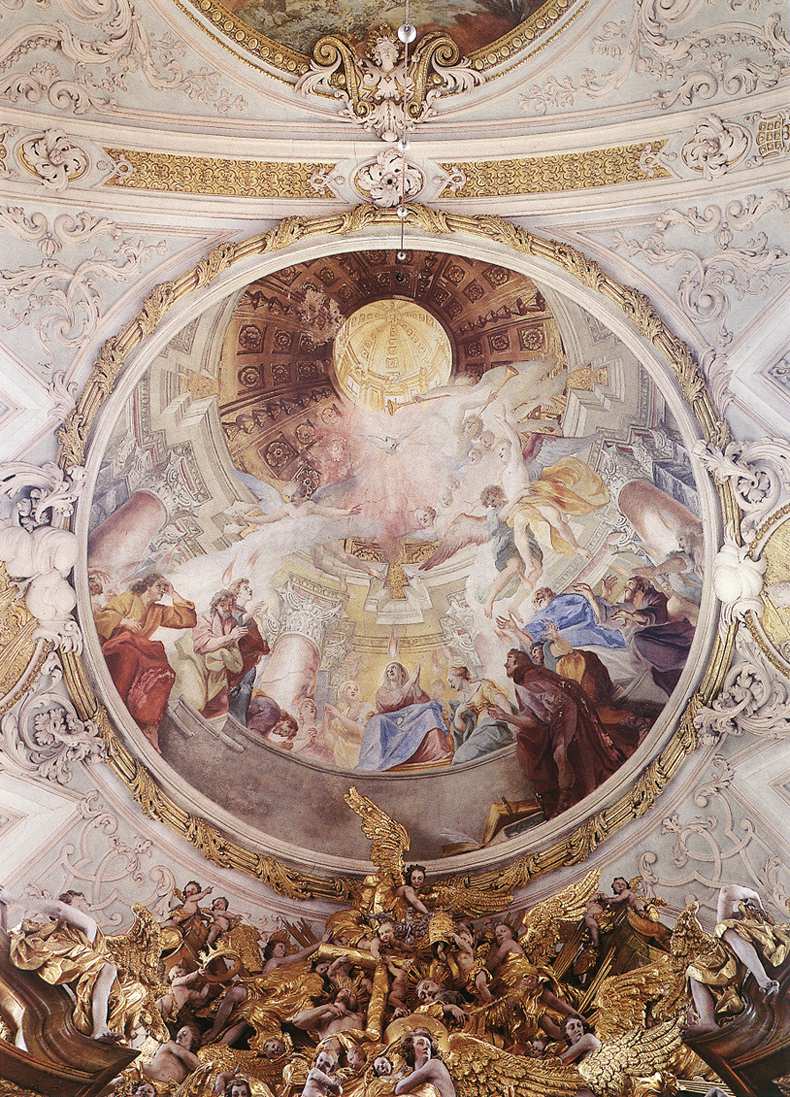 Cosmas Damian Asam, Pentecoste, 1720 circa, Chiesa abbaziale, Aldersbach
-
27-05-07, 08:47 #38**********
- Data Registrazione
- 04 Jun 2003
- Messaggi
- 23,775
-
- 18
-
- 35
- Mentioned
- 2 Post(s)
- Tagged
- 0 Thread(s)
Dom Prosper Guéranger, L'anno liturgico - II. Tempo Pasquale e dopo la Pentecoste, trad. it. L. Roberti, P. Graziani e P. Suffia, Alba, 1959, p. 280-284
I DONI DELLO SPIRITO SANTO
Durante tutta questa settimana dovremo esporre le diverse operazioni dello Spirito Santo nella Chiesa e nelle anime dei fedeli; ma è necessario, fin da oggi, anticipare l'insegnamento che abbiamo a presentare. Ci sono dati sette giorni per conoscere e studiare il Dono supremo che il Padre e il Figlio hanno voluto inviarci, e lo Spirito, che procede dai due, si manifesta in sette modi nelle anime. È dunque giusto che ogni giorno di questa settimana sia consacrato ad onorare ed a raccogliere questo settenario di benefici, per mezzo dei quali dovrà operarsi la nostra salvezza e la nostra santificazione.
I sette doni dello Spirito Santo sono sette fonti di energia che egli degna deporre nelle nostre anime, quando vi penetra con la grazia santificante. Le grazie attuali mettono in movimento, simultaneamente o separatamente, quelle potenze divinamente infuse in noi, ed il bene soprannaturale e meritorio per la vita eterna si produce col consenso della nostra volontà.
Il Profeta Isaia, guidato dall'ispirazione divina, ci aveva fatto conoscere questi sette doni, nel brano in cui, descrivendo l'operazione dello Spirito Santo sull'anima del Figlio di Dio fatto uomo, che ci rappresenta come il fiore uscito dal ramo Verginale nato dal tronco di Jesse, ci dice: "Si poserà sopra di lui lo Spirito del Signore, Spirito di saviezza e discernimento, Spirito di consiglio e fortezza, Spirito di conoscenza e di pietà, e nel timore del Signore è la sua ispirazione" (Is 9,2-3). Niente di più misterioso che queste parole; ma si sente che ciò che esse esprimono non è una semplice enumerazione dei caratteri del divino Spirito, ma la descrizione degli effetti che opera nell'anima umana. Così l'ha compresa la tradizione cristiana, ed enunciata negli scritti degli antichi padri, e formulata con la teologia.
L'umanità sacra del Figlio di Dio incarnato è il tipo soprannaturale della nostra, e ciò che lo Spirito Santo ha operato in lei deve proporzionalmente aver luogo in noi. Egli ha deposto nel Figlio di Maria quelle sette forze che descrive il profeta; i medesimi doni sono stati preparati all'uomo rigenerato. Notiamo la successione che si manifesta nella loro serie. Isaia nomina prima lo Spirito di sapienza e finisce con quello del timor di Dio. La Sapienza è effettivamente, come vedremo, la più elevata delle prerogative alla quale possa giungere l'anima umana, mentre il Timor di Dio, secondo la profonda espressione del Salmista, non è che il principio e l'abbozzo di questa divina qualità. Si capisce facilmente che l'anima di Gesù chiamata a contrarre l'unione personale con il Verbo, sia stata trattata con una dignità particolare, in modo che il dono della Sapienza debba essere stato infuso in essa in una maniera primordiale, mentre il dono del Timor di Dio, qualità necessaria ad una natura creata, sia stata posta in lei soltanto come complemento. Per noi, al contrario, fragili e incostanti come siamo, il Timor di Dio è la base di tutto l'edificio ed è per mezzo suo che ci eleviamo di grado in grado fino a quella Sapienza che ci unisce a Dio. È dunque nell'ordine inverso di quello segnalato da Isaia nei riguardi del Figlio di Dio incarnato, che l'uomo s'innalza alla perfezione, per mezzo dei doni dello Spirito Santo, che gli sono stati conferiti nel Battesimo e che gli vengono resi nel sacramento della riconciliazione, se ha avuto la sventura di perdere la grazia santificante per il peccato mortale.
Ammiriamo con profondo rispetto l'augusto settenario, di cui troviamo l'impronta in tutta l'opera della nostra salvezza e della nostra santificazione. Sette sono le virtù che rendono l'anima gradita a Dio; per mezzo dei suoi sette Doni, lo Spirito Santo la conduce al suo fine; i sette Sacramenti le comunicano i frutti dell'Incarnazione e della Redenzione di Gesù Cristo; e, finalmente, dopo trascorse sette settimane dalla Pasqua, lo Spirito è mandato sulla terra per stabilirvi e consolidarvi il regno di Dio. Dopo tutto questo, noi non ci meraviglieremo che Satana abbia cercato di fare una parodia sacrilega dell'opera divina, opponendole l'orribile settenario dei sette peccati capitali, per mezzo dei quali egli si sforza di perdere l'uomo che Dio vuole salvare.
I DONI DEL TIMORE
L'orgoglio per noi è l'ostacolo al bene. È l'orgoglio che ci porta a resistere a Dio, a mettere il nostro fine in noi stessi; in una parola, a perderci. Solo l'umiltà può salvarci da un sì grande pericolo. Chi ce la darà? Lo Spirito Santo, infondendo in noi il dono del Timor di Dio.
Questo sentimento riposa sull'idea che la fede ci da della maestà di Dio, in presenza del quale non siamo che un nulla; della sua Santità infinita, davanti alla quale non siamo che indegnità e sozzura; del giudizio sovranamente equo che dovrà esercitare su noi all'uscire da questa vita; e del pericolo di una caduta, sempre possibile, se non corrispondiamo alla grazia che non ci manca mai, ma alla quale possiamo resistere.
La salvezza dell'uomo si opera, dunque, "con timore e tremore", come c'insegna l'Apostolo (Fil 2,12); ma questo timore, che è un dono dello Spirito Santo, non è un sentimento rudimentale che si limita a gettarci nello spavento al pensiero dei castighi eterni. Esso ci mantiene nella compunzione del cuore, anche quando i nostri peccati fossero da molto tempo perdonati; c'impedisce di dimenticare che siamo peccatori, che dobbiamo tutto alla misericordia divina, e che non siamo ancora salvi che in speranza (Rm 8,24).
Questo timor di Dio non è dunque un timore servile, ma diviene, al contrario, la fonte dei sentimenti più delicati: può allearsi con l'amore, non essendo più che un sentimento filiale che teme il peccato a causa dell'oltraggio che reca a Dio. Ispirato dal rispetto della maestà divina, dal sentimento della sua santità infinita, colloca la creatura nel vero suo posto, e san Paolo c'insegna che, purificandosi così, ci aiuta, "compiendo l'opera della nostra santificazione" (2Cor 9,27). È per questo che il grande Apostolo, che era stato rapito fino al terzo Cielo, ci confessa che è rigoroso verso se stesso "al fine di non essere condannato" (1Cor 9,27).
Lo spirito di indipendenza e di falsa libertà che regna oggi, contribuisce a rendere più raro il timor di Dio, ed è questa una delle piaghe del nostro tempo. La familiarità con Dio tiene troppo spesso il posto di questa disposizione fondamentale della vita cristiana, ed è allora che ogni progresso si arresta, l'illusione si introduce nell'anima, ed i sacramenti, che nel momento del ritorno a Dio avevano operato con tanta forza, divengono press'a poco sterili. E ciò accade perché il dono del timore è stato soffocato sotto la vana compiacenza dell'anima in se stessa. L'umiltà si è spenta; un orgoglio, segreto e universale, è venuto a paralizzare i movimenti di quell'anima, che arriva, senza accorgersene, a non conoscere più Iddio, per il fatto stesso che non trema più davanti a Lui.
Conservaci, dunque, o divino Spirito, il dono del timor di Dio, che hai diffuso in noi nel nostro Battesimo. Questo timore salutare ci assicurerà la perseveranza nel bene, arrestando il progresso dello spirito d'orgoglio. Che esso sia, dunque, come un dardo che attraversi la nostra anima da parte a parte, restandovi fissato sempre a nostra salvaguardia. Che esso abbassi la nostra alterigia, che ci strappi alla mollezza, rivelandoci, senza tregua, lo splendore e la santità di Colui che ci ha creati e che ci deve giudicare.
Sappiamo, o divino Spirito, che questo beato timore non soffoca l'amore; ma, ben lungi da ciò, toglie, invece, gli ostacoli che impedirebbero il suo sviluppo. Le potenze celesti vedono ed amano ardentemente il Sommo Bene, e se ne sono inebriate per l'eternità; e, nondimeno, tremano di fronte a quella temibile maestà: "tremunt Potestates". E noi, ricoperti dalle cicatrici del peccato, pieni d'imperfezione, esposti a mille insidie, obbligati a lottare contro tanti nemici, non sentiremo, forse, che dobbiamo stimolare con un forte timore filiale, nello stesso tempo, la nostra volontà che si addormenta così facilmente e il nostro spirito assediato da tante tenebre? Veglia sulla tua opera, o divino Spirito! Preserva in noi il dono prezioso che ti sei degnato di farci; insegnaci a conciliare la pace e la gioia del cuore con il timor di Dio, secondo questo avvertimento del Salmista: "Servite a Dio con timore rendetegli omaggio con tremore" (Sal 2,11).
PREGHIAMO
O Dio, che oggi hai ammaestrato i cuori dei fedeli con la luce dello Spirito Santo, donaci di gustare nello stesso Spirito la verità e di godere sempre della sua consolazione.
-
27-05-07, 11:09 #39**********
- Data Registrazione
- 04 Jun 2003
- Messaggi
- 23,775
-
- 18
-
- 35
- Mentioned
- 2 Post(s)
- Tagged
- 0 Thread(s)
I GIORNI DEL CILIEGIO
--------------------------------------------------------------------------
di Tito Casini
-------------------------------------------------------------------------
XXXII - PENTECOSTE.
Da dieci giorni egli era partito: da dieci giorni aspettavano, sotto il grave incarco dell'ultime sue parole - «...e mi sarete testimoni in Gerusalemme e in tutta la Giudea e la Samaria, e fino all'estremità della terra» - che si compisse prima l'altra sua pardola, senza cui mal si sarebbe eseguito il testamento tremendo: «...ma voi riceverete forza dall'alto, quando verrà su di voi».
Aveva comandato che non si allontanassero, fino a tanto, da Gerusalemme, - e vivevano tutti insieme nella casa cittadina che Pietro e Giovanni avevan trovato seguendo l'uomo dalla brocca, nella stanza dov'egli aveva detto loro le più tenere cose, aveva lavato a ciascuno i piedi, si era dato in azzimo e in mosto.
Eran coi dodici (Mattia aveva già preso, tratto a sorte, il luogo del traditore) i più affezionati suoi discepoli, le donne e sopra tutti Maria, la madre di lui, la sposa dell'Aspettato. Ignari del giorno in cui sarebbe disceso, del modo in cui si sarebbe mostrato, gli andavano senza posa incontro con l'ardente desiderio e la concorde orazione.
Era ormai giunto il mattino del Cinquantesimo. Nel riposo perfetto da ogni servile fatica, con l'offerta dei pani nuovi, degli agnelli senza macchia, degli arieti e del vitello di branco, Gerusalemme celebrava il giorno che Dio avea comandato «solennissimo e santissimo», il giono bello di molti nomi - Festa delle Settimane o della Chiusura, per chiudersi in quello, dopo sette settimane, i dì della Pasqua; Festa delle Primizie, per que' due primi pani, presentati al Signore, dell'ancora inassaggiata nuova raccolta; Giorno della Mèsse, per il grano a cui si sarebber poste l'indomani le falci -, giorno glorioso per la memoria del Patto, quando tra folgori e lampi, fra tuoni e clangori di trombe, fu dettata dalla fumosa vetta del Sinai la legge divina: «Io sono il Signore Dio tuo che ti trassi dalla terra d'Egitto, dalla casa di schiavitù
Nella letizia della stagione e dei ricordi, Gerusalemme celebrava la sua Pentecoste - e come avviene che l'allegrezza circostante faccia più grave, per contrasto, l'altrui mestizia, così sentivan più amara, quei del Cenacolo, la lontananza di chi era stato tutta la loro festa; più struggente il ritardo a giungere del promesso Consolatore... . Era già l'ora terza, l'ora della preghiera, l'ora, forse, che quindici secoli innanzi s'era udita d'in cima al monte crepitar la prima saetta sotto i passi di Dio («Splendeva - infatti - il mattino...») quand'ecco che l'immenso prodigio parve rinnovarsi. Un tuono, come di vento impetuoso, fragoreggiò su nel cielo, rintronò nella casa. E dal cielo, insieme al tuono, una rossa nevicata di lingue simili a fuoco calò sull'attonita adunanza, sostando su ciascuno una fiaccola, sì che ciascuno parve d'improvviso mutato in ardente lume, e l'accolta un solo immenso candelabro.
Era lo Spirito - il Promesso, l'Aspettato, il Paracleto - che giungeva, ed eri tu, o santa Chiesa cattolica, che nascevi: intera, sin dal primo istante, e perfetta: già una, già santa, già cattolica e apostolica, come ogni giorno, dopo tanti secoli, noi, eretti in piedi e scoperta la fronte, noi, tuoi figli e soldati, ti professiamo... Perciò, come chi nasce non fanciullo ma nel pieno vigore, tu cominciasti tosto a parlare - «...e tutti furon ripieni di Spirito Santo, e principiarono a parlare» -, che voleva dire a insegnare, a combattere, a conquistare. Cattolica era già la tua voce sì che tutti la intendevano, - e n'eran confusi di meraviglia - per quanto diversissima di nazione fosse la folla che il tuono aveva tratto intorno ai pescatori. « Questi che parlano non son dunque tutti quanti Galilaei? E come va che noi li udiamo parlare ciascuno nel nostro proprio linguaggio? Noi Parti, Medi, Elamiti, e della Mesopotamia, della Giudea e della Cappadocia, del Ponto e dell'Asia, della Frigia e della Panfilia, dell'Egitto e dei paesi della Libia c'h'è intorno a Cirene, pellegrini romani, proseliti giudei, Cretesi e Arabi... tutti noi udimmo parlare nelle nostre lingue delle grandezze di Dio». Tu conoscesti pure, già dal quel primo passo, l'opposizione e lo scherno - domani saran le prigioni e i supplizi - della rabbia avversaria. Poichè allo stupor della folla, la quale si chiedeva tremante e commossa: «che vuol dir mai tutto questo?», rispondeva il gelido sarcasmo di alcuni: «Son pieni di vin dolce...».
Ma Pietro, il capo, emergendo fra gli undici, prese tosto a compier là sua parte di sommo e universale Pontefice:
«Uomini di Giudea, e voi tutti che vi trovate in Gerusalemme, sia noto a voi questo, e aprite le orecchie alle mie parole... ». Distrusse con facile argomento la malignazione nemica: «Costoro non sono, no, ubriachi, come voi vi pensate: siamo appena alla terza ora del giorno...». Spiegò, come a lui solo competeva, le Scritture: « Questo che avviene è quel che fu predetto dal profeta Joele: E avverrà (dice il Signore) ch'io negli ultimi giorni spanderò del mio Spirito su ogni carne, e i vostri figli e le vostre figlie profeteranno, e i vostri giovani vedranno delle visioni, e i vostri vecchi sogneranno dei sogni. E sopra i miei servi e le mie serve spanderò in que' giorni il mio Spirito, e profeteranno. E farò prodigi su in cielo e segni giù in terra, sangue e fuoco e vapor di fumo...». Dall'Inviato risali all'Inviante, predicando forte Cristo uomo e Dio, crocifisso e risuscitato: «Uomini d'Israele, ponete mente a queste parole: Gesù di Nazaret, uomo cui Dio ha reso irrefragabile testimonianza fra voi con opere potenti e prodigi e segni...: quest'uomo che, conformemente al determinato consiglio e alla prescienza di Dio, vi fu dato nelle mani, voi, inchiodandolo per man d'iniqui sopra una croce, l'avete fatto morire; ma Dio l'ha risuscitato, avendo rotti gli angosciosi legami del sepolcro, perchè non era possibile ch'ei ne fosse ritenuto...». Appoggiò con nuove scritture il suo asserimento. Di chi parlava mai Davide quando diceva, nel salmo: «Tu non abbandonerai l'anima mia l'inferno nè sopporterai che il tuo Santo veda la corruzione»? «Tu m'hai fatto conoscere le vie della vita; tu mi ricolmerai di gioia con la tua presenza»? Certo non di sè, poichè «il patriarca Davide morì e fu sepolto, tanto che la sua tomba è anche al dì d'oggi presso di noi». Ma «essendo egli profeta e sapendo che Dio gli aveva promesso con giuramento che uno della sua stirpe dovea sedere sopra il suo trono, profeticamente disse della risurrezione del Cristo ch'egli non fu abbandonato nell'inferno nè la carne di lui vide la corruzione». Aggiunse infine - eseguendo già, con gioia, il recente testamento - la testimonianza viva e presente di tutta la Chiesa: «Questo Gesù, Iddio lo ha risuscitato, e noi tutti ne siamo testimoni». Lo attestò asceso al cielo, lo mostrò, secondo un altro passo di Davide, assiso, regalmente, alla destra dei Padre («Il Signore ha detto al mio Signore: Siedi alla mia destra!») e conchiusie, fermo, solenne: «Sappia dunque certissimamente tutta la casa d'Israele che Dio ha costituito Signore e Cristo questo Gesù che voi avete croeffisso».
Fra l'ombre del tramonto, Gerusalemme poneva fine alla sua Pentecoste, la festa bella di molti nomi, a cui uno solo, dopo quel tuono dell' ora terza, pareva ormai, nel suo più disteso senso, convenire, l'amaro nome di Chiusura. Accanto al tempio giudaico, cui il vento dello Spirito serrava, nel discender, la porta, la santa Chiesa cattolica celebrava, all'opposto, la festa delle primizie, porgendo allo Spirito, che in lei avea inaugurato il suo indeclinabile regno, tremila prime anime, quante n'avea generate la prima allocuzion di Pietro.
Ed ecco, ogni anno, alla Chiesa piace riviver commemorando e lodando quel caldo giorno di sua nascita, che fu pure delle sue nozze e della sua maternità prima.
La Pentecoste è propriamente, fra tutte, la festa della Chiesa. Le campane, quella mattina, suonando a doppio col medesimo slancio della mattina di Pasqua (quando pareva volessero risvegliar Cristo, assopito all'ombra della roccia), non sai se chiamino, con le parole della sequenza, lo Spirito - Veni, Sancte Spiritus... - o se proclamino, con l'introito, l'ampiezza dell'avvenuto suo regno: «Spiritus Domini replevit orbem terrarum...: lo Spirito del Signore ha riempito l'orbe terrestre, alleluia! ed esso, che tutto abbraccia, tutto intende, alleluia! alleluia! » Da ogni punto dell'orbe terrestre, le campane, la mattina, dicono queste o quelle parole.
Un sublime sguardo a ritroso, della Chiesa che a sè nello Spirito fa festa, è, quella mattina, la messa. Dalla contemplazione delle presenti sue tende, che l'introito mostra sparse per tutto il globo; dopo il grido di battaglia che all'introito è congiunto - Exsurgat Deus, et dissipentur inimici cius: et fugiant, qui oderunt eum a facie eius ... - si riporta, con la lezione, a Gerusalemme, alle origini, quando, men vastadella più ristretta parrocchia, era ancor tutta sotto la roggia piova divina e Pietro, il capo, non aveva ancor celebrato il primo pontificale.
Dalla lezione, al graduale e alla sequenza: dal giorno della nascita, ai giorni del concepimento; dall'arrivo dell'Aspettato, all'aspettazione del Promesso, dal tuono e il vento, al gemito, al sospiro orfanile: «Emitte Spiritum tuum...: manda, Signore, il tuo Spirito, e avverrà la nuova creazione...»
«Veni, sancte Spiritus... : vieni, o Santo Spirito...».
Ah, come dovette commoversi, su alla destra del Padre, colui che aveva detto, innanzi di partire: «Io non vi lascerò orfani» come dovette affrettarsi a scendere il Consolatore, se tali gli giunsero, come quelle onde, palpita la sequenza di Pentecoste, le supplicazioni dei pescatori!
Veni, Sancte Spiritus,
Et emitte coelitus
Lucis tuae radium!
«Vieni! » Quante, volte e in quali note questa parola!
Veni, pater pauperum
Veni, dator munerum
veni, lumen cordium
Quanti amorosi titoli, oltre a quel di «padre dei poveri», di «distributore di doni», di «lume dei cuori»! quanta dolce lusinga!
Consolator optime,
Dulcis hospes animae,
Dulce refrigeriam.
In labore requies,
In aestu temperies,
In fletu solatium...
Quanta dimostrazion di bisogni!
Sine tuo numine,
Nihil est in bomine,
Nibil est innoxium
Quanta richiesta di soccorso!
Lava quod est sordidurn,
Riga quod est aridum,
Sana quod est saucium.
Flecte quod est rigidum,
Fove quod est frigidum,
Rege quod est devium...
e finalmente
Da virtutis meritum,
Da salutis exitum,
Da perenne gaudium.
Amen. Alleluia!
Nel vangelo, il guardo a ritroso della Chiesa si spinge ancora più oltre, sebbene non si discosti dal Cenacolo: è Cristo, non ancora risalito, non ancora immolato, che annunzia ai suoi dopo averli di sè sfamati e dissetati, la grande promessa: «Chiunque mi ama osserverà la mia parola, e il Padre mio lo amerà, e verremo a lui, e faremo dimora presso di lui... Queste cose io v'ho detto stando con voi. Il Paracleto, poi, lo Spirito Santo, che il Padre manderà nel nome mio, egli insegnerà a voi ogni cosa, e vi ricorderà tutto quel che v'ho detto... Ora, ve l'ho detto, prima che succeda, affinchè, quando sia venuto, crediate:... ut cum factum fuerit, credatis».
Ciò è avvenuto; la promessa è stata esattamente mantenuta - e noi crediamo.
Deh, come ardenti, come alte, come, solenni, or che tutto è compiuto; che anche la Terza Persona ha visitato la terra; che la Chiesa è fondata, come baldanzose si levano stamattina le note del Credo! Credo in unum Deum, Patrem omnipotentem, factorem caeli et terrae... Et in unum Dominum Jesum Christum, Filium Dei unigenitum... Et in Spiritum Sanctum Dominum et vivificantem... Et unam, sanctam, catholicam et apostolicam Ecclesiam... .
Dal passato, all'avvenire. Dopo l'ultime parole del Simbolo, dove la fede di credenza si fa aspettazione - Et expecto resurrectionem mortuorum et vitam venturi saeculi... - anche il restante sguardo della Chiesa si rivolge dal trascorso al futuro, dalle origini ai destini, dalla Gerusalemme caduca e caduta alla Gerusalemme immortale. E l'offertorio vede i popoli entrarvi, nei loro re che offron doni: Confirma hoc, Deus. quod operatus es in nobis: a templo tuo, quod est in Jerusalem, tibi offerent reges munera, alleluia!
...E l'ultimo canto del giorno, l'antifona del Magnificat, non è che una ripresa - lieta, alleluiante ripresa, dopo le celebrate memorie del suo cammino: «Hodie completi sunt dies Pentecostes... : oggi si son compiuti i dì della Pentecoste, alleluia! oggi lo Spirito Santo apparve in fuoco ai discepoli e diè loro i doni dei carismi: gli ha mandati per l'universo mondo a predicare e testimoniare. Chi, dunque, crederà e verrà battezzato, sarà salvo. Alleluia!»
FONTE
-
27-05-07, 11:54 #40**********
- Data Registrazione
- 04 Jun 2003
- Messaggi
- 23,775
-
- 18
-
- 35
- Mentioned
- 2 Post(s)
- Tagged
- 0 Thread(s)
 Guido Reni, La discesa dello Spirito Santo, 1608-09, Sala delle Dame, Vaticano

 Rispondi Citando
Discussioni Simili
-
SOLENNITÀ - Solennità di Pentecoste
Di Colombo da Priverno nel forum CattoliciRisposte: 3Ultimo Messaggio: 09-06-19, 23:52 -
Veglia di Pentecoste
Di Carnby nel forum CattoliciRisposte: 0Ultimo Messaggio: 31-05-09, 01:38 -
Solennità di Pentecoste
Di Colombo da Priverno nel forum CattoliciRisposte: 6Ultimo Messaggio: 11-05-08, 08:51 -
Santa Pentecoste
Di vescovosilvano nel forum Chiesa Ortodossa TradizionaleRisposte: 0Ultimo Messaggio: 27-05-07, 09:35 -
Pentecoste 2006
Di niocat55 (POL) nel forum CattoliciRisposte: 0Ultimo Messaggio: 23-06-06, 02:17
 Permessi di Scrittura
Powered by vBulletin® Version 4.2.5
Copyright © 2026 vBulletin Solutions Inc. All rights reserved.
Change privacy settings
Copyright © 2026 vBulletin Solutions Inc. All rights reserved.
Change privacy settings
Tutti gli orari sono GMT +2. Adesso sono le 01:10.
