


BENEDETTO XVI
OMELIA NELLA
SANTA MESSA NELLA CENA DEL SIGNORE
Basilica di San Giovanni in Laterano
Giovedì Santo, 5 aprile 2007
Cari fratelli e sorelle,
nella lettura dal Libro dell’Esodo, che abbiamo appena ascoltato, viene descritta la celebrazione della Pasqua di Israele così come nella Legge mosaica aveva trovato la sua forma vincolante. All’origine può esserci stata una festa di primavera dei nomadi. Per Israele, tuttavia, ciò si era trasformato in una festa di commemorazione, di ringraziamento e, allo stesso tempo, di speranza. Al centro della cena pasquale, ordinata secondo determinate regole liturgiche, stava l’agnello come simbolo della liberazione dalla schiavitù in Egitto. Per questo l’haggadah pasquale era parte integrante del pasto a base di agnello: il ricordo narrativo del fatto che era stato Dio stesso a liberare Israele “a mano alzata”. Egli, il Dio misterioso e nascosto, si era rivelato più forte del faraone con tutto il potere che aveva a sua disposizione. Israele non doveva dimenticare che Dio aveva personalmente preso in mano la storia del suo popolo e che questa storia era continuamente basata sulla comunione con Dio. Israele non doveva dimenticarsi di Dio.
La parola della commemorazione era circondata da parole di lode e di ringraziamento tratte dai Salmi. Il ringraziare e benedire Dio raggiungeva il suo culmine nella berakha, che in greco è detta eulogia o eucaristia: il benedire Dio diventa benedizione per coloro che benedicono. L’offerta donata a Dio ritorna benedetta all’uomo. Tutto ciò ergeva un ponte dal passato al presente e verso il futuro: ancora non era compiuta la liberazione di Israele. Ancora la nazione soffriva come piccolo popolo nel campo delle tensioni tra le grandi potenze. Il ricordarsi con gratitudine dell’agire di Dio nel passato diventava così al contempo supplica e speranza: Porta a compimento ciò che hai cominciato! Donaci la libertà definitiva!
Questa cena dai molteplici significati Gesù celebrò con i suoi la sera prima della sua Passione. In base a questo contesto dobbiamo comprendere la nuova Pasqua, che Egli ci ha donato nella Santa Eucaristia. Nei racconti degli evangelisti esiste un’apparente contraddizione tra il Vangelo di Giovanni, da una parte, e ciò che, dall’altra, ci comunicano Matteo, Marco e Luca. Secondo Giovanni, Gesù morì sulla croce precisamente nel momento in cui, nel tempio, venivano immolati gli agnelli pasquali. La sua morte e il sacrificio degli agnelli coincisero. Ciò significa, però, che Egli morì alla vigilia della Pasqua e quindi non poté personalmente celebrare la cena pasquale – questo, almeno, è ciò che appare. Secondo i tre Vangeli sinottici, invece, l’Ultima Cena di Gesù fu una cena pasquale, nella cui forma tradizionale Egli inserì la novità del dono del suo corpo e del suo sangue. Questa contraddizione fino a qualche anno fa sembrava insolubile. La maggioranza degli esegeti era dell’avviso che Giovanni non aveva voluto comunicarci la vera data storica della morte di Gesù, ma aveva scelto una data simbolica per rendere così evidente la verità più profonda: Gesù è il nuovo e vero agnello che ha sparso il suo sangue per tutti noi.
La scoperta degli scritti di Qumran ci ha nel frattempo condotto ad una possibile soluzione convincente che, pur non essendo ancora accettata da tutti, possiede tuttavia un alto grado di probabilità. Siamo ora in grado di dire che quanto Giovanni ha riferito è storicamente preciso. Gesù ha realmente sparso il suo sangue alla vigilia della Pasqua nell’ora dell’immolazione degli agnelli. Egli però ha celebrato la Pasqua con i suoi discepoli probabilmente secondo il calendario di Qumran, quindi almeno un giorno prima – l’ha celebrata senza agnello, come la comunità di Qumran, che non riconosceva il tempio di Erode ed era in attesa del nuovo tempio. Gesù dunque ha celebrato la Pasqua senza agnello – no, non senza agnello: in luogo dell’agnello ha donato se stesso, il suo corpo e il suo sangue. Così ha anticipato la sua morte in modo coerente con la sua parola: “Nessuno mi toglie la vita, ma la offro da me stesso” (Gv 10,18). Nel momento in cui porgeva ai discepoli il suo corpo e il suo sangue, Egli dava reale compimento a questa affermazione. Ha offerto Egli stesso la sua vita. Solo così l’antica Pasqua otteneva il suo vero senso.
San Giovanni Crisostomo, nelle sue catechesi eucaristiche ha scritto una volta: Che cosa stai dicendo, Mosè? Il sangue di un agnello purifica gli uomini? Li salva dalla morte? Come può il sangue di un animale purificare gli uomini, salvare gli uomini, avere potere contro la morte? Di fatto – continua il Crisostomo – l’agnello poteva costituire solo un gesto simbolico e quindi l’espressione dell’attesa e della speranza in Qualcuno che sarebbe stato in grado di compiere ciò di cui il sacrificio di un animale non era capace. Gesù celebrò la Pasqua senza agnello e senza tempio e, tuttavia, non senza agnello e senza tempio. Egli stesso era l’Agnello atteso, quello vero, come aveva preannunciato Giovanni Battista all’inizio del ministero pubblico di Gesù: “Ecco l’agnello di Dio, ecco colui che toglie il peccato del mondo!” (Gv 1,29). Ed è Egli stesso il vero tempio, il tempio vivente, nel quale abita Dio e nel quale noi possiamo incontrare Dio ed adorarlo. Il suo sangue, l’amore di Colui che è insieme Figlio di Dio e vero uomo, uno di noi, quel sangue può salvare. Il suo amore, quell’amore in cui Egli si dona liberamente per noi, è ciò che ci salva. Il gesto nostalgico, in qualche modo privo di efficacia, che era l’immolazione dell’innocente ed immacolato agnello, ha trovato risposta in Colui che per noi è diventato insieme Agnello e Tempio.
Così al centro della Pasqua nuova di Gesù stava la Croce. Da essa veniva il dono nuovo portato da Lui. E così essa rimane sempre nella Santa Eucaristia, nella quale possiamo celebrare con gli Apostoli lungo il corso dei tempi la nuova Pasqua. Dalla croce di Cristo viene il dono. “Nessuno mi toglie la vita, ma la offro da me stesso”. Ora Egli la offre a noi. L’haggadah pasquale, la commemorazione dell’agire salvifico di Dio, è diventata memoria della croce e risurrezione di Cristo – una memoria che non ricorda semplicemente il passato, ma ci attira entro la presenza dell’amore di Cristo. E così la berakha, la preghiera di benedizione e ringraziamento di Israele, è diventata la nostra celebrazione eucaristica, in cui il Signore benedice i nostri doni – pane e vino – per donare in essi se stesso. Preghiamo il Signore di aiutarci a comprendere sempre più profondamente questo mistero meraviglioso, ad amarlo sempre di più e in esso amare sempre di più Lui stesso. Preghiamolo di attirarci con la santa comunione sempre di più in se stesso. Preghiamolo di aiutarci a non trattenere la nostra vita per noi stessi, ma a donarla a Lui e così ad operare insieme con Lui, affinché gli uomini trovino la vita – la vita vera che può venire solo da Colui che è Egli stesso la Via, la Verità e la Vita. Amen.
Pascal-Adolphe-Jean Dagnan-Bouveret, Ultima Cena, XIX sec., collezione privata
Risultati da 31 a 40 di 48
Discussione: Giovedì Santo
-
06-04-07, 12:17 #31**********


- Data Registrazione
- 04 Jun 2003
- Messaggi
- 23,775
-

- 18
-

- 35
- Mentioned
- 2 Post(s)
- Tagged
- 0 Thread(s)
 Interessante Omelia
-
20-03-08, 13:31 #32**********
- Data Registrazione
- 04 Jun 2003
- Messaggi
- 23,775
-
- 18
-
- 35
- Mentioned
- 2 Post(s)
- Tagged
- 0 Thread(s)
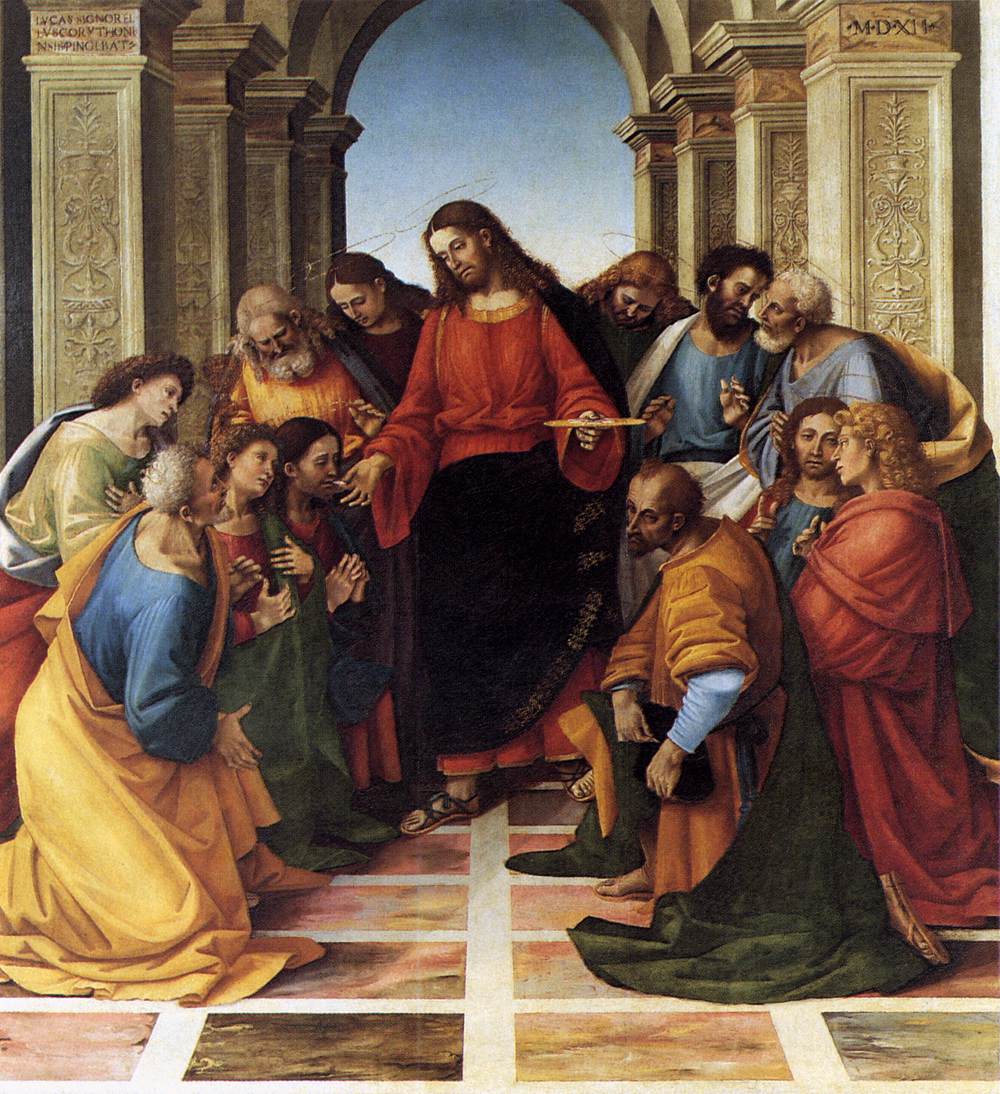 Luca Signorelli, Istituzione dell'Eucaristia, 1512, Museo Diocesano, Cortona
 Palma il Giovane, Lavanda dei piedi, 1591-92, San Giovanni in Bragora, Venezia
 Pieter Pauwel Rubens, Ultima Cena, 1631-32, Pinacoteca di Brera, Milano
 Paolo Veronese, Ultima Cena, 1585 circa, Pinacoteca di Brera, Milano
-
20-03-08, 15:17 #33**********
- Data Registrazione
- 04 Jun 2003
- Messaggi
- 23,775
-
- 18
-
- 35
- Mentioned
- 2 Post(s)
- Tagged
- 0 Thread(s)
The Passion of Christ in the Four Gospels
We have in the Gospels four separate accounts of the Passion of Our Lord, each of which supplements the others, so that only from a careful examination and comparison of all can we arrive at a full and clear knowledge of the whole story. The first three Gospels resemble each other very closely in their general plan, so closely indeed that some sort of literary connection among them may be assumed; but the fourth Gospel, although the writer was evidently familiar at least with the general tenor of the story told by the other three, gives us an independent narrative.
If we begin by marking in any one of the Synoptic Gospels those verses which occur in substance in both of the other two, and then read these verses continuously, we shall find that we have in them a brief but a complete narrative of the whole passion story. There are of course very few details, but all the essentials of the story are there. In St. Mark's Gospel the marked verses will be as follows: xiv, 1, 10-14, 16-18, 21-23, 26, 30, 32, 35-6, 41, 43, 45, 47-9, 53-4, 65 to xv, 2, 9, 11-15, 21-2, 26-7, 31-33, 37-9, 41, 43, 46-7. Verbal alterations would be required to make the verses run consecutively. Sometimes the division will not quite coincide with the verse. It is possible that this nucleus, out of which our present accounts seem to have grown, represents more or less exactly some original and more ancient narrative, whether written or merely oral matters little, compiled in the earliest days at Jerusalem. This original narrative, so far as we can judge from what is common to all the three Synoptics, included the betrayal, the preparation of the Paschal Supper, the Last Supper with a brief account of the institution of the Eucharist, the Agony in the Garden, the arrest and taking of Our Lord before Caiphas, with His examination there and condemnation for blasphemy. Then follow Peter's denials, and the taking of Our Lord before Pilate. Next comes Pilate's question: "Art thou the king of the Jews?" and Our Lord's answer, "Thou sayest it", with Pilate's endeavour to set Him free on account of the feast, frustrated by the demand of the people for Barabbas. After this Pilate weakly yields to their insistence and, having scourged Jesus, hands Him over to be crucified. The story of the Crucifixion itself is a short one. It is confined to the casting of lots for the garments, the accusation over the head, the mocking of the chief priests, the supernatural darkness, and the rending of the Temple veil. After the death we have the confession of the centurion, the begging of the body of Jesus from Pilate, and the burial of it, wrapped in a clean linen cloth, in Joseph's new tomb hewn out in the rock close by.
In order to distinguish what is peculiar to each Evangelist we must notice a remarkable series of additional passages which are found both in St. Matthew and St. Mark. There are no similar coincidences between St. Matthew and St. Luke, or between St. Mark and St. Luke. These passages taken as they occur in St. Mark, are as follows: Mark, xiv, 15, 19-20, 24-28, 31, 33-4, 37-40, 42, 44, 46, 50-2, 55-8, 60-4, xv, 3-8, 10, 16-20, 23-4, 29-30, 34-6, 40, 42. They have the character rather of expansions than of additions. Still some of them are of considerable importance, for instance, the mocking of Our Lord by the soldiers in the Prætorium, and the cry from the Cross, "My God, my God, why hast thou forsaken me?" Possibly this series also formed part of an original narrative omitted by St. Luke, who had a wealth of special information on the Passion. Another explanation would be that St. Mark expanded the original narrative, and that his work was then used by St. Matthew. The passages found in St. Mark alone are quite unimportant. The story of the young man who fled naked has very generally been felt to be a personal reminiscence. Mark alone speaks of the Temple as "made with hands", and he is also the only one to note that the false witnesses were not in agreement one with another. He mentions also that Simon the Cyrenian was "father of Alexander and of Rufus", no doubt because these names were well known to those for whom he was writing. Lastly, he is the only one who records the fact that Pilate asked for proof of the death of Christ. In St. Matthew's Gospel the peculiarities are more numerous and of a more distinctive character. Naturally in his Gospel, written for a Jewish circle of readers, there is insistence on the position of Jesus as the Christ. There are several fresh episodes possessing distinctive and marked characteristics. They include the washing of Pilate's hands, the dream of Pilate's wife, and the resurrection of the saints after the death of Christ, with the earthquake and the rending of the tombs. The special features by which St. Luke's passion narrative is distinguished are very numerous and important. Just as St. Matthew emphasizes the Messianic character, so St. Luke lays stress on the universal love manifested by our Lord, and sets forth the Passion as the great act by which the redemption of mankind was accomplished. He is the only one who records the statement of Pilate that he found no cause in Jesus; and also the examination before Herod. He alone tells us of the angel who came to strengthen Jesus in his agony in the garden, and, if the reading is right, of the drops of blood which mingled with the sweat which trickled down upon the ground. To St. Luke again we owe our knowledge of no less than three of the seven words from the Cross: the prayer for His murderers; the episode of the penitent thief; and the last utterance of all, "Father, into thy hands I commend my spirit". Finally it is St. Luke alone who tells us of the effect produced upon the spectators, who so short a time before had been so full of hatred, and how they returned home "striking their breasts".
The traditional character of the Fourth Gospel as having been written at a later date than the other three, and after they had become part of the religious possession of Christians generally, is entirely borne out by a study of the passion. Although almost all the details of the story are new, and the whole is drawn up on a plan owing nothing to the common basis of the Synoptists, yet a knowledge of what they had written is presupposed throughout, and is almost necessary before this later presentment of the Gospel can be fully understood. Most important events, fully related in the earlier Gospels, are altogether omitted in the Fourth, in a way which would be very perplexing had we not thus the key. For instance, there is no mention of the institution of the Holy Eucharist, the agony in the garden, or the trial and condemnation before Caiphas. On the other hand, we have a great number of facts not contained in the Synoptists. For instance, the eagerness of Pilate to release our Lord and his final yielding only to a definite threat from the Jewish leaders; the presence of our Lady at the foot of the Cross, and Jesus' last charge to her and to St. John. Most important of all perhaps, is the piercing of the side by the soldier's spear and the flowing forth of blood and water. It is St. John alone, again, who tells us of the order to break the legs of all, and that Jesus Christ's legs were not broken, because he was already dead.
There seems at first sight a discrepancy between the narrative of the Fourth Gospel and that of the Synoptists, namely, as to the exact day of the crucifixion, which involves the question whether the Last Supper was or was not, in the strict sense, the Paschal meal. If we had the Synoptists only we should almost certainly decide that it was, for they speak of preparing the Pasch, and give no hint that the meal which they describe was anything else. But St. John seems to labour to show that the Paschal meal itself was not to be eaten till the next day. He points out that the Jews would not enter the court of Pilate, because they feared pollution which might prevent them from eating the Pasch. He is so clear that we can hardly mistake his meaning, and certain passages in the Synoptists seem really to point in the same direction. Joseph, for instance, was able to buy the linen and the spices for the burial, which would not have been possible on the actual feast-day. Moreover, one passage, which at first sight seems strongest in the other direction, has quite another meaning when the reading is corrected. "With desire I have desired", said Jesus to His Apostles, "to eat this pasch with you, before I suffer. For I say to you, that from this time, I will not eat it, till it be fulfilled in the kingdom of God" (Luke 22:15). When the hour for it had fully come He would have been already dead, the type would have passed away, and the Kingdom of God would have already come.
Fonte: The Catholic Encyclopedia, vol. XI, 1911, New York
-
20-03-08, 15:20 #34**********
- Data Registrazione
- 04 Jun 2003
- Messaggi
- 23,775
-
- 18
-
- 35
- Mentioned
- 2 Post(s)
- Tagged
- 0 Thread(s)
Devotion to the Passion of Christ
The sufferings of Our Lord, which culminated in His death upon the cross, seem to have been conceived of as one inseparable whole from a very early period. Even in the Acts of the Apostles (i, 3) St. Luke speaks of those to whom Christ "shewed himself alive after his passion" (meta to mathein autou). In the Vulgate this has been rendered post passionem suam, and not only the Reims Testament but the Anglican Authorized and Revised Versions, as well as the medieval English translation attributed to Wyclif, have retained the word "passion" in English. Passio also meets us in the same sense in other early writings (e.g. Tertullian, "Adv. Marcion.", IV, 40) and the word was clearly in common use in the middle of the third century, as in Cyprian, Novatian, and Commodian. The last named writes:
"Hoc Deus hortatur, hoc lex, hoc passio Christi
Ut resurrecturos nos credamus in novo sæclo."
St. Paul declared, and we require no further evidence to convince us that he spoke truly, that Christ crucified was "unto the Jews indeed a stumbling-block, and unto the Gentiles foolishness" (1 Corinthians 1:23). The shock to Pagan feeling, caused by the ignominy of Christ's Passion and the seeming incompatibility of the Divine nature with a felon's death, seems not to have been without its effect upon the thought of Christians themselves. Hence, no doubt, arose that prolific growth of heretical Gnostic or Docetic sects, which denied the reality of the man Jesus Christ or of His sufferings. Hence also came the tendency in the early Christian centuries to depict the countenance of the Saviour as youthful, fair, and radiant, the very antithesis of the vir dolorum familiar to a later age (cf. Weis Libersdorf, "Christus-und Apostel-bilder", 31 sq.) and to dwell by preference not upon His sufferings but upon His works of mercifulness, as in the Good Shepherd motive, or upon His works of power, as in the raising of Lazarus or in the resurrection figured by the history of Jonas.
But while the existence of such a tendency to draw a veil over the physical side of the Passion may readily be admitted, it would be easy to exaggerate the effect produced upon Christian feeling in the early centuries by Pagan ways of thought. Harnack goes too far when he declares that the Death and Passion of Christ were regarded by the majority of the Greeks as too sacred a mystery to be made the subject of contemplation or speculation, and when he declares that the feeling of the early Greek Church is accurately represented in the following passage of Goethe: "We draw a veil over the sufferings of Christ, simply because we revere them so deeply. We hold if to be reprehensible presumption to play, and trifle with, and embellish those profound mysteries in which the Divine depths of suffering lie hidden, never to rest until even the noblest seems mean and tasteless" (Harnack, "History Of Dogma", tr., III, 306; cf. J. Reil, "Die frühchristlichen Darstellungen der Kreuzigung Christi", 5). On the other hand, while Harnack speaks with caution and restraint, other more popular writers give themselves to reckless generalizations such as may be illustrated by the following passage from Archdeacon Farrar: "The aspect", he says, "in which the early Christians viewed the cross was that of triumph and exultation, never that of moaning and misery. It was the emblem of victory and of rapture, not of blood or of anguish." (See "The Month", May, 1895, 89.) Of course it is true that down to the fifth century the specimens of Christian art that have been preserved to us in the catacombs and elsewhere, exhibit no traces of any sort of representation of the crucifixion. Even the simple cross is rarely found before the time of Constantine (see CROSS), and when the figure of the Divine Victim comes to be indicated, it at first appears most commonly under some symbolical form, e.g. that of a lamb, and there is no attempt as a rule to represent the crucifixion realistically. Again, the Christian literature which has survived, whether Greek or Latin, does not dwell upon the details of the Passion or very frequently fall back upon the motive of our Saviour's sufferings. The tragedy known as "Christus Patiens", which is printed with the works of St. Gregory Nazianzus and was formerly attributed to him, is almost certainly a work of much later date, probably not earlier than the eleventh century (see Krumbacher, "Byz. Lit.", 746).
In spite of all this it would be rash to infer that the Passion was not a favourite subject of contemplation for Christian ascetics. To begin with, the Apostolical writings preserved in the New Testament are far from leaving the sufferings of Christ in the background as a motive of Christian endeavour; take, for instance, the words of St. Peter (1 Peter 2:19, 21, 23): "For this is thankworthy, if for conscience towards God, a man endure sorrows, suffering wrongfully"; "For unto this are you called: because Christ also suffered for us, leaving you an example that you should follow his steps"; "Who, when he was reviled, did not revile", etc.; or again: "Christ therefore having suffered in the flesh, be you also armed with the same thought" (ibid., iv, 1). So St. Paul (Galatians 2:19): "with Christ I am nailed to the cross. And I live, now not I; but Christ liveth in me"; and (ibid., v, 24): "they that are Christ's, have crucified their flesh, with the vices and concupiscences" (cf. Colossians 1:24); and perhaps most strikingly of all (Galatians 6:14): "God forbid that I should glory, save in the cross of our Lord Jesus Christ; by whom the world is crucified to me, and I to the world." Seeing the great influence that the New Testament exercised from a very early period upon the leaders of Christian thought, it is impossible to believe that such passages did not leave their mark upon the devotional practice of the West, though it is easy to discover plausible reasons why this spirit should not have displayed itself more conspicuously in literature. It certainly manifested itself in the devotion of the martyrs who died in imitation of their Master, and in the spirit of martyrdom that characterized the early Church.
Further, we do actually find in such an Apostolic Father as St. Ignatius of Antioch, who, though a Syrian by birth, wrote in Greek and was in touch with Greek culture, a very continuous and practical remembrance of the Passion. After expressing in his letter to the Romans (cc. iv, ix) his desire to be martyred, and by enduring many forms of suffering to prove himself the true disciple of Jesus Christ, the saint continues: "Him I seek who dies on our behalf; Him I desire who rose again for our sake. The pangs of a new birth are upon me. Suffer me to receive the pure light. When I am come thither then shall I be a man. Permit me to be an imitator of the Passion of my God. If any man hath Him within himself, let him understand what I desire, and let him have fellow-feeling with me, for he knoweth the things which straiten me." And again he says in his letter to the Smyrnæans (c. iv): "near to the sword, near to God (i.e. Jesus Christ), in company with wild beasts, in company with God. Only let it be in the name of Jesus Christ. So that we may suffer together with Him" (eis to sympathein auto).
Moreover, taking the Syrian Church in general -- and rich as it was in the traditions of Jerusalem it was far from being an uninfluential part of Christendom -- we do find a pronounced and even emotional form of devotion to the Passion established at an early period. Already in the second century a fragment preserved to us of St. Melito of Sardis speaks as Father Faber might have spoken in modern times. Apostrophising the people of Israel, he says: "Thou slewest thy Lord and He was lifted up upon a tree and a tablet was fixed up to denote who He was that was put to death -- And who was this? -- Listen while ye tremble: -- He on whose account the earth quaked; He that suspended the earth was hanged up; He that fixed the heavens was fixed with nails; He that supported the earth was supported upon a tree; the Lord was exposed to ignominy with a naked body; God put to death; the King of Israel slain by an Israelitish right hand. Ah! the fresh wickedness of the fresh murder! The Lord was exposed with a naked body, He was not deemed worthy even of covering, but in order that He might not be seen, the lights were turned away, and the day became dark because they were slaying God, who was naked upon the tree" (Cureton, "Spicilegium Syriacum", 55).
No doubt the Syrian and Jewish temperament was an emotional temperament, and the tone of their literature may often remind us of the Celtic. But in any case it is certain that a most realistic presentation of Our Lord's sufferings found favour with the Fathers of the Syrian Church apparently from the beginning. It would be easy to make long quotations of this kind from the works of St. Ephraem, St. Isaac of Antioch, and St. James of Sarugh. Zingerle in the "Theologische Quartalschrift" (1870 and 1871) has collected many of the most striking passages from the last two writers. In all this literature we find a rather turgid Oriental imagination embroidering almost every detail of the history of the Passion. Christ's elevation upon the cross is likened by Isaac of Antioch to the action of the stork, which builds its nest upon the treetops to be safe from the insidious approach of the snake; while the crown of thorns suggests to him a wall with which the safe asylum of that nest is surrounded, protecting all the children of God who are gathered in the nest from the talons of the hawk or other winged foes (Zingerle, ibid., 1870, 108). Moreover St. Ephraem who wrote in the last quarter of the fourth century, is earlier in date and even more copious and realistic in his minute study of the physical details of the Passion. It is difficult to convey in a short quotation any true impression of the effect produced by the long-sustained note of lamentation, in which the orator and poet follows up his theme. In the Hymns on the Passion ("Ephraem Syri Hymni et Sermones," ed. Lamy, I) the writer moves like a devout pilgrim from scene to scene, and from object to object, finding everywhere new motives for tenderness and compassion, while the seven "Sermons for Holy Week" might both for their spirit and treatment have been penned by any medieval mystic. "Glory be to Him, how much he suffered!" is an exclamation which bursts from the preacher's lips from time to time. To illustrate the general tone, the following passage from a description of the scourging must suffice:
"After many vehement outcries against Pilate, the all-mighty One was scourged like the meanest criminal. Surely there must have been commotion and horror at the sight. Let the heavens and earth stand awestruck to behold Him who swayeth the rod of fire, Himself smitten with scourges, to behold Him who spread over the earth the veil of the skies and who set fast the foundations of the mountains, who poised the earth over the waters and sent down the blazing lightning-flash, now beaten by infamous wretches over a stone pillar that His own word had created. They, indeed, stretched out His limbs and outraged Him with mockeries. A man whom He had formed wielded the scourge. He who sustains all creatures with His might submitted His back to their stripes; He who is the Father's right arm yielded His own arms to be extended. The pillar of ignominy was embraced by Him who bears up and sustains the heaven and the earth in all their splendour" (Lamy, I, 511 sq.). The same strain is continued over several pages, and amongst other quaint fancies St. Ephraem remarks: "The very column must have quivered as if it were alive, the cold stone must have felt that the Master was bound to it who had given it its being. The column shuddered knowing that the Lord of all creatures was being scourged". And he adds, as a marvel, witnessed even in his own day, that the "column had contracted with fear beneath the Body of Christ".
In the devotional atmosphere represented by such contemplations as these, it is easy to comprehend the scenes of touching emotion depicted by the pilgrim lady of Galicia who visited Jerusalem (if Dr. Meester's protest may be safely neglected) towards the end of the fourth century. At Gethsemane she describes how "that passage of the Gospel is read where the Lord was apprehended, and when this passage has been read there is such a moaning and groaning of all the people, with weeping that the groans can be hear almost at the city. While during the three hours' ceremony on Good Friday from midday onwards we are told: "At the several lections and prayers there is such emotion displayed and lamentation of all the people as is wonderful to hear. For there is no one, great or small, who does not weep on that day during those three hours, in a way that cannot be imagined, that the Lord should have suffered such things for us" (Peregrinatio Sylviæ in "Itinera Hierosolymitana", ed. Geyer, 87, 89). It is difficult not to suppose that this example of the manner of honouring Our Saviour's Passion, which was traditional in the very scenes of those sufferings, did not produce a notable impression upon Western Europe. The lady from Galicia, whether we call her Sylvia, Ætheria, or Egeria, was but one of the vast crowd of pilgrims who streamed to Jerusalem from all parts of the world. The tone of St. Jerome (see for instance the letters of Paula and Eustochium to Marcella in A.D. 386; P.L., XXII, 491) is similar, and St. Jerome's words penetrated wherever the Latin language was spoken. An early Christian prayer, reproduced by Wessely (Les plus anciens mon. de Chris., 206), shows the same spirit.
We can hardly doubt that soon after the relics of the True Cross had been carried by devout worshippers into all Christian lands (we know the fact not only from the statement of St. Cyril of Jerusalem himself but also from inscriptions found in North Africa only a little later in date) that some ceremonial analogous to our modern "adoration" of the Cross upon Good Friday was introduced, in imitation of the similar veneration paid to the relic of the True Cross at Jerusalem. It was at this time too that the figure of the Crucified began to be depicted in Christian art, though for many centuries any attempt at a realistic presentment of the sufferings of Christ was almost unknown. Even in Gregory of Tours (De Gloria Mart.) a picture of Christ upon the cross seems to be treated as something of a novelty. Still such hymns as the "Pange lingua gloriosi prœlium certaminis", and the "Vexilla regis", both by Venantius Fortunatus (c. 570), clearly mark a growing tendency to dwell upon the Passion as a separate object of contemplation. The more or less dramatic recital of the Passion by three deacons representing the "Chronista", "Christus", and "Synagoga", in the Office of Holy Week probably originated at the same period, and not many centuries later we begin to find the narratives of the Passion in the Four Evangelists copied separately into books of devotion. This, for example, is the case in the ninth-century English collection known as "the Book of Cerne". An eighth century collection of devotions (manuscript Harley 2965) contains pages connected with the incidents of the Passion. In the tenth century the Cursus of the Holy Cross was added to the monastic Office (see Bishop, "Origin of the Prymer", p. xxvii, n.).
Still more striking in its revelation of the developments of devotional imagination is the existence of such a vernacular poem as Cynewulf's "Dream of the Rood", in which the tree of the cross is conceived of as telling its own story. A portion of this Anglo-Saxon poem still stands engraved in runic letters upon the celebrated Ruthwell Cross in Dumfriesshire, Scotland. The italicized lines in the following represent portions of the poem which can still be read upon the stone:
I had power all
his foes to fell,
but yet I stood fast.
Then the young hero prepared himself,
That was Almighty God,
Strong and firm of mood,
he mounted the lofty cross
courageously in the sight of many,
when he willed to redeem mankind.
I trembled when the hero embraced me,
yet dared I not bow down to earth,
fall to the bosom of the ground,
but I was compelled to stand fast,
a cross was I reared,
I raised the powerful King
The lord of the heavens,
I dared not fall down.
They pierced me with dark nails,
on me are the wounds visible.
Still it was not until the time of St. Bernard and St. Francis of Assisi that the full developments of Christian devotion to the Passion were reached. It seems highly probable that this was an indirect result of the preaching of the Crusades, and the consequent awakening of the minds of the faithful to a deeper realization of all the sacred memories represented by Calvary and the Holy Sepulchre. When Jerusalem was recaptured by the Saracens in 1187, worthy Abbot Samson of Bury St. Edmunds was so deeply moved that he put on haircloth and renounced flesh meat from that day forth -- and this was not a solitary case, as the enthusiasm evoked by the Crusades conclusively shows.
Under any circumstances it is noteworthy that the first recorded instance of stigmata (if we leave out of account the doubtful case of St. Paul) was that of St. Francis of Assisi. Since his time there have been over 320 similar manifestations which have reasonable claims to be considered genuine (Poulain, "Graces of Interior Prayer", tr., 175). Whether we regard these as being wholly supernatural or partly natural in their origin, the comparative frequency of the phenomenon seems to point to a new attitude of Catholic mysticism in regard to the Passion of Christ, which has only established itself since the beginning of the thirteenth century. The testimony of art points to a similar conclusion. It was only at about this same period that realistic and sometimes extravagantly contorted crucifixes met with any general favour. The people, of course, lagged far behind the mystics and the religious orders, but they followed in their wake; and in the fourteenth and fifteenth centuries we have innumerable illustrations of the adoption by the laity of new practices of piety to honour Our Lord's Passion. One of the most fruitful and practical was that type of spiritual pilgrimage to the Holy Places of Jerusalem, which eventually crystalized into what is now known to us as the "Way of the Cross". The "Seven Falls" and the "Seven Bloodsheddings" of Christ may be regarded as variants of this form of devotion. How truly genuine was the piety evoked in an actual pilgrimage to the Holy Land is made very clear, among other documents, by the narrative of the journeys of the Dominican Felix Fabri at the close of the fifteenth century, and the immense labour taken to obtain exact measurements shows how deeply men's hearts were stirred by even a counterfeit pilgrimage. Equally to this period belong both the popularity of the Little Offices of the Cross and "De Passione", which are found in so many of the Horæ, manuscript and printed, and also the introduction of new Masses in honour of the Passion, such for example as those which are now almost universally celebrated upon the Fridays of Lent. Lastly, an inspection of the prayer-books compiled towards the close of the Middle Ages for the use of the laity, such as the "Horæ Beatæ Mariæ Virginis", the "Hortulus Animæ", the "Paradisus Animæ" etc., shows the existence of an immense number of prayers either connected with incidents in the Passion or addressed to Jesus Christ upon the Cross. The best known of these perhaps were the fifteen prayers attributed to St. Bridget, and described most commonly in English as "the Fifteen O's", from the exclamation with which each began.
In modern times a vast literature, and also a hymnology, has grown up relating directly to the Passion of Christ. Many of the innumerable works produced in the sixteenth, seventeenth, and eighteenth centuries have now been completely forgotten, though some books like the medieval "Life of Christ" by the Carthusian Ludolphus of Saxony, the "Sufferings of Christ" by Father Thomas of Jesus, the Carmelite Guevara's "Mount of Calvary", or "The Passion of Our Lord" by Father de La Palma, S.J., are still read. Though such writers as Justus Lipsius and Father Gretser, S.J., at the end of the sixteenth century, and Dom Calmet, O.S.B., in the eighteenth, did much to illustrate the history of the Passion from historical sources, the general tendency of all devotional literature was to ignore such means of information as were provided by archæology and science, and to turn rather to the revelations of the mystics to supplement the Gospel records.
Amongst these, the Revelations of St. Bridget of Sweden, of Maria Agreda, of Marina de Escobar and, in comparatively recent times, of Anne Catherine Emmerich are the most famous. Within the last fifty years, however, there has been a reaction against this procedure, a reaction due probably to the fact that so many of these revelations plainly contradict each other, for example on the question whether the right or left shoulder of Our Lord was wounded by the weight of the cross, or whether Our Saviour was nailed to the cross standing or lying. In the best modern lives of Our Saviour, such as those of Didon, Fouard, and Le Camus, every use is made of subsidiary sources of information, not neglecting even the Talmud. The work of Père Ollivier, "The Passion" (tr., 1905), follows the same course, but in many widely-read devotional works upon this subject, for example: Faber, "The Foot of the Cross"; Gallwey, "The Watches of the Passion"; Coleridge, "Passiontide" etc.; Groenings, "Hist. of the Passion" (Eng. tr); Belser, D'Gesch. d. Leidens d. Hernn; Grimm, "Leidengeschichte Christi", the writers seem to have judged that historical or critical research was inconsistent with the ascetical purpose of their works.
Fonte: The Catholic Encyclopedia, vol. XI, 1911, New York
-
20-03-08, 15:23 #35**********
- Data Registrazione
- 04 Jun 2003
- Messaggi
- 23,775
-
- 18
-
- 35
- Mentioned
- 2 Post(s)
- Tagged
- 0 Thread(s)
The Last Supper
The meal held by Christ and His disciples on the eve of His Passion at which He instituted the Holy Eucharist.
TIME
The Evangelists and critics generally agree that the Last Supper was on a Thursday, that Christ suffered and died on Friday, and that He arose from the dead on Sunday. As to the day of the month there seems a difference between the record of the synoptic Gospels and that of St. John. In consequence some critics have rejected the authenticity of either account or of both. Since Christians, accepting the inspiration of the Scriptures, cannot admit contradictions in the sacred writers, various attempts have been made to reconcile the statements. Matthew 26:17 says, "And on the first day of the Azymes"; Mark 14:12, "Now on the first day of the unleavened bread, when they sacrificed the pasch"; Luke 22:7, "And the day of the unleavened bread came, on which it was necessary that the pasch should be killed". From these passages it seems to follow that Jesus and his disciples conformed to the ordinary custom, that the Last Supper took place on the 14th of Nisan, and that the Crucifixion was on the l5th, the great festival of the Jews. This opinion, held by Tolet, Cornelius a Lapide, Patrizi, Corluy, Hengstenberg, Ohlshausen, and Tholuck, is confirmed by the custom of the early Eastern Church which, looking to the day of the month, celebrated the commemoration of the Lord's Last Supper on the 14th of Nisan, without paying any attention to the day of the week. This was done in conformity with the teaching of St. John the Evangelist. But in his Gospel, St. John seems to indicate that Friday was the 14th of Nisan, for (18:28) on the morning of this day the Jews "went not into the hall, that they might not be defiled, but that they might eat the pasch". Various things were done on this Friday which could not be done on a feast, viz., Christ is arrested, tried, crucified; His body is taken down" (because it was the parasceve) that the bodies might not remain upon the cross on the sabbath day (for that was a great sabbath day)"; the shroud and ointments are bought, and so on.
The defenders of this opinion claim that there is only an apparent contradiction and that the differing statements may be reconciled. For the Jews calculated their festivals and Sabbaths from sunset to sunset: thus the Sabbath began after sunset on Friday and ended at sunset on Saturday. This style is employed by the synoptic Gospels, while St. John, writing about twenty-six years after the destruction of Jerusalem, when Jewish law and customs no longer prevailed, may well have used the Roman method of computing time from midnight to midnight. The word pasch does not exclusively apply to the paschal lamb on the eve of the feast, but is used in the Scriptures and in the Talmud in a wider sense for the entire festivity, including the chagigah; any legal defilement could have been removed by the evening ablutions; trials, and even executions and many servile works, though forbidden on the Sabbath, were not forbidden on feasts (Numbers 28:16; Deuteronomy 16:23). The word parasceve may denote the preparation for any Sabbath and may be the common designation for any Friday, and its connexion with pasch need not mean preparation for the Passover but Friday of the Passover season and hence this Sabbath was a great Sabbath. Moreover it seems quite certain that if St. John intended to give a different date from that given by the Synoptics and sanctioned by the custom of his own Church at Ephesus, he would have said so expressly. Others accept the apparent statement of St. John that the Last Supper was on the 13th of Nisan and try to reconcile the account of the Synoptics. To this class belong Paul of Burgos, Maldonatus, Pétau, Hardouin, Tillemont, and others. Peter of Alexandria (P.G., XCII, 78) says: "In previous years Jesus had kept the Passover and eaten the paschal lamb, but on the day before He suffered as the true Paschal Lamb He taught His disciples the mystery of the type." Others say: Since the Pasch, falling that year on a Friday, was reckoned as a Sabbath, the Jews, to avoid the inconvenience of two successive Sabbaths, had postponed the Passover for a day, and Jesus adhered to the day fixed by law; others think that Jesus anticipated the celebration, knowing that the proper time He would be in the grave.
PLACE
The owner of the house in which was the upper room of the Last Supper is not mentioned in Scripture; but he must have been one of the disciples, since Christ bids Peter and John say, "The Master says". Some say it was Nicodemus, or Joseph of Arimathea, or the mother of John Mark. The hall was large and furnished as a dining-room. In it Christ showed Himself after His Resurrection; here took place the election of Matthias to the Apostolate and the sending of the Holy Ghost; here the first Christians assembled for the breaking of bread; hither Peter and John came when they had given testimony after the cure of the man born lame, and Peter after his liberation from prison; here perhaps was the council of the Apostles held. It was for awhile the only church in Jerusalem, the mother of all churches, known as the Church of the Apostles or of Sion. It was visited in 404 by St. Paula of Rome. In the eleventh century it was destroyed by the Saracens, later rebuilt and given to the care of the Augustinians. Restored after a second destruction, it was placed in charge of the Franciscans, who were driven out in 1561. At present it is a Moslem mosque.
SEQUENCE OF EVENTS
Some critics give the following harmonized order: washing of the feet of the Apostles, prediction of the betrayal and departure of Judas, institution of the Holy Eucharist. Others, believing that Judas made a sacrilegious communion, place the institution of the sacrament before the departure of Judas.
IN ART
The Last Supper has been a favourite subject. In the catacombs we find representations of meals giving at least an idea of the surroundings of an ancient dining hall. Of the sixth century we have a bas-relief in the church at Monza in Italy, a picture in a Syrian codex of the Laurentian Library at Florence, and a mosaic in S. Apollmare Nuovo at Ravenna. One of the most popular pictures is that of Leonardo da Vinci in Santa Maria delle Grazie, Milan. Among the modern school of German artists, the Last Supper of Gebhardt is regarded as a masterpiece.
Bibliography
FOUARD, The Christ, the Son of God, tr. GRIFFITH, II (London, 1895), 386; MADAME CECILIA, Cath. Scripture Manuals; St. Matthew, II, 197; The Expository Times, XX (Edinburgh, 1909), 514; Theolog. praktische Quartalschrift (1877), 425; LANGEN, Die letzten Lebenstage Jesu (Freiburg, 1864), 27; KRAUS, Gesch. der chr. Kunst, s. v. Abendmahl; Stimmen aus Maria Laach, XLIX, 146; CHWOLSON in Mém. de l'Acad. impér. des Sciences de St. Pétersbourg, 7th ser., XLI, p. 37; VIGOUROUX, Dict. de la Bible (Paris, 1899), s. vv. Cène; Cénacle, where a full bibliography may be found.
Fonte: The Catholic Encyclopedia, vol. XIV, 1912, New York
-
20-03-08, 15:25 #36**********
- Data Registrazione
- 04 Jun 2003
- Messaggi
- 23,775
-
- 18
-
- 35
- Mentioned
- 2 Post(s)
- Tagged
- 0 Thread(s)
Paschal Lamb
A lamb which the Israelites were commanded to eat with peculiar rites as a part of the Passover celebration. The Divine ordinance is first recorded in Exodus, xii, 3-11, where Yahweh is represented as giving instructions to Moses to preserve the Hebrews from the last of the plagues inflicted upon the Egyptians, viz. the death of the firstborn. On the tenth day of the first month each family (or group of families, if they are small) is commanded to take a lamb without blemish, male, of one year, and keep it until the fourteenth day of the month, and sacrifice it in the evening. The blood of the lamb must be sprinkled on the transom and doorposts of the houses in which the paschal meal is taken. The lamb should be roasted and eaten with unleavened bread and wild lettuce.
The whole of the lamb must be consumed -- head, feet, and entrails -- and if any thing remain of it until morning it must be burned with fire. The Israelites are commanded to eat the meal in haste, with girded loins, shoes on their feet, and staves in their hands "for it is the Phase (that is, Passage) of the Lord." The blood of the lamb on the doorposts served as a sign of immunity or protection against the destroying hand of the Lord, who smote in one night all the first-born in the land of Egypt, both man and beast. This ordinance is repeated in abridged form in Numbers xix, 11, 12, and again in Deuteronomy, xvi, 2-6, where sheep and oxen are mentioned instead of the lamb.
That the Paschal Lamb prefigured symbolically Christ, "the Lamb of God", who redeemed the world by the shedding of His blood, and particularly the Eucharistic banquet, or new Passover, has always remained the constant belief of Christian tradition.
Fonte: The Catholic Encyclopedia, vol. VIII, 1910, New York
-
20-03-08, 15:35 #37**********
- Data Registrazione
- 04 Jun 2003
- Messaggi
- 23,775
-
- 18
-
- 35
- Mentioned
- 2 Post(s)
- Tagged
- 0 Thread(s)
Agony of Christ
(From agonia, a struggle; particularly, in profane literature, the physical struggle of athletes in the arena, or the mental excitement previous to the conflict).
The word is used only once in Sacred Scripture (Luke 22:43) to designate the anguish of Our Lord in the Garden of Gethsemani. The incident is narrated also in St. Matthew (26 6-46) and St. Mark (142-42); but it is remarkable that only St. Luke mentions the details of the sweat of blood and the visitation of the angel. The authenticity of the verses narrating these details (43-44) has been called in question, because of their absence, not only from the text of the other synoptists, but even from that of St. Luke in several of the ancient codices (notably 1/1a -- the revised Sinaiticus -- A., B., et al.). The presence of the verses, however, in the majority of the manuscripts, both uncial and cursive, has sufficed to warrant their being retained in the critical editions of the New Testament. Their acceptance by such scholars as Tischendorf, Hammond, and Scrivener, seems to place the question of their authenticity beyond controversy. The "sweat of blood" is understood literally by almost all Catholic exegetes; and medical testimony has been alleged in evidence of the fact that such a phenomenon (haematodrosis), though rare and abnormal, is neither impossible nor preternatural.
Bibliography
DURAND, VACANT, BARABAN, composite article in VACANT, Dict. de theol. cath., s.v. Agonie du Christ.
Fonte: The Catholic Encyclopedia, vol. I, 1907, New York
-
20-03-08, 15:36 #38**********
- Data Registrazione
- 04 Jun 2003
- Messaggi
- 23,775
-
- 18
-
- 35
- Mentioned
- 2 Post(s)
- Tagged
- 0 Thread(s)
Gethsemani
Gethsemani (Hebrew gat, press, and semen, oil) is the place in which Jesus Christ suffered the Agony and was taken prisoner by the Jews. Saint Mark (xiv, 32) calls it chorion, a "a place" or "estate"; St. John (xviii, 1) speaks of it as kepos, a "garden" or "orchard". In the East, a field shaded by numerous fruit trees and surrounded by a wall of loose stone or a quickset hedge forms the el bostan, the garden. The name "oil-press" is sufficient indication that it was planted especially with olive trees. According to the Greek version and others, St. Mathew (xxvi, 36) designates Gethsemani by a term equivalent to that used by St. Mark. The Vulgate renders chorion by the word villa, but there is no reason to suppose that there was a residence there. St. Luke (xxii, 39) refers to it as "the Mount of Olives", and St. John (xviii, 1) speaks of it as being "over the brook Cedron". According to St. Mark, the Savior was in the habit of retiring to this place; and St. John writes: Judas also, who betrayed him, knew the place; because Jesus had often resorted thither together with his disciples".
A place so memorable, to which all the Evangelists direct attention, was not lost sight of by the early Christians. In his "Onomasticon," Eusebius of Caesarea says that Gethsemani is situated "at the foot of the Mount of Olives", and he adds that "the faithful were accustomed to go there to pray". In 333 the Pilgrim of Bordeaux visited the place, arriving by the road which climbs to the summit of the mountain, i.e. beyond the bridge across the valley of Josaphat. In the time of the Jews, the bridge which spanned the torrent of Cedron occupied nearly the same place as one which is seen there today, as is testified by the ancient staircase cut in the rock, which on one side came down from the town and on the other wound to the top of the mountain. Petronius, Bishop of Bologna (c. 420), and Sophronius, Patriarch of Jerusalem, speak of this immense staircase and two other pilgrims counted the steps. Traces of it are still to be seen on the side towards the city, and numerous steps, very large and well-preserved, have been discovered above the present Garden of Gathsemani. The Pilgrim of Bordeaux notes "to the left, among the vines, the stone where Judas Iscariot betrayed Christ". In translating the "Onomasticon" of Eusebius, St. Jerome adds to the article Gethsemani the statement that "a church is now built there" (Onomasticon, ed. Klostermann, p. 75). St. Sylvia of Aquitania (385-388) relates that on Holy Thursday the procession coming down from the Mount of Olives made a station at "the beautiful church" built on the spot where Jesus underwent the Agony. "From there", she adds, "they descend to Gethsemani where Christ was taken prisoner" (S. Silviae Aquit. Peregr., ed. Gamurrini, 1888, pp. 62-63). This church, remarkable for its beautiful columns (Theophanes, Chronogr. ad an. 682), was destroyed by the Persians in 614; rebuilt by the Crusaders, and finally razed, probably in 1219. Arculf (c. 670), St. Willibald (723), Daniel the Russian (1106), and John of Wurzburg (1165) mention the Church of the Agony. The foundations have recently been discovered at the place indicated by them, i.e. at a very short distance from the south-east corner of the present Garden of Gethsemani.
A fragmentary account of a pilgrimage in the fourth century, preserved by Peter the Deacon (1037), mentions "a grotto at the place where the Jews the Savior captive". According to the tradition it was in this grotto that Christ was wont to take refuge with his disciples to pass the night. It was also memorable for a supper and a washing of the feet which, according to the same tradition, took place there. Eutychius, Patriarch of Constantinople (d. 583), says in one of his sermons that the Church commemorates three suppers. "The first repast", he says, "together with the purification, took place at Gethsemani on the Sabbath day, the first day, i.e. when Sunday was already begun. That is why we then celebrate the vigil" (P. G., LXXXVI, 2392). The second supper was that of Bethany, and the third was that was that of Holy Thursday at which was instituted the Holy Eucharist. Theodosius (c. 530) describes this grotto in these terms: "There [in the valley of Josaphat] is situated the basilica of Holy Mary, Mother of God, with her sepulchre. There is also the place where the Lord supped with his disciples. There he washed their feet. There are to be seen four benches where Our Lord reclined in the midst of His Apostles. Each bench can seat three persons. There also Judas betrayed the Saviour. Some persons, when they visit this spot, through devotion partake of some refreshment, but no meat. They light torches because the place is in a grotto". Antonius of Plaisance (570), Arculf, Epiphanius the Hagiopolite, and others make mention of the well known pasch of which the grotto of Gethsemani was witness. In the Church of the Agony the stone was preserved on which, according to tradition, Jesus knelt during His Agony. It is related by the Arculf that, after the destruction of the church by the Persians, the stone was removed to the grotto and there venerated. In 1165 John of Wurzburg found it still preserved at this spot, and there is yet to be seen on the ceiling of the grotto an inscription concerning it. In the fourteenth century the pilgrims, led astray by the presence of the stone and the inscription, mistakenly called this sanctuary the Grotto of the Agony.
In ancient times the grotto opened to the south. The surrounding soil being raised considerably by earth carried down the mountain by the rains, a new entrance has been made on the north-west side. The rocky ceiling is supported by six pillars, of which three are in masonry, and, since the sixth century, has been pierced by a sort of skylight which admits a little light. The grotto, which is irregular in form, is, in round numbers, 56 feet long, 30 feet wide, and 12 feet high in its largest dimentions. It is adorned with four altars, but of the pictures which formerly covered the walls, and of the mosaic floor, traces only can be found. At a distance of about 130 feet to the south of the grotto is the Garden of Gethsamani, a quadrangular-shaped enclosure which measures about 195 feet on each side. Here are seven olive trees, the largest of which is about 26 feet in circumference. If they were not found there in the time of Christ they are at least the offshoots of those which witnessed His Agony. With the aid of historical documents it has been established that these same trees were already in existence in the seventh century. To the east of the garden there is a rocky mass regarded as the traditional spot where the three Apostles waited. A stone's throw to the south, the stump of a column fitted in a wall pointed out to the native Christians the place where Jesus prayed on the eve of his Passion. The foundations of the ancient Church of the Agony were discovered behind this wall.
Fonte: The Catholic Encyclopedia, vol. VI, 1909, New York
-
20-03-08, 15:40 #39**********
- Data Registrazione
- 04 Jun 2003
- Messaggi
- 23,775
-
- 18
-
- 35
- Mentioned
- 2 Post(s)
- Tagged
- 0 Thread(s)
Maundy Thursday
The feast of Maundy (or Holy) Thursday solemnly commemorates the institution of the Eucharist and is the oldest of the observances peculiar to Holy Week. In Rome various accessory ceremonies were early added to this commemoration, namely the consecration of the holy oils and the reconciliation of penitents, ceremonies obviously practical in character and readily explained by the proximity of the Christian Easter and the necessity of preparing for it. Holy Thursday could not but be a day of liturgical reunion since, in the cycle of movable feasts, it brings around the anniversary of the institution of the Liturgy. On that day, whilst the preparation of candidates was being completed, the Church celebrated the Missa chrismalis of which we have already described the rite (see HOLY OILS) and, moreover, proceeded to the reconciliation of penitents. In Rome everything was carried on in daylight, whereas in Africa on Holy Thursday the Eucharist was celebrated after the evening meal, in view of more exact conformity with the circumstances of the Last Supper. Canon 24 of the Council of Carthage dispenses the faithful from fast before communion on Holy Thursday, because, on that day, it was customary take a bath, and the bath and fast were considered incompatible. St. Augustine, too, speaks of this custom (Ep. cxviii ad Januarium, n. 7); he even says that as certain persons did not fast on that day, the oblation was made twice, morning and evening, and in this way those who did not observe the fast could partake of the Eucharist after the morning meal, whilst those who fasted awaited the evening repast.
Holy Thursday was taken up with a succession of ceremonies of a joyful character. the baptism of neophytes, the reconciliation of penitents, the consecration of the holy oils, the washing of the feet, and commemoration of the Blessed Eucharist, and because of all these ceremonies, the day received different names, all of which allude to one or another of solemnities.
Redditio symboli was so called because, before being admitted to baptism, the catechumens had to recite the creed from memory, either in the presence of the bishop or his representative.
Pedilavium (washing of the feet), traces of which are found in the most ancient rites, occurred in many churches on Holy Thursday, the capitilavium (washing of the head) having taken place on Palm Sunday (St. Augustine, "Ep. cxviii, cxix", e. 18).
Exomologesis, and reconciliation of penitents: letter of Pope Innocent I to Decentius of Gubbio, testifies that in Rome it was customary "quinta feria Pascha" to absolve penitents from their mortal and venial sins, except in cases of serious illness which kept them away from church (Labbe, "Concilia" II, col. 1247; St. Ambrose, "Ep. xxxiii ad Marcellinam"). The penitents heard the Missa pro reconciliatione paenitentium, and absolution was given them before the offertory. The "Sacramentary" of Pope Gelasius contains an Ordo agentibus publicam poenitentiam (Muratori, "Liturgia romana vetus", I, 548-551).
Olei exorcizati confectio. In the fifth century the custom was established of consecrating on Holy Thursday all the chrism necessary for the anointing of the newly baptized. The "Comes Hieronymi", the Gregorian and Gelasian sacramentaries and the "Missa ambrosiana" of Pamelius, all agree upon the confection of the chrism on that day, as does also the "Ordo romanus I".
Anniversarium Eucharistiae. The nocturnal celebration and the double oblation early became the object of increasing disfavour, until in 692 the Council of Trullo promulgated a formal prohibition. The Eucharistic celebration then took place in the morning, and the bishop reserved a part of the sacred species for the communion of the morrow, Missa praesanctificatorum (Muratori, "Liturg. rom. Vetus", II, 993).
Other observances. On Holy Thursday the ringing of bells ceases, the altar is stripped after vespers, and the night office is celebrated under the name of Tenebræ.
Fonte: The Catholic Encyclopedia, vol. X, 1911, New York
-
20-03-08, 15:41 #40**********
- Data Registrazione
- 04 Jun 2003
- Messaggi
- 23,775
-
- 18
-
- 35
- Mentioned
- 2 Post(s)
- Tagged
- 0 Thread(s)
Tenebræ
Tenebræ is the name given to the service of Matins and Lauds belonging to the last three days of Holy Week. This service, as the "Cæremoniale episcoporum" expressly directs, is to be anticipated and it should be sung shortly after Compline "about the twenty-first hour", i.e. about three p.m. on the eve of the day to which it belongs. "On the three days before Easter", says Benedict XIV (Institut., 24), "Lauds follow immediately on Matins, which in this occasion terminate with the close of day, in order to signify the setting of the Sun of Justice and the darkness of the Jewish people who knew not our Lord and condemned Him to the gibbet of the cross." Originally Matins on these days, like Matins at all other seasons of the year, were sung shortly after midnight, and consequently if the lights were extinguished the darkness was complete. That this putting out of lights dates from the fifth century, so far at least as regards the night Office, is highly probable. Both in the first Ordo Romanus and in the Ordo of St. Amand published by Duchesne a great point is made of the gradual extinction of the lights during the Friday Matins; though it would seem that in this earliest period the Matins and Lauds of the Thursday were sung throughout with the church brightly illuminated (ecclesia omni lumine decoretur). On Friday the candles and lamps were gradually extinguished during the three Nocturns, while on Saturday the church was in darkness from beginning to end, save that a single candle was kept near the lectern to read by.
All this suggests, as Kutschker has remarked, that the Office of these three days was treated as a sort of funeral service, or dirge, commemorating the death of Jesus Christ. It is natural also that, since Christ by convention was regarded as having lain three days and three nights in the tomb, these obsequies should have come in the end to be celebrated on each of the three separate occasions with the same demonstrations of mourning. There can be no reasonable doubt that it was from the extinguishing of lights that the service came to be known as Tenebræ, though the name itself seems to have arisen somewhat later. The liturgist de Vert has suggested an utilitarian explanation of the putting out of the candles one by one, contending that the gradual approach of the dawn rendered the same number of lights unnecessary, and that the number was consequently diminished as the service drew to a close. This view seems sufficiently refuted by the fact that this method of gradual extinction is mentioned by the first Ordo Romanus on the Friday only. On the Saturday we are explicitly told that the lights were not lit. Moreover, as pointed out under HOLY WEEK, the tone of the whole Office, which seems hardly to have varied in any respect from that now heard in our churches, is most noticeably mournful--the lessons taken from the Lamentations of Jeremias, the omission of the Gloria Patri, of the Te Deum, and of blessings etc., all suggest a service cognate to the Vigiliæ Mortuorum, just as the brilliant illumination of the Easter eve spoke of triumph and of joy, so the darkness of the preceding night's services seems to have been designedly chosen to mark the Church's desolation. In any case it is to be noticed that the Office of these three days has been treated by liturgical reformers throughout the ages with scrupulous respect. The lessons from Jeremias in the first Nocturn, from the Commentaries of St. Augustine upon the Psalms in the second, and from the Epistles of St. Paul in the third remain now as when we first hear of them in the eighth century.
The Benedictine Order, who normally have their own arrangement of psalms and nocturns, differing from the Roman, on these three days conform to the ordinary Roman practice. Even the shifting of the hour from midnight to the previous afternoon, when no real darkness can be secured, seems to have been prompted by the desire to render these sublime Offices more accessible to clergy and laity. Already in the thirteenth century it seems probable that at Rome Tenebræ began at four or five o'clock on the Wednesday (see Ord. Rom., xiv, 82, and Ord. Rom., xv, 62). Despite the general uniformity of this service throughout the Western Church, there was also a certain diversity of usage in some details, more particularly, in the number of candles which stood in the Tenebræ hearse, and in some accretions which, especially in the Sarum Use, marked the termination of the service. With regard to the candles Durandus speaks of as many as seventy-two being used in some churches and as few as nine or seven in others. In England the Sarum Ordinal prescribed twenty-four, and this was the general number in this country, variously explained as symbolizing the twenty-four hours of the day, or the twelve Apostles with the twelve Prophets. A twenty-fifth candle was allowed to remain lighted and hidden, as is done at the present day, behind the altar, when all the others had been gradually extinguished. At present, the rubrics of the "Ceremoniale," etc., prescribe the use of fifteen candles. The noise made at the end of Tenebræ undoubtedly had its origin in the signal given by the master of ceremonies for the return of the ministers to the sacristy. A number of the earlier Ceremoniales and Ordines are explicit on this point. But at a later date others lent their aid in making this knocking. For example Patricius Piccolomini says: "The prayer being ended the master of ceremonies begins to beat with his hand upon the altar step or upon some bench, and all to some extent make a noise and clatter." This was afterwards symbolically interpreted to represent the convulsion of nature which followed the death of Jesus Christ.
Bibliography
KUTSCHKER, Die heiligen Gebräuche (Vienna, 1843); CATALANI, Comment. in cæremoniale episcoporum, II (Rome, 1744), 241-50; MARTENE, De antiquis ecclesiæ ritibus, III (Venice, 1788), 81-82; and IV, 122-24; THURSTON, Lent and Holy Week (London, 1904).
Fonte: The Catholic Encyclopedia, vol. XIV, 1912, New York

 Rispondi Citando
Discussioni Simili
-
PAPA: MESSA GIOVEDI' SANTO CON CARITA' PER HAITI
Di Elmariac nel forum Cattolici in PoliticaRisposte: 3Ultimo Messaggio: 23-03-10, 12:56 -
22-03-10 PAPA: MESSA GIOVEDI' SANTO CON CARITA' PER HAITI
Di Elmariac nel forum Politica NazionaleRisposte: 1Ultimo Messaggio: 23-03-10, 11:24 -
PAPA: MESSA GIOVEDI' SANTO CON CARITA' PER HAITI
Di Elmariac nel forum Centrodestra ItalianoRisposte: 0Ultimo Messaggio: 23-03-10, 10:51 -
Giovedì santo
Di Augustinus nel forum TradizionalismoRisposte: 4Ultimo Messaggio: 09-04-09, 23:01 -
Giovedì Santo
Di Colombo da Priverno nel forum CattoliciRisposte: 1Ultimo Messaggio: 16-04-03, 22:16
 Permessi di Scrittura
Powered by vBulletin® Version 4.2.5
Copyright © 2026 vBulletin Solutions Inc. All rights reserved.
Change privacy settings
Copyright © 2026 vBulletin Solutions Inc. All rights reserved.
Change privacy settings
Tutti gli orari sono GMT +2. Adesso sono le 01:42.
